
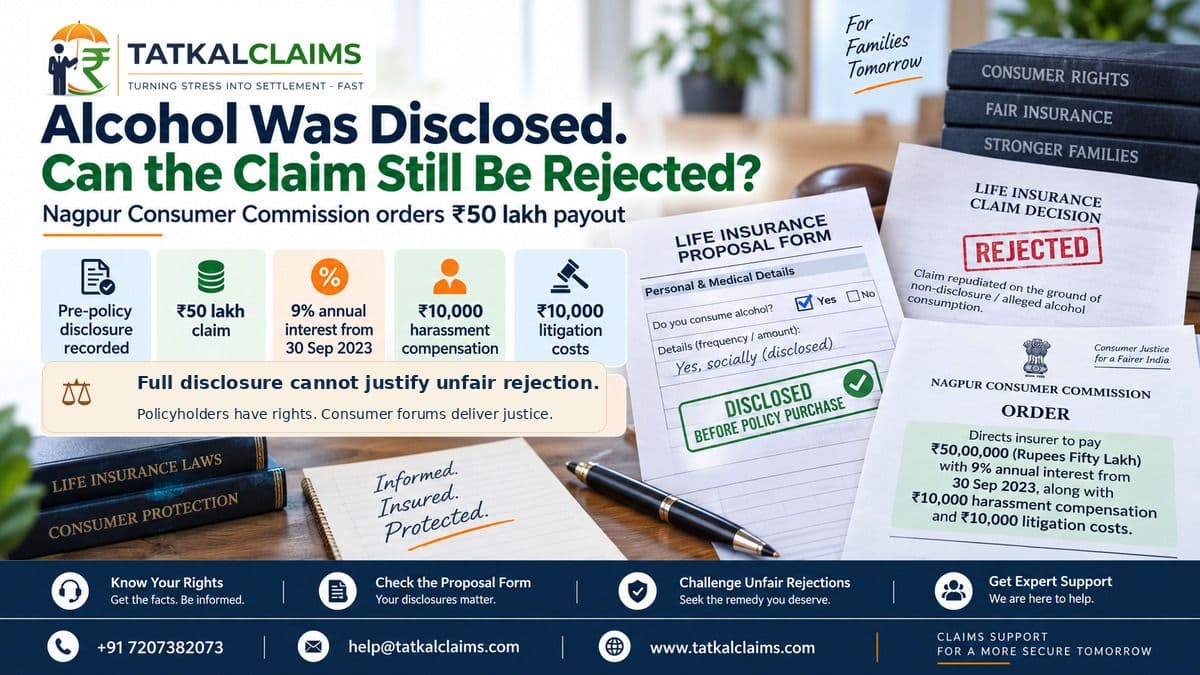
A life insurer rejected a widow's ₹50 lakh death claim alleging that her husband had concealed chronic alcoholism, hypertension and diabetes. The dispute took a different turn because the insurer's own pre-policy records showed that alcohol consumption had already been disclosed before the policy was issued.
What happened in the ₹50 lakh life insurance claim?
According to a PTI report published by The Economic Times on September 4, 2026, the policyholder purchased a life insurance policy from Edelweiss Tokio Life Insurance Company Limited in April 2021. He died suddenly on January 26, 2023, after which his widow filed the death claim.
The insurer later rejected the claim, cancelled the policy and sent a cheque refunding ₹18,713 in premium in September 2023. The widow then approached the District Consumer Disputes Redressal Commission in Nagpur.
Why did the insurer reject the claim?
During the proceedings, the insurer argued that the deceased had concealed a history of chronic alcoholism, hypertension and diabetes mellitus, and that this violated the principle of utmost good faith that applies to insurance contracts.
But the commission examined the pre-policy records. A medical examination form dated May 20, 2021 recorded that the insured consumed 90 ml of whisky twice a month and had done so for around 15 years. The commission therefore found that alcohol consumption itself was not information hidden from the insurer.
The insurer's own pre-policy medical examination also mattered
The reported order also noted that a pre-policy medical examination conducted through the insurer's panel doctor did not mention hypertension or diabetes. That made the underwriting record particularly important when the insurer later relied on those conditions while defending the rejection.
A pre-policy medical examination does not excuse a policyholder from answering proposal-form questions truthfully. But when an insurer has already collected medical and lifestyle information before issuing the policy, those records can become critical evidence in a later non-disclosure dispute.
What did the Consumer Commission order?
The Nagpur District Consumer Commission directed the insurer to pay the ₹50 lakh claim amount together with 9% annual interest calculated from September 30, 2023. It also awarded ₹10,000 for physical and mental harassment and another ₹10,000 towards litigation costs.
The central finding was that rejecting the claim amounted to deficiency in service when the insured's alcohol consumption had already been disclosed before the policy was issued.
Does this mean alcohol consumption can never cause a life insurance claim rejection?
No. That would be too broad a reading of the case. Alcohol consumption, frequency, quantity, treatment for alcohol dependence or an alcohol-related medical history can be relevant to underwriting if the proposal form asks about them.
The safer rule for policyholders is simple: disclose accurately, answer the exact questions asked, and preserve evidence of what was submitted. An insurer can assess a disclosed risk before issuing a policy. A later allegation of concealment deserves much closer scrutiny when the information was already available to the insurer.
Section 45 of the Insurance Act: why the timing and materiality matter
Life insurance non-disclosure disputes also need to be examined under Section 45 of the Insurance Act, 1938. The provision restricts when and how a life insurance policy may be called into question, and it distinguishes fraud from a material misstatement or suppression that is not based on fraud.
For a non-fraud material misstatement or suppression within the statutory period, Section 45 says the fact must have a direct bearing on the risk undertaken by the insurer. The onus is on the insurer to show that it would not have issued the life policy had it known the fact, and the grounds and materials for repudiation must be communicated in writing.
That is why a rejection letter containing the words 'material non-disclosure' is not the end of the analysis. The proposal form, underwriting records, medical examination, the insured's knowledge, the timing of the policy and the evidence relied on by the insurer all matter.
Why the proposal form may become the most important document
If a claim is rejected for alleged non-disclosure, start by asking what the proposal form actually asked and what answer was recorded. Then compare that answer with tele-verification, medical questionnaires, pre-policy examinations, laboratory reports and underwriting correspondence. For a broader evidence-and-escalation checklist, see our guide to challenging a rejected insurance claim.
If you are handling the death claim as nominee or family member, our life insurance death claim process guide covers intimation, documents, investigation and timelines.
This is also why proposal-form disputes can become decisive. In another Tatkal Claims case analysis, the Kurnool Consumer Commission examined an HDFC Life ₹50 lakh claim dispute involving proposal-form ambiguity. Different facts can produce different outcomes, but the common lesson is to examine the original underwriting record rather than the repudiation letter in isolation.
If the insurer says alcohol was not disclosed, check these five things
First, read the exact alcohol-related question in the proposal form. A question about any consumption is different from a question about quantity, frequency, addiction or treatment.
Second, check the signed proposal and any recorded verification to see exactly what answer the policyholder gave.
Third, look for the same information elsewhere in the insurer's records, especially pre-policy medical examinations and underwriting questionnaires.
Fourth, distinguish ordinary alcohol consumption from allegations such as chronic alcoholism, alcohol dependence or an alcohol-related disease. They are not automatically interchangeable.
Fifth, ask what evidence supports the insurer's allegation and whether the information was genuinely unknown to the insurer when it accepted the proposal.
Alcohol exclusions are a different issue from alcohol disclosure
It is also important not to confuse a non-disclosure dispute with a policy exclusion that applies when an insured person is under the influence at the time of an accident. Tatkal Claims has separately examined Indian decisions on alcohol exclusions, BAC evidence and causation. The legal questions in those cases can be very different from whether alcohol use was disclosed when a life policy was purchased.
What should a nominee do after a life insurance claim is rejected?
Obtain the detailed repudiation letter, the complete proposal form, pre-policy medical reports, underwriting questionnaires, the policy document and the medical records relied upon by the insurer. Build a timeline from proposal and medical examination through policy issuance, death, claim filing and repudiation.
If the rejection rests on a factual assertion contradicted by the insurer's own records, point to that contradiction specifically when seeking reconsideration. Depending on the facts and jurisdiction, further remedies may include the insurer's grievance process, the Insurance Ombudsman or the appropriate Consumer Commission.
The bigger lesson from the Nagpur ruling
The useful lesson is not that alcohol can never affect a life insurance claim. It is that an allegation of non-disclosure should be tested against what the policyholder actually disclosed and what the insurer actually knew before accepting the risk.
In this reported case, the insured's alcohol consumption was already recorded during the pre-policy process, the insurer issued the policy, and the Consumer Commission later found the rejection unjustified on the evidence before it.
Frequently asked questions
Can a life insurer reject a claim because the insured consumed alcohol?
Potentially, depending on the proposal questions, disclosures, policy terms, medical history and facts of the claim. Alcohol consumption does not automatically make every claim either payable or rejectable.
What if alcohol use was disclosed before the policy was issued?
Evidence of prior disclosure can be highly significant. In the Nagpur case reported in September 2026, the Consumer Commission relied on the fact that alcohol consumption had already been recorded before policy issuance.
Should occasional alcohol consumption be disclosed when buying life insurance?
Answer the proposal form truthfully and completely. If the insurer asks about alcohol consumption, quantity or frequency, provide accurate information and keep a copy of the submitted proposal.
Can a rejected life insurance claim be challenged?
Yes. The appropriate route depends on the policy, rejection grounds, evidence, claim amount and jurisdiction. A document-by-document review is usually the starting point.
Disclaimer: This article is for general information and consumer awareness. Insurance disputes depend on individual policy wording, disclosures, medical records, evidence and applicable law. It does not guarantee that another claim with different facts will have the same outcome.


