
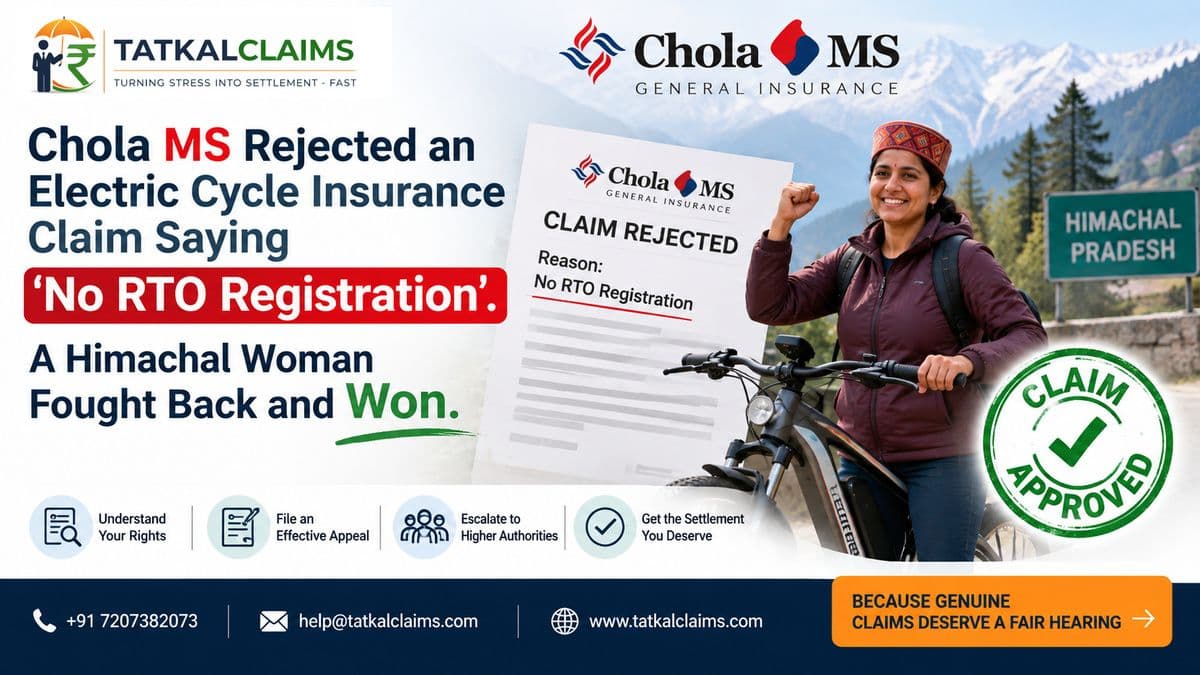
A New Electric Cycle, a Comprehensive Policy, and a Rejection Letter
When Kesri Devi purchased a brand new Komki XGT-X4 slow-speed electric cycle from GOROX in Hamirpur on February 28, 2024, she did what any careful buyer would do. She bought a comprehensive insurance policy from Cholamandalam MS General Insurance Company, valid from March 6, 2024, to March 5, 2025. The premium was paid. The policy was issued. The vehicle was described in the policy documents as an electrical vehicle under the SLOW SPEED, NON-RTO category. Everything seemed in order.
On May 7, 2024, while the electric cycle was parked near her residence, it was severely damaged after being hit by stray animals. She took the vehicle to the dealer's workshop on May 18, 2024, where she was advised to intimate the insurer. Cholamandalam appointed a surveyor to inspect the damaged vehicle. The surveyor came, assessed the damage, and left.
Then, by a letter dated May 28, 2024, the insurance company repudiated the claim. The sole reason? The vehicle did not have temporary or permanent registration with the RTO at the time of the incident.
Cholamandalam's Defence: No RTO Registration, No Claim
The insurer opposed the complaint before the Hamirpur District Consumer Disputes Redressal Commission, contending that the vehicle was not legally registered with the RTO at the time of the incident. According to the insurer, this violated the Motor Vehicles Act, 1988, and the terms and conditions of the insurance policy. It disputed the complainant's assertion regarding the assessment of loss and maintained that the repudiation was entirely valid.
The commission, presided over by Hemanshu Mishra with members Sneh Lata and Joginder Mahajan, examined a narrow but critical question: could an insurance company lawfully repudiate a comprehensive insurance claim solely because the insured electric cycle had not been registered with the RTO?
The Law: Non-RTO Electric Vehicles Are Exempt from Registration
The commission's answer was an emphatic no. It observed that under the Central Motor Vehicles Rules, 1989, electric two-wheelers having a maximum motor output of 250 watts or less and a maximum speed of 25 kmph or below are exempt from registration, driving licence requirements, and mandatory third-party insurance.
It also referred to the Gazette Notification dated April 24, 2014, which exempts this category of slow-speed electric vehicles from RTO registration. The complainant's vehicle, the Komki XGT-X4, fulfilled these statutory conditions. Its certified maximum speed was 25 kmph. It was legally a Non-RTO vehicle.
The Smoking Gun: The Policy Itself Said Non-RTO
Here is where the commission's findings become devastating for the insurer. The insurance policy itself described the vehicle as an electrical vehicle under the SLOW SPEED, NON-RTO category. The dealer had also admitted that registration was not required for this vehicle. The insurer was therefore fully aware of the nature and legal status of the vehicle when it accepted the premium and issued the comprehensive insurance policy.
The commission stated in no uncertain terms: It is highly contradictory and a clear sign of bad faith for an insurance company to collect a premium to comprehensively insure a certified Non-RTO Category vehicle, only to later repudiate a legitimate damage claim on the ground that the vehicle was not registered with the RTO. The ground of repudiation is entirely flimsy, arbitrary, and legally unsustainable, constituting a glaring deficiency in service and an unfair trade practice on the part of Cholamandalam MS General Insurance Company Limited.
If your current dispute is with Chola MS, use our Chola MS claim rejection, short-settlement and escalation guide for Customer Care, Nodal Officer, Chief Grievance Officer, Bima Bharosa and Insurance Ombudsman steps.
The Commission's Order (July 17, 2026)
The Hamirpur District Consumer Commission directed Cholamandalam MS General Insurance to pay:
| Award | Amount |
|---|---|
| Assessed Loss | Rs 15,526.50 |
| Interest | 9% per annum from date of filing complaint |
| Mental Agony & Harassment | Rs 5,000 |
| Litigation Costs | Rs 5,000 |
The complaint against the dealer was dismissed, as the commission found that the dealer had actively assisted the complainant in pursuing the insurance claim and no deficiency in service was established against it.
What This Ruling Means for Electric Vehicle Owners
This ruling establishes several critical principles that every electric cycle and low-speed EV owner in India must understand.
First, if your low-speed electric vehicle is legally exempt from RTO registration, an insurer cannot reject your comprehensive insurance claim solely because it is not registered. The law is clear. The Central Motor Vehicles Rules, 1989, and the April 24, 2014 Gazette Notification exempt electric two-wheelers with motor output of 250W or less and top speed of 25 kmph or below from registration, licence, and mandatory third-party insurance requirements.
Second, an insurer cannot knowingly issue a policy for a Non-RTO vehicle and then use the lack of RTO registration as a ground for repudiation. This is not just a technical violation. The commission explicitly called it bad faith. When the policy document itself classifies the vehicle as SLOW SPEED, NON-RTO, the insurer cannot pretend ignorance at the time of claim settlement.
Third, comprehensive insurance for Non-RTO electric vehicles is a valid and enforceable contract. The insurer's obligation to honour the claim arises from the policy terms, not from RTO registration. If the vehicle never needed registration in the first place, the absence of registration cannot be a contractual breach.
Fourth, this ruling reinforces that consumer courts will not tolerate insurers collecting premiums and then inventing excuses to avoid payout. The commission's language was unusually strong, describing the repudiation as flimsy, arbitrary, legally unsustainable, and a glaring deficiency in service.
The Broader Problem: Insurers Exploiting EV Owner Confusion
At Tatkal Claims, we see a growing pattern of insurers exploiting confusion around electric vehicle regulations to deny legitimate claims. Many EV owners are unaware that their low-speed electric cycles are exempt from RTO registration. When an insurer rejects a claim citing lack of registration, the policyholder often assumes the insurer must be right. They do not know that the exemption is statutory, or that the insurer itself classified the vehicle as Non-RTO in the policy document.
This case exposes that playbook. Cholamandalam issued a comprehensive policy for a Non-RTO vehicle, collected the premium, and then rejected the claim on the exact ground that the vehicle was Non-RTO. It was, in the commission's words, highly contradictory and a clear sign of bad faith.
How to Protect Yourself: A Checklist for EV Owners
If you own a low-speed electric cycle or scooter, here is what you need to know and do to protect yourself from arbitrary claim rejections.
First, verify your vehicle's classification. Check the manufacturer's specifications for motor output and top speed. If the motor is 250W or less and the top speed is 25 kmph or below, your vehicle is exempt from RTO registration, driving licence, and mandatory third-party insurance under the Central Motor Vehicles Rules, 1989.
Second, read your insurance policy carefully. If the policy describes your vehicle as Non-RTO, SLOW SPEED, or similar, screenshot or photograph that page. This is your strongest evidence if the insurer later claims the vehicle needed registration.
Third, keep the dealer's acknowledgement. If the dealer told you at the time of purchase that registration was not required, keep that communication. The dealer's admission in this case strengthened the complainant's position significantly.
Fourth, know your legal exemptions. The Gazette Notification dated April 24, 2014, is the statutory authority that exempts low-speed electric vehicles from registration. Cite this notification if your insurer raises registration as an issue.
Fifth, document the damage immediately. Take photographs and videos of the damage before moving the vehicle. Obtain a repair estimate from an authorised service centre. Keep all receipts and correspondence.
Sixth, if your claim is rejected, do not accept the insurer's explanation at face value. Ask for the specific policy clause and legal provision that supposedly requires registration. If your vehicle is exempt, the insurer's rejection is legally unsustainable.
Seventh, escalate systematically. File a complaint with the insurer's Grievance Redressal Officer. If unresolved, approach Bima Bharosa, the Insurance Ombudsman, or the District Consumer Disputes Redressal Commission. The Ombudsman process is free and can award up to Rs 50 lakh. Consumer courts have consistently held insurers accountable for bad faith rejections.
Understanding Non-RTO Electric Vehicle Rules in India
Not all electric two-wheelers are treated equally under Indian law. The distinction is based on motor power and top speed.
Under the Central Motor Vehicles Rules, 1989, and the Gazette Notification dated April 24, 2014:
- Electric two-wheelers with motor output of 250 watts or less and top speed of 25 kmph or below are exempt from RTO registration, driving licence requirements, and mandatory third-party insurance.
- Electric two-wheelers that exceed these thresholds must be registered with the RTO, require a valid driving licence, and must have at least third-party insurance under the Motor Vehicles Act, 1988.
This means that if you own a low-speed electric cycle, you are not required to register it. You do not need a driving licence to operate it. And you are not legally required to have third-party insurance. However, if you choose to buy comprehensive insurance, as Kesri Devi did, that policy is a valid contract and the insurer must honour it.
What to Do If Your Electric Cycle Insurance Claim Is Rejected
If your electric cycle or low-speed EV insurance claim has been rejected on grounds of non-registration, here is your action plan.
First, obtain your vehicle's technical specifications from the manufacturer or dealer. Confirm the motor output in watts and the certified top speed in kmph. If both are within the exempt thresholds, your vehicle does not require RTO registration.
Second, examine your insurance policy document. Look for how the vehicle is classified. If it is described as Non-RTO, SLOW SPEED, or ELECTRICAL VEHICLE without registration requirements, the insurer cannot later claim ignorance.
Third, obtain the Gazette Notification dated April 24, 2014, and the relevant provisions of the Central Motor Vehicles Rules, 1989. These are your statutory shields. The insurer cannot contractually override a statutory exemption.
Fourth, file a written complaint with the insurer's Grievance Redressal Officer, citing the statutory exemption and the policy's own classification. Demand a review and reversal of the rejection. The GRO must respond within 15 days.
Fifth, if the GRO upholds the rejection, escalate to IRDAI's Bima Bharosa portal at bimabharosa.irdai.gov.in. While Bima Bharosa does not directly order payment, it forwards complaints to the insurer and monitors resolution.
Sixth, approach the Insurance Ombudsman if the claim value is within Rs 50 lakh. The Ombudsman can pass a binding award within three months. The process is free and does not require a lawyer.
Seventh, file a complaint with the District Consumer Disputes Redressal Commission under the Consumer Protection Act, 2019. Consumer courts have the power to award the claim amount, interest, compensation for mental agony, and litigation costs. The Hamirpur commission's ruling in Kesri Devi's case is a powerful precedent.
Bottom Line
A woman bought a low-speed electric cycle. She bought a comprehensive insurance policy. The policy described the vehicle as Non-RTO. A few months later, stray animals damaged the cycle. She filed a claim. The insurer appointed a surveyor. Then the insurer rejected the claim solely because the vehicle was not registered with the RTO.
The Hamirpur Consumer Commission said no. It held that the vehicle was legally exempt from registration. It held that the insurer knew this when it issued the policy. It held that the repudiation was flimsy, arbitrary, legally unsustainable, and a clear sign of bad faith. It held that the insurer's conduct constituted deficiency in service and unfair trade practice. And it ordered Cholamandalam to pay over Rs 25,500 with interest.
If you are facing an electric cycle or low-speed EV insurance claim rejection based on lack of RTO registration, do not accept the insurer's explanation at face value. The law exempts your vehicle from registration. The insurer cannot use that exemption as a weapon to deny your claim. And consumer courts are increasingly willing to call this conduct what it is: bad faith.
At Tatkal Claims, we help EV owners challenge unfair insurance claim rejections, interpret complex policy wordings, and hold insurers accountable for arbitrary denials. If your electric cycle or e-bike claim has been rejected, delayed, or underpaid, contact us.
Facing a rejected electric cycle or e-bike insurance claim? Contact our legal team at Tatkal Claims for expert assistance in challenging unfair denials and securing the settlement you deserve.


