The E20 Fuel Controversy: Government Says Your Insurance Is Safe — But Is It Really?
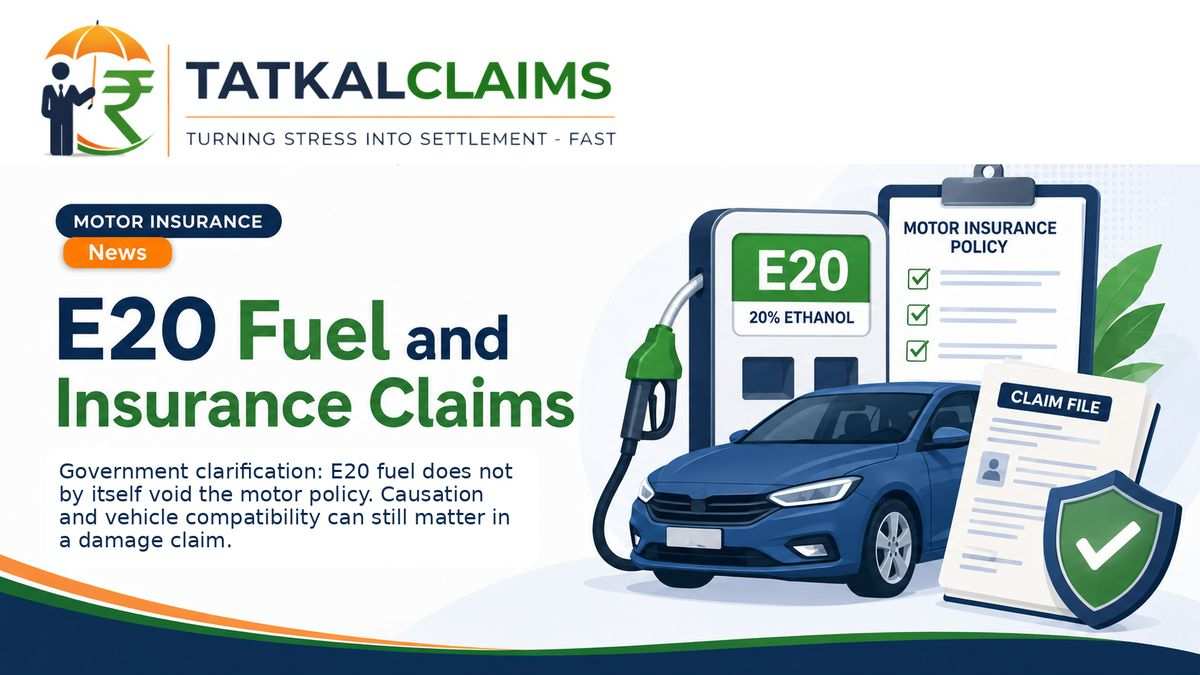
If you've been worried about whether using E20 ethanol-blended petrol could void your motor insurance, the government has officially stepped in to calm the waters. On 16 June 2026, PIB Fact Check issued a clear statement: motor insurance policies remain valid with the use of E20 fuel, dismissing viral social media claims as "fake".
But here's what the headlines aren't telling you — and it's critical if you own a vehicle that's not E20-compliant.
What the Government Actually Said
PIB Fact Check addressed widespread social media panic that using E20 fuel could lead to rejection of vehicle insurance claims. Their official clarification was unambiguous:
"Motor insurance policies remain valid with the use of E20 fuel."
This means your insurance policy does not become null and void simply because you filled up with E20. ICICI Lombard, one of India's leading private insurers, echoed this position, stating that "the type of fuel used in the vehicle... is not a determining factor in claim admissibility."
The Hidden Risk: Why Your E20 Claim Could Still Be Rejected
This is where every vehicle owner needs to pay close attention. While the government and insurers confirm that policy validity is not affected by E20 usage, they have been notably quieter about claim admissibility for E20-related damage.
Here's the critical distinction:
| What IS Covered | What MAY NOT Be Covered |
|---|---|
| Accidents, collisions, theft, third-party liability | Gradual fuel system corrosion from E20 |
| Claims where E20 is incidental to the damage | Claims where E20 is the cause of the damage |
| Standard accidental damage regardless of fuel type | "Consequential damage" from incompatible fuel use |
The "Consequential Damage" Loophole
ICICI Lombard's own blog post (published 9 June 2026) revealed the fine print that every policyholder should know:
Standard motor insurance policies exclude "consequential damage" — damage that builds up over time rather than occurring in a single incident. E20-related damage in non-compliant vehicles falls squarely into this category because:
- E20 absorbs moisture from the air, accelerating corrosion
- Fuel system components (gaskets, seals, tanks, fuel lines) degrade gradually
- This damage accumulates over months of E20 usage, not from one fill-up
The insurer explicitly noted: *"Not every damage claim linked to E20 will be approved."*
Are You Driving a Non-Compliant Vehicle? Here's How to Check
E20 compliance became mandatory for new vehicles only with BS6 Phase 2 norms (April 2023). If your vehicle was manufactured before this:
- E10-compliant vehicles: May face gradual fuel system damage
- Pre-E10 vehicles: Higher risk of incompatibility issues
- Two-wheelers and older cars: Particularly vulnerable to seal/gasket degradation
Since April 2025, E20 has been the baseline petrol blend at Indian pumps. You cannot choose E10 even if you want to. Your only alternative is XP100 (pure petrol), which is available at limited outlets and costs approximately Rs 160 per litre — making it unfeasible for daily use.
The Add-On Cover Myth
Many vehicle owners believe purchasing an "engine protection add-on" will safeguard them. Think again.
ICICI Lombard clarified that most engine protection add-ons are designed for:
- Water ingress damage
- Oil leakage issues
They do not cover "chemical corrosion from fuel." So even with add-ons, E20-related gradual damage may remain uncovered.
What Should You Do If Your E20-Related Claim Is Rejected?
If the insurer actually rejects an E20-related claim, start with our rejected insurance claim guide to test the stated policy ground and supporting evidence. If the insurer does not correct the decision, our IRDAI grievance-handling guide explains the formal escalation route.
If your insurer rejects a claim citing "consequential damage" or "improper fuel use," here's your action plan:
1. Demand a Written Rejection Reason
Insurers must provide the specific policy clause under which your claim is denied. Generic rejections are challengeable.
2. Check Your Policy Wording
Review whether "consequential damage" is explicitly defined and whether fuel-related gradual damage is specifically excluded.
3. Document Everything
- Service records showing regular maintenance
- Fuel receipts proving E20 usage
- Expert mechanic's report linking damage to fuel incompatibility
- Vehicle compliance certification (E10 vs E20)
4. Challenge the "Negligence" Argument
ICICI Lombard has officially stated they "do not treat usage of E20 fuel in older vehicles as negligence." Use this against any insurer attempting to reject your claim on negligence grounds.
5. Escalate to IRDAI
If your insurer refuses to budge, file a complaint with the Insurance Regulatory and Development Authority of India (IRDAI) or approach the Insurance Ombudsman.
The Bigger Picture: E25 Is Coming
The government has already signaled plans to increase the baseline ethanol blend further — possibly to E25 in the near future. ARAI is currently evaluating the impact of E25 on E20- and E10-compliant vehicles.
If E25 becomes the new standard, even vehicles currently certified for E20 could face the same dilemma that E10-compliant vehicles face today.
Bottom Line
The government's clarification is factually correct: your motor insurance policy remains valid regardless of whether you use E20. But policy validity and claim payout are two different things.
If you own a non-E20-compliant vehicle and suffer gradual fuel system damage, your insurer may legally reject the claim under the "consequential damage" exclusion — even while maintaining that your policy itself is active.
A different modification-and-compliance dispute can arise with aftermarket fuel conversions. If a CNG/LPG kit is not endorsed in the RC or insurance records, see our CNG/LPG kit claim-rejection guide.
The government's statement protects your policy. It does not guarantee your claim.
*Facing a motor insurance claim rejection related to E20 fuel damage? Contact our legal team for expert assistance in challenging unfair claim denials and understanding your policy's fine print.*