An insurance claim rejection does not always mean the matter is over. The right response depends on why the insurer rejected the claim, what your policy actually says, the evidence available, and whether the insurer followed the applicable grievance process.
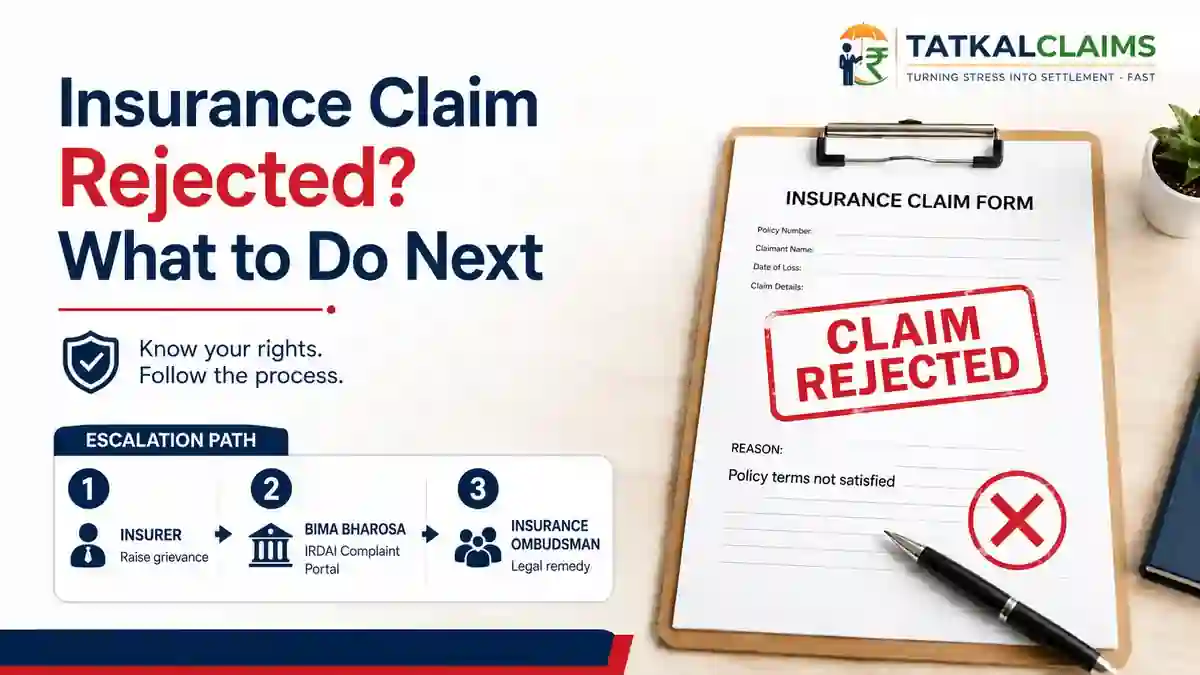
If your insurance claim is rejected, start by getting the rejection reason in writing, compare it with your policy terms, collect the complete claim record, and raise a written grievance with the insurer. If the response is delayed or unsatisfactory, you can use IRDAI's Bima Bharosa grievance platform and, where your complaint is eligible, approach the Insurance Ombudsman. Other legal remedies may also be available depending on the facts.
What Should You Do Immediately After an Insurance Claim Is Rejected?
- Get the insurer's rejection or repudiation letter in writing.
- Identify the exact policy clause, exclusion, disclosure issue, document deficiency, or other reason relied on by the insurer.
- Do not rely only on a phone call or verbal explanation; preserve written records.
- Collect your policy schedule, wording, proposal form, claim form, bills, reports, correspondence, and any other evidence relevant to the rejection.
- Prepare a factual written response explaining why you believe the rejection should be reconsidered.
- Submit a grievance to the insurer's Grievance Redressal Officer and keep the acknowledgement or complaint number.
- Escalate through the appropriate grievance mechanism if the insurer does not resolve the complaint satisfactorily.
First, Find Out Why Your Insurance Claim Was Rejected
A strong appeal starts with the insurer's stated reason. Common disputes include alleged non-disclosure or misrepresentation, policy exclusions, waiting periods, policy lapse, late intimation, missing documents, questions about pre-existing conditions, treatment or expense exclusions, alleged fraud, and disagreements about whether the loss falls within the policy cover.
Do not assume that every rejection is automatically wrong. Some rejections are supported by clear policy terms. Others may depend on disputed facts, incomplete records, an incorrect interpretation of the policy, or whether the reason cited by the insurer is actually relevant to the claim.
15 Common Reasons Insurance Claims Are Rejected in India
Use the rejection reason as a diagnostic starting point, not as the final answer. The insurer should be able to identify the policy term, fact, document or evidence behind its decision. The table below shows the most common rejection themes and what to verify before accepting the decision.
| Reason cited by insurer | What to verify |
|---|---|
| Non-disclosure or misrepresentation | Review the proposal form, the questions actually asked, the answers given, the alleged undisclosed fact and the evidence linking it to the insurer's decision. |
| Pre-existing disease | Check the policy definition, medical history, waiting-period terms, continuity or portability records and the medical evidence relied on. |
| Waiting period not completed | Confirm the exact waiting-period clause, policy start date, continuity credits and whether the treatment actually falls within that restriction. |
| Policy exclusion | Read the exact exclusion rather than only the rejection summary and test whether the facts of the claim genuinely fit it. |
| Policy lapse or premium issue | Verify premium receipts, renewal records, grace-period facts where relevant and policy status on the date of loss or treatment. |
| Late claim intimation | Check the policy condition, the actual chronology, the reason for delay and all written correspondence about intimation. |
| Missing or incomplete documents | Ask for the exact outstanding-document list, why each document is required and whether documents already submitted were acknowledged. |
| Medical necessity or hospitalisation dispute | Compare the policy definition with admission notes, treating-doctor rationale, diagnostics and discharge records. |
| Cashless authorisation denied | Distinguish a cashless denial from a final claim rejection. Where the policy permits, reimbursement may still need to be considered separately. |
| Room-rent cap or sub-limit | Check room eligibility, the wording of any sub-limit or proportionate-deduction clause and the insurer's calculation. |
| Reasonable and customary charge deduction | Ask for the policy basis and the benchmark or calculation used to support the R&C deduction. |
| Fraud or suspicious-claim allegation | Ask what specific evidence or inconsistency is relied on and preserve records that directly address that allegation. |
| Cause of loss said to be outside cover | Review the insured event, proximate cause, survey or medical evidence and the policy's coverage and exclusion wording. |
| Motor licence, vehicle use, ownership or policy-transfer issue | Check driving documents, permitted use, registration, ownership or transfer records, policy endorsements and the relevance of the alleged breach to the loss. |
| Life-claim disclosure or investigation issue | Review proposal answers, medical and financial records, premium status, investigation material made available and the stated basis of repudiation. |
For a deeper issue-specific review, see our guides on pre-existing-disease claim rejection, cashless denial and reimbursement, fever-admission disputes, room-rent capping, reasonable and customary charge deductions, and the Manipal Cigna consumer-commission case. If the dispute is moving into escalation, compare Bima Bharosa vs the Insurance Ombudsman and use our Insurance Ombudsman filing guide.
Insurer-Specific Appeal and Escalation Guides
For insurer-specific grievance contacts, claim-review steps and escalation routes, see our guides for Zuno General Insurance, ACKO General Insurance, Bajaj General Insurance, SBI General Insurance, HDFC ERGO, Go Digit General Insurance and Kshema General Insurance.
For standalone health insurers, use the insurer-specific guides for Aditya Birla Health Insurance, Narayana Health Insurance and Galaxy Health Insurance.
Is the Insurance Company's Rejection Valid?
Check the rejection letter against the actual policy wording rather than only the insurer's summary. Ask four questions:
- Which exact clause is the insurer relying on?
- Does that clause apply to the facts of your claim?
- Does the insurer have evidence supporting the reason for rejection?
- Do you have documents or facts that contradict the insurer's conclusion?
For disclosure-related disputes, review the proposal form and what was actually asked and answered when the policy was purchased. For health claims, compare medical records and policy definitions carefully. For motor claims, examine the surveyor's findings, policy exclusions, cause of loss, and supporting repair or accident records. For life claims, review the proposal, medical disclosures, claim investigation, and the stated basis of repudiation.
Documents You Need to Challenge a Rejected Claim
The exact documents depend on the type of insurance, but a useful claim-rejection file usually includes:
- Policy schedule and complete policy wording
- Proposal form and declarations, if available
- Premium receipts and renewal records
- Claim form and claim acknowledgement
- Rejection or repudiation letter
- Emails, letters, SMS messages, complaint numbers, and other insurer correspondence
- Medical records, discharge summaries, diagnostic reports, and hospital bills for health claims
- FIR, photographs, repair estimates, survey reports, driving documents, and related records for motor claims
- Death certificate, medical records, nomination documents, and investigation correspondence for life claims
- Any evidence that directly addresses the insurer's stated reason for rejection
Keep copies of everything you submit and record the date and method of submission.
How to Appeal a Rejected Insurance Claim
The most effective appeal is usually specific rather than emotional. Quote the rejection reason, identify the relevant policy language, explain the facts in chronological order, attach supporting evidence, and state clearly what resolution you are asking for.
Step 1: File a Grievance With the Insurance Company
Approach the insurer's Grievance Redressal Officer or designated grievance channel first. IRDAI's Bima Bharosa FAQ says an insurer should resolve a policyholder complaint within 15 days of receipt. For health insurance specifically, IRDAI's current Health Department TAT table lists 14 days for action on the complaint and intimation of the decision. Keep the written complaint, supporting documents and acknowledgement.
Your grievance should include the policy number, claim number, rejection date, rejection reason, the policy clauses relevant to your case, supporting documents, and the remedy you want.
Step 2: Escalate Through IRDAI's Bima Bharosa Grievance Platform
If the insurer does not resolve the grievance within the prescribed period or you are dissatisfied with the response, IRDAI provides the Bima Bharosa platform for registering and monitoring insurance grievances. A complaint registered through Bima Bharosa flows to the insurer's system as well as IRDAI's repository and can be tracked using the generated token number.
Bima Bharosa is a grievance and monitoring mechanism; it should not be described as a guarantee that IRDAI will order payment of a disputed claim.
Step 3: Consider the Insurance Ombudsman
The Insurance Ombudsman provides a no-fee grievance-redressal mechanism for eligible complaints. The Council for Insurance Ombudsmen says a complaint is generally to be filed within one year of the insurer's rejection, or within one year after expiry of one month from the complaint where the insurer gives no reply. The amount of compensation sought must not exceed Rs 50 lakh, and the same subject matter must not already be pending before or disposed of by a court, consumer forum or arbitrator.
If the insurer's response is unsatisfactory, an eligible policyholder may approach the Insurance Ombudsman. If the insurer has not replied at all, the Council for Insurance Ombudsmen requires expiry of one month from the complaint before that no-reply route is available. This Ombudsman prerequisite is separate from the insurer's 14-day or 15-day grievance-service timelines.
Step 4: Consider Consumer or Other Legal Remedies Where Appropriate
Depending on the facts, claim value, type of dispute, limitation periods, and proceedings already taken, a policyholder may have remedies outside the insurer/IRDAI/Ombudsman grievance process. These can include proceedings before the appropriate consumer commission or other legal forums.
Because jurisdiction and procedure depend on the individual case and current law, do not choose a forum only from a generic online checklist. For a significant or complex claim, obtain case-specific professional advice before starting proceedings.
What If a Health Insurance Claim Is Rejected?
Health claim disputes commonly involve pre-existing disease allegations, waiting periods, exclusions, non-disclosure, medical necessity, room-rent or treatment restrictions, documentation, and disagreements about whether the treatment is covered.
Start by comparing the rejection letter with the policy definitions and exclusions, then review the proposal form, medical records, discharge summary, bills, and insurer queries. If the insurer alleges non-disclosure, identify exactly what information it says should have been disclosed and whether that information was asked for and available when the policy was purchased.
What If a Life Insurance Claim Is Rejected?
Life claim repudiations may involve alleged non-disclosure, medical history, occupation, income, policy status, or investigation findings. Obtain the written repudiation basis and review it against the proposal form, policy records, medical evidence, premium history, and any investigation material made available to you.
For life-insurance repudiations involving the statutory three-year rule, see our Section 45 life-insurance guide.
What If a Motor Insurance Claim Is Rejected?
Motor claim disputes can involve policy exclusions, driving licence issues, vehicle use, delay in intimation, survey findings, modifications, cause of damage, or allegations that the loss is consequential rather than accidental. Preserve photographs, FIR or police records where applicable, repair estimates, survey communications, driving and registration documents, and all correspondence with the insurer.
Common Mistakes to Avoid After Claim Rejection
- Accepting a verbal rejection without obtaining the written reason
- Appealing without reading the policy clause relied on by the insurer
- Sending incomplete or inconsistent documents
- Making allegations that are not supported by evidence
- Missing grievance, Ombudsman, limitation, or other procedural timelines
- Starting multiple proceedings without checking whether one forum affects eligibility in another
- Assuming that filing a complaint guarantees that the claim will be paid
How Tatkal Claims Can Help With a Rejected Insurance Claim
Tatkal Claims assists policyholders with insurance claim disputes by reviewing the rejection reason, policy wording, claim documents, correspondence, and available escalation options. The objective is to identify the real dispute, organise the evidence, and choose an appropriate next step rather than sending a generic complaint.
Every case depends on its own policy terms and facts, and no outcome can be guaranteed. If your claim has been rejected and you want an assessment of the documents and rejection reason, you can request a free case evaluation through Tatkal Claims.
Frequently Asked Questions
Can an insurance claim rejection be challenged?
Yes. A rejection can be challenged when there is a factual, contractual, procedural, or evidentiary basis to dispute the insurer's decision. Whether the challenge succeeds depends on the policy wording and facts of the individual claim.
Where should I complain first after an insurance claim is rejected?
Start with the insurer's grievance mechanism or Grievance Redressal Officer. Keep the complaint acknowledgement and all supporting documents. If the response is delayed or unsatisfactory, consider the escalation channels available through Bima Bharosa and, if eligible, the Insurance Ombudsman.
Does IRDAI directly settle rejected insurance claims?
IRDAI provides and oversees the grievance framework and Bima Bharosa enables complaints to be registered, monitored, and escalated for regulatory review where appropriate. It should not be treated as a promise that IRDAI will adjudicate every contractual dispute or order a claim payment.
Is the Insurance Ombudsman free?
No fee is charged for lodging an Insurance Ombudsman complaint. The Council for Insurance Ombudsmen also states that the Ombudsman Rules do not provide for engaging a lawyer in the proceeding. Eligibility, the Rs 50 lakh monetary ceiling and filing timelines should still be checked before filing.
What is the most important document after a claim rejection?
The written rejection or repudiation letter is usually the starting point because it identifies the insurer's stated reason. The policy wording and evidence relevant to that reason are then essential for assessing whether the decision can be challenged.
Should I immediately go to court after a claim rejection?
Not necessarily. Many disputes should first go through the insurer's grievance process, and other grievance mechanisms may be available. The appropriate route depends on the claim, urgency, value, evidence, limitation periods, and whether another proceeding is already pending.