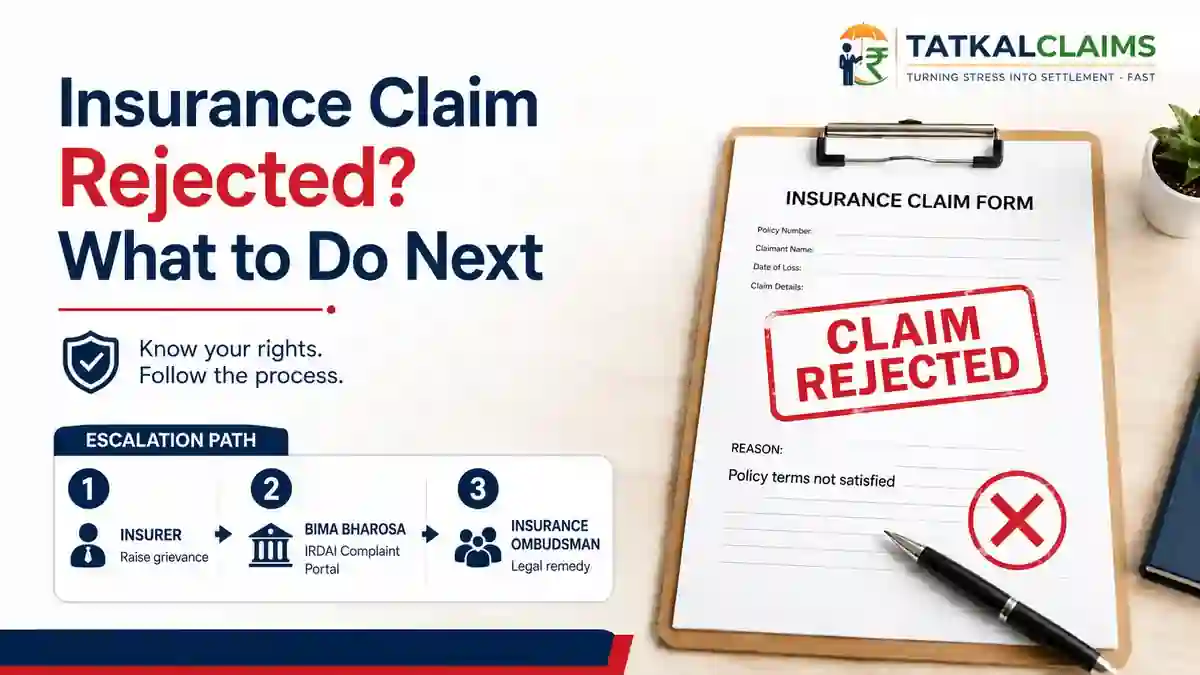

A cashless denial does not automatically mean your health-insurance claim is finally rejected. Cashless is a payment facility: the insurer pays an approved amount directly to an eligible hospital. If cashless authorisation is denied or withdrawn, you may still be able to pay the hospital and submit a reimbursement claim, subject to your policy terms and claim admissibility.
Cashless Denial vs Reimbursement Claim
Non-network treatment is a separate issue from cashless denial. For a government-scheme example, our Kerala MEDISEP non-empanelled-hospital case explains why the High Court required the claim to be verified and the admissible scheme amount paid rather than rejected solely on the hospital's empanelment status.
If the hospital was previously in the insurer’s network but was later removed or delisted, see our hospital-network removal guide for the cashless, reimbursement and excluded-provider questions to check.
| Cashless | Reimbursement |
|---|---|
| Insurer pays approved treatment costs directly to an eligible hospital | You pay first and claim admissible expenses back from the insurer |
| Requires pre-authorisation / final authorisation | Requires submission of claim documents after treatment |
| Denial can create immediate funding pressure | Allows the insurer to assess the completed claim file |
| Cashless denial is not necessarily final repudiation of the underlying claim | Reimbursement can still be rejected or reduced under policy terms |
Current IRDAI Health-Claim Timelines
IRDAI's current health-insurance guidance lists one hour for a decision on cashless pre-authorisation, three hours for final discharge authorisation after the discharge request, and 15 days for settlement of claims other than cashless. These are regulatory turnaround-time benchmarks; they do not make an otherwise inadmissible expense payable.
For the current 1-hour, 3-hour and 15-day benchmarks and what to do when they are crossed, see our IRDAI health-claim timeline guide.
What to Do Immediately After Cashless Is Denied
- Ask the hospital or TPA for the written denial or query and the reason code/explanation.
- Ask whether additional medical records can resolve the cashless query before discharge.
- If you must pay, keep receipts and proof of payment for every amount.
- Tell the hospital billing desk that you will need a complete reimbursement claim file.
- Check the insurer's claim form, Customer Information Sheet and required-document list.
Documents Commonly Needed for Reimbursement
Exact requirements vary by insurer and policy. Commonly requested records include the completed claim form, policy details, discharge summary, final itemised bill, payment receipts, prescriptions, diagnostic reports, pharmacy invoices, implant or device invoices where relevant, KYC/bank details and the cashless denial or correspondence. Use your insurer's current checklist rather than treating any generic list as exhaustive.
How to Build a Strong Reimbursement File
Explain the treatment chronology
Make sure the diagnosis, admission, treatment, discharge and follow-up records tell a consistent story. If cashless was denied because the insurer lacked information, attach the missing records prominently.
Reconcile bills and receipts
The final hospital bill, itemised bill and payment proofs should match. Flag any deposit refunds, discounts or credit notes so that the claim calculation is transparent.
Address the cashless denial reason
If the denial cited a pre-existing condition, waiting period, non-disclosure, medical necessity or policy exclusion, do not ignore it. Submit records that directly address the issue or explain why the clause does not apply.
If the insurer says inpatient admission itself was not medically necessary or that treatment could have been managed as OPD, use our medical-necessity rejection guide to test that reasoning against the contemporaneous medical record.
If Reimbursement Is Also Rejected or Short-Settled
Ask for a reasoned written decision identifying the policy clause and calculation. File a grievance with the insurer. IRDAI's Bima Bharosa platform can register and monitor policyholder grievances, and an eligible complaint may later be taken to the Insurance Ombudsman under its procedural rules.
If reimbursement is admitted but paid for less than the amount claimed, use our health-insurance short-settlement guide to reconcile the settlement sheet, policy clauses and disputed deductions.
Common Mistakes to Avoid
- Assuming cashless denial itself proves the entire claim is not covered.
- Leaving the hospital without an itemised bill, discharge summary or receipts.
- Submitting only photocopies when the insurer's procedure requires originals or certified records.
- Ignoring a medical or disclosure query raised during cashless processing.
- Missing the insurer's stated claim-submission procedure without documenting the reason for any delay.
Frequently asked questions
If cashless is denied, is reimbursement guaranteed?
No. Reimbursement is assessed under the same insurance contract and can be admitted, reduced or rejected depending on the policy terms and claim evidence.
Should I pay the hospital and leave immediately?
First ask whether the cashless query can be resolved with additional information. If payment is necessary, preserve complete billing and medical records and use traceable payment methods where possible.
How long should reimbursement settlement take?
IRDAI's current health guidance lists 15 days for settlement of claims other than cashless, subject to the applicable claim process and complete requirements.
Can I complain if both cashless and reimbursement are denied?
Yes. Start with the insurer's written grievance mechanism. Bima Bharosa can be used for regulatory grievance registration and monitoring, and the Insurance Ombudsman may be available for eligible disputes.
Sources
A cashless denial is not always the final claim decision. If the reimbursement claim is later rejected, follow our insurance claim rejection appeal guide. If the problem is an approval or settlement that is simply not moving, use our insurance claim delay escalation guide.