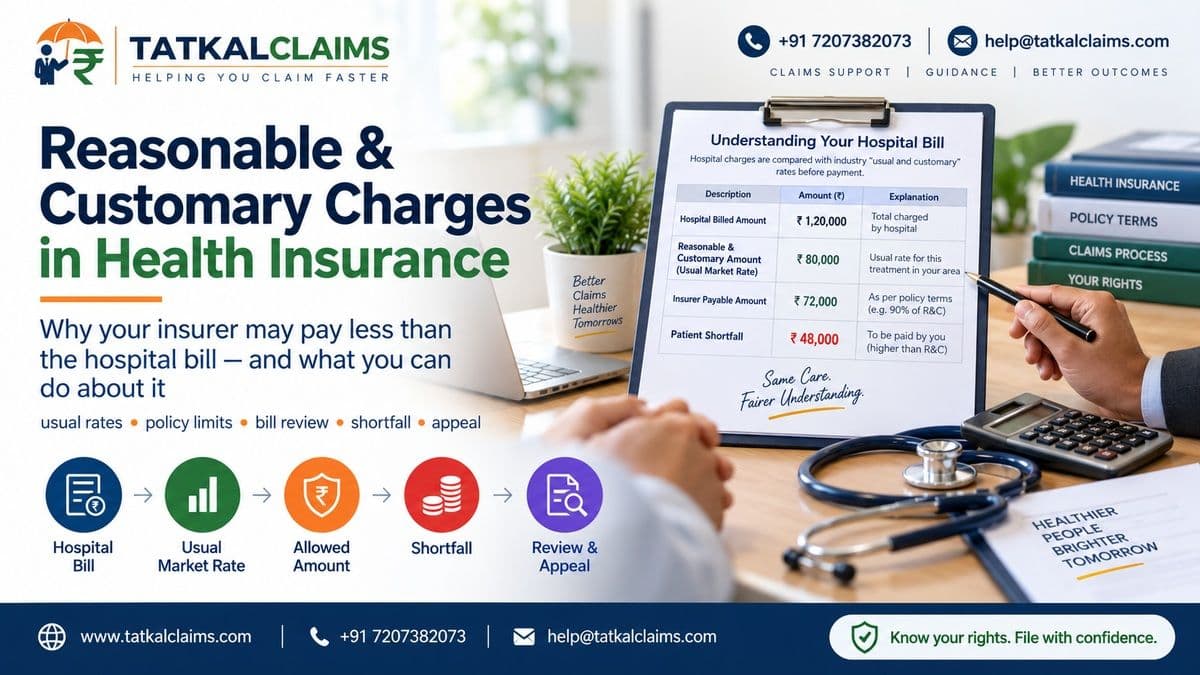

A health insurance claim is short-settled when the insurer accepts the claim but pays less than the amount claimed. The difference may be legitimate under the policy—for example because of a co-payment, deductible, sub-limit or non-payable item—or it may need a closer review if the deduction is unclear, unsupported or inconsistent with the policy wording.
What Does Short Settlement Mean in Health Insurance?
A short settlement is different from a total claim rejection. The insurer has admitted at least part of the claim but has reduced the payable amount. In health insurance, common reasons include co-payment, deductibles, room-rent restrictions, proportionate deductions, treatment sub-limits, non-medical items, reasonable and customary charge adjustments, and expenses that the insurer considers outside the policy cover.
If the reduction is specifically an R&C adjustment, use our reasonable and customary charges guide to test the benchmark and policy wording. If the deduction arose from room eligibility or a proportionate-reduction formula, use our room-rent capping and proportionate deduction guide to check the calculation.
IRDAI's current health-insurance guidance tells policyholders to pay particular attention to room-rent and ICU limits, sub-limits, deductibles, co-payment, exclusions and the claim procedure. These are policy-specific features, so the correct starting point is your policy schedule, Customer Information Sheet and full policy wording.
Start With the Claim Settlement Letter
Ask for or download the final settlement statement and compare it with the hospital's itemised bill. Do not rely only on a phone explanation. The useful question is not simply 'Why did you pay less?' but 'Which line item was reduced, by how much, under which policy clause, and how was that amount calculated?'
| Deduction | What to verify | Possible dispute point |
|---|---|---|
| Co-payment | Percentage stated in the policy and whether it applies to this claim | Wrong percentage or clause applied |
| Deductible | Amount and trigger stated in the policy | Deductible applied twice or to the wrong cover |
| Room-rent / proportionate deduction | Eligible room category or limit and linked deduction formula | Deduction not supported by your policy wording or incorrect ratio |
| Sub-limit | Disease, procedure or expense-specific limit | Wrong sub-limit or treatment classification |
| Reasonable & customary charge | Policy clause and benchmark/basis used | Insurer does not explain why the hospital charge was treated as excessive |
| Non-payable / consumable | Exact excluded item and any add-on cover | Item may actually be covered or incorrectly categorised |
How to Audit a Short-Settled Claim Step by Step
1. Reconstruct the numbers
Create a simple reconciliation: total hospital bill, amount claimed, amount considered admissible, each deduction head, and final amount paid. If the insurer's numbers do not add up, ask for a corrected settlement statement before arguing the legal merits.
2. Match every deduction to the contract
Check the policy schedule, Customer Information Sheet, base policy wording and any add-ons. A generic label such as 'non-payable', 'R&C', 'room category' or 'policy terms' is not enough for you to understand the calculation. Ask the insurer to identify the relevant clause and explain how it was applied.
3. Collect evidence that addresses the deduction
Useful records can include the itemised hospital bill, discharge summary, prescriptions, diagnostic reports, indoor case papers where available, payment receipts, cashless or reimbursement correspondence, the settlement sheet and the insurer's written explanation. For a charge-related dispute, a written clarification from the hospital about the service and price can be useful.
4. Raise a written grievance with the insurer
Set out the disputed deductions in a table or numbered list. For each one, state the amount, insurer's reason, relevant policy clause, your evidence and the correction you are requesting. Keep the complaint acknowledgement and all attachments.
5. Escalate if the response is unsatisfactory
Bima Bharosa is IRDAI's grievance registration and monitoring platform. IRDAI's current Health service-standard table lists 14 days for action on a complaint and intimation of the decision, while the Bima Bharosa FAQ still says 15 days and the portal banner says 14 days. Because these official pages are not fully aligned, treat 14 days as the current service-standard reference and re-check the portal when escalating. The Insurance Ombudsman has a separate prior-complaint threshold and filing rules.
When Is a Short Settlement More Worth Challenging?
- The settlement letter does not identify the policy clause behind a major deduction.
- The mathematical calculation appears wrong.
- A co-pay, deductible or sub-limit appears to have been applied even though your schedule shows different terms.
- A room-rent or proportionate deduction does not appear to match the room eligibility or policy wording.
- A reasonable-and-customary deduction is substantial but the insurer has not explained its benchmark or basis.
- The insurer deducted an item that is expressly covered by an add-on or endorsement.
What Not to Assume
A high sum insured does not mean every rupee on a hospital bill is automatically payable. Health insurance is a contract and admissibility depends on the terms, medical necessity, sub-limits, exclusions and other conditions. At the same time, a settlement statement is not beyond scrutiny: policyholders can ask the insurer to explain and reconsider deductions that appear unsupported.
If the insurer says the payable amount stopped because the base sum insured was exhausted, also check any restore, recharge or refill clause before assuming the settlement is correct. See our health-insurance restoration-benefit guide.
Practical Complaint Format
- State the policy number, claim number, hospitalisation dates and amount claimed.
- Attach the settlement sheet and itemised hospital bill.
- List each disputed deduction separately.
- Quote or attach the policy wording that you believe applies.
- Explain the evidence supporting your position.
- State the exact correction or additional amount you are requesting.
- Ask for a reasoned written response and preserve the acknowledgement.
Frequently asked questions
Can an insurer legally pay less than my hospital bill?
Yes. An indemnity health policy pays admissible expenses under the contract, not automatically the entire bill. Co-payments, deductibles, sub-limits, exclusions and other policy conditions can reduce the payable amount.
Is a short settlement the same as claim rejection?
No. In a short settlement, the insurer admits at least part of the claim but reduces the amount paid. A total rejection or repudiation denies the claim altogether.
Can I approach the Insurance Ombudsman for a partial settlement?
Partial or total repudiation of claims can fall within the Ombudsman's complaint scope, but you must satisfy the current prerequisite, time-limit, forum and monetary-jurisdiction rules.
What is the first document I should ask for?
Start with the detailed claim settlement statement or deduction sheet. It should let you reconcile the hospital bill against the insurer's admissible amount and identify what needs to be challenged.