
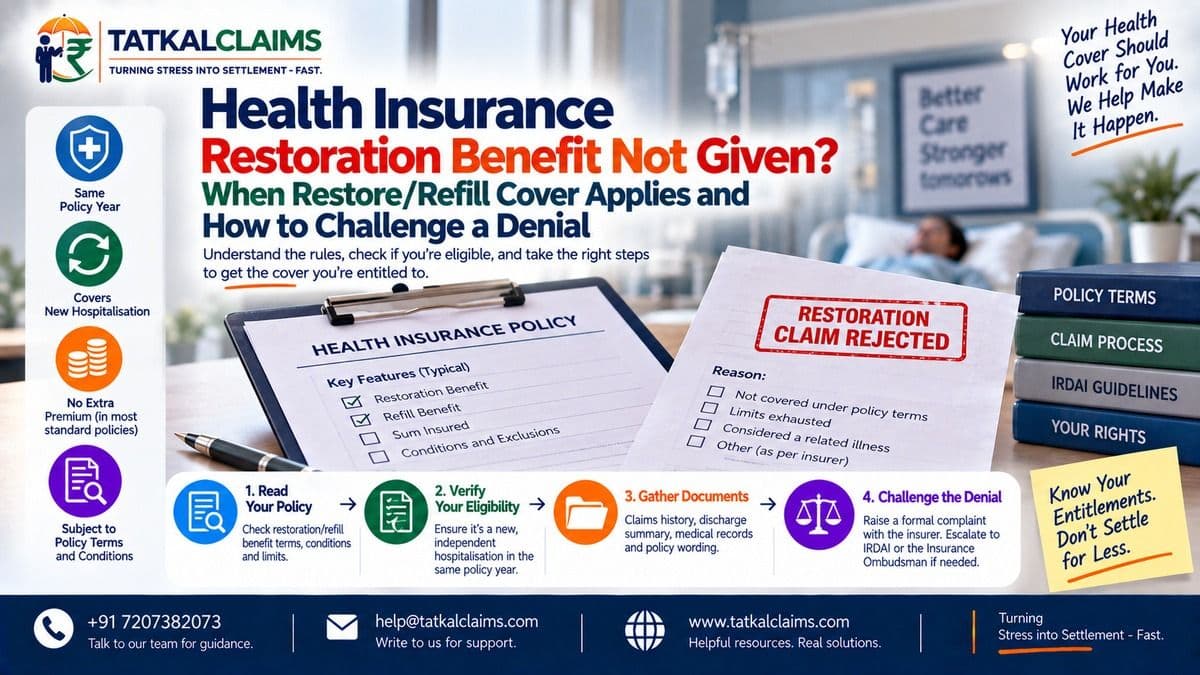
A health-insurance policy can advertise a restore, recharge, refill or reinstatement benefit and still produce a claim dispute when that extra cover is actually needed. The problem is usually not whether the policy has some form of restoration feature, but exactly when it triggers and what the restored amount can be used for.
Different products use very different rules. One policy may restore cover after partial use of the base sum insured, another only after complete exhaustion. Some permit the restored amount for the same illness and the same insured person; others restrict it to a later hospitalisation, a different illness, or a limited number of restorations. Some products also separate a restoration benefit from a distinct recharge benefit.
If your insurer says the restoration benefit was not available, do not start with the marketing phrase on the brochure. Start with the policy schedule, Customer Information Sheet, applicable policy wording for that policy year, endorsements, claim-settlement calculation and the exact clause the insurer says prevented restoration.
First: Restoration Is a Policy Benefit, Not One Uniform Rule Across India
IRDAI's consumer guidance tells policyholders to read the terms and conditions, restrictions, sub-limits and the Customer Information Sheet. The CIS is meant to place the basic features of the policy in one place, including the sum insured, coverage, exclusions, sub-limits, deductibles and waiting periods.
IRDAI's current health-insurance framework does not turn every product's restore or recharge feature into one identical statutory entitlement. The benefit that applies to your claim must therefore be established from the product documents issued for your policy and the exact wording applicable to the policy year in which the claim occurred.
The Eight Clauses That Usually Decide a Restoration Dispute
| Clause to check | Why it matters | Typical dispute |
|---|---|---|
| Trigger | Does restoration start after partial use or only after full exhaustion? | Insurer says base cover was not fully exhausted |
| What counts as utilisation | Is the trigger based on payable/admissible claim amount rather than total hospital bill? | Policyholder counts denied or non-payable expenses as consumed sum insured |
| Timing | Can restored cover be used in the same hospitalisation or only a later claim? | Hospital bill exceeds base cover during one admission |
| Same illness | Can the restored amount fund treatment for the same disease or injury? | Second admission is for the same condition |
| Same insured person | Can the same member use the restored amount again? | Family floater member has repeated hospitalisation |
| Frequency | Once, three times, unlimited, or another limit? | Earlier restoration already used |
| Permitted benefits | Hospitalisation only, or also ambulance, day care, modern treatment, etc.? | Claim falls under a benefit excluded from restored cover |
| Policy-year treatment | Does unused restored cover expire at year-end? | Policyholder tries to carry unused restoration into the next year |
Current Product Examples Show Why You Must Read the Exact Wording
HDFC ERGO's current Optima Restore material says the restore benefit can trigger on partial or complete utilisation of the base cover and restores an amount equal to the base sum insured for future claims. Its product page describes the restored amount as available to insured persons for subsequent in-patient claims during the policy year.
Niva Bupa's current ReAssure material describes unlimited reinstatement and expressly says it can apply to the same or different illness; its comparison material also states that the reinstated cover can be used for the same insured person.
Care Supreme uses a different trigger. Its current product material says unlimited automatic recharge is available when coverage runs out, and its policy wording states that recharge is used only after the base sum insured and specified bonus/benefit amounts are completely exhausted. The wording also says the recharge can be used for the same illness as well as different illnesses.
Star Health's current Family Health Optima page shows yet another structure: automatic restoration is available three times after exhaustion, while a separate recharge benefit can provide additional indemnity that may be used even for the same hospitalisation or the same disease, illness or injury. That distinction is exactly why the heading on a brochure is not enough.
| Product example | Trigger / frequency shown by insurer | Same illness / same insured / same hospitalisation |
|---|---|---|
| HDFC ERGO Optima Restore | Partial or complete utilisation; restores base sum insured for future claims | Product page describes use for subsequent in-patient claims; check current wording for your exact variant |
| Niva Bupa ReAssure | Unlimited reinstatement after activation | Current material states same and different illness and same insured can be covered |
| Care Supreme | After complete exhaustion of specified available cover; unlimited recharge | Current wording states same or different illness; subject to listed covered benefits |
| Star Family Health Optima | Restoration three times after exhaustion plus a separate recharge feature | Current product page says recharge may be used even for same hospitalisation / same illness |
1. Partial Use vs Full Exhaustion: The Most Common Trigger Dispute
Suppose your base sum insured is ₹10 lakh and the first admissible claim consumes ₹6 lakh. A policy that restores after partial utilisation may replenish cover at that stage. A policy that requires complete exhaustion may not. The fact that the hospital bill was ₹12 lakh does not by itself prove that ₹10 lakh of sum insured was consumed if part of the bill was non-payable, excluded, reduced by co-payment or otherwise not admitted.
Ask the insurer to show the claim settlement sheet and the running balance of base sum insured, cumulative bonus and any other benefit that the restoration clause requires to be exhausted first. If the rejection simply says 'sum insured not exhausted' without a calculation, request the arithmetic.
If the dispute is really about deductions that prevented the available sum insured from being treated as exhausted, first audit the settlement using our health-insurance short-settlement and deduction guide.
2. Same Illness and Same Insured Person: Do Not Assume Either Way
Older restoration products often restricted use of the restored sum insured to an unrelated illness or to a different claim. Newer products may expressly allow the same illness, the same insured person, or both. A generic insurer statement that 'restore cannot be used for the same disease' should therefore be checked against the exact policy clause rather than accepted as an industry-wide rule.
In a family floater, identify who used the original cover and who is making the later claim. Some wordings make the restored amount available to all insured persons, while others impose conditions tied to the member, illness or claim sequence. The family relationship does not answer the coverage question; the clause does.
3. Can Restored Cover Be Used for the Same Hospitalisation?
This is different from asking whether it can be used for the same illness. A policy may allow the same illness but only for a subsequent hospitalisation. If one admission itself exceeds the available base cover, the restoration amount may still be unavailable unless the wording specifically permits use during that same hospitalisation.
Star Family Health Optima's current material illustrates why this distinction matters: it describes a separate recharge benefit that can be used even for the same hospitalisation, whereas the restoration feature is separately described. Other products may not contain that same-hospitalisation language.
If the immediate problem is that a cashless approval stopped at the available sum insured, see our cashless rejection and reimbursement guide before assuming the unpaid balance must come from restoration.
4. Family Floater Claims: Who Gets the Restored Amount?
For a family floater, create a member-wise claim timeline. Record the base sum insured at the start of the policy year, cumulative bonus, each claim paid for each insured member, remaining balance after each claim, when restoration was triggered, and who used any restored amount.
This is especially important when two members are hospitalised close together. If the first member's claim partially or fully consumed the cover and the second member's admission followed, the claim decision may turn on whether the policy had already triggered restoration and whether the restored amount was available to all members.
5. A Rejected or Non-Payable Claim May Not Trigger Restoration
Many restoration clauses are linked to utilisation through a payable claim. If the insurer rejects the first claim entirely, it may argue that no admissible sum insured was consumed and therefore no restoration trigger occurred. Challenging the restoration denial may then require challenging the underlying claim rejection first.
Similarly, a hospital may bill ₹8 lakh but the insurer may admit only ₹5 lakh after exclusions, co-payment or limits. Restoration usually follows the policy's calculation of covered utilisation, not the gross hospital invoice. That is why the settlement sheet and policy clause must be read together.
Where the underlying claim itself has been rejected, use the broader insurance claim rejection appeal guide to challenge that decision before treating restoration as a standalone issue.
6. Restoration Does Not Normally Remove Other Policy Conditions
A restored sum insured usually increases the amount available under the specified benefit; it does not automatically erase room-rent limits, co-payments, deductibles, waiting periods, exclusions, network conditions or benefit-specific caps. Those restrictions continue unless the policy wording says otherwise.
If the restored amount appears available but the insurer still reduces the claim because of room category or proportionate deduction, analyse that separately using our room-rent capping and proportionate deduction guide.
7. Rebuild the Insurer's Calculation Before You Appeal
| Step | Document / number to obtain | Question to answer |
|---|---|---|
| 1 | Policy schedule and CIS | What was the base sum insured for this policy year? |
| 2 | Applicable policy wording / endorsement | What exact trigger and restrictions apply? |
| 3 | Opening cumulative bonus or other enhanced cover | Must this be used before restoration? |
| 4 | Settlement sheet for each earlier claim | How much covered sum insured was actually consumed? |
| 5 | Running balance after each claim | Was the required exhaustion point reached? |
| 6 | Restoration entry in claim system / letter | When does the insurer say restoration activated? |
| 7 | Later claim calculation | Was restored cover ignored, restricted or already used? |
| 8 | Reason for denial | Which clause is the insurer relying on? |
Do not let the appeal remain at the level of 'my policy had restore benefit'. Reconstruct the numbers. A strong grievance identifies the starting cover, each deduction, the balance after every claim, the exact restoration trigger and the amount that should have become available.
Evidence to Collect for a Restoration-Benefit Dispute
| Evidence | Why it matters |
|---|---|
| Policy schedule, CIS and full wording for the disputed policy year | Establishes the actual contractual benefit |
| Renewal notice and endorsements | Shows whether wording or plan variant changed |
| All prior claim settlement letters in that policy year | Shows how much cover was consumed |
| Hospital final bills and discharge summaries | Separates gross bill from admissible claim |
| Cashless pre-authorisation and enhancement requests | Shows what the insurer knew during treatment |
| Insurer app/dashboard screenshots showing available sum insured | Can expose inconsistent balance or restore status |
| Email/chat/grievance responses | Locks the insurer into a written reason |
| Claim ledger or running-balance calculation prepared by you | Makes the dispute auditable |
If the insurer relies on an internal medical or claim assessment that you have not been shown, use our guide to requesting the claim file, medical opinion and evidence used against you.
What to Ask the Insurer in Writing
| Question | Why it is useful |
|---|---|
| Which exact clause governs restoration/recharge for my policy and policy year? | Prevents reliance on a generic brochure statement |
| What was my available base SI and bonus before each claim? | Creates the starting point for the calculation |
| How much SI did each prior paid claim consume? | Tests the insurer's exhaustion calculation |
| On what date did restoration activate, if at all? | Fixes the trigger point |
| Is the denial because of same illness, same insured, same hospitalisation, or incomplete exhaustion? | Forces the insurer to identify the real restriction |
| Has any restored amount already been used? If yes, on which claim? | Detects double counting |
| Does the clause permit partial-utilisation restoration or require complete exhaustion? | Addresses the most common wording mismatch |
| Please provide the revised claim calculation if restoration was omitted | Turns the grievance into a quantifiable correction request |
How to Challenge a Restoration or Recharge Denial
First raise a written grievance with the insurer and attach the clause, your running-balance calculation and the claim documents that show why the trigger was met. Ask for a point-by-point response and a revised settlement calculation, not a generic reconsideration.
IRDAI's Bima Bharosa FAQ states that policyholders should first approach the insurer's grievance mechanism in writing with supporting documents. If the issue remains unresolved or the resolution is unsatisfactory, the complaint can be escalated through the regulatory grievance channel.
Before choosing the next forum, compare the routes in our Bima Bharosa vs Insurance Ombudsman guide.
Where the complaint falls within the Insurance Ombudsman framework, the Ombudsman can consider eligible disputes involving claim repudiation, partial settlement and policy interpretation after the insurer-first requirement is met. Check the current eligibility, monetary limit and filing deadline before relying on that route.
For the filing sequence and current eligibility rules, use our Insurance Ombudsman complaint process guide.
7-Day Action Plan After a Restore/Recharge Denial
| Day | Action | Output |
|---|---|---|
| 1 | Collect policy schedule, CIS, wording, endorsements and renewal papers | Correct policy-year contract |
| 2 | Collect all settlement letters and cashless approvals from the policy year | Claim chronology |
| 3 | Build a running balance of base SI, bonus and prior paid claims | Exhaustion calculation |
| 4 | Mark the exact restore/recharge clause and every trigger restriction | Clause matrix |
| 5 | Request insurer's claim ledger, restore status and written denial basis | Insurer calculation |
| 6 | File a focused grievance with your calculation and requested correction | Formal reconsideration record |
| 7 | Prepare Bima Bharosa/Ombudsman bundle if the response remains unsatisfactory | Escalation-ready file |
Can Tatkal Claims Help With a Restoration-Benefit Denial?
Tatkal Claims assists policyholders with rejected and short-settled health claims. In a restoration dispute, the review can include the policy-year wording, CIS, base sum insured, cumulative bonus, earlier claim utilisation, same-illness and same-insured restrictions, cashless approvals, settlement calculations and the insurer's written reason for refusing restored cover.
No outcome can be guaranteed. A restore or recharge label does not by itself prove that the extra cover was available for the disputed claim. The strength of an appeal depends on the exact product wording, the claim sequence and whether the trigger conditions were actually met.
Frequently asked questions
Does every health insurance policy automatically restore the sum insured after a claim?
No. Restoration, recharge or refill is a product benefit and its trigger varies. Check whether your policy includes it and the exact conditions in the wording applicable to your policy year.
Can restoration activate after only part of the sum insured is used?
Some products allow restoration after partial utilisation, while others require complete exhaustion. The policy clause decides.
Can restored cover be used for the same illness?
Sometimes. Current products differ: some expressly allow the same illness, while others restrict restored cover to unrelated illness or later claims. Do not assume one rule applies to all insurers.
Can the same insured person use the restored amount again?
That depends on the wording. Some current products expressly permit the same insured person to use reinstated cover, while others may impose member or claim-sequence restrictions.
Can restore benefit pay the balance of the same hospitalisation?
Not necessarily. Many restoration benefits are intended for subsequent claims. A same-hospitalisation payment requires wording that permits it; some products use a separate recharge feature for this.
If my hospital bill exceeds the base sum insured, does that automatically trigger restoration?
No. The trigger may depend on the amount of covered sum insured actually utilised after exclusions, co-payment, deductibles and other limits, not the gross hospital bill.
Does restored sum insured remove room-rent limits or co-payment?
Usually no. Restoration typically replenishes the available cover but does not erase other policy terms unless the wording specifically says so.
Can unused restored cover be carried to the next policy year?
Often it cannot be carried forward, but you should check your own policy wording. Many restoration/recharge clauses apply only within the current policy year.
What should I ask the insurer if it says restoration was not available?
Ask for the exact clause, the running balance of base sum insured and bonus, the amount consumed by each prior claim, the date restoration did or did not trigger, and the specific restriction relied upon.
Where can I complain if the insurer refuses to apply the restoration benefit?
Raise a written grievance with the insurer first. If unresolved or unsatisfactory, consider Bima Bharosa and, where eligible, the Insurance Ombudsman.
Official and Product Sources
Disclaimer: This article provides general information about health-insurance restoration, recharge, refill and reinstatement benefits in India. Product names and policy designs change, and the same insurer may have multiple versions with different triggers and restrictions. Always use the policy schedule, Customer Information Sheet, endorsements and policy wording applicable to the policy year of the disputed claim. A restoration benefit does not guarantee that every hospital bill above the base sum insured will be payable.