An insurance claim rejection can be difficult to challenge when the insurer refers to a survey, investigation, medical review, underwriting record or alleged non-disclosure but the policyholder has never seen the material behind that conclusion.
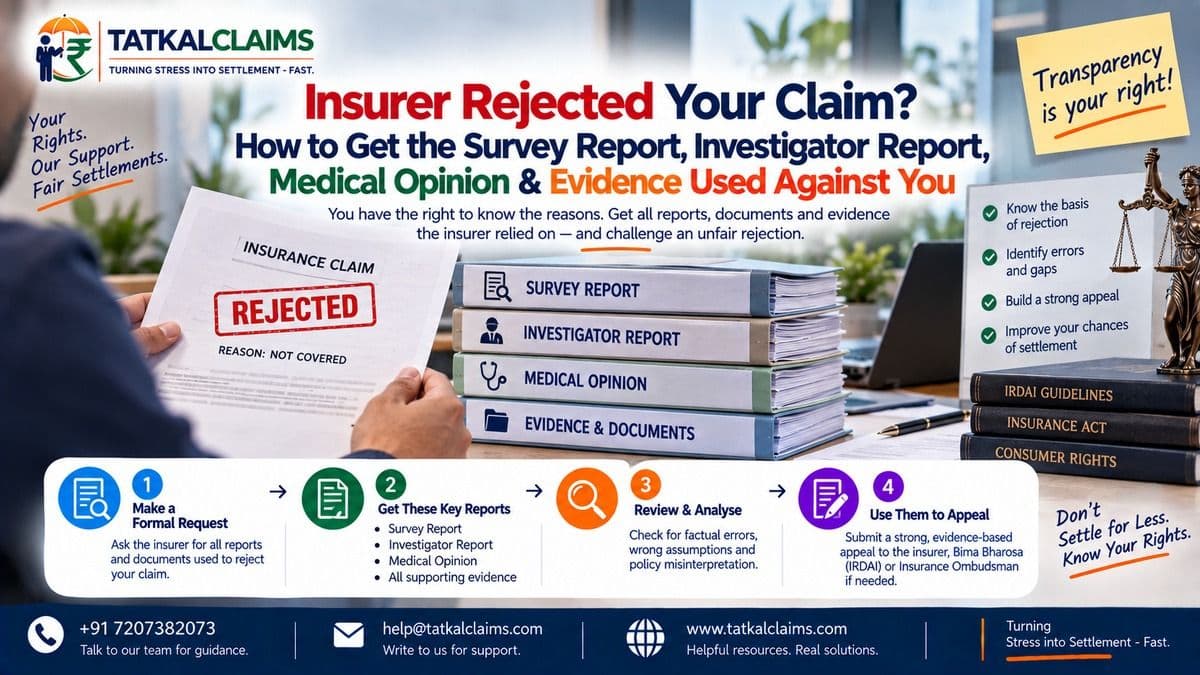
The first objective is therefore not to write a long emotional appeal. It is to identify the exact evidence the insurer relied on, compare that evidence with your own records and the policy wording, and force the dispute into a document-by-document form.
This guide explains what to ask for after a life, health, motor, property or other general-insurance claim is rejected or short-settled, what the current 2024 IRDAI framework clearly supports, where older rules were more explicit, and how to escalate when the insurer gives only a conclusion but not the factual basis.
Why the Insurer's Evidence Matters
A rejection letter often gives the final conclusion: non-disclosure, excluded peril, pre-existing disease, lack of medical necessity, inconsistent accident history, underinsurance, fraud concern, or a lower assessed loss. But the real dispute usually sits one level deeper: which record led the insurer to that conclusion?
For example, a motor or property claim may turn on a surveyor's assessment; a life claim may turn on an investigation into medical, financial or lifestyle history; and a health claim may turn on hospital records or an insurer-side medical review. Without identifying that source, the policyholder may rebut the wrong issue.
If you first need the wider appeal sequence, use Tatkal Claims' complete insurance claim rejection guide.
First: Separate the Claim Decision From the Evidence Behind It
| Item | Why it matters | What to ask for |
|---|---|---|
| Written rejection / repudiation letter | Shows the insurer's stated reason and policy clause | Complete decision letter with clause references and factual grounds |
| Settlement / deduction calculation | Shows how the insurer arrived at a lower amount | Line-by-line calculation, depreciation, exclusions, excess, co-pay, sub-limit or assessed loss |
| Proposal form / declarations | Critical in non-disclosure and misrepresentation disputes | Copy of the completed proposal and any declarations or amendments attributed to you |
| Survey report / loss assessment | Often central to motor, property and other general-insurance claims | Final survey report, relevant assessment sheets and basis of deductions |
| Investigator findings | May underpin fraud, non-disclosure, theft, death or accident disputes | Report if available; otherwise the specific findings, statements and records relied upon |
| Medical opinion / claim medical review | May underpin health and life rejection | The medical conclusion, records reviewed, questions considered and factual basis |
| Hospital / treatment records relied upon | Can expose wrong history, dates or diagnosis | Copies or identification of the records relied on by the insurer/TPA |
| Inspection / photographs / digital records | Important for motor, property, crop and digital claims | Inspection photos, timestamps, geolocation or inspection observations relied upon |
| Additional or second assessment | Shows whether the insurer departed from an earlier assessment | Any additional report and the reasons for obtaining or preferring it |
1. Ask for the Proposal Form and Declarations
If the rejection alleges non-disclosure, incorrect health history, occupation, income, smoking, prior insurance, vehicle details or another proposal-stage fact, the proposal form is one of the first documents to obtain.
The current IRDAI Master Circular on Protection of Policyholders' Interests, 2024 states that the insurer should furnish the insured, without additional charge, a soft or hard copy of the proposal form submitted by the prospect along with the policy document within the prescribed issuance timeline. That makes a request for the completed proposal especially important where the insurer is relying on what was allegedly declared or omitted.
Compare the copy supplied by the insurer with emails, OTP records, medical disclosures, sales illustrations, call recordings or documents given to the agent. Do not assume the version held by the insurer exactly matches what you remember submitting.
For health claims involving alleged non-disclosure or a pre-existing disease, also use our PED and non-disclosure claim rejection guide.
2. Ask for the Survey Report in Motor, Property and Other General-Insurance Claims
Under the current 2024 retail general-insurance framework, specified claims above the regulatory thresholds require a registered surveyor and loss assessor; surveyor allocation is to happen quickly, the insurer must communicate the surveyor appointment, and the survey report is subject to a prescribed turnaround time.
There is an important legal-history distinction. The 2017 Policyholders' Interests Regulations expressly said that a copy of the surveyor's report should be furnished to the insured or claimant if requested. Those regulations were replaced by the 2024 framework. The current materials clearly regulate surveyor appointment, reporting and claim-decision timelines, but we do not recommend presenting the old copy-on-request wording as though it were unchanged current law.
Practically, you should still request the final survey report when the insurer relies on the survey to reject or reduce the claim. If the insurer refuses, ask for the assessed loss, each disallowed item, the factual observations, photographs or measurements relied upon, and the exact policy provision used for every material deduction.
In Sri Venkateswara Syndicate v. Oriental Insurance and New India Assurance v. Pradeep Kumar, the Supreme Court explained that survey reports deserve importance but are not sacrosanct or automatically binding. A later court reviewing those authorities similarly emphasised that an insurer needs valid reasons if it departs from a properly prepared survey report.
For vehicle valuation disputes, compare the survey assessment with our car total-loss and constructive-total-loss guide.
3. If an Investigator Was Used, Ask What Findings Were Relied On
Life, theft, fraud-suspected, early-duration and other disputed claims may involve an investigator. The investigator may collect statements, visit addresses, contact hospitals or doctors, check employment or financial records, review prior medical records, or compare the claim narrative with other data.
Do not assume that every internal investigation report must automatically be handed over in full. Instead, make a precise written request for the report or, if the insurer says the report is confidential or internal, for the specific adverse findings, statements, records, dates and contradictions relied upon in the claim decision.
That distinction matters. A fair appeal does not necessarily require every internal note. It does require enough specificity to identify what fact is being alleged and to answer it. A rejection that says only 'investigation revealed non-disclosure' is much harder to test than one that identifies the alleged undisclosed diagnosis, record date and source.
4. Ask for the Medical Basis of a Health or Life Rejection
If the insurer says treatment was not medically necessary, the disease was pre-existing, the hospitalisation could have been outpatient, a condition was unrelated to the insured event, or a death claim conflicts with medical history, ask for the medical basis—not merely the conclusion.
Request the medical opinion or claim-review conclusion relied on, the medical records reviewed, the diagnosis or history said to be inconsistent, and the policy definition or exclusion applied. If a full internal medical note is not shared, ask the insurer to state the clinical facts and records supporting its conclusion.
Current IRDAI health-insurance reforms also shift much of the document-collection burden toward insurers and TPAs, which are expected to obtain necessary claim documents from hospitals. IRDAI's current material separately states that express consent is required for sharing medical records and related information.
Your rebuttal should usually come from the treating doctor's records, discharge summary, investigation results, prior medical history and a focused explanation of why the treatment or admission was clinically required—not simply from a statement that the insurer is wrong.
How to Write the Evidence Request
Send the request in writing through the insurer's claims or grievance channel. Use the policy number and claim number in the subject line and ask for the documents and findings used in the decision.
| Request | Suggested wording |
|---|---|
| Decision basis | Please identify every factual ground and policy clause relied upon for rejection or deduction. |
| Proposal record | Please provide the completed proposal form and declarations attributed to the insured/proposer. |
| Survey | Please provide the final survey/loss-assessment report and assessment basis relied upon. |
| Investigation | Please provide the investigator report, or if the full report is not shared, the specific adverse findings, statements and records relied upon. |
| Medical review | Please provide the medical opinion/conclusion relied upon and identify the medical records reviewed. |
| Documents | Please identify every document said to be missing, inconsistent or adverse to the claim. |
| Calculation | Please provide the complete settlement/deduction calculation and basis for each reduction. |
| Additional report | Please identify any second/additional opinion or report and explain why it was obtained or preferred. |
Do not demand an undefined 'entire internal file' and stop there. A narrower request tied to the actual rejection reason is harder to answer with a generic template and creates a better record for the next grievance stage.
What If the Insurer Refuses to Share the Report?
First, distinguish between refusal to give a complete internal document and refusal to explain the basis of the claim decision. Even where the insurer does not hand over a complete investigator or medical-review file, ask it to state the adverse facts, documents and policy clauses it relied upon.
Second, make the non-disclosure itself part of the grievance: identify the document requested, why it is material to the rejection, the date of your request, the insurer's response, and the exact issue you cannot meaningfully answer without the underlying finding.
IRDAI's Bima Bharosa guidance says complaints should first be made to the insurer in writing with supporting documents and that the insurer should resolve the complaint within 15 days. If the response is unsatisfactory or the complaint is not resolved in the prescribed period, the grievance can be escalated through Bima Bharosa.
Before external escalation, compare the roles of Bima Bharosa and the Insurance Ombudsman.
When the Insurance Ombudsman Can Become Relevant
The Insurance Ombudsman can consider complaints involving delay, partial or total repudiation, policy servicing and certain regulatory or policy violations, subject to its eligibility rules. The claimant must first complain to the insurer.
If your case reaches the Ombudsman, attach both sides of the evidence dispute: your written request for the report or findings and the insurer's refusal, incomplete answer or adverse material. That allows the complaint to show not merely that you disagree with the result, but why the factual basis could not be tested.
Use our Insurance Ombudsman complaint guide for the current eligibility, filing and deadline checks.
How to Challenge the Insurer's Evidence Once You Get It
| Check | Questions to ask |
|---|---|
| Identity and chronology | Does the report refer to the correct insured, vehicle, hospital, property, event and dates? |
| Source of information | Is the conclusion based on an actual record, a third-party statement, an assumption or hearsay? |
| Completeness | Were important bills, photographs, diagnostic reports, repair estimates or declarations omitted? |
| Policy relevance | Does the fact actually trigger the exclusion or condition cited by the insurer? |
| Causation | Is there evidence connecting the alleged breach or medical condition to the claimed loss where that connection matters? |
| Calculation | Can every deduction be reproduced from the policy wording and supporting figures? |
| Contradictions | Does the investigator or medical opinion conflict with the survey report, hospital record, proposal form or insurer's earlier communication? |
| Opportunity to answer | Was the claimant ever asked to explain an alleged discrepancy before the final decision? |
A strong rebuttal is usually structured as Issue → Insurer's evidence → Your contrary evidence → Policy clause → Remedy requested. This is more effective than sending a fresh bundle of documents without explaining what each one disproves.
For a delayed claim, preserve the dates on which you requested the evidence and the insurer responded. Those dates can become part of the grievance chronology.
If the insurer is not deciding the claim at all, use our claim-delay escalation guide.
What Not to Do
Do not accuse the surveyor, investigator, doctor or insurer of fraud merely because you disagree with the conclusion. Identify the factual or contractual error.
Do not rely only on telephone calls. Follow up by email or the insurer's grievance portal and preserve ticket numbers and acknowledgements.
Do not assume that an insurer's refusal to share one internal document automatically proves the claim must be paid. The dispute still has to be tested against the policy, facts and admissible evidence.
Do not cite the superseded 2017 survey-report rule as though it were unquestionably the current 2026 rule. It remains useful historical context, but the present request should be grounded in the current claim decision, transparency, grievance and evidence framework.
7-Day Action Plan After a Claim Is Rejected Without Clear Evidence
| Day | Action | Output |
|---|---|---|
| 1 | Obtain the full rejection/settlement letter and policy wording | Exact reason and clause list |
| 2 | Request proposal form, survey/investigation/medical basis and calculation | Written evidence request |
| 3 | Collect your own records: hospital, repair, financial, photographs, declarations and correspondence | Indexed claimant evidence |
| 4 | Map each insurer allegation against your contrary evidence | Issue-by-issue matrix |
| 5 | Send a focused insurer grievance with missing-evidence requests repeated | Grievance acknowledgement |
| 6 | Prepare Bima Bharosa/Ombudsman chronology if the response remains inadequate | Escalation file |
| 7 | Check deadlines, claim value and forum eligibility before external filing | Final action checklist |
Can Tatkal Claims Help With an Evidence-Based Claim Appeal?
Tatkal Claims assists policyholders with rejected, delayed and short-settled insurance claims. Depending on the case, this can include identifying the evidence behind the insurer's decision, reconciling the proposal form and claim record, testing survey or medical findings against the policy, organising rebuttal documents and preparing insurer, Bima Bharosa or Ombudsman representations.
No outcome can be guaranteed. The strength of an appeal depends on the policy wording, claim facts, applicable regulations and the quality of the evidence on both sides.
Frequently asked questions
Can I ask my insurer for the survey report?
Yes, you can and should request it when the survey is material to a rejection or deduction. Older 2017 IRDAI regulations expressly required a copy on request, but those rules were replaced in 2024, so do not present the old wording as an unchanged current entitlement. If the report is not shared, ask for the assessment findings, deductions and factual basis relied upon.
Can I get a copy of my insurance proposal form?
The current 2024 IRDAI policyholder-protection framework requires insurers to furnish the insured a copy of the proposal form without additional charge as part of policy issuance. If a claim is rejected for non-disclosure, request the exact completed proposal and declarations attributed to you.
Does an insurer have to give me its investigation report?
Do not assume every internal investigation report must automatically be disclosed in full. Request it, but also ask for the specific adverse findings, statements, records and contradictions relied upon if the insurer refuses to share the complete report.
What if a health insurer says its doctor decided the admission was unnecessary?
Ask for the medical conclusion, the records reviewed and the clinical facts supporting it. Then obtain a focused explanation from the treating doctor and compare both positions with the policy wording and treatment records.
Is a surveyor's report final and binding?
No. Supreme Court decisions have treated the survey report as important evidence but not the last or conclusive word. A party challenging it should identify cogent factual, technical or policy-based reasons.
What if the insurer's settlement is lower than the surveyor's assessment?
Ask whether the insurer accepted the survey report, what amount the surveyor assessed, why the insurer departed from it and the policy or evidence supporting each further deduction.
What if the insurer will only give me a one-line rejection reason?
Raise a written grievance asking for the precise factual grounds, records relied upon and policy clauses. A useful appeal requires enough detail to know what allegation must be answered.
Can I complain to IRDAI if documents or findings are not provided?
Yes, after first raising the grievance with the insurer. Bima Bharosa can be used when the insurer's resolution is unsatisfactory or the grievance is not resolved within the prescribed timeline.
Can the Insurance Ombudsman look at a dispute about evidence used to reject my claim?
Potentially, where the underlying complaint concerns delay, partial or total repudiation, policy servicing or related regulatory/policy issues and the case meets the Ombudsman's eligibility requirements.
What is the most useful format for challenging insurer evidence?
Use a simple matrix: insurer allegation, document or report relied upon, your contrary evidence, relevant policy clause and the correction you want. It makes the dispute easier to review at every escalation stage.
Official and Legal Sources
Disclaimer: This article provides general information about insurance claim evidence, grievance and escalation processes in India. It does not mean that every internal insurer document must be disclosed in every case, and it does not constitute legal advice. Rights and procedures depend on the policy, claim type, applicable rules and forum.