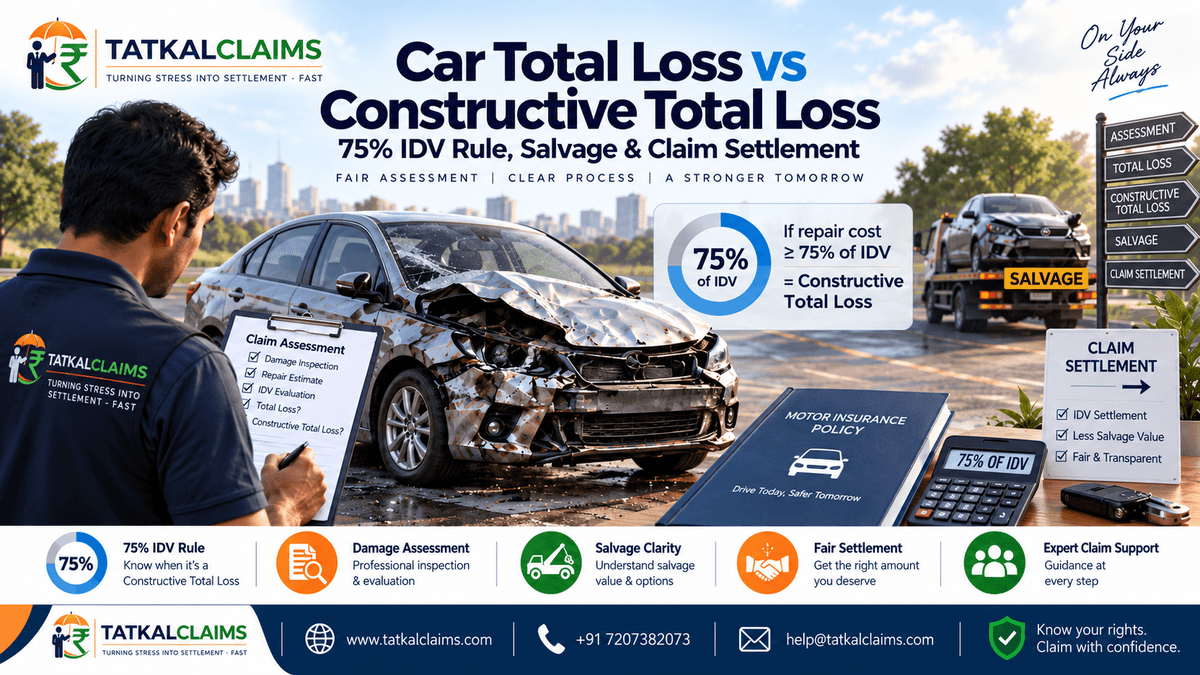
Has the insurer declared your car a total loss—or insisted it is repairable? In a constructive total loss (CTL) dispute, compare the assessed retrieval and/or repair cost with the insured declared value (IDV) and the exact policy wording. Under the standard CTL formulation, costs exceeding 75% of IDV can trigger CTL classification. That 75% figure is not the percentage of IDV automatically payable; salvage treatment and policy deductions can affect the final settlement.
Total Loss vs Constructive Total Loss
| Term | Practical meaning |
|---|---|
| Partial loss | The vehicle is repairable and the claim is handled as repair/replacement of damaged parts under policy terms. |
| Actual total loss | The vehicle is destroyed, lost or otherwise treated as a complete loss under the policy. |
| Constructive total loss (CTL) | Repair/retrieval economics cross the threshold stated in the policy, commonly more than 75% of IDV in the standard wording considered by the Supreme Court. |
Example of the 75% IDV Rule
| Item | Illustration |
|---|---|
| IDV | ₹10,00,000 |
| 75% of IDV | ₹7,50,000 |
| Assessed retrieval + repair cost | ₹8,20,000 |
| Result under a policy using the standard threshold | Potential CTL because the assessed cost exceeds 75% of IDV |
75% Does Not Mean the Insurer Pays Only 75%
This is a common misunderstanding. The 75% figure is used to decide whether the vehicle crosses the CTL threshold under the standard clause. The amount payable after CTL classification depends on the policy settlement provisions, IDV, wreck/salvage treatment, deductibles and other applicable terms.
What Does IDV Actually Do?
IDV is the value stated in the policy schedule for the insured vehicle and is central to total-loss/CTL settlement. It is not necessarily the current showroom price, the outstanding car loan or the amount you personally believe the car is worth.
Claim-settlement statistics can be useful when comparing insurers, but they do not predict whether a particular total-loss claim will be admitted or how IDV and salvage will be applied. See our car insurance claim settlement ratio comparison for the underlying metrics and their limitations.
What Happens to the Wreck or Salvage?
The answer depends on the settlement structure. In Bajaj Allianz General Insurance Co. Ltd. v. Mukul Aggarwal, the Supreme Court read the policy as limiting liability for total loss/CTL to IDV less the value of the wreck where the insured retained the wreck, and also noted the insurer's contractual option in the policy context. Your own policy and settlement offer must be read carefully before agreeing to retain or transfer salvage.
Why the Surveyor's Assessment Matters
The repair estimate from a workshop and the insurer-approved surveyor's assessed loss may differ. A CTL dispute often turns on which parts are accepted, labour rates, depreciation, pre-existing damage, retrieval costs and whether the surveyor considers the vehicle economically repairable.
How to Audit a CTL Decision
- Check the IDV in the policy schedule.
- Get the workshop estimate and the surveyor's final assessment.
- Confirm which retrieval and repair amounts were included in the CTL threshold calculation.
- Calculate 75% of IDV yourself and compare it with the insurer's figures.
- Ask how salvage/wreck value is being handled and who will own it after settlement.
- Check deductibles, depreciation and endorsements such as return-to-invoice or zero-depreciation cover separately; they do not all operate the same way in a total-loss claim.
What If the Insurer Says Repair Instead of Total Loss?
Ask for the surveyor's written assessment and the policy clause supporting the classification. If the approved repair and retrieval cost is below the contractual CTL threshold, the insurer may treat the claim as repairable. If you believe the assessment understates the real damage, obtain a detailed workshop estimate and challenge specific omitted items rather than merely asserting that the car 'looks totaled'.
What If the Insurer Declares CTL but the Amount Looks Too Low?
Separate the disputes: IDV, salvage value, deductible, policy endorsements and any non-payable components. Demand a written calculation. A lower settlement can sometimes be caused by the insured retaining salvage, while in other cases the dispute may be about the surveyor's valuation or policy interpretation.
When to Escalate
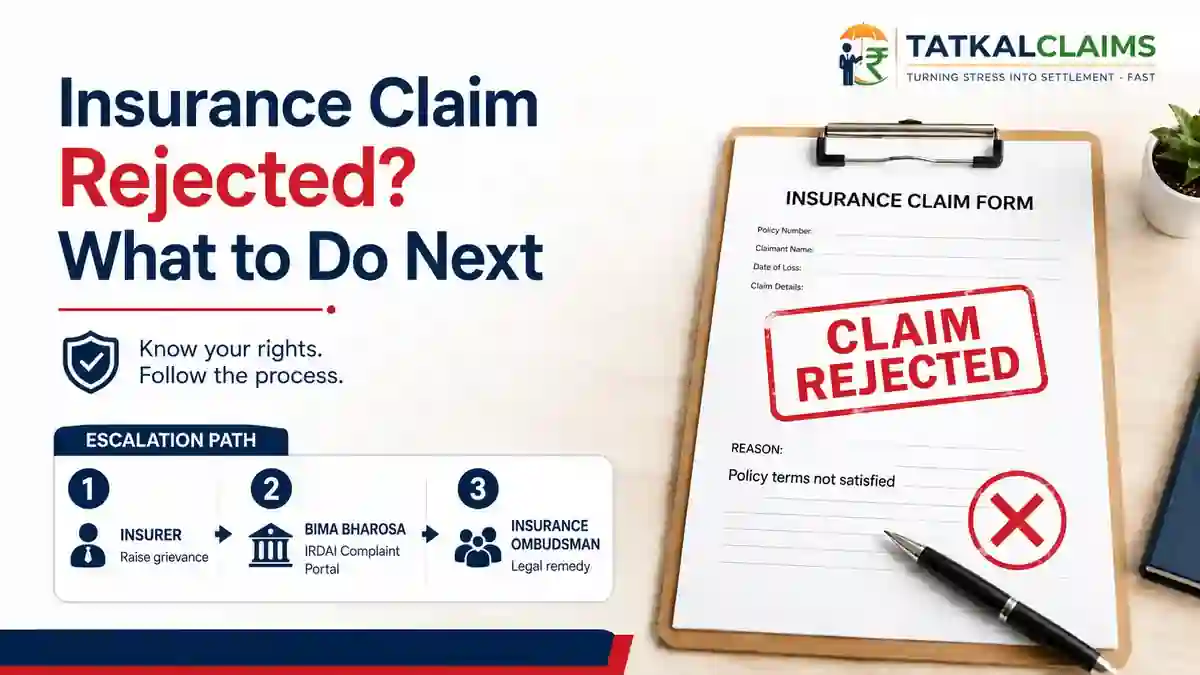
If the insurer does not explain the CTL classification or settlement calculation, use its formal grievance process. Keep the survey report, estimates, photographs, policy schedule and settlement offer. Bima Bharosa and the Insurance Ombudsman may be available for eligible disputes after the required insurer-complaint step.
Frequently asked questions
Is a car automatically CTL if repair cost is 75% of IDV?
The standard formulation discussed by the Supreme Court uses a threshold where aggregate retrieval and/or repair cost exceeds 75% of IDV. Check the exact wording of your policy.
Does CTL mean I receive 75% of IDV?
No. The 75% figure is a classification threshold, not automatically the payout percentage.
Who decides the repair cost?
The insurer relies heavily on the approved surveyor's assessment, though workshop estimates and other evidence can be relevant in a dispute.
Can salvage reduce my settlement?
Yes, depending on who retains the wreck and the policy settlement structure. The 2023 Supreme Court case illustrates IDV less wreck value under the policy wording before it.