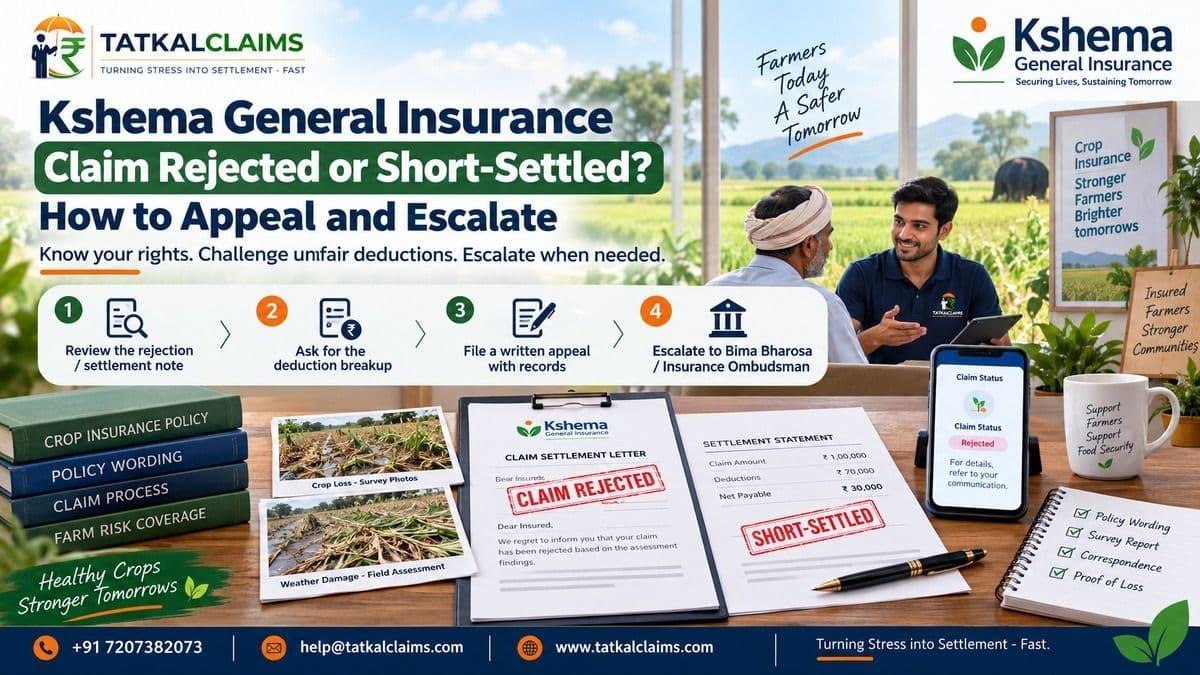
If Kshema General Insurance has rejected your claim, reduced the amount payable or delayed a decision, the insurer's first position does not necessarily end the matter.
Kshema remains strongly associated with crop insurance, but its current product range also includes hospital-cash and motor covers. The appeal therefore has to stay product-specific: crop-intimation and geotagged evidence rules should not be mixed with hospital-cash benefit conditions or motor survey requirements.
A useful appeal should address Kshema's exact reason. Identify the policy clause, medical conclusion, survey or assessment finding, documentation issue or deduction relied upon and answer that point with evidence.
The strongest grievance is not a general request for reconsideration. It is a structured record showing what the insurer decided, why you disagree, what document or policy wording supports your position and what precise correction you want.
First: Identify What Happened to Your Kshema Claim
| Claim problem | What to obtain | What the appeal should examine |
|---|---|---|
| Crop claim rejected | Rejection letter and policy wording | Peril, insured location, crop stage, intimation timing and evidence |
| Crop loss under-assessed | Assessment basis and photographs | Method used to quantify damage and policy compensation mechanism |
| Health claim rejected/short-settled | Decision letter / settlement sheet | Medical basis, exclusions, deductions and document completeness |
| Motor/general claim reduced | Survey or assessment report | Loss causation, covered damage, deductions and exclusions |
| Claim delayed | Chronology of intimation and document submission | Which service stage or evidence request is outstanding |
For the wider insurer-neutral framework, use Tatkal Claims' Insurance Claim Rejected? What to Do Next – Complete Guide for India.
Step 1: Obtain the Exact Rejection or Deduction Reason
Before appealing, obtain Kshema's written claim decision. For a rejected claim, identify the exact clause and factual basis. For a short settlement, obtain the calculation showing how the insurer moved from the amount claimed to the amount paid.
For a crop dispute, identify whether the decision concerns the insured peril, polygon/location, crop stage, waiting period, intimation timing, evidence sufficiency or loss assessment. For Hospi DinDhan hospital-cash claims, identify the admission, covered benefit, waiting period, deductible or day-limit issue. For motor claims, identify the survey, causation, policy-condition or liability basis.
Address the insurer's reasoning line by line. If the reason is unclear, ask for clarification in writing before building a long appeal around assumptions.
Step 2: Register the Complaint With Kshema
For claim or policy assistance, Kshema's current product pages publish 1800 572 3013 and customer.support@kshema.co. For a formal grievance, Kshema's current grievance page publishes grievance.cell@kshema.co and 1800 570 2998. Preserve the complaint reference, product name, UIN where available, claim decision and evidence-submission timestamps.
A written complaint should identify the policy number, claim number, relevant dates, amount claimed, amount rejected or deducted, Kshema's stated reason, the policy clause in dispute, the key supporting evidence and the specific remedy requested.
Always preserve the acknowledgement or interaction reference. If documents are re-submitted, record both the original submission date and the later re-submission so the chronology remains clear.
Step 3: Escalate to the Grievance Redressal Officer
If the first grievance response is unsatisfactory, Kshema's current grievance page names Mr. Ashish Luthra as Grievance Redressal Officer and publishes gro@kshema.co for escalation. Forward the earlier grievance trail and identify the exact policy provision, assessment issue or evidence dispute that remains unresolved.
Do not restart the story at every level. Forward the earlier complaint and response, then identify the precise unresolved issue, the evidence already supplied and the correction still requested.
Separate Channel for Senior Citizens
Kshema publishes complaints.seniorcitizens@kshema.co for senior citizens.
How Long Should a Kshema Grievance Take?
Kshema's current grievance page states a 14-day response time. Kshema's separate policy-servicing page also lists immediate acknowledgement of complaints and action plus intimation of the decision within 14 days.
IRDAI's Bima Bharosa FAQ separately states that an insurance company should resolve a grievance within 15 days of receipt.
The Insurance Ombudsman uses a different insurer-first threshold: if the insurer does not respond within 30 days, the no-response route may become available, subject to the other eligibility conditions.
Kshema Crop Insurance Claim Disputes
Crop claims need event, location and timing evidence. A claimant may need to show that a covered peril occurred, that the loss affected the insured crop at the insured location and that the policy's intimation and evidence requirements were followed.
Crop-loss reporting is product-specific. Current Kshema Sukriti wording requires loss intimation not later than 24 hours after occurrence of a covered peril. Kshema's PMFBY wording, by contrast, uses a 48-hour intimation window for specified post-harvest and localised loss routes. Neither deadline should be presented as a universal rule for every Kshema crop policy.
Under current Sukriti wording, the claimant should take geo-tagged photographs of the damaged crop with date and time stamps through the Kshema Application, safeguard the crop for verification and submit dated photos and video clips every alternate day for seven days from the loss date. If Kshema alleges a location mismatch, compare the claimed loss location with the insured polygon or coordinates recorded at proposal stage.
Current Sukriti wording says claim detection and loss assessment may use remote-sensing satellite imagery plus photos or videos submitted through the Kshema Application and an in-house algorithm. If the dispute concerns the assessed percentage or amount of loss, ask for the factual basis used, then compare the affected area, crop stage, loss percentage, indemnity percentage, claim excess and policy formula rather than relying only on expected yield or market value.
Kshema Hospital-Cash Claim Disputes
Kshema's current Hospi DinDhan Suraksha retail product is a daily cash benefit plan. For claim assistance, Kshema publishes 1800 572 3013, healthclaims@kshema.co and customer.support@kshema.co. Preserve the admission and discharge records, hospital papers required by the applicable wording, claim acknowledgement and the calculation of eligible hospitalisation days.
Hospi DinDhan Is a Daily Cash Benefit, Not Standard Cashless Mediclaim
A Hospi DinDhan dispute should be analysed against the fixed daily benefit selected under the policy, the number of admissible hospitalisation days, applicable waiting periods, deductibles and benefit limits. Do not analyse it as though Kshema were reimbursing the hospital bill line by line under a standard indemnity mediclaim policy.
If Kshema pays fewer hospital-cash days than expected, request the day-by-day benefit calculation and the exact policy provision used to exclude any admission period or benefit.
Pre-Existing Disease and Non-Disclosure Rejections
If Kshema relies on a pre-existing condition or non-disclosure, obtain the proposal form or declaration record, prior and current medical records, the rejection letter and the relevant policy wording. The review should compare what was asked, what the insured knew, what was disclosed and how the alleged non-disclosure relates to the claim.
Use Tatkal Claims' Health Insurance Claim Rejected for Pre-Existing Disease guide for the wider framework.
Underpaid Hospital-Cash Benefits
If Kshema admits a Hospi DinDhan claim but pays less than expected, compare the selected daily benefit, admissible hospitalisation days, any deductible period, policy-year or per-hospitalisation day limits and any optional benefit such as an ICU or accident-related enhancement. Ask for the insurer's calculation rather than comparing payment with the hospital's total bill.
Use Tatkal Claims' Health Insurance Claim Short-Settled? How to Check and Challenge Deductions guide to analyse the settlement.
Kshema Motor Claim Disputes
Kshema currently markets motor products including a Passenger Carrying Vehicle Package Policy covering own damage and third-party liability, alongside liability-only products. Its public motor product pages direct claim intimation through the Kshema app or customer.support@kshema.co. Preserve the first-loss intimation, accident photographs, police papers where applicable, survey record, garage estimate and settlement calculation.
| Service stage | Published / stated TAT |
|---|---|
| Surveyor appointment | Within 24 hours through technology-based solutions |
| Final survey report | Within 15 days after insurer request |
| Claim acceptance/rejection communication | Within 7 days |
Kshema's policy-servicing page separately lists surveyor appointment, final survey report and claim acceptance/rejection communication standards. Treat these as distinct published service stages rather than one guaranteed end-to-end motor settlement period.
Accident Repair and Survey Disputes
If Kshema's approved repair amount is below the garage estimate, compare the survey or inspection assessment with the estimate item by item. Separate accident-related damage from depreciation, deductibles, consumables, excluded damage, salvage and repair-versus-replacement decisions.
Total Loss and Constructive Total Loss
For a total-loss or constructive-total-loss dispute, obtain the IDV, survey report, repair estimate, salvage assessment, policy wording and settlement calculation before challenging the decision.
Use Tatkal Claims' Car Total Loss vs Constructive Total Loss: 75% IDV Rule, Salvage & Claim Settlement guide for the wider framework.
Vehicle Theft Claims
Preserve the FIR, keys, registration documents, police final report or non-traceable report where applicable, financier documents and every insurer communication. If the claim is delayed for documents, ask the insurer to identify the exact outstanding requirement in writing.
See Tatkal Claims' Car Stolen? Insurance Claim Process, Documents, FIR, Non-Traceable Certificate & Delayed Intimation guide for the broader process.
How to Structure a Strong Kshema Appeal
Start with a short factual summary: policy number, claim number, date of hospitalisation, crop loss or motor event, amount or benefit claimed, amount paid if any and date of Kshema's decision.
Then quote Kshema's exact rejection clause, crop-assessment finding, hospital-cash benefit interpretation, motor survey finding, deduction or document allegation. Explain precisely why you disagree and attach the evidence that answers that point.
Finish with a specific remedy: reconsider the repudiation, correct the crop-loss assessment, pay the omitted hospital-cash benefit days, reverse named motor deductions, consider identified evidence, release an admitted amount or issue a reasoned written decision.
A focused representation is usually more useful than a long narrative that does not address the insurer's actual reasoning.
Escalating Through Bima Bharosa
IRDAI states that a policyholder should first approach the insurer's grievance mechanism, submit the grievance in writing with supporting documents and obtain written acknowledgement.
IRDAI's current Bima Bharosa FAQ states that the insurance company should resolve the complaint within 15 days of receipt. If the grievance is unresolved within the prescribed period, or the response is unsatisfactory, the policyholder can use Bima Bharosa and IRDAI's grievance channels.
Use Tatkal Claims' Bima Bharosa vs Insurance Ombudsman guide before deciding which escalation route fits the dispute.
When to Approach the Insurance Ombudsman
The Council for Insurance Ombudsmen says that you should first complain to the insurer.
If you are dissatisfied with the insurer's response, or there is no response within 30 days, you may approach the Insurance Ombudsman subject to the other eligibility rules.
The current procedure states that the claim value including relevant expenses must not exceed ₹50 lakh, the complaint generally must be filed within one year, and the same subject matter should not already be before or disposed of by a court, consumer forum or arbitrator.
Claims involving delay, partial settlement or complete repudiation are among the matters the Ombudsman can consider.
See Tatkal Claims' Insurance Ombudsman Complaint Process in India guide before filing.
7-Day Action Plan After a Kshema Claim Rejection
| Day | Action | Output to preserve |
|---|---|---|
| Day 1 | Obtain the written rejection, deduction or delay position | Decision letter / claim status |
| Day 2 | Collect policy wording, proposal/declarations and the settlement or assessment calculation | Policy and calculation file |
| Day 3 | Build the medical, motor, crop or other loss-evidence chronology | Indexed evidence set |
| Day 4 | Write the first insurer grievance around the exact disputed reason | Complaint and acknowledgement |
| Day 5 | Reconcile every deduction or disputed factual finding | Issue-by-issue response |
| Day 6 | Prepare the next internal escalation using the same chronology | Escalation-ready file |
| Day 7 | Check Bima Bharosa / Ombudsman eligibility and deadlines if the internal route is not resolving the issue | External-escalation checklist |
Keep the dispute in writing. Telephone calls may help with follow-up, but they should not replace a documentary record.
Can Tatkal Claims Help With a Kshema Claim Dispute?
Tatkal Claims assists policyholders dealing with rejected, delayed and short-settled insurance claims. Depending on the case, assistance may include reviewing Kshema's reasoning, analysing policy wording, organising crop, hospital-cash, motor and other loss evidence, preparing a structured representation and preparing the dispute for Bima Bharosa or the Insurance Ombudsman.
No claim outcome can be guaranteed. Every claim depends on its own policy wording, facts, disclosures, evidence and applicable rules.
Frequently asked questions
Where can I first raise a Kshema grievance?
Kshema's current grievance page publishes grievance.cell@kshema.co and toll-free 1800 570 2998 for the first grievance stage.
What is Kshema's next grievance escalation?
Kshema publishes gro@kshema.co as the role contact for its Grievance Redressal Officer.
Does Kshema have a senior-citizen grievance channel?
Yes. Kshema publishes complaints.seniorcitizens@kshema.co.
How long does Kshema state it takes to resolve a grievance?
Its current grievance page states a 14-day response target.
How quickly can crop loss need to be intimated?
The exact requirement depends on the product. Current Kshema Sukriti wording, for example, requires intimation not later than 24 hours after occurrence of a covered peril.
What evidence is important in a Kshema crop claim?
Product-specific requirements may include geotagged photographs, field images, crop-stage evidence and proof of prompt loss intimation.
What are Kshema's published survey/decision service standards?
Its current servicing page lists surveyor appointment within 24 hours, final survey report within 15 days after request, and communication of acceptance or rejection within seven days.
What should I do if Kshema says documents are incomplete?
Ask for a specific written list of outstanding documents and preserve proof of every earlier submission.
Can I escalate through Bima Bharosa?
Yes, after first using Kshema's grievance mechanism and subject to the applicable IRDAI framework.
Can I approach the Insurance Ombudsman?
Potentially yes, after first approaching the insurer and subject to the Ombudsman's eligibility requirements.
Official Sources
Disclaimer: This article provides general information about insurance claim grievance and escalation processes in India. Kshema's requirements differ by product, insured peril, timing, evidence and policy wording. It does not guarantee that a rejected, delayed or short-settled claim will be reversed.