
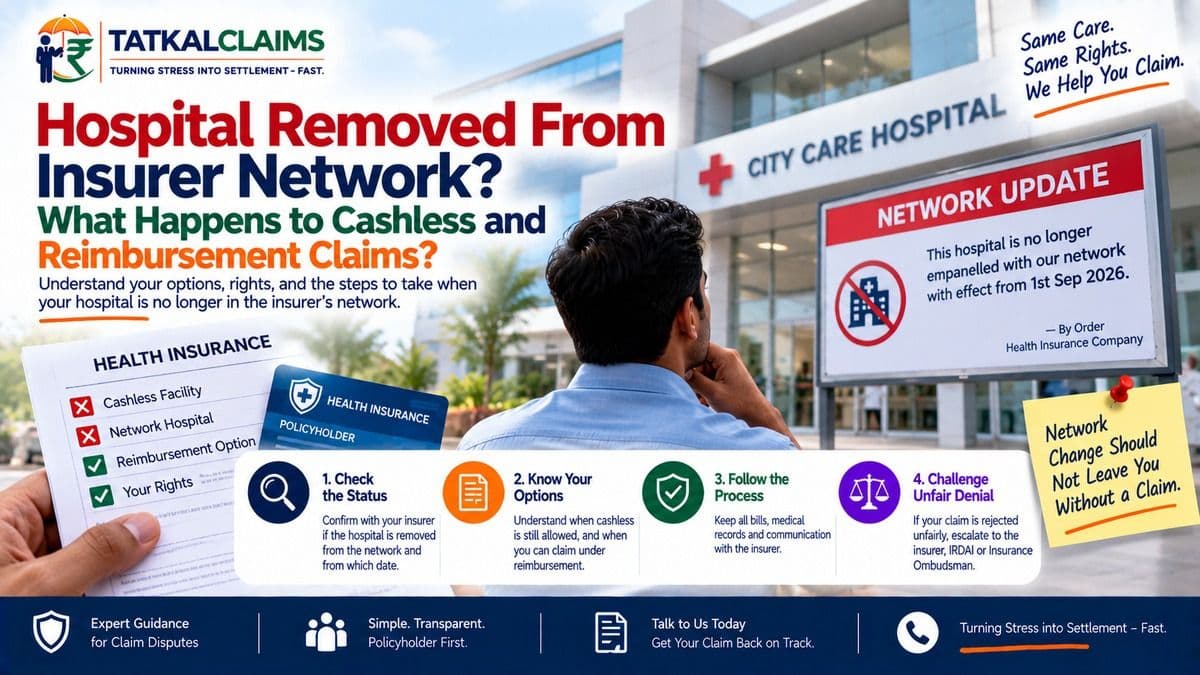
A hospital can disappear from your insurer's network at the worst possible time: after you planned treatment, after pre-authorisation was requested, or even while you are already admitted. When that happens, policyholders are often told only one thing — 'the hospital is no longer cashless' — without being told whether reimbursement remains available, whether Cashless Everywhere can still be attempted, or whether the hospital has actually been placed on an excluded or blacklisted list.
Those are not the same issue. A hospital that is simply outside the ordinary network may still be eligible for reimbursement and, depending on the insurer's operating process, may be considered for Cashless Everywhere. A hospital that has been expressly excluded for fraud, licensing, billing or other reasons may face a much broader restriction, including reimbursement denial under the insurer's stated rules.
This guide is for private health-insurance disputes in India. It explains what to check if the hospital was in-network when treatment was planned, was removed before admission, was removed after cashless pre-authorisation, or was delisted during treatment.
What the Current IRDAI Framework Says
IRDAI's current health-insurance guidance describes cashless as a facility in which the insurer or TPA pays an empanelled hospital or healthcare provider directly, to the extent cashless approval is given. It also tells policyholders to check the insurer's current list of eligible hospitals and healthcare providers for cashless treatment.
IRDAI's current guidance separately states that insurers' websites should explain reimbursement procedures and make clear that treatment at hospitals or healthcare providers not listed for cashless will generally require a reimbursement claim. Current turnaround times are one hour for the cashless pre-authorisation decision, three hours for final discharge authorisation, and 15 days for claims other than cashless.
For the current turnaround-time rules and escalation if the insurer delays authorisation or reimbursement, see our IRDAI health-claim timeline guide.
The Five Network-Removal Scenarios You Need to Separate
| Scenario | Immediate cashless position | What to check next |
|---|---|---|
| Hospital removed before planned admission | Ordinary network cashless may no longer be available | Updated network list, Cashless Everywhere, reimbursement, excluded-provider list |
| Hospital removed after admission but before final bill | Cashless continuity becomes a live dispute | Admission date, delisting effective date, pre-authorisation, insurer/hospital communication |
| Pre-authorisation already approved before removal | Do not assume approval simply disappears | Written authorisation, terms of approval, reason for any withdrawal, delisting timing |
| Hospital becomes non-network but is not excluded | Ordinary network cashless may stop | Cashless Everywhere and reimbursement may remain possible |
| Hospital is on an excluded/blacklisted list | Cashless may be blocked and reimbursement may also be restricted | Exact exclusion effective date, emergency exception, policy wording, insurer's published rules |
1. Hospital Removed Before Admission
If you have not yet been admitted and the hospital has already disappeared from the insurer's ordinary network list, do not rely on an old hospital directory, insurance card or screenshot from months earlier. Check the insurer's current online network list on the date of admission and save a screenshot or PDF showing the result.
Then ask whether the insurer offers Cashless Everywhere or a similar non-network cashless process. Current insurer operating pages show that non-network cashless is often conditional: advance intimation for planned treatment, prompt intimation for emergencies, hospital consent, hospital licensing/eligibility and claim admissibility may all be required.
If non-network cashless cannot be arranged, reimbursement may still remain available subject to the policy. IRDAI's current consumer guidance and current insurer claims pages distinguish ordinary non-network treatment from excluded providers, and many insurers expressly allow reimbursement for treatment at non-network hospitals that are otherwise eligible.
If the insurer refuses cashless but does not reject the underlying claim, move immediately to the documentation steps in our cashless denial and reimbursement guide.
2. Hospital Removed After Admission or During Treatment
This is a stronger dispute because the patient may have chosen the hospital, been admitted and started treatment while the hospital was still shown as an eligible network provider. The first task is to establish the timeline: when the hospital was admitted to the network, when removal became effective, when you were admitted, when pre-authorisation was requested, and when any approval was issued.
Ask the insurer to state in writing whether the hospital was removed prospectively or was placed on an excluded-provider list with retrospective effect. Also ask whether the insurer is withdrawing cashless only because of network status or because it alleges a separate claim-admissibility problem such as fraud, exclusion, waiting period, non-disclosure or medical necessity.
If the hospital was networked when you were admitted and there was no warning that cashless would stop, preserve the network-list screenshot, hospital admission papers and all insurer/TPA communications. These facts can be central to a grievance even where the current regulations do not contain the same explicit continuation clause that appeared in the repealed 2016 Health Insurance Regulations.
3. Pre-Authorisation Was Already Approved Before Delisting
A cashless pre-authorisation is not an unconditional guarantee that the final claim will be paid in full. Final settlement can still change if the discharge records reveal a policy exclusion, material discrepancy, non-payable charges or another valid coverage issue.
But if an insurer approved a specific treatment at a specific hospital and later withdraws that approval solely because the hospital was removed from the network, demand a precise written explanation. Ask for the date of delisting, the clause or operating rule relied upon, whether the hospital was merely removed from the network or formally excluded, and how the insurer proposes to deal with treatment already authorised.
Keep every authorisation letter, enhancement approval and email. The standard cashless authorisation framework is designed to tell both the hospital and policyholder the extent of approval and its conditions. If the insurer later changes its position, those documents create the audit trail.
The Old 2016 'Continue Cashless After Delisting' Rule — Important, but No Longer Current
The IRDAI Health Insurance Regulations, 2016 contained a very specific provision: if a policyholder had already received pre-authorisation for a procedure, or was already undergoing treatment, and the hospital was proposed to be removed from the network before final settlement, the insurer had to provide cashless benefits as if the hospital remained in the network.
However, the IRDAI (Insurance Products) Regulations, 2024 repealed the 2016 Health Insurance Regulations from 1 April 2024. The 2024 regulations preserve existing insurance contracts and allow IRDAI to carry forward necessary requirements through circulars, but the old clause should not be quoted as if it remains unchanged current regulation for a 2026 claim.
For a current dispute, use the old provision only as historical regulatory context unless your policy, service agreement, applicable circular or specific facts independently support the same result. The safer current argument is evidence-based: establish the hospital's status on the admission and authorisation dates, identify what the insurer promised, and demand the present contractual or regulatory basis for withdrawing cashless.
4. Can Cashless Everywhere Help After a Hospital Leaves the Network?
The General Insurance Council launched Cashless Everywhere in January 2024 to expand cashless access beyond an insurer's ordinary network. Current insurer pages continue to operate non-network cashless processes, but they are not automatic. The hospital usually has to agree to cashless arrangements, the request must meet the insurer's notice and documentation requirements, and the claim must be admissible under the policy.
Current insurer rules differ on notice. Some insurers require 48 hours' advance notice for planned admissions and notice within 24 or 48 hours after an emergency admission; others use different operating windows. Use the insurer's current process for your policy rather than assuming the original GI Council timing applies identically everywhere.
Cashless Everywhere also does not override an insurer's excluded-hospital list. Current HDFC ERGO guidance says non-network cashless will not be processed when the hospital is on its excluded list, and Narayana Health Insurance similarly excludes blacklisted, IIB-flagged or inadequately licensed hospitals from its Cashless Everywhere process.
| Hospital status | Cashless possibility | Reimbursement possibility |
|---|---|---|
| Ordinary network provider | Standard cashless subject to policy and approval | Usually available if cashless fails, subject to policy |
| Non-network but otherwise eligible | May be possible through Cashless Everywhere / insurer-specific process | Often available subject to policy and documentation |
| Hospital refuses non-network cashless arrangement | Cashless may fail operationally | Reimbursement may remain available if provider is otherwise eligible |
| Excluded / blacklisted provider | Often blocked | May also be blocked or restricted; check insurer's published list and policy |
| Emergency at excluded provider | Insurer-specific exception may apply for stabilization only | Do not assume full reimbursement; check exact wording |
5. Removed From Network vs Excluded/Blacklisted Hospital
This distinction can decide the case. Insurers remove hospitals from ordinary cashless networks for many reasons, including commercial disagreements, package-rate disputes, service issues or the hospital choosing to exit the arrangement. That does not necessarily mean the hospital is accused of fraud or is barred from reimbursement.
An excluded or blacklisted provider is different. Current insurer pages show that some insurers deny both cashless and reimbursement at specifically excluded providers, sometimes with a limited exception for emergency stabilization. Before paying a large bill, check whether the hospital appears on the insurer's excluded-provider list and save the list with the date.
If the insurer labels the hospital 'blacklisted' only after your treatment, ask when the exclusion took effect and whether the list was publicly available when you were admitted. Do not assume a later website update automatically proves that the hospital was excluded on the treatment date.
When Cashless Stops, Reimbursement May Still Be the Correct Route
IRDAI's current health-insurance guidance distinguishes cashless from claims other than cashless and lists a 15-day turnaround time for non-cashless claim settlement. Current insurer claims pages commonly state that treatment at an ordinary non-network hospital can be submitted for reimbursement, subject to policy terms and documentation.
That does not mean reimbursement will equal the full hospital bill. The insurer can still apply the policy's room-rent limits, co-payment, deductible, sub-limits, exclusions, non-payable expenses, reasonable-and-customary restrictions and other valid terms. The correct question is whether the claim remains admissible — not whether the hospital remained cashless.
If you are forced to pay because the network tie-up broke during treatment, ask the insurer to confirm in writing that you can submit the same hospitalisation as reimbursement and whether any special form, original document or deadline applies.
What the 2026 Kerala High Court MEDISEP Case Does — and Does Not — Prove
In Anilkumar B S v. State Medical Officer, decided on 8 July 2026, the Kerala High Court dealt with a MEDISEP reimbursement claim where the patient said the empanelled facilities lacked the staff or equipment required for his acute leukaemia treatment. The claim had been rejected solely because treatment was taken at a non-empanelled hospital.
The Court relied on the Supreme Court's reasoning in Shiv Kant Jha and directed verification of the treatment and payment of the admissible MEDISEP amount if the claim was established. The case is useful when a scheme rejects genuine covered treatment solely on empanelment grounds despite evidence that suitable empanelled treatment was unavailable.
But MEDISEP is a government scheme, not an ordinary private retail policy. The judgment should not be presented as a universal rule that every private insurer must pay every non-network hospital claim regardless of its policy terms or excluded-provider rules.
For the facts, limits and proper use of that precedent, see our Kerala High Court non-empanelled-hospital case analysis.
What to Check Before You Accept a Network-Based Denial
| Question | Evidence to collect | Why it matters |
|---|---|---|
| Was the hospital in-network on the admission date? | Dated insurer network-list screenshot, hospital confirmation | Fixes status when treatment began |
| When did delisting take effect? | Insurer email, website notice, hospital communication | Separates prospective removal from later dispute |
| Was pre-authorisation issued? | Initial approval and enhancement letters | Shows what was authorised before removal |
| Was the hospital merely non-network or formally excluded? | Current and archived excluded-provider list | Determines whether reimbursement may also be affected |
| Was treatment already underway? | Admission record, doctor orders, OT/ICU timeline | Shows reliance and practical inability to shift |
| Can Cashless Everywhere apply? | Insurer's current operating page and hospital consent | Tests alternative cashless route |
| If cashless fails, is reimbursement allowed? | Policy wording, CIS, claims procedure | Identifies the correct payment route |
| Did the insurer raise a separate coverage issue? | Written rejection/query and cited clause | Distinguishes network problem from claim-admissibility problem |
What to Ask the Insurer in Writing
| Ask the insurer | Purpose |
|---|---|
| What was the hospital's network status on my admission date? | Fixes the relevant status |
| On what date and time did removal/exclusion become effective? | Tests retroactive treatment |
| Was the hospital removed from ordinary network or placed on the excluded-provider list? | Separates two very different consequences |
| If pre-authorisation had already been issued, why is it being withdrawn? | Forces insurer to identify the new basis |
| Can Cashless Everywhere be arranged at this hospital? | Tests non-network cashless route |
| If cashless cannot continue, may I file reimbursement? | Secures next-step clarity |
| If reimbursement is barred, which policy clause or published exclusion applies? | Prevents vague 'non-network' rejection |
| Please provide the full claim calculation and written decision | Creates an appeal-ready record |
If the insurer relies on an internal investigation, medical opinion or undisclosed evidence to justify the change, use our guide to requesting the claim file and evidence used against you.
Evidence to Preserve Immediately
| Document | Why it matters |
|---|---|
| Policy schedule, CIS and wording | Establishes claim and reimbursement terms |
| Dated screenshot of network-hospital search | Shows hospital status when checked |
| Pre-authorisation and enhancement approvals | Shows insurer's earlier cashless decision |
| Hospital admission form and admission timestamp | Fixes when treatment began |
| Hospital email/letter about delisting | May reveal whether removal was insurer- or hospital-driven |
| Excluded/blacklisted provider list for relevant month | Tests whether broader restriction applied |
| Cashless denial/withdrawal letter | Identifies stated reason |
| Final itemised bill, receipts and discharge summary | Required if reimbursement becomes necessary |
| Emergency/referral evidence | Supports why transfer was unsafe or impractical |
| Insurer/TPA call logs, emails and grievance replies | Creates chronology and notice record |
Should You Shift Hospitals After Delisting?
Do not transfer a patient solely to preserve cashless status without medical advice. If treatment is already underway, ask the treating doctor whether transfer is clinically safe and document the answer. The financial consequence of network removal should not override urgent medical judgment.
If a planned admission has not yet happened, you have more flexibility. Compare an alternative network hospital, Cashless Everywhere at the chosen hospital, and reimbursement. The best financial route may differ from the best clinical route, so obtain written medical advice where specialist capability matters.
How to Escalate a Network-Removal Cashless Dispute
Start with a written grievance to the insurer. Attach the timeline, network-status evidence, pre-authorisation, excluded-list evidence and your specific request: continue cashless, arrange Cashless Everywhere, confirm reimbursement, or reverse an exclusion-based denial.
IRDAI's current health guidance lists 14 days for action on a complaint. If the insurer's response remains unsatisfactory, Bima Bharosa can be used to register and track the grievance. An eligible policy-interpretation, repudiation or partial-settlement dispute may also be taken to the Insurance Ombudsman after the insurer-first requirement is met.
Compare the escalation options in our Bima Bharosa vs Insurance Ombudsman guide.
For the current filing sequence and eligibility rules, use our Insurance Ombudsman complaint guide.
7-Day Action Plan After a Hospital Is Removed From the Network
| Day | Action | Output |
|---|---|---|
| 1 | Save the current network and excluded-provider lists; collect policy/CIS | Status snapshot |
| 2 | Collect admission papers, pre-authorisation and all enhancements | Cashless chronology |
| 3 | Ask insurer for effective delisting/exclusion date and written reason | Network-removal record |
| 4 | Ask whether Cashless Everywhere or reimbursement is available | Alternative payment route |
| 5 | Collect complete reimbursement file in case cashless fails | Ready claim bundle |
| 6 | File focused grievance with timeline and requested remedy | Formal reconsideration |
| 7 | Prepare Bima Bharosa/Ombudsman file if unresolved | Escalation-ready case |
Can Tatkal Claims Help With a Hospital-Network Dispute?
Tatkal Claims assists policyholders with rejected, delayed and short-settled health claims. In a hospital-network dispute, the review can include network status on the admission date, delisting or exclusion timing, pre-authorisation, Cashless Everywhere eligibility, reimbursement terms, emergency circumstances, claim calculations and the insurer's written reason for stopping cashless.
No outcome can be guaranteed. A hospital being removed from the network does not automatically make the entire claim payable, and an excluded/blacklisted provider can raise a much more serious issue than ordinary network removal. The result depends on the policy, provider status, timing and evidence.
Frequently asked questions
What happens if my hospital is removed from the insurer's network before admission?
Ordinary network cashless may no longer be available. Check the current network list, Cashless Everywhere process, reimbursement rules and whether the hospital is merely non-network or formally excluded.
What if I was already admitted when the hospital was delisted?
Build a dated timeline of admission, delisting and cashless approvals. Ask the insurer whether it will continue cashless, arrange another cashless route or require reimbursement, and demand the current contractual or regulatory basis for its position.
Can the insurer cancel a cashless pre-authorisation after approving it?
Pre-authorisation is not an unconditional final claim guarantee. It can change for genuine coverage or factual reasons. If the only new reason is hospital delisting after approval, ask for the effective delisting date and written basis for withdrawal.
Does Cashless Everywhere mean every hospital must provide cashless treatment?
No. It is subject to insurer operating rules, claim admissibility, notice requirements and hospital acceptance. Excluded or blacklisted providers may be outside the facility.
If a hospital is non-network, can I still claim reimbursement?
Often yes, subject to policy terms and provider eligibility. But reimbursement may be barred or restricted at specifically excluded providers, so check the insurer's current excluded-hospital list.
Is a delisted hospital the same as a blacklisted hospital?
No. A hospital may leave or be removed from an ordinary network for commercial or service reasons without being on an excluded/blacklisted list. The consequences for reimbursement can be very different.
Does the old IRDAI rule requiring cashless continuity after delisting still apply in 2026?
The 2016 Health Insurance Regulations contained that explicit rule, but those regulations were repealed by the 2024 Insurance Products Regulations. Do not quote the old clause as unchanged current law for a 2026 claim without checking the current policy and applicable circulars.
What if the hospital is excluded after my treatment date?
Ask for the effective date and preserve the provider lists that applied when you were admitted. A later website update does not by itself establish that the provider was excluded on the treatment date.
Should I shift hospitals if cashless is withdrawn mid-treatment?
Do not transfer solely for financial reasons without medical advice. Ask the treating doctor whether transfer is safe and document that advice while you pursue cashless or reimbursement options.
Where can I complain if the insurer refuses cashless or reimbursement after network removal?
Raise a written grievance with the insurer first. If unresolved or unsatisfactory, consider Bima Bharosa and, where eligible, the Insurance Ombudsman.
Official, Industry and Legal Sources
Disclaimer: This article provides general information about hospital-network changes, cashless treatment and reimbursement under health insurance in India. Network lists, excluded-provider lists, Cashless Everywhere procedures and policy wording can change. Always preserve dated evidence and check the insurer's current list and policy documents applicable to the date of admission. The repealed 2016 Health Insurance Regulations are discussed only as historical context and should not be treated as unchanged current law.


