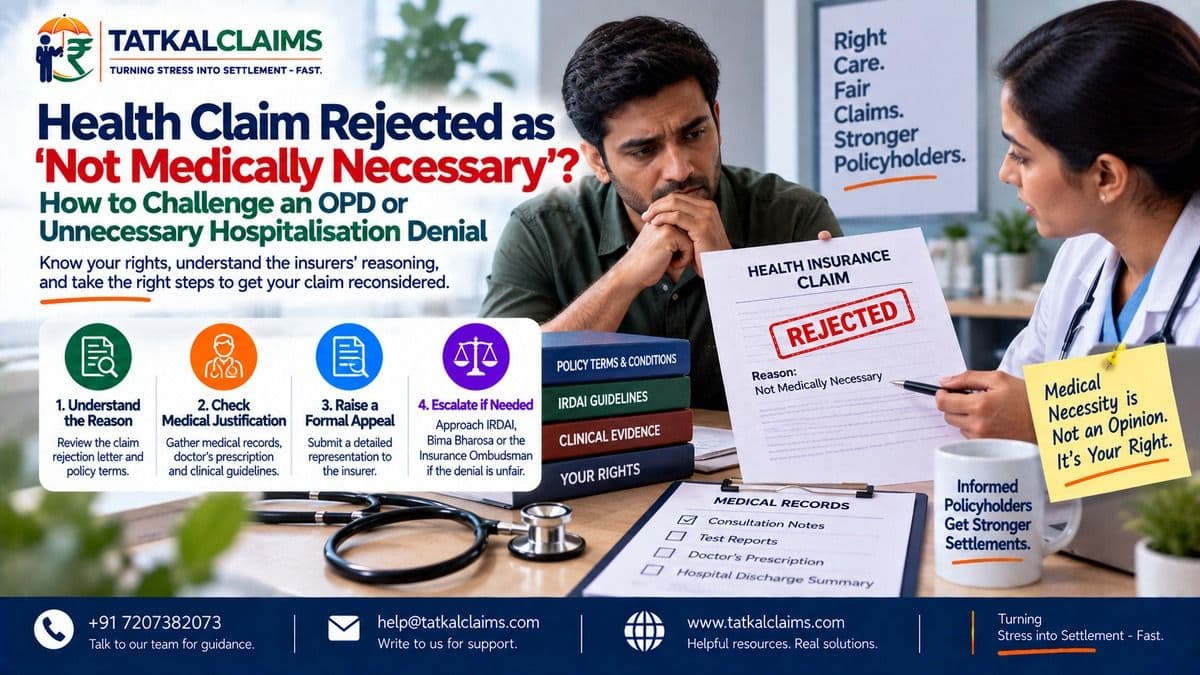
A health insurer can accept that you were genuinely ill and still reject the claim by saying the admission itself was not medically necessary. The rejection letter may say that the condition could have been managed on an OPD basis, that the patient was admitted mainly for investigation or observation, that vital signs were stable, or that there was no active line of inpatient treatment.
These disputes are difficult because the issue is not simply whether a diagnosis existed. The real question is whether the level, duration and intensity of hospital care were justified by the patient's condition at the time, and whether the medical record proves that need.
A one-line doctor's certificate saying 'hospitalisation was necessary' is often too weak. At the same time, an insurer's one-line statement that 'OPD treatment was sufficient' should not end the analysis. The strongest appeal reconstructs the clinical timeline from contemporaneous records and then tests the insurer's medical reasoning against the policy wording and the evidence it actually reviewed.
What Does 'Medically Necessary' Actually Mean in Health Insurance?
Current health-insurance policy wordings commonly define medically necessary treatment using four linked tests: the treatment or hospital stay must be required for management of the illness or injury; the level of care must not exceed what is safe, adequate and appropriate in scope, duration or intensity; it must be prescribed by a medical practitioner; and it must conform to professionally accepted medical standards.
That means the insurer can examine more than whether a doctor signed an admission note. It can ask whether inpatient care was clinically required, whether the same care could reasonably have been delivered without admission, whether the length of stay was justified, and whether the treatment matched accepted practice.
But the definition also means the decision should be medical and evidence-based. A rejection that merely repeats 'not medically necessary' without identifying the disputed clinical facts, the policy clause, the records considered or the medical reasoning is incomplete from an appeal perspective.
Separate the Diagnosis From the Need for Hospitalisation
| Question | What it asks | Evidence that answers it |
|---|---|---|
| Was the illness or injury genuine? | Did the patient actually have a covered medical condition? | Clinical notes, diagnosis, labs, imaging, prescriptions |
| Was inpatient admission necessary? | Did the patient's condition require hospital-level care rather than OPD management? | Presenting severity, failed OPD care, IV treatment, monitoring, risk factors, doctor reasoning |
| Was the full duration necessary? | Was the entire length of stay justified? | Progress notes, daily vitals, treatment escalation, discharge criteria |
| Was the treatment itself necessary? | Were tests, medicines or procedures appropriate for the condition? | Orders, specialist notes, guidelines, results and treatment response |
1. 'Could Have Been Managed on OPD Basis' — What the Insurer Is Really Saying
When an insurer says the case could have been managed on OPD basis, it is usually challenging the intensity of care rather than denying that the patient had symptoms. Your response should therefore explain what could not safely or effectively be done as an outpatient.
Relevant facts can include persistent vomiting or inability to tolerate oral medication, dehydration requiring repeated IV fluids, respiratory distress or oxygen need, uncontrolled pain, unstable or concerning vitals, repeated seizures, altered consciousness, bleeding risk, rapidly falling platelets, significant inflammatory markers, serious comorbidities, extremes of age, failed outpatient treatment, or the need for frequent clinical monitoring.
Not every one of these factors must be present, and the absence of one red flag does not automatically make admission unnecessary. The point is to identify the actual clinical risk and the inpatient intervention or monitoring used to manage it.
Failed OPD Treatment Can Be Powerful Evidence — If It Is Documented
If the patient had already been treated as an outpatient before admission, preserve the prescriptions, consultation notes, test results and dates. A clear sequence showing that symptoms persisted or worsened despite appropriate outpatient care can directly answer the insurer's claim that OPD treatment was sufficient.
If there was no prior OPD visit because the condition arose suddenly or was severe at presentation, say so and document the emergency features. Do not invent a failed-OPD history merely because it would strengthen the claim.
2. Admission Primarily for Investigation or Evaluation
This is a separate exclusion used in current health-policy wordings. For example, current ReAssure wording excludes expenses related to admission primarily for diagnostics and evaluation only, and also excludes diagnostic expenses unrelated or incidental to the current diagnosis and treatment.
The word 'primarily' matters. Hospitalised patients can legitimately undergo extensive tests while also receiving active treatment, monitoring or risk management. The appeal should show whether the investigations were part of an ongoing inpatient treatment plan or whether the admission was effectively a diagnostic work-up that could have been performed without inpatient care.
| Record pattern | How it may be viewed | What to clarify |
|---|---|---|
| Tests performed but no treatment beyond routine oral medicines | May support investigation-only / OPD argument | Why admission or monitoring was required despite limited treatment |
| IV fluids, IV medicines, oxygen, frequent monitoring or specialist intervention | Supports active inpatient management | Link each intervention to the presenting risk |
| Tests led to treatment changes during admission | Supports diagnostic work being incidental to treatment | Show result → clinical decision → treatment change |
| Patient remained stable and records do not explain why discharge was unsafe | Can weaken necessity argument | Obtain contemporaneous rationale if available; avoid retrospective exaggeration |
| Observation after a serious symptom/event with defined risk | May still be clinically justified | Explain the risk being watched for and monitoring performed |
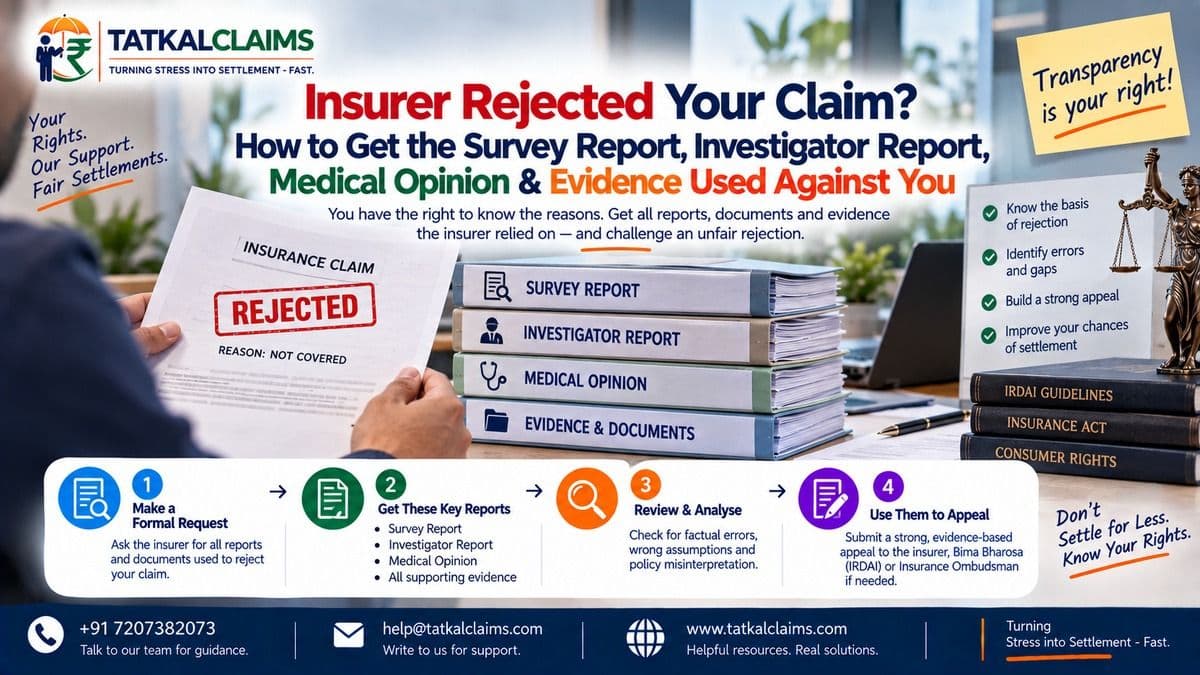
If the insurer relied on an internal medical opinion, investigation report or other material that you have not seen, use our claim-file and insurer-evidence request guide.
3. Short Stay, 24-Hour Hospitalisation and Day-Care Treatment
A short stay is not automatically an OPD claim. Current policy definitions distinguish inpatient care, day-care treatment and OPD treatment. Many policies define hospitalisation around a minimum 24-hour inpatient stay while separately covering qualifying day-care procedures that take less than 24 hours because of medical or technological advancement.
A claimant should therefore ask two questions: was the service meant to be inpatient care, and if not, does it qualify under the policy's day-care benefit? A treatment can be medically necessary but still fall outside an inpatient benefit if the policy classifies it as OPD or does not include that type of short-stay treatment.
Do not challenge a rejection simply by saying 'I was inside the hospital for many hours.' The policy category and the clinical purpose of the stay matter.
4. Fever and Infectious-Disease Admissions After the 2026 GI Council Advisory
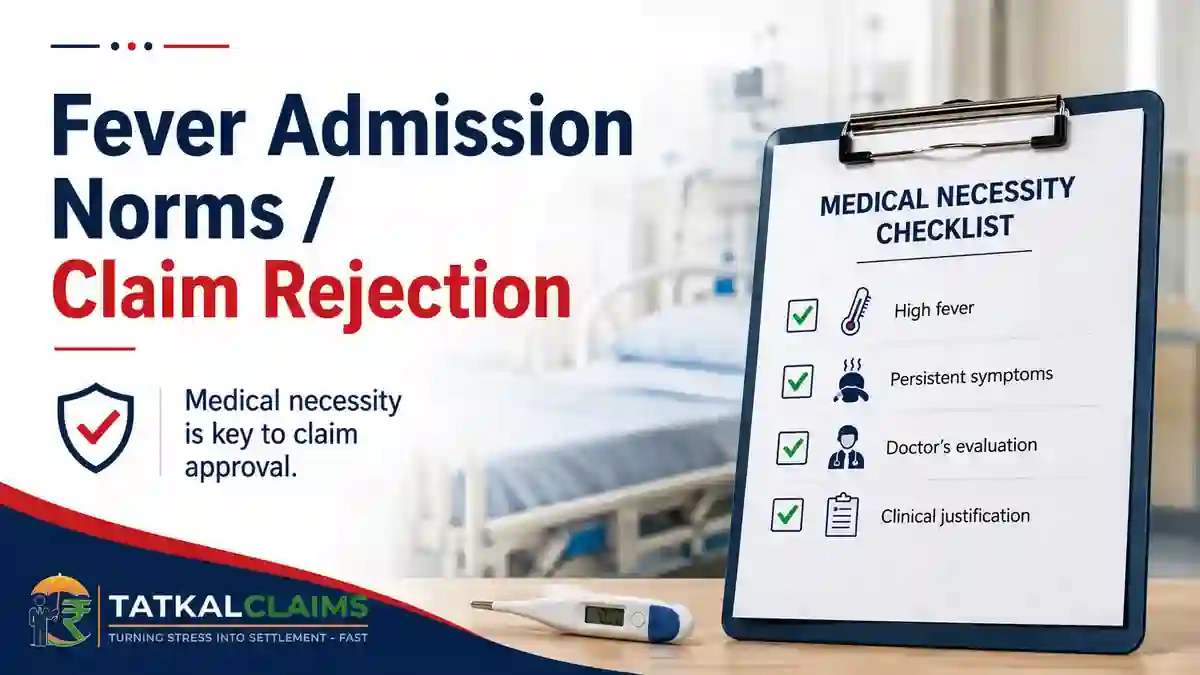
The General Insurance Council's 2026 advisory on fever and infectious-disease admissions triggered concern because it recommended outpatient management for uncomplicated cases and identified warning signs that can support hospital admission.
The Council later clarified that the advisory is not binding and does not override doctors' clinical judgment. It described the framework as evidence-based guidance drawing on ICMR and Ministry of Health material rather than an automatic claim-rejection rule.
For a fever-related denial, do not argue only that 'the advisory is non-binding.' Show the patient-specific facts: duration and severity of fever, hydration status, respiratory findings, mental status, bleeding or gastrointestinal symptoms, comorbidities, age, lab trends, inability to tolerate oral treatment, previous treatment, and why inpatient monitoring was chosen.
For the specific fever-admission debate and what the GI Council advisory does—and does not—mean, see our fever admission and insurance claims analysis.
The Medical Records That Matter Most
| Evidence | What it can prove | Common weakness |
|---|---|---|
| Emergency / first assessment note | Severity at presentation and immediate risks | Symptoms recorded vaguely or copied later |
| OPD records before admission | Failed outpatient management or worsening course | Missing dates or no treatment chronology |
| Admission note | Why hospital care was chosen | Generic 'admit for observation' without reason |
| Vitals chart | Instability, trend or need for monitoring | Only isolated normal readings cited |
| Nursing chart | Frequency of monitoring, fluids, symptoms, response | Often omitted from claim bundle |
| Medication / treatment chart | Active inpatient treatment actually given | Discharge summary may list drugs without timing/intensity |
| Lab and imaging trends | Objective severity or evolving condition | Single normal report considered in isolation |
| Progress notes | Daily reassessment and reason stay continued | Sparse notes make length-of-stay difficult to defend |
| Discharge summary | Diagnosis, treatment and condition at discharge | Retrospective summary may be less detailed than contemporaneous charts |
| Treating-doctor clarification | Explains clinical reasoning and rebuts insurer points | Weak if it is generic and unsupported by records |
Treating Doctor vs Insurer Medical Reviewer: Neither Opinion Should Be Examined in Isolation
Some recent consumer decisions have criticised insurers for rejecting hospitalisation without producing contrary expert medical evidence, especially where the treating records showed active treatment and the insurer's conclusion was unsupported.
But recent decisions also show the opposite outcome. Where records showed stable vitals, normal or non-concerning investigations, no convincing primary diagnosis or prior treatment history, and documentation concerns, a commission has upheld repudiation under a medically-unnecessary-hospitalisation exclusion.
The practical lesson is not that the treating doctor always wins or that the insurer's reviewer always wins. The stronger side is usually the one whose conclusion is better supported by the contemporaneous medical record and the policy wording.
| Case | Outcome | Why it matters for a claim appeal |
|---|---|---|
| Ms. Shivani Tomer v Oriental Insurance, Delhi District Commission, 4 June 2026 | Policyholder succeeded | Active treatment and medical records were unrebutted; insurer did not produce contrary medical evidence |
| Ilayaraja M v Care Health, Salem District Commission, 27 April 2026 | Policyholder succeeded in part | Treating-doctor justification and contemporaneous abnormal findings supported inpatient care; selective insurer interpretation was rejected |
| Gurvinder Singh v Care Health, Amritsar District Commission, 24 February 2026 | Policyholder succeeded | Severe dehydration/vomiting/fever and doctor-advised admission were not rebutted by independent expert evidence |
| Star Health v Priya Devi, Delhi State Commission, 29 May 2026 | Insurer succeeded on appeal | Commission relied on stable/normal findings, lack of convincing diagnosis/OPD history and documentation concerns to find admission unwarranted |
These are consumer-forum decisions on their own records and policy clauses. They should be used as examples of how evidence can change the result, not as blanket rules guaranteeing payment or rejection.
What to Ask About the Insurer's Medical Review
| Ask the insurer | Why it matters |
|---|---|
| Which exact policy clause was applied? | Separates medical-necessity exclusion from investigation-only or another exclusion |
| What medical records did the reviewer examine? | Tests whether the decision ignored nursing charts, progress notes or prior OPD treatment |
| What specific findings show that OPD care was sufficient? | Forces patient-specific reasoning |
| Which findings in the record were considered abnormal or normal? | Prevents selective reliance on one lab or vital sign |
| Was an internal or external medical opinion obtained? Please provide it. | Allows comparison with treating evidence |
| What is the reviewer's specialty and role? | Relevant where a specialised condition is being assessed |
| Was any clinical guideline, protocol or advisory used? | Lets you test whether it was binding, current and applicable to the individual patient |
| If only part of the stay was excessive, why was the entire claim rejected? | Tests whether a narrower duration-based adjustment was considered |
Where the insurer refuses to provide the medical basis and only repeats the rejection wording, preserve that correspondence. A focused appeal is easier when the disputed reasoning is visible.
What If Cashless Was Approved at Admission but Denied at Discharge?
Initial cashless approval is useful evidence, but it is not an unconditional final settlement. The insurer may receive additional records during the stay and change its assessment. If the reason changes to 'hospitalisation not medically necessary,' compare the records available at pre-authorisation with the records relied upon at discharge.
If this happened after an initial approval, use our cashless approved-at-admission but denied-at-discharge guide to reconstruct the approval and reversal timeline.
How to Get a Useful Treating-Doctor Clarification
Ask for a reasoned clarification, not a certificate written to 'help insurance.' The doctor should state the presenting symptoms and clinical findings, the working diagnosis, why outpatient care was inadequate or unsafe, treatment/monitoring requiring admission, relevant risks or comorbidities, and the clinical criteria used for discharge.
The clarification should be consistent with the original admission notes, charts and investigations. If it introduces new symptoms or risks that were never documented during treatment, the insurer may treat it as a retrospective reconstruction.
Common Facts That Can Weaken a Medical-Necessity Appeal
| Weakness | Why insurer may rely on it | How to respond |
|---|---|---|
| All recorded vitals stable throughout | May support OPD argument | Explain other risks/interventions if genuinely present; do not overstate severity |
| No prior OPD record despite days of mild symptoms | May suggest immediate admission was unnecessary | Explain emergency onset or why prior OPD was not clinically required, if true |
| No IV/oxygen/monitoring or other inpatient-level intervention | May suggest limited treatment intensity | Identify any actual inpatient need; if none, assess appeal realistically |
| Admission note says 'for evaluation' only | Supports investigation exclusion | Show active treatment or risk monitoring if records support it |
| Normal tests with no evolving diagnosis | May weaken inpatient rationale | Explain the clinical concern that existed before results were known |
| Long stay after clinical stability | Insurer may dispute only duration | Separate necessity of initial admission from later length-of-stay issue |
| Doctor certificate conflicts with original chart | Creates credibility problem | Use a clarification that explains rather than rewrites the record |
| Identical / stereotyped entries or document irregularities | Can trigger fraud or fabricated-record concern | Obtain originals, timestamps and hospital verification |
How to Build the Appeal
Start with the rejection letter and identify whether the actual ground is medical necessity, OPD-manageability, investigation-only admission, lack of active treatment, excessive duration, document inconsistency, or a combination. Do not answer a different issue.
Then build a one-page clinical chronology: first symptoms, first consultation, treatment before admission, condition at admission, abnormal findings, inpatient interventions, progress, and discharge. Attach the supporting record next to each point.
For the broader insurer-grievance sequence, use our complete insurance claim rejection appeal guide.
If cashless was refused and you paid the hospital yourself, preserve the full file and follow our cashless denial to reimbursement guide while the medical-necessity challenge proceeds.
Escalation After the Insurer Maintains the Denial
File a written grievance with the insurer and request a reasoned response to the medical evidence. IRDAI's current health guidance lists 14 days for action on a complaint. If the grievance remains unresolved or unsatisfactory, Bima Bharosa can be used to register and track the complaint.
Where eligible, an Insurance Ombudsman complaint can address repudiation, partial settlement and policy-interpretation disputes after the insurer-first requirement is met. High-value or fact-heavy cases may also require consideration of consumer-court or other legal remedies.
For the current health-claim and grievance timelines, see our IRDAI health-claim timeline guide.
Compare escalation routes in our Bima Bharosa vs Insurance Ombudsman guide.
For Ombudsman eligibility, documents and filing steps, use our Insurance Ombudsman complaint guide.
7-Day Action Plan After a 'Not Medically Necessary' Rejection
| Day | Action | Output |
|---|---|---|
| 1 | Collect rejection letter, policy wording, CIS and complete hospital file | Exact dispute and governing clause |
| 2 | Collect pre-admission OPD/emergency records and build symptom timeline | Pre-hospital clinical chronology |
| 3 | Obtain vitals, nursing charts, treatment sheets, labs and progress notes | Contemporaneous inpatient evidence |
| 4 | Request insurer's medical opinion, reviewer basis and records considered | Insurer evidence file |
| 5 | Obtain treating-doctor clarification tied to the original records | Reasoned medical rebuttal |
| 6 | File insurer grievance with indexed evidence and specific questions | Formal reconsideration request |
| 7 | Prepare Bima Bharosa/Ombudsman or legal bundle if unresolved | Escalation-ready case |
Can Tatkal Claims Help With a Medical-Necessity Rejection?
Tatkal Claims assists policyholders with rejected and short-settled health claims. In a medical-necessity dispute, the review can include the policy definition, exclusion relied upon, admission and emergency notes, failed OPD treatment, vitals and lab trends, nursing and medication charts, treating-doctor reasoning, insurer/TPA medical opinion, cashless history and the grievance record.
No outcome can be guaranteed. Some medically-necessary-hospitalisation disputes are strong because the insurer's conclusion is unsupported; others are weak because the contemporaneous record genuinely does not show a need for inpatient care. The evidence should be assessed before escalating.
Frequently asked questions
Can a health insurer reject a claim by saying hospitalisation was not medically necessary?
Yes, if the policy makes medically necessary treatment a condition or excludes unwarranted hospitalisation. But the decision should be tested against the exact clause and the patient's medical records rather than accepted as a bare conclusion.
Does a treating doctor's admission advice automatically make the claim payable?
No. It is important evidence, but the policy may still require that the level and duration of care were medically necessary and consistent with accepted practice. The contemporaneous record matters.
What evidence best proves that OPD treatment was not enough?
Evidence can include failed outpatient treatment, emergency findings, inability to tolerate oral treatment, IV therapy, oxygen, repeated monitoring, significant lab trends, serious comorbidities and a reasoned treating-doctor explanation supported by the charts.
Can normal vital signs alone prove that hospitalisation was unnecessary?
Not automatically. Normal readings can be relevant, but necessity depends on the full clinical picture, including symptoms, trends, risks, investigations, treatment and the reason for monitoring. In some cases, consistently normal records with little active treatment can weaken the claim.
What does 'admission primarily for investigation and evaluation' mean?
It refers to an admission whose main purpose is diagnostic or evaluative rather than treatment. Current policy wordings can exclude such admissions. Tests performed during genuine active inpatient treatment are a different factual situation.
Is a stay under 24 hours automatically not covered?
No. Some qualifying treatments are covered as day-care procedures even when the stay is under 24 hours. Whether a short stay is covered depends on the policy's inpatient, day-care and OPD definitions.
Can insurers use the 2026 GI Council fever advisory to automatically reject fever admissions?
The General Insurance Council clarified that its advisory is not binding and does not override clinical judgment. A claim still needs to be assessed against the policy and the patient's individual medical evidence.
Should I ask for the insurer's medical opinion?
Yes. Ask which records were reviewed, the medical reasoning, any guideline relied upon and the internal or external medical opinion if one was obtained. This helps you answer the actual basis of the denial.
What if cashless was first approved and later rejected at discharge?
Initial approval is useful evidence but is not a final guarantee. Compare what was known at pre-authorisation with the later records and ask the insurer to explain exactly why its medical-necessity assessment changed.
Where can I complain if the insurer maintains a medical-necessity rejection?
Raise a written grievance with the insurer first. If unresolved or unsatisfactory, consider Bima Bharosa and, where eligible, the Insurance Ombudsman. Other legal remedies may also be available depending on the case.
Official, Policy and Legal Sources
Disclaimer: This article provides general information about health-insurance medical-necessity disputes in India. Whether hospitalisation or treatment was medically necessary depends on the policy wording and the patient's individual clinical evidence. Consumer-forum decisions discussed here are fact-specific and should not be treated as automatic rules for other claims. Medical decisions should be taken with qualified treating professionals; insurance appeal strategy should not alter or manufacture clinical records.