A Veteran Pilot's Final Flight: The Baramati Crash That Shook India
On January 28, 2026, a private aircraft crashed near Baramati, Maharashtra, killing all five people on board. Among the victims was Maharashtra Deputy Chief Minister Ajit Pawar. But this story is not about politics. It is about the man at the controls: Captain Sumit Kamal Kapur, a veteran commercial pilot with over 22,000 flying hours and an Airline Transport Pilot Licence held since 1985.
Captain Kapur was not just a pilot. He was a husband, a father, and the primary breadwinner for his family. His wife, Anju Kapur, and their two children, Captain Shiv Kapur and Dr. Sanya Kapur Wadhwa, were left to pick up the pieces of a life shattered in an instant.
What they did not expect was that their battle for justice would extend far beyond the crash site. It would take them to the Delhi High Court, fighting an insurance company that refused to honour a policy their husband and father had faithfully maintained through the Federation of Indian Pilots.
The Insurance Policy: Rs 85.6 Lakh in Coverage
Captain Kapur was covered under a Loss of Licence and Personal Accident Group Insurance Policy obtained through the Federation of Indian Pilots (FIP). Under this policy, a total amount of Rs 85.6 lakh was payable upon his death, comprising an Rs 80 lakh sum insured and cumulative bonus benefits.
The family submitted the claim. They provided the death certificate, the crash report, and all required documentation. Then they waited. And waited. Finally, on June 25, 2026, New India Assurance Company Ltd. issued a rejection letter.
The insurer's reason for denial? Section 64VB of the Insurance Act, 1938.
What Is Section 64VB and Why Did the Insurer Invoke It?
Section 64VB of the Insurance Act, 1938, is one of the most commonly cited provisions in insurance claim disputes. It states that no insurer shall assume any risk in India unless and until the premium payable is received in advance. In plain language: no premium, no coverage.
The provision is designed to protect insurers from assuming liability before receiving consideration. But it is also one of the most misused provisions in Indian insurance law. Insurers frequently invoke Section 64VB to deny claims where premium payments were delayed, disputed, or processed through intermediaries.
In Captain Kapur's case, New India Assurance argued that the premium for the policy period had not been received in advance as required by Section 64VB. Therefore, the insurer claimed, no valid coverage was in force at the time of the crash on January 28, 2026.
The Family's Counter: The Insurer Extended the Renewal Window
The family's response to the Section 64VB defence is both legally sophisticated and factually compelling.
According to the petition filed before the Delhi High Court, New India Assurance had itself extended the timeline for policy renewals and fresh enrolments until January 31, 2026. This extension was communicated to members of the Federation of Indian Pilots. The fatal accident occurred on January 28, 2026, squarely within this extended renewal period.
The petition argues that once the insurer voluntarily kept the premium payment and renewal window open until January 31, the insurance coverage continued during that period. The insurer cannot subsequently invoke the premium-payment provision to deny liability for a death that occurred within the very window it had extended.
This argument draws on a well-established legal principle: waiver and estoppel. When an insurer voluntarily extends a deadline, accepts a premium, or otherwise indicates that coverage continues, it cannot later turn around and claim the coverage was never valid. The Calcutta High Court, in ECGC Ltd. v. Mittal Technopack, held that an insurer which waives the requirement of immediate premium payment cannot later reject a claim on Section 64VB grounds.
The Legal Battle: Delhi High Court Issues Notice
On July 21, 2026, Justice Jasmeet Singh of the Delhi High Court issued notice on the petition filed by Anju Kapur and her children. The Court directed that the respondents, including New India Assurance Company Ltd. and IRDAI, be served through all permissible modes, including electronic and dasti service. The matter has been listed for further hearing on August 19, 2026.
The petition seeks multiple reliefs:
- A writ directing New India Assurance to release the insurance amount of Rs 85,60,000 under the Loss of Licence Insurance Policy
- Interest on the delayed payment from the date the claim became due
- Quashing of the insurer's rejection letter dated June 25, 2026
- A direction to IRDAI to conduct an inquiry into the alleged wrongful denial of the claim
The matter was argued by Advocates Saurav Agarwal, Ritika Jhurani, and Dinesh Sharma, while Dr. Sanya Kapur Wadhwa also appeared as petitioner-in-person.
Why This Case Matters: Section 64VB and the Waiver Doctrine
This case is significant not just for the Kapur family, but for every policyholder in India who has faced a Section 64VB denial. The legal question at its heart is this: can an insurer extend a coverage window, accept or promise to accept a premium, and then deny a claim by citing non-receipt of premium?
The answer, according to established jurisprudence, is no.
Section 64VB(1) states that no insurer shall assume any risk unless the premium is received in advance. But sub-section (5) empowers the Central Government to relax this requirement for particular categories of policies. More importantly, courts have consistently held that insurers can waive the strict requirements of Section 64VB through their conduct.
In the Calcutta High Court's 2024 ruling in ECGC Ltd. v. Mittal Technopack, the Court held that an insurer which accepts delayed premium payments and continues to treat the policy as valid cannot later reject a claim on Section 64VB grounds. The Court cited the principle of waiver under Section 63 of the Indian Contract Act, 1872, which allows a promisee to waive performance of a promise.
The Court stated: the appellants having waived the requirement of Section 64VB under the Insurance Policy resulting in a contract and also having accepted the deferred payment of Insurance Premium, cannot be permitted to approbate and reprobate, to reject the claim on the ground of Section 64VB.
This principle applies directly to Captain Kapur's case. If New India Assurance extended the renewal window to January 31, 2026, it effectively waived the strict premium-in-advance requirement for that period. The crash on January 28 fell within the waived period. The insurer cannot now claim the premium was not received in advance.
The Baramati Crash: Context and Scale
The Baramati crash was one of the most significant aviation accidents in India in recent years. The aircraft involved was a Learjet 45, a mid-size business jet owned by Delhi-based VSR Aviation. It reportedly overshot the runway while attempting to land at Baramati airport and caught fire.
The crash killed all five occupants: Maharashtra Deputy Chief Minister Ajit Pawar, Captain Sumit Kamal Kapur, and three others. The aircraft was insured for around Rs 50 crore under an aviation policy issued by ICICI Lombard, with reinsurance backing from GIC Re and Munich Re. The total payout for hull damage and passenger liability was estimated at around Rs 55 crore.
While the aviation hull insurance was promptly acknowledged by ICICI Lombard, the personal accident claim under Captain Kapur's Loss of Licence policy has become mired in dispute. This highlights a troubling pattern: large corporate aviation claims are processed swiftly, while individual policyholders' families are left to fight for years.
What Is Loss of Licence Insurance?
Loss of Licence insurance is a specialised product designed for commercial pilots. It provides financial cover if a pilot's licence is revoked due to medical reasons, or in the case of death, pays a lump sum to the nominated beneficiaries.
For pilots, this coverage is critical. Their entire career depends on maintaining medical fitness. A single health event can end a career worth crores in lifetime earnings. Loss of Licence insurance is meant to be the safety net that catches them when they fall.
Captain Kapur's policy, obtained through the Federation of Indian Pilots, was a group policy covering multiple pilots. Group policies are common in aviation because they allow pilots to obtain coverage at negotiated rates through their professional association. But they also create complexity: the insurer deals with the association, not the individual pilot, and disputes over premium collection, renewal dates, and coverage periods are frequent.
What to Do If Your Insurer Invokes Section 64VB
If your insurer has rejected your claim citing Section 64VB, here is your action plan.
First, examine the timeline carefully. When was the premium due? When was it paid? When did the loss occur? If the insurer extended the payment deadline, accepted a late payment, or otherwise indicated that coverage continued, Section 64VB may not apply.
Second, gather all correspondence with the insurer and any intermediaries. Emails, letters, SMS messages, and WhatsApp chats can all constitute evidence of waiver. If the insurer's agent told you coverage was in force, that statement matters.
Third, check whether the policy is one of the categories exempted from Section 64VB. The Central Government has granted exemptions to certain types of policies, including marine insurance, aviation insurance, and policies issued to government entities.
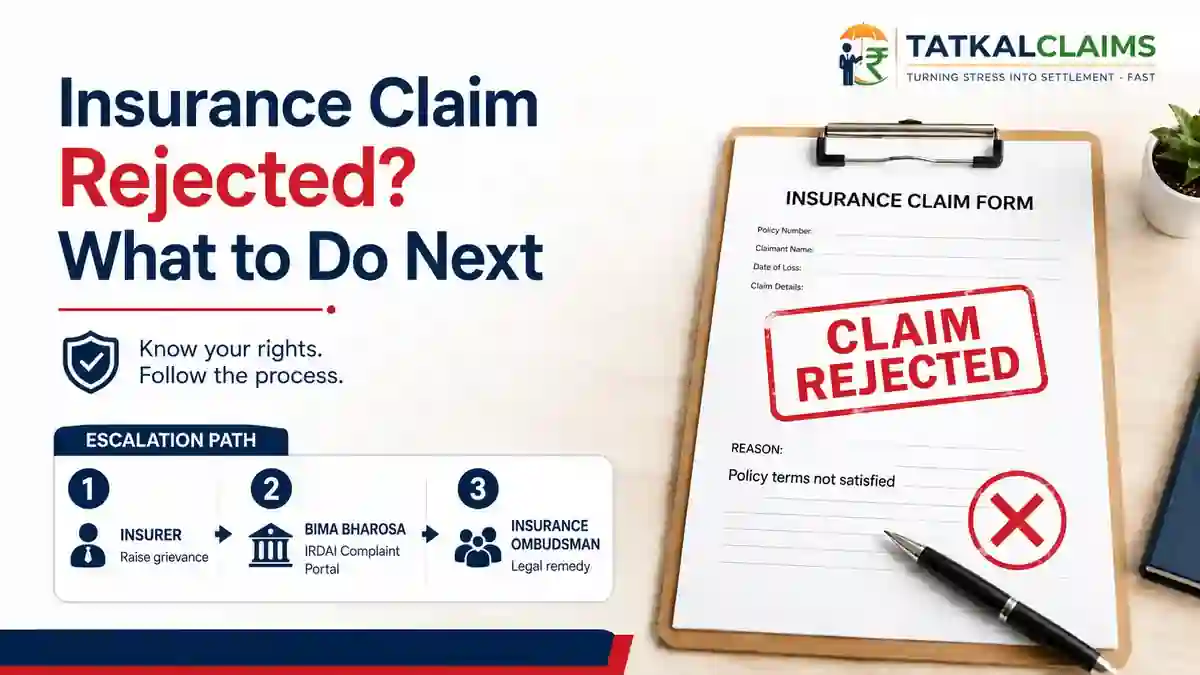
Fourth, file a complaint with the insurer's Grievance Redressal Officer. Include your timeline, evidence of waiver, and demand a review. The GRO must respond within 30 days.
Fifth, if the GRO upholds the rejection, escalate to the Insurance Ombudsman. The Ombudsman can review Section 64VB disputes and has the power to pass binding awards up to Rs 50 lakh.
Sixth, for large claims or clear cases of bad faith, approach the High Court under Article 226 of the Constitution, as the Kapur family has done. Writ jurisdiction allows courts to quash arbitrary executive actions, including wrongful claim denials by public sector insurers.
Seventh, demand an IRDAI inquiry. The Kapur family's petition specifically seeks a direction to IRDAI to investigate the wrongful denial. IRDAI has the power to examine insurer conduct, impose penalties, and direct claim settlement.
The Bottom Line
A veteran pilot with 22,000 flying hours died in the line of duty. He had maintained his insurance coverage through his professional association for years. His family submitted a claim for Rs 85.6 lakh. The insurer rejected it, citing Section 64VB of the Insurance Act.
The family fought back. They approached the Delhi High Court, arguing that the insurer itself had extended the renewal window to January 31, 2026, making the January 28 crash fall within the coverage period. They cited established legal principles of waiver and estoppel. They demanded not just the claim amount, but interest, quashing of the rejection, and an IRDAI inquiry.
Justice Jasmeet Singh issued notice. The matter is now listed for August 19, 2026.
If you are facing a Section 64VB denial, a claim rejection based on premium non-payment, or an insurer that extended a deadline and then changed its mind, this case is your precedent. The law is clear: insurers cannot approbate and reprobate. They cannot extend coverage and then deny it. They cannot waive a requirement and then invoke it.
At Tatkal Claims, we help families challenge unfair insurance claim rejections, including Section 64VB denials, policy cancellation tactics, and bad faith delay strategies. If your claim has been rejected, delayed, or underpaid, contact us.
---
Facing a rejected insurance claim based on Section 64VB or premium non-payment? Contact our legal team at Tatkal Claims for expert assistance in challenging unfair denials and securing the settlement your family deserves.