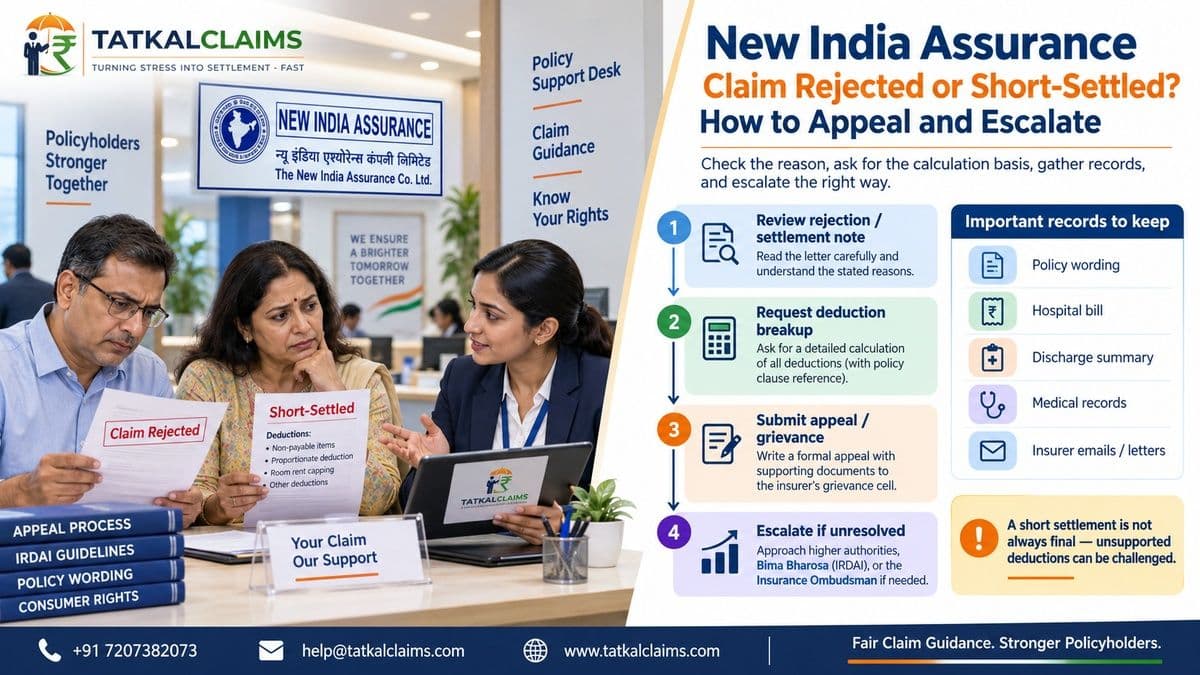
A New India Assurance claim rejection, delay or short settlement should be challenged according to the policy type and the exact reason given. New India Assurance writes multiple classes of general insurance, so a health reimbursement dispute, a motor own-damage claim and a fire or property loss do not require the same evidence even though they ultimately use the same insurer grievance system.
First: Identify What Happened to Your New India Assurance Claim
| Claim problem | What it usually means | Best first move |
|---|---|---|
| Cashless health request denied | Cashless authorisation was refused; the underlying reimbursement claim may still need separate assessment | Get the denial reason and preserve the complete hospital file |
| Reimbursement or indemnity claim rejected | The insurer or claims administrator has issued a final adverse decision | Challenge the exact clause, factual finding or document deficiency |
| Claim partly paid | The claim was admitted but deductions, depreciation, limits or assessment reduced the payout | Ask for the calculation, surveyor/TPA basis and clause for every deduction |
| Claim pending | No final approval, repudiation or settlement has been communicated | Build a dated chronology and escalate delay separately |
If you need the general framework before dealing with New India’s insurer-specific route, use our complete insurance claim rejection guide.
Step 1: Get the Rejection, Deduction or Delay Position in Writing
Before appealing, record the policy number, claim number, date of loss or hospitalisation, amount claimed, amount approved, date of the insurer’s decision, and the exact rejection or deduction reason. If a surveyor, TPA, branch office or claims hub has communicated only a verbal reason, ask for the written basis and the policy clause or assessment relied upon.
Do not send the full claim file again without an index. Create a short chronology and attach only the records that answer each disputed point. The strongest appeal connects each insurer allegation or deduction to a specific document, medical clarification, repair record, survey record, invoice, stock statement or policy clause.
Step 2: Follow New India Assurance’s Own Grievance Ladder
New India Assurance’s current grievance page says a policyholder should first contact the policy-issuing office. If dissatisfied, the grievance can be escalated to the Customer Care Officer at the relevant Regional Office. If the Regional Office does not resolve it, the matter can then be escalated to Head Office.
The insurer currently lists Mr. K K Sunil Kumar, Deputy General Manager, as its Grievance Redressal Officer at Head Office, with the email address gro@newindia.co.in. Because officer details can change, always verify the current grievance page before sending a high-level escalation.
New India Assurance also allows an online grievance to be initiated through its customer portal. Its contact page instructs customers to log in and use the My Grievance section. Carry the same complaint reference forward through each level rather than creating unrelated complaints with different versions of the facts.
Health Claims: Do Not Let the TPA and Insurer Pass Responsibility Back and Forth
New India Assurance uses Third Party Administrators for many health-insurance servicing functions. Its own intermediary information says the TPA may process the claim and upload payment details, but final payment is made by The New India Assurance Co. If a TPA says the insurer must decide, or the insurer says the TPA is processing the file, preserve both communications and escalate the unresolved issue through New India’s grievance system.
If the problem is only a cashless denial, first distinguish it from final rejection of the reimbursement claim. Our cashless-to-reimbursement guide explains the difference and the documents to preserve.
For health rejection based on pre-existing disease, non-disclosure, waiting period, medical necessity or incomplete documents, answer the exact medical and contractual point. If a hospital record is ambiguous, obtain a treating-doctor clarification that explains the diagnosis and clinical timeline instead of relying only on a general statement that the claim is genuine.
If a health claim was partly paid, reconstruct the settlement line by line. Separate co-pay, deductible, room-rent or proportionate deductions, sub-limits, non-payables and excluded expenses. Use our health-insurance short-settlement guide to audit the calculation.
Motor Claims: Challenge the Survey and Policy Basis, Not Just the Outcome
For a motor own-damage or theft dispute, first identify whether the rejection concerns policy coverage, delayed intimation, driving licence, vehicle use, repair before inspection, theft documentation, depreciation, salvage or the surveyor’s assessment. Ask for the survey or assessment basis where available and compare it with photographs, repair estimates, final invoices, RC, driving licence, FIR or non-traceable records as relevant.
For theft claims, the chronology of police reporting, insurer intimation and non-traceable documentation can be decisive. See our car-theft insurance claim process guide for the evidence sequence.
Property, Fire and Other General-Insurance Claims: Rebuild the Assessment
For fire, burglary, shop, property or business-loss disputes, the core question is often how the loss was assessed. Obtain the repudiation or settlement letter and identify whether the dispute concerns cause of loss, policy warranty, underinsurance, average clause, stock records, valuation, salvage, excluded property, delayed intimation or the surveyor’s quantification.
Reconstruct the claim from contemporaneous evidence: fire brigade or police records where applicable, photographs and video, purchase invoices, stock registers, GST or accounting records, repair or replacement quotations, survey correspondence and the applicable policy schedule. A grievance is stronger when it identifies the exact line in the assessment that is disputed rather than merely demanding a higher amount.
Step 3: Escalate an Unresolved New India Assurance Grievance to Bima Bharosa
New India Assurance’s grievance page links policyholders directly to IRDAI’s Bima Bharosa portal for unresolved grievances. Bima Bharosa is a regulatory grievance registration and monitoring system; it creates a trackable complaint record and should not be described as an automatic order requiring the insurer to pay the claim.
The Bima Bharosa portal currently states that a registered complaint will be attended to within 14 days. For a claim complaint, the portal asks for the relevant policy, proposal, certificate or claim identifier and permits supporting document uploads.
For the practical difference between IRDAI grievance tracking and an independent redressal forum, read Bima Bharosa vs Insurance Ombudsman.
Step 4: Check Whether the Insurance Ombudsman Can Hear Your Case
The Council for Insurance Ombudsmen currently says you should first complain to the insurer or insurance broker. If you are dissatisfied with the response, or there is no response within 30 days, an eligible complaint may be filed with the Ombudsman. Current CIO guidance states that the value of the claim including expenses should not exceed ₹50 lakh and that the complaint should be filed within one year from rejection, repudiation or partial settlement, subject to the applicable procedure.
The Ombudsman route is not available mechanically for every business policy or every dispute. CIO’s current procedure identifies eligible complainants including personal-lines policyholders, group policyholders, sole proprietorships and micro enterprises. It also says the same subject matter should not already have been taken to another forum, court or arbitrator.
If the Ombudsman route fits your case, use our step-by-step Insurance Ombudsman complaint guide for jurisdiction, filing method and document checks.
A Practical New India Assurance Appeal Structure
- Identify the policy, insured person or asset, claim number and exact decision you are challenging.
- Quote New India Assurance’s rejection reason, survey finding or disputed deduction exactly.
- Explain why the reason is factually, medically, technically or contractually incorrect.
- Attach a numbered evidence index that directly answers each disputed point.
- State the remedy you want: reconsideration, recalculation, reasoned review, release of pending payment or payment of the disputed admissible amount.
- Preserve every branch, Regional Office, Head Office, Bima Bharosa and Ombudsman reference for the next stage.
Your 7-Day Action Plan After a New India Assurance Claim Rejection
Day 1: collect the policy schedule, wording and rejection or settlement letter. Day 2: build a dated claim chronology. Day 3: identify the exact disputed clause, medical conclusion, survey finding or deduction. Day 4: obtain the missing medical, technical, repair, police, stock or valuation evidence. Day 5: prepare a point-by-point representation. Day 6: submit it to the policy-issuing office or appropriate New India grievance channel and save proof. Day 7: calendar the insurer follow-up, Bima Bharosa and Ombudsman deadlines that may apply.
When Tatkal Claims Can Help
If the rejection reason is unclear, the survey or deduction is difficult to reconstruct, the medical or technical evidence is disputed, or repeated branch and grievance attempts have not resolved the matter, Tatkal Claims can help review the documents, identify the disputed issue and structure the next escalation.
No appeal or claim-resolution service can guarantee payment. The outcome depends on the policy wording, facts, evidence, applicable regulations, limitation periods and the forum that ultimately reviews the dispute.
Frequently asked questions
Where should I first complain about a rejected New India Assurance claim?
New India Assurance’s current grievance page says grievances should first be taken to the policy-issuing office. If unresolved, the complaint can be escalated to the Regional Office Customer Care Officer and then to Head Office.
Can I register a New India Assurance grievance online?
Yes. New India Assurance’s contact page says customers can log in to its portal and initiate a grievance under the My Grievance section.
If the TPA rejects or delays my health claim, should I complain only to the TPA?
No. New India Assurance states that TPAs may process health claims, but final payment is made by the insurer. Keep the TPA record, but escalate an unresolved claim through New India Assurance’s grievance system as well.
Does a denied cashless health request automatically mean my reimbursement claim is rejected?
Not necessarily. Cashless is a settlement facility. Depending on the policy terms and facts, a reimbursement claim may still require separate assessment. Preserve the denial reason, hospital papers, bills and payment receipts.
Can a New India Assurance short-settlement dispute go to the Insurance Ombudsman?
Partial settlement is within the Ombudsman complaint framework, subject to the complainant and policy being eligible, the prior-insurer-complaint requirement, the ₹50 lakh monetary limit, the one-year filing window and the other current CIO conditions.
Should I go to Bima Bharosa and the Consumer Commission at the same time?
Do not choose multiple forums mechanically. Bima Bharosa is a regulatory grievance platform, while the Insurance Ombudsman and consumer fora have separate jurisdiction and procedural rules. Current CIO guidance also restricts Ombudsman complaints where the same subject matter has already been taken to another forum, court or arbitrator.
Sources
Disclaimer: This article is for general informational purposes and does not constitute legal, medical or financial advice. Insurance disputes depend on the exact policy wording, claim type, evidence, facts and applicable law.