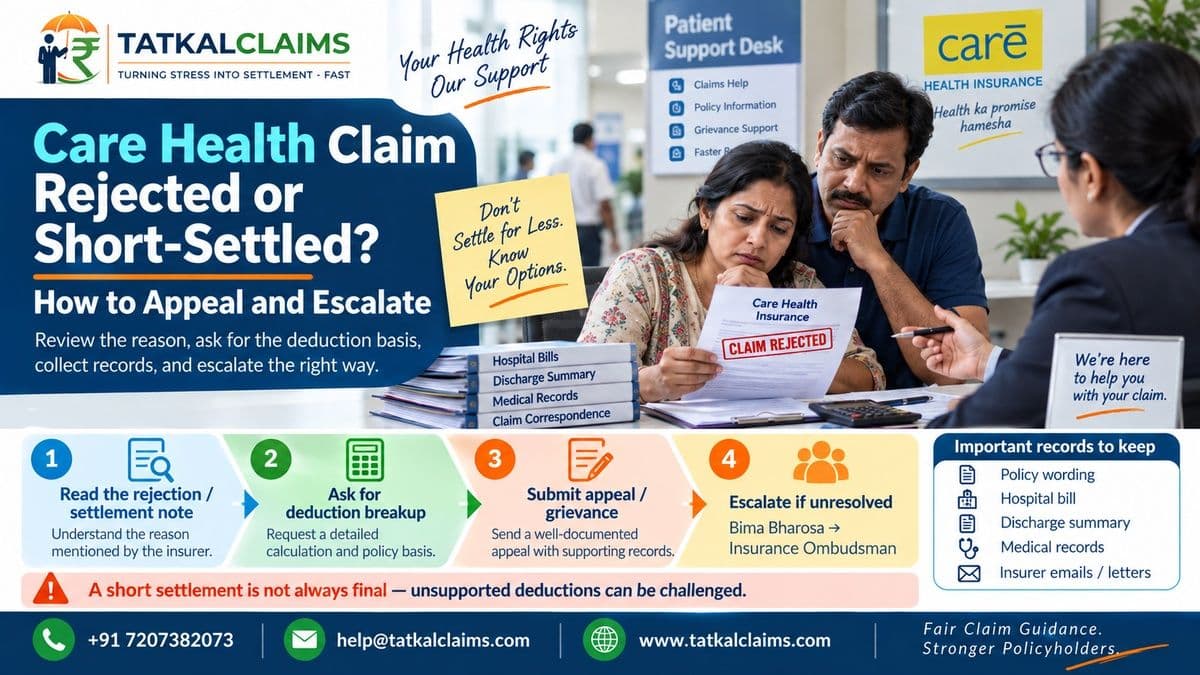
A Care Health Insurance claim rejection or short settlement should be challenged according to the exact problem. A denied cashless request, a rejected reimbursement claim, a reduced payout and a claim that is simply delayed are not the same dispute, and they should not be escalated with the same evidence.
First: Identify What Actually Happened to Your Care Health Claim
| Claim status | What it means | Best first move |
|---|---|---|
| Cashless request denied | Cashless authorisation was not granted; this does not automatically decide every reimbursement claim | Get the denial reason and preserve the hospital file |
| Reimbursement claim rejected | Care Health has issued a claim decision after reviewing the submitted file | Challenge the exact reason with documents and medical or contractual clarification |
| Claim partly paid | The claim was admitted but deductions, caps or exclusions reduced the payout | Demand the line-by-line settlement calculation and clause basis |
| Claim pending | No final settlement or rejection has been communicated | Track the claim against the current regulatory timeline and escalate the delay |
If only cashless authorisation was denied, first read our cashless-to-reimbursement guide so you do not treat a payment-facility denial as final repudiation of the entire claim.
Step 1: Get the Exact Rejection or Deduction Reason in Writing
Before escalating, record the policy number, claim number, decision date, amount claimed, amount approved, exact rejection or deduction reason, and every policy clause quoted by Care Health. If the decision is vague, ask for the factual and contractual basis. Your appeal should answer a defined reason, not simply say that the claim is genuine.
Create one indexed evidence file containing the policy schedule and wording, proposal disclosures, Customer Information Sheet if available, claim form, discharge summary, prescriptions, investigation reports, itemised bills, receipts, prior medical records where relevant, insurer queries, your replies, cashless correspondence and the final rejection or settlement letter.
Step 2: Use Care Health’s Current Grievance Ladder in Sequence
Care Health’s current grievance page publishes a defined escalation structure rather than a single generic complaint address. It lists customer care and grievance channels, Level 1 at resolve1@careinsurance.com, Level 2 at resolve2@careinsurance.com, and then the Grievance Redressal Officer at GRO@careinsurance.com. The page states an expected grievance resolution time of 14 days.
Do not restart the complaint from zero at each level. Carry forward the claim number, previous grievance or service-request number, the earlier response, your evidence index and the exact remedy you want. A short chronology makes the escalation easier to audit and reduces the chance that the dispute is treated as a fresh service request.
Care Health also publishes a senior-citizen route through its toll-free service number. If the insured person is a senior citizen, use that support path where appropriate while keeping the grievance record in writing.
Step 3: Understand Care Health’s Internal Insurance Ombudsman Stage
A Care-specific feature worth using correctly is the insurer’s published Internal Insurance Ombudsman stage. Care Health’s grievance page says that after using customer care, branch channels, Resolve 1 or Resolve 2 and the Grievance Redressal Officer, a dissatisfied policyholder may escalate internally to iio@careinsurance.com.
This internal stage should not be confused with the external Insurance Ombudsman administered through the Council for Insurance Ombudsmen. Treat the internal ombudsman as another insurer-level review. If the dispute remains unresolved, the external Ombudsman has a separate eligibility test, jurisdiction and filing procedure.
How to Challenge Common Care Health Rejection Reasons
1. Pre-existing disease or alleged non-disclosure
Compare the proposal form and disclosures against the condition, symptom, consultation or treatment Care Health says was not disclosed. Ask what medical record it relies on and when the alleged condition existed. Where the insurer is relying on a symptom history rather than a clear earlier diagnosis, a treating-doctor clarification on the clinical timeline may be important.
IRDAI’s current health guidance limits waiting periods, including pre-existing-disease waiting periods, to a maximum of 36 months. It also provides a 60-month continuous-coverage moratorium framework, subject to the applicable exceptions and rules for enhanced sum insured.
For a deeper document-by-document framework, see our health-insurance PED rejection guide.
2. Hospitalisation said to be medically unnecessary or manageable as OPD
This dispute is mainly medical, not rhetorical. Ask the treating doctor to state why inpatient care was clinically required, what monitoring, treatment or risk could not reasonably have been managed on an outpatient basis, and which contemporaneous records support that conclusion. Treatment charts, vitals, investigation reports and discharge notes are usually more useful than a generic certificate saying admission was necessary.
3. Waiting period or exclusion
Ask Care Health to identify the exact exclusion or waiting-period clause and the diagnosis or procedure said to fall within it. Then check the policy version, commencement date, renewals, portability or migration credits, and the diagnosis recorded by the hospital. An exclusion dispute cannot be assessed correctly without matching the medical facts to the exact wording in force for that policy.
4. Missing, inconsistent or incomplete documents
Match every insurer query to a numbered response. If dates, diagnoses, bills or treatment details conflict across records, obtain a correction or clarification from the hospital instead of leaving the inconsistency unexplained. Preserve proof of when each document was submitted.
5. Claim approved but short-settled
If Care Health approved the claim but paid less than expected, reconstruct the settlement line by line. Separate co-pay, deductible, room-rent or proportionate deductions, sub-limits, non-payables, package-rate adjustments and excluded expenses. Use our health-insurance short-settlement guide to audit the calculation before escalating.
6. Claim delayed without a final decision
A delay dispute should focus on dates. Record claim registration, every document request, every submission and the date the file became complete. Current IRDAI guidance lists 15 days for settlement of claims other than cashless. If the file keeps cycling through repeated queries, use our claim-delay guide to separate a genuine information request from avoidable processing delay.
Step 4: Escalate an Unresolved Care Health Grievance to Bima Bharosa
Care Health’s grievance page directs unresolved complaints to IRDAI’s Integrated Grievance Management System, Bima Bharosa. A complaint registered there flows into the insurer’s grievance system as well as the IRDAI repository, creating a regulatory trail that can be tracked by the policyholder.
Bima Bharosa should not be presented as an automatic payment order. Its role is grievance registration, monitoring and regulatory review. The portal currently states that a complaint will be attended to within 14 days.
For the practical difference between regulatory grievance tracking and independent redressal, see Bima Bharosa vs Insurance Ombudsman.
Step 5: Check Whether the External Insurance Ombudsman Fits Your Case
The Council for Insurance Ombudsmen says the policyholder or eligible claimant should first complain to the insurer or insurance broker. If the solution is unsatisfactory, or there is no response within 30 days, an eligible complaint can be taken to the Ombudsman. Current CIO guidance states that the value of the claim including expenses should not exceed ₹50 lakh and that the complaint should be filed within one year from rejection, repudiation or partial settlement, subject to the applicable procedure.
The same subject matter should not already have been taken to another forum, court or arbitrator. That makes forum selection important. Do not file in multiple places mechanically without checking how one proceeding can affect another.
If the Ombudsman route is appropriate, use our step-by-step Insurance Ombudsman complaint guide for filing method, documents, jurisdiction and deadline checks.
A Practical Care Health Appeal Structure
- Identify the policy, insured person, claim number and exact decision you are challenging.
- Quote Care Health’s rejection reason or disputed deduction exactly as written.
- Explain why that reason is factually, medically or contractually incorrect.
- Attach an indexed set of records that directly answer each disputed point.
- State the remedy you want: reconsideration, recalculation, a reasoned review or payment of the disputed admissible amount.
- Preserve every complaint number, email, acknowledgement and insurer response for later escalation.
Your 7-Day Action Plan After a Care Health Claim Rejection
Day 1: download the rejection or settlement letter and applicable policy wording. Day 2: build the medical and billing chronology. Day 3: identify the exact disputed clause or allegation. Day 4: collect missing records or a doctor’s clarification. Day 5: prepare the written appeal with numbered evidence. Day 6: submit it through the appropriate Care Health grievance level and save proof. Day 7: calendar the 14-day grievance action standard, the relevant claim-settlement timeline and any later Ombudsman deadline.
When Tatkal Claims Can Help
If the rejection reason is unclear, the medical evidence is complicated, the deduction calculation does not match the policy, or insurer-level grievances have not resolved the dispute, Tatkal Claims can help review the file, identify the disputed issue and structure the next escalation. For the broader framework across insurers, see our complete insurance claim rejection guide.
No appeal, grievance or claim-resolution service can guarantee payment. The outcome depends on the policy wording, medical and factual evidence, applicable regulations, limitation periods and the forum that ultimately reviews the dispute.
Frequently asked questions
How do I escalate a Care Health Insurance grievance?
Care Health’s current grievance page lists customer care and branch channels, Resolve 1, Resolve 2, the Grievance Redressal Officer and then an Internal Insurance Ombudsman stage before external escalation options.
How long should Care Health take to act on a grievance?
Care Health’s current grievance page states an expected resolution time of 14 days. Its service-parameter page and current IRDAI health guidance also list 14 days for action on a complaint and intimation of the decision.
Does a denied Care Health cashless request mean reimbursement is also rejected?
Not necessarily. Cashless is a payment mechanism. Depending on the policy terms and facts, reimbursement assessment may still be available, although reimbursement is not guaranteed merely because cashless was denied.
How long should a non-cashless health claim take under current rules?
Current IRDAI health guidance and Care Health’s service-parameter page list 15 days for settlement of claims other than cashless.
Can a Care Health short-settlement dispute go to the Insurance Ombudsman?
Partial repudiation or partial settlement is within the complaint categories listed by the Council for Insurance Ombudsmen, subject to the prior-insurer-complaint requirement, ₹50 lakh limit, one-year filing period and other eligibility rules.
Is Care Health’s Internal Insurance Ombudsman the same as the external Insurance Ombudsman?
No. Care Health’s published Internal Insurance Ombudsman is an insurer-level escalation stage. The external Insurance Ombudsman is a separate independent redressal mechanism administered through the Council for Insurance Ombudsmen and has its own eligibility and filing procedure.
Sources
Disclaimer: This article is for general informational purposes and does not constitute legal, medical or financial advice. Insurance disputes depend on the exact policy wording, medical records, facts and applicable law.