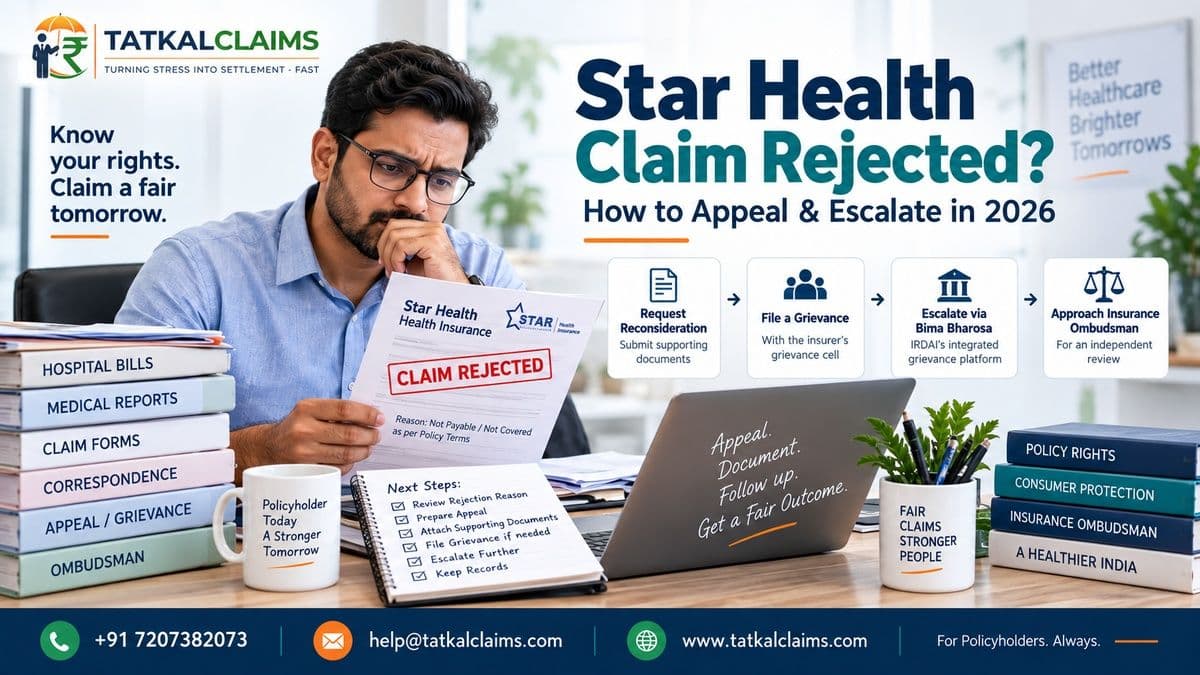
Star Health has rejected your claim: should you seek reconsideration or file a grievance? If missing documents or a medical clarification can answer the rejection reason, check the reconsideration route described in Star Health's official app guidance. For an unresolved dispute, raise a formal grievance and retain its reference number. If the rejection cites a pre-existing disease or non-disclosure, compare the proposal answers, pre-policy records, diagnosis and exact policy clause rather than relying on a general statement that you were healthy.
First: Identify What Kind of Claim Problem You Have
| What happened | What it usually means | Best first move |
|---|---|---|
| Cashless request denied | The hospital did not get cashless authorisation; this may not be the final decision on the underlying claim | Ask for the written reason and check whether reimbursement can still be filed |
| Reimbursement claim rejected | The insurer has repudiated the claim after reviewing the submitted file | Request reconsideration and challenge the stated reason with evidence |
| Claim partly approved | Some expenses were admitted and others were deducted or capped | Ask for the settlement calculation, deduction reasons and policy clauses |
| Claim still pending | No final acceptance, rejection or settlement has been communicated | Track the claim, preserve acknowledgements and escalate delay separately |
If only cashless authorisation was denied, do not automatically treat that as final repudiation. See our cashless-to-reimbursement guide before escalating the dispute.
Step 1: Read the Rejection or Settlement Letter Line by Line
Do not start by arguing that the rejection is unfair. Start by identifying exactly what Star Health says is wrong. Note the rejection reason, the clause number if one is quoted, the medical facts being relied on, the amount claimed, the amount admitted, and the date of the decision.
Create one claim file containing the policy schedule and wording, Customer Information Sheet if available, proposal form or disclosures, claim form, hospital records, discharge summary, bills, receipts, prescriptions, diagnostic reports, cashless correspondence, insurer queries, your responses, rejection or settlement letter, and every grievance acknowledgement.
Step 2: Use Star Health’s Claim Reconsideration Route
Star Health’s current claim-rejection FAQ says that if a claim has been rejected and you have missing documents or clarifications, you may raise a claim reconsideration request through the Star Health App. A reconsideration request is most useful when you can answer the rejection reason with new or clearer evidence rather than simply repeating the original claim.
For example, if the insurer says hospitalisation was not medically necessary, obtain a treating-doctor note explaining why inpatient treatment was clinically required. If the issue is alleged non-disclosure, compare the proposal form, pre-policy records and the specific medical history the insurer says was withheld. If documents were missing, submit them in an indexed, clearly labelled bundle.
Step 3: File a Formal Star Health Grievance
If reconsideration does not resolve the issue, create a formal grievance trail. Star Health’s current grievance page says concerns can be submitted through its grievance form or by writing from the registered email ID to support@starhealth.in, quoting the policy or claim number and describing the concern. It also lists customer-care and senior-citizen helplines and allows policyholders to approach designated grievance officers at branch or zonal offices.
Star Health says grievances are recorded and assigned a unique reference number immediately upon receipt. Keep that reference number, the acknowledgement, the documents submitted and every subsequent response together in your claim file. Because insurer contact structures can change, use Star Health’s live grievance page to confirm the current channel before escalating.
What to include in the grievance
- Policy number, claim number and the insured person’s name.
- A one-page chronology: admission, claim filing, queries, replies and final decision.
- The exact rejection or deduction ground you dispute.
- The policy wording or medical evidence that supports your position.
- A precise remedy: reconsider the repudiation, recalculate the deduction, provide the basis for the decision, or pay the admissible balance.
How to Challenge Common Star Health Rejection Reasons
1. Pre-existing disease or non-disclosure
A useful example is the Ghaziabad consumer-commission dispute in which Star Health relied on a history of leg weakness to allege that Myasthenia Gravis was pre-existing. The treating doctor recorded that the patient had been healthy until only a few months before diagnosis, and the commission found the insurer had not produced earlier records proving that the specific disease existed before the policy or had been knowingly concealed. It directed payment of ₹61,582 with interest. Read the Star Health PED case analysis for the full reasoning. The lesson is narrow but important: the medical history relied on by the insurer must actually support the specific PED or non-disclosure allegation; a different claim can turn on different records and wording.
IRDAI’s current health guidance also limits waiting periods, including pre-existing disease waiting periods, to a maximum of 36 months and lists a 60-month continuous-coverage moratorium framework. Whether either rule helps in a particular dispute depends on the policy history, facts, exclusions and any allegation of fraud.
2. “Hospitalisation was not medically necessary”
This dispute usually turns on medical evidence, not emotion. Ask the treating doctor to explain why inpatient monitoring, IV treatment, oxygen, procedures or other hospital-level care was clinically required and why outpatient care would not have been appropriate in the circumstances. Attach vitals, investigation reports, treatment charts and the discharge summary that support that explanation.
3. Waiting period or exclusion
Ask Star Health to identify the exact clause and the diagnosis or procedure it says falls within that clause. Then compare the policy version applicable to your policy period, the date coverage started, continuity credits if any, and the medical diagnosis recorded in the hospital file. A generic statement that a waiting period applies is not enough for you to evaluate the decision.
4. Missing or inconsistent documents
List every discrepancy and fix it directly. If dates differ between the discharge summary and bills, get the hospital to correct or explain them. If a prior consultation is missing, obtain it. If the insurer says a diagnosis appears in one record but not another, ask the treating doctor for a written clarification. Reconsideration is stronger when every insurer query has a corresponding document or explanation.
5. Claim approved but short-settled
A short settlement should be audited line by line. Separate genuine policy deductions from unexplained reductions. Reconcile room-rent or proportionate deductions, co-pay, deductible, non-payables, sub-limits, package-rate adjustments and any amount marked outside coverage. Our health-insurance short-settlement guide explains how to reconstruct the settlement calculation before you challenge it.
Step 4: Escalate Through Bima Bharosa if the Insurer Grievance Remains Unresolved
Bima Bharosa is IRDAI’s grievance registration and monitoring platform. It is useful for creating a formal regulatory grievance trail and tracking the insurer’s response. The portal currently states that a registered complaint will be attended to within 14 days.
Bima Bharosa is not the same as an independent order directing the insurer to pay your disputed claim. For the distinction between regulatory grievance tracking and the Ombudsman route, see Bima Bharosa vs Insurance Ombudsman.
Step 5: Check Whether the Insurance Ombudsman Is the Right Next Forum
The Council for Insurance Ombudsmen currently says you must first complain to the insurer or insurance broker. If you are dissatisfied with the response, or there is no response within 30 days, an eligible complaint can be filed with the Ombudsman. Current CIO guidance states that the claim value including expenses should not exceed ₹50 lakh and that the complaint should be filed within one year from the relevant rejection, repudiation or partial-settlement decision, subject to the procedural rules.
The same subject matter should not already be pending before or disposed of by a court, consumer forum or arbitrator. This is why forum selection matters: do not file everywhere at once without understanding the consequences.
If the Ombudsman route fits your case, use our step-by-step Insurance Ombudsman complaint guide for the filing process, evidence bundle, ₹50 lakh limit and one-year deadline.
A Simple Appeal Structure You Can Use
- Identify the policy, insured person, claim number and decision being challenged.
- Quote the exact rejection or deduction reason from Star Health’s letter.
- State why you believe that reason is factually or contractually incorrect.
- Attach the medical records, policy clauses and correspondence supporting your position.
- Ask for a specific outcome: reconsideration, a reasoned review, recalculation, or payment of the disputed admissible amount.
- Request a written response and preserve the complaint reference number.
Your 7-Day Action Plan After a Star Health Claim Rejection
Day 1: download the rejection or settlement letter and policy documents. Day 2: build the medical and billing chronology. Day 3: identify the exact disputed clause or medical allegation. Day 4: obtain missing records or a treating-doctor clarification. Day 5: prepare the reconsideration or grievance with numbered annexures. Day 6: submit it through the current Star Health channel and save proof. Day 7: create a calendar for the 14-day complaint service standard and, if needed later, the separate Ombudsman eligibility timeline.
What Tatkal Claims Would Check First in a Star Health Dispute
We would begin with the rejection or settlement letter, proposal disclosures and the medical timeline. For a PED or non-disclosure dispute, we would compare what Star Health says existed earlier with the actual pre-policy records and treating-doctor evidence. For a short settlement, we would rebuild the calculation deduction by deduction. For a cashless denial, we would first establish whether reimbursement remains open before treating the matter as final repudiation. For the broader insurer-neutral framework, also see our complete insurance claim rejection guide.
No claim-resolution service can guarantee that a disputed claim will be paid. The outcome depends on the policy wording, medical and factual evidence, applicable regulations, limitation periods and the forum that reviews the dispute.
Frequently asked questions
Can Star Health reconsider a rejected claim?
Yes. Star Health’s current FAQ says a policyholder with missing documents or clarifications may raise a claim reconsideration request through the Star Health App. Reconsideration does not guarantee approval.
Does a rejected cashless request mean the entire claim is rejected?
Not necessarily. Cashless is a payment mechanism. Depending on the policy and claim facts, a reimbursement claim may still be available even after cashless authorisation is denied.
Do I need to wait 30 days before approaching the Ombudsman if Star Health has already rejected my grievance?
Current CIO guidance says you may approach the Ombudsman if you are dissatisfied with the insurer’s response; the 30-day threshold applies where there is no response. Check the current procedure and your facts before filing.
Should I file with the Ombudsman and Consumer Commission at the same time?
Do not assume you can run both routes simultaneously. CIO guidance says the same subject matter should not already be pending before or disposed of by a court, consumer forum or arbitrator. Choose the forum carefully.
Sources
Disclaimer: This article is for general informational purposes and does not constitute legal, medical or financial advice. Insurance disputes depend on the exact policy wording, medical records, facts and applicable law.