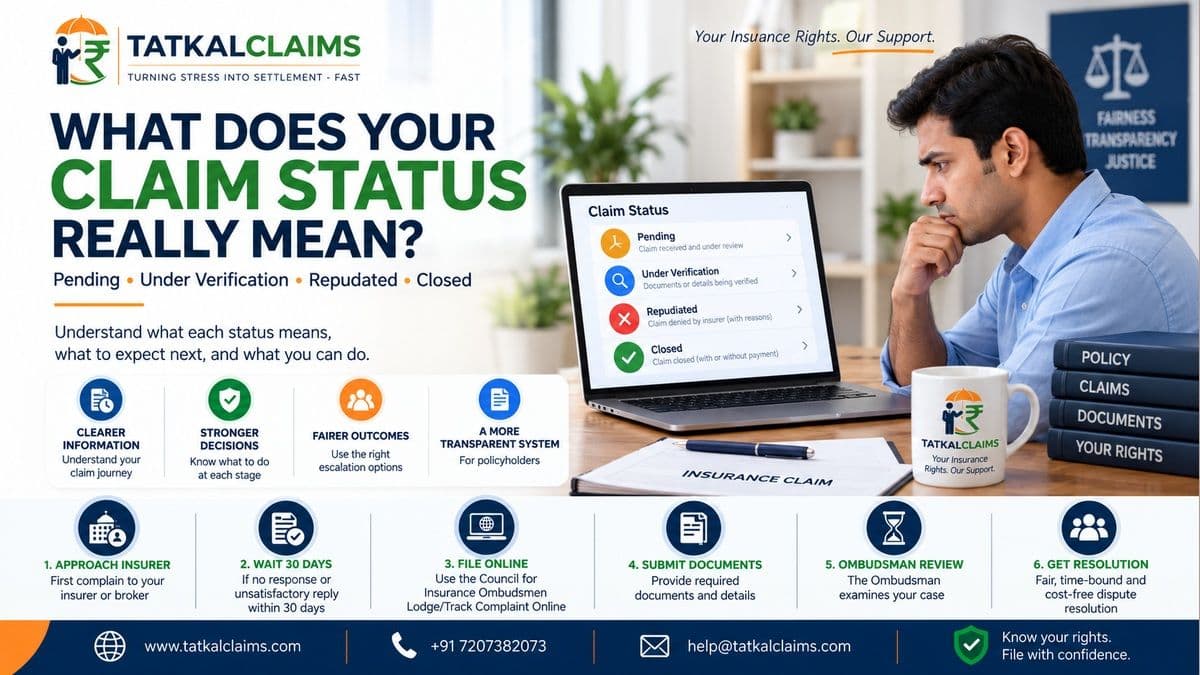

Your Claim Is Under Process: The Two Words Every Policyholder Dreads
You have submitted every document they asked for. You have responded to every email. You have called the helpline so many times that you know the hold music by heart. And yet, every time you check, the status is the same: under process.
Whether it is a health insurance claim after surgery, a life insurance claim after a loved one's death, or a motor insurance claim after an accident, the story is eerily similar. Insurers delay. Policyholders suffer. And the system that is supposed to provide financial protection becomes a source of financial stress.
But here is what most policyholders do not know: IRDAI has laid down strict timelines for insurers. Delay beyond those timelines is not just bad service. It is a regulatory violation. And it comes with a financial penalty.
IRDAI Timelines: First Identify the Type of Claim
The Insurance Regulatory and Development Authority of India has clear rules on how quickly an insurance company must process and settle claims. These rules apply across all categories: health, life, motor, and general insurance.
There Is No Single 30-Day Rule for Every Insurance Claim
IRDAI's claim-handling timelines differ across life, health, motor and other general-insurance claims. Some rules use receipt of all relevant papers, some depend on survey or investigation steps, and cashless health claims have separate turnaround times. Do not assume that one universal 30-day clock applies to every claim. For a practical workflow when the insurer is stalling, see our claim-delay guide.
IRDAI also says insurers cannot keep asking for documents one by one. All required documents should ideally be requested together at one time. The practice of demanding documents in dribs and drabs to stall settlement is explicitly discouraged.
Investigation and Settlement Timelines Depend on the Product
Insurers can investigate a claim if they suspect fraud or need further verification. But IRDAI has imposed strict limits even on investigations.
For health insurance, use the current IRDAI health-insurance master circular and policyholder guidance for the applicable cashless, reimbursement and investigation requirements. Older 30-day/45-day formulations should not be applied automatically without checking the current rule and the claim type.
For life insurance and other general-insurance claims, the applicable policyholder-protection framework sets claim-processing and delay-interest requirements, but the trigger can differ depending on whether the claim requires investigation, a surveyor, additional documents or other prescribed steps. Ask the insurer to identify the exact regulatory timeline it is applying to your claim.
Cashless Health Claims: 1 Hour and 3 Hours
IRDAI's 2024 Master Circular introduced even faster timelines for cashless health insurance approvals:
- Cashless pre-authorisation requests under health insurance should be decided within 1 hour of receipt of the request.
- Final cashless authorisation at discharge should be decided within 3 hours of the hospital's request.
These timelines were introduced specifically to reduce the delays faced by patients during hospital discharge. Yet, as surveys have shown, 5 in 10 policyholders who filed cashless claims waited between 6 and 48 hours for insurer approval.
Delay Interest: The Trigger Depends on the Applicable Claim Rule
IRDAI's policyholder-protection framework provides for interest where insurers delay eligible claim payments beyond the prescribed timeline, commonly linked to the bank rate plus 2 percentage points in applicable provisions. The exact start date and trigger are not identical across every insurance product, so calculate delay interest only after identifying the rule governing your claim.
This means insurers face a direct financial cost for unreasonable delays. The longer they delay, the more they pay. And yet, many insurers continue to stall, betting that policyholders will not know their rights or will give up before escalating.
What IRDAI Says About Claim Rejections
An insurer cannot simply reject a claim with a vague message or a one-line email. IRDAI mandates that the company must clearly communicate:
- The exact reason for rejection
- The specific policy clause being relied upon
- The grievance redressal process available to the customer
- Details of the Insurance Ombudsman mechanism
If your rejection letter does not contain all four elements, it is defective. You have grounds to challenge it.
Health Insurance Moratorium: 60 Continuous Months
Under the current IRDAI health-insurance framework, after 60 continuous months of coverage, including portability and migration, a policy and claim generally cannot be contested for non-disclosure or misrepresentation except for established fraud. If the sum insured is enhanced, a separate 60-month period applies to the enhanced portion from the date of enhancement.
After the moratorium period, a claim cannot be rejected on the basis of non-disclosure or misrepresentation of facts. The insurer cannot appeal to IRDAI against settling any claim except in case of fraud or if the event is in the exclusions list of the policy.
This 60-month moratorium applies to health insurance and should not be described as a universal protection across every insurance category. Fraud and applicable exclusions can still matter even after the moratorium.
What to Do If Your Insurer Keeps Delaying
If your insurer is not responding or repeatedly delaying the matter, policyholders can escalate the complaint step by step. Here is your action plan.
Step 1: Document Everything
Keep a record of every call, email, document submission, and response from the insurer. Log the date and time of every communication. Save screenshots of claim status pages. This documentation is your evidence if you need to escalate.
Step 2: Demand a Written Status Update
Send a formal email or letter to the insurer requesting a written status update. Ask for the specific reason for the delay, the expected timeline for resolution, and the name and designation of the person handling your claim. Insurers are less likely to stall when they know you are documenting everything.
Step 3: Complain to the Grievance Redressal Officer
Every insurer has a Grievance Redressal Officer (GRO). File the complaint in writing with your policy number, claim number, timeline and supporting records. IRDAI's current Bima Bharosa FAQ says the insurer should resolve the complaint within 15 days of receipt; if it is not resolved in that period or the response is unsatisfactory, you can escalate through Bima Bharosa and other available redress channels.
Step 4: File on IRDAI's Bima Bharosa Portal
If the GRO does not resolve the issue, file a complaint on IRDAI's Bima Bharosa portal at bimabharosa.irdai.gov.in. This is IRDAI's integrated grievance management system. Once a complaint is logged, the insurer is required to respond and resolve the matter under IRDAI supervision.
Step 5: Approach the Insurance Ombudsman
If the issue remains unresolved, approach the Insurance Ombudsman. The Ombudsman is a free, independent quasi-judicial authority that can mediate disputes and pass binding awards up to Rs 50 lakh. The process does not require a lawyer and is designed to be consumer-friendly.
Step 6: Move the Consumer Court
For serious cases involving large claims, bad faith delay tactics, or repeated violations of IRDAI timelines, approach the District Consumer Disputes Redressal Commission under the Consumer Protection Act, 2019. Consumer courts can award the claim amount, interest, compensation for mental agony, and litigation costs.
Real-World Impact: Why Delays Matter
Delays are not just inconvenient. They are destructive.
For a patient waiting for cashless approval, a 48-hour delay can mean extended hospitalisation, additional room rent charges, and emotional distress for the family. For a bereaved family waiting for a life insurance payout, a months-long delay can mean unpaid mortgages, children's school fees, and daily expenses. For a vehicle owner waiting for a motor claim, the delay can mean no transportation to work.
IRDAI's timelines exist because policymakers understand that insurance is not a luxury. It is a safety net. When that net is slow to deploy, people fall through the gaps.
The Bottom Line
IRDAI gives policyholders several time-bound protections, but they are not one-size-fits-all. Health cashless requests have 1-hour and 3-hour decision timelines; health policies now have a 60-month moratorium; grievances should generally be resolved within 15 days; and settlement/delay-interest rules depend on the insurance product and claim process. The safest way to challenge delay is to identify the exact rule governing your claim and demand a written status against that timeline.
If your insurer keeps saying your claim is under process for weeks without valid justification, it is time to escalate formally. Document everything. Demand written responses. Complain to the GRO. File on Bima Bharosa. Approach the Ombudsman. And if necessary, move the consumer court.
At Tatkal Claims, we help policyholders fight delayed claims every day. We know the IRDAI rules inside out. We know the escalation pathways. And we know how to hold insurers accountable when they violate the timelines that are supposed to protect you. If your claim has been delayed, stalled, or kept in limbo, contact us.
Is your insurance claim stuck in under process limbo? Contact our legal team at Tatkal Claims for expert assistance in forcing timely settlement and securing the payout you deserve.