
The insured dies within a few months or a couple of years of taking or reviving a life insurance policy, and the nominee receives a message: “Claim under investigation.” That does not mean the claim has been rejected—and an early death is not, by itself, proof of fraud or non-disclosure.
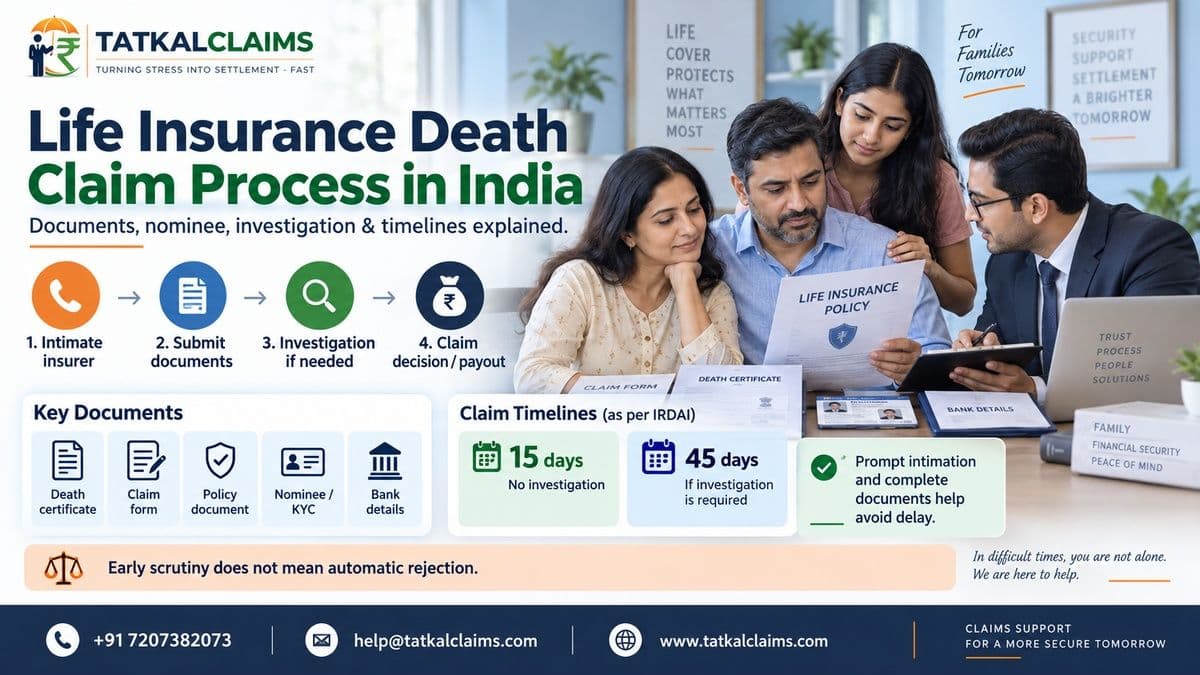
Insurers may investigate a death claim when the circumstances require additional verification. But the current IRDAI policyholder-protection framework also puts a firm turnaround time on that process: an ordinary death claim is to be settled within 15 days from claim intimation, while a death claim warranting investigation is to be settled within 45 days from claim intimation.
For early-duration claims, the investigation commonly focuses on whether the proposal or revival disclosures were accurate, whether there were prior medical conditions or treatment, whether the death circumstances match the claim record, and whether the policy was valid and in force. The correct response is to cooperate with relevant requests while forcing the insurer to identify what it is actually investigating.
What Does “Life Claim Under Investigation” Actually Mean?
An investigation means the insurer is carrying out additional verification before admitting, rejecting or otherwise deciding the death claim.
That verification can be conducted by insurer employees or an external investigator and may involve checking medical records, hospital history, employer information, financial information relevant to underwriting, proposal answers, revival declarations, police records, address history or statements from persons connected with the deceased.
The investigation should have a claim-specific purpose. A claimant is entitled to ask what issue is being verified instead of accepting a generic “investigation pending” status indefinitely.
| Investigation issue | What the insurer may be trying to verify |
| Medical history | Whether material illnesses, treatment or tests pre-dated proposal/revival |
| Proposal disclosures | Whether answers about health, income, occupation, habits or existing insurance were accurate |
| Revival / reinstatement | Whether declarations made when reviving the policy were accurate |
| Cause and circumstances of death | Whether death certificate, medical records, FIR/post-mortem and claim narrative are consistent |
| Policy validity | Whether cover was actually in force on the date of death |
| Financial underwriting | Whether declared income/occupation and sum assured were supported where relevant |
| Identity / claimant title | Whether the insured and claimant records are genuine and correctly matched |
What Is an “Early Death Claim”?
“Early claim” is an insurance-industry operational expression, not a separate statutory ground for repudiation. In practice, insurers may apply additional verification where death occurs relatively soon after policy commencement or revival.
LIC’s current public claim guidance is a useful operational example: where death occurs within three years from the date of risk or from revival/reinstatement, it calls for additional claim forms and records. LIC says these additional forms help verify the genuineness of the claim and whether material information affecting acceptance of the proposal was withheld.
That does not mean every insurer uses the same forms or that every death within three years is suspicious. The legal question remains whether the insurer has relevant, legally tenable evidence to support any adverse decision.
Current IRDAI Timeline: 15 Days vs 45 Days
The September 2024 IRDAI Master Circular on Protection of Policyholders’ Interests changed the practical timeline that claimants should now use.
| Claim type | Current IRDAI timeline |
| Death claim not warranting investigation | Within 15 days from the date of claim intimation |
| Death claim warranting investigation | Within 45 days from the date of claim intimation |
The same circular states that if a claim is not settled within the specified timeline, the claimant is entitled to interest at the bank rate plus 2% from the date of claim intimation until payment, and the insurer is to pay that interest suo motu along with the claim amount.
This is important because some older insurer FAQs and older regulatory materials still refer to longer investigation periods. For a current claim, ask the insurer to explain any timeline it is using that differs from the September 2024 Master Circular.
The 45-day clock does not mean the claimant should withhold required records. Submit relevant documents promptly, keep dated proof of submission, and ask the insurer to confirm in writing whether anything specific remains outstanding.
What Documents Can the Insurer Ask For?
IRDAI’s current Master Circular says insurers should state the documents required for claim processing in the policy document and display them on their websites. It also says no claim should be rejected or closed merely for want of documents or delayed intimation.
For a death claim, common documents include the claim form, death certificate, FIR and post-mortem report for accidental cases, and hospital discharge records where applicable.
An investigation may justify additional relevant evidence, but repeated or open-ended requests should still be challenged. Ask the insurer to explain why each additional document is material to the issue being investigated.
| Record | Why it may be requested |
| Proposal form and KYC | Baseline disclosures and identity |
| Pre-policy medical reports | What insurer already knew before issuing cover |
| Treating-doctor certificate | Last illness, diagnosis and treatment history |
| Earlier hospital/doctor records | Possible pre-proposal medical history |
| Employer certificate | Occupation, employment and sometimes income verification |
| Income / financial records | Financial underwriting for high sum assured, where relevant |
| FIR / post-mortem / inquest | Accidental or unnatural death circumstances |
| Revival declaration / health statement | Disclosures made when policy was revived |
| Existing insurance details | What was disclosed about other life cover if proposal asked for it |
If the insurer is sending repeated document requests or a deficiency memo, use our claim query and deficiency-letter response guide.
How to Cooperate Without Weakening the Claim
Cooperation is usually sensible, but do it in a controlled way. Do not guess medical dates, diagnoses or proposal answers from memory if records exist.
| Do | Avoid |
| Answer each query point by point | Sending a pile of unrelated documents without an index |
| Use records for dates and diagnoses | Guessing dates or medical history |
| Keep exact copies of everything submitted | Handing over originals without acknowledgement |
| Ask why an unusual document is needed | Flatly refusing every additional request |
| Correct an inaccurate investigator statement immediately | Signing a statement you have not read |
| Record investigator name, phone, date and visit purpose | Treating informal phone calls as the final insurer position |
| Submit unavailable-document explanations in writing | Leaving a query unanswered because the document does not exist |
If an investigator asks a family member to sign a statement, read it carefully. Correct factual errors before signing and keep a copy or photograph of the final signed version wherever possible.
Do not accuse the investigator of wrongdoing merely because the questioning is uncomfortable. Focus on relevance, accuracy and proof.
How Section 45 Fits Into an Early-Death Investigation
Section 45 of the Insurance Act governs when a life policy can be called into question. No life policy can be called in question on any ground whatsoever after three years from the latest of the date of issuance, commencement of risk, revival or rider.
Within that three-year window, the insurer may question the policy on fraud or on qualifying material misstatement/suppression grounds, subject to the statutory requirements.
For a non-fraud material-misstatement case, the fact must have a direct bearing on the risk, and the insurer bears the onus of showing that it would not have issued the life policy had it known that fact. If repudiation is on material misstatement/suppression but not fraud, Section 45 requires the premiums collected up to repudiation to be returned within 90 days of repudiation.
For fraud, the statutory analysis differs, including the burden provisions applicable after the policyholder’s death. Do not treat every allegation of “non-disclosure” as automatically equivalent to fraud.
For the detailed legal test, revival issues and the three-year contestability calculation, use our dedicated Section 45 life-claim guide.
Why Revival Can Trigger Investigation Even on an Older Policy
A policy may have been originally issued many years ago but revived recently after a lapse. Section 45 expressly includes the date of revival when identifying the three-year contestability period.
That does not mean every old medical condition can automatically be used after revival. The insurer must connect its legal ground to the statements or suppression relevant to issuance, revival or rider as required by Section 45 and the facts.
The practical investigation question is therefore: what declaration or evidence was obtained at revival, what fact is now alleged to have been misstated or suppressed, and why was that fact material to the risk?
What Investigators Commonly Cross-Check
| Source | Typical comparison |
| Proposal form | Health answers vs prior treatment records |
| Pre-policy medical examination | What insurer’s own tests showed |
| Hospital records | Diagnosis dates, history recorded by doctors, previous admissions |
| Pharmacy / diagnostic trail | Whether ongoing treatment pre-dated policy |
| Employer / occupation records | Declared occupation and employment facts |
| Financial documents | Income vs sum assured where financial underwriting matters |
| Other insurance proposals | Consistency of disclosures across policies |
| Police / post-mortem records | Cause and circumstances of accidental/unnatural death |
| Revival documents | Health declaration at reinstatement vs medical history |
A contradiction is not automatically material. The insurer must still establish the legal significance of the fact it relies on, especially if repudiation is ultimately based on Section 45.
When an Investigation Starts Looking Like Avoidable Delay
| Red flag | Why it matters |
| 45 days from claim intimation have passed without settlement | Current investigated-death-claim TAT may have been exceeded |
| Insurer will not say what issue is under investigation | Prevents meaningful response |
| Same documents are requested repeatedly | May indicate process failure rather than a genuine outstanding requirement |
| New requirements arrive one at a time without explanation | Creates rolling delay |
| Investigator completed visit but insurer gives no next step | Ask for investigation completion and decision status |
| Status remains “under investigation” despite no pending document | Escalate for a regulatory-timeline response |
| Insurer verbally alleges non-disclosure but will not identify the record | Demand written particulars rather than arguing on phone |
A genuine investigation can take time, but the current 45-day standard means “investigation” should not become an indefinite holding status.
Questions to Send the Insurer in Writing
| Question | Purpose |
| On what date was the claim intimation registered? | Fixes the current 15/45-day timeline |
| Has the claim formally been classified as warranting investigation? | Prevents vague status labels |
| On what date was investigation initiated? | Creates a process record |
| What specific issue is being investigated? | Lets claimant answer the real concern |
| Which exact documents remain outstanding? | Stops open-ended requests |
| Have all documents already submitted been mapped to the claim file? | Prevents repeat demands |
| Has the investigator submitted the report? | Identifies whether delay is investigator-side or insurer-side |
| What is the expected decision date under IRDAI’s 45-day TAT? | Forces timeline accountability |
| If the timeline has expired, how will delay interest be handled? | Preserves current regulatory entitlement |
Do You Have a Right to the Investigator’s Full Report?
Do not assume that every internal investigator report must automatically be supplied in full. The current framework is stronger on the insurer’s obligation to have legally tenable evidence and to communicate the basis of an adverse decision than on an automatic right to every internal note.
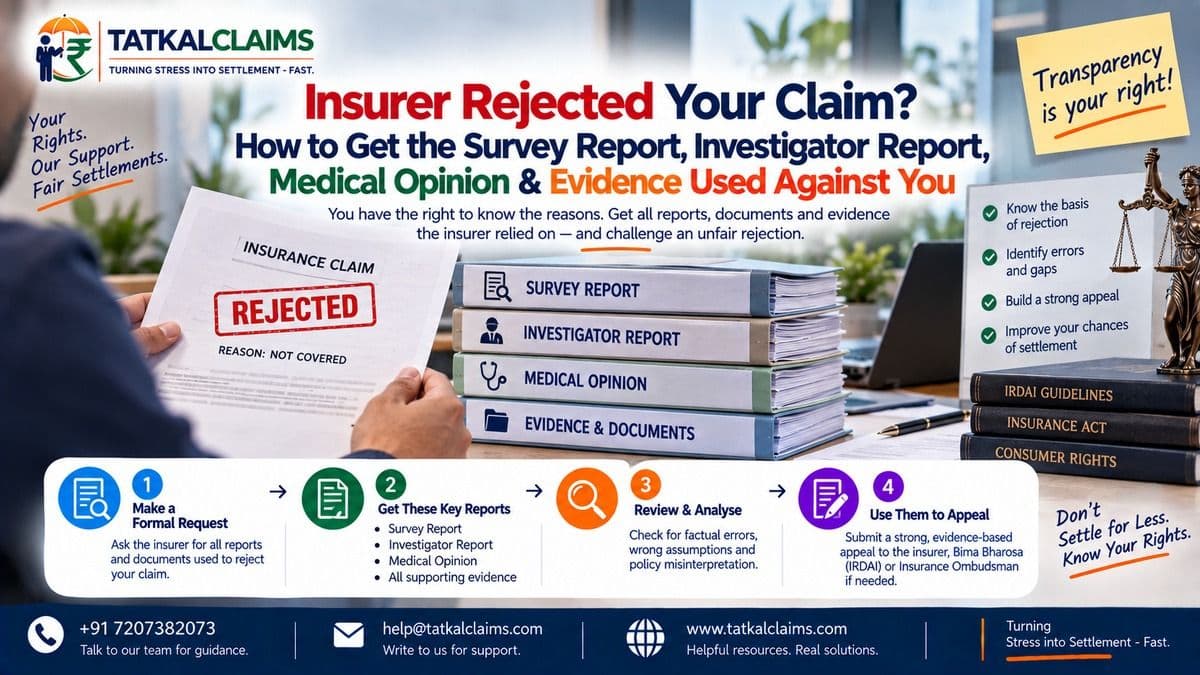
If the claim is later rejected, ask for the specific adverse facts, documents, statements, dates and contradictions relied on. A vague line such as “investigation revealed non-disclosure” is not enough to meaningfully test the decision.
If the claim is eventually rejected and the insurer relies on investigation or medical evidence, use our claim-file evidence and investigator-report guide.
Do Pre-Policy Medical Tests Protect the Claim?
Pre-policy medical tests are important evidence because they show what the insurer examined before issuing cover. But they do not automatically prove that every proposal answer was complete.
If the insurer alleges an undisclosed condition that should reasonably have been apparent from its own pre-policy records, preserve those reports and ask the insurer to explain why the alleged fact was not already within its knowledge.
Conversely, a normal pre-policy test does not necessarily disprove a separate undisclosed diagnosis or treatment history. The exact medical record and proposal question matter.
Does the Undisclosed Condition Have to Cause the Death?
Do not reduce every Section 45 dispute to a simple “same disease caused death” test. The statutory question for non-fraud material misstatement is whether the misstated or suppressed fact had a direct bearing on the risk and whether the insurer would have issued the policy had it known the fact.
Causation can still be relevant in particular disputes and court decisions, but the safest claim review is to test the exact statutory ground, proposal question, medical evidence and underwriting materiality rather than rely on a universal causation slogan.
Accidental or Unnatural Death Claims
Where death is accidental or unnatural, the insurer may need FIR, post-mortem, inquest or police investigation records. This can be a legitimate part of verifying the insured event or an accidental-death rider.
If the police investigation itself is pending, tell the insurer which records are presently available and provide the final report when issued. Ask whether the base death benefit can be decided separately from any accidental rider if the policy structure permits.
Do not assume that an accidental-death investigation automatically opens every aspect of old medical history. Ask what each requested record is meant to establish.
If the Investigation Ends in Rejection
A repudiation is a new stage. Stop treating it as a status problem and audit the rejection itself.
IRDAI’s current Master Circular says no claim should be repudiated without legally tenable evidence. Section 45 also requires written communication of the grounds and materials when the insurer calls a life policy into question within the statutory window.
| Check | Question |
| Ground | Fraud, non-fraud material misstatement, exclusion, lapse or something else? |
| Evidence | Which medical/financial/investigation record is relied on? |
| Proposal question | What exactly was asked and answered? |
| Materiality | Why would the alleged fact have changed underwriting? |
| Section 45 dates | Which issuance/risk/revival/rider date is the insurer using? |
| Communication | Are the grounds and materials identified in writing? |
| Premium refund | If non-fraud Section 45 repudiation, has the statutory premium-refund rule been applied? |
For the broader appeal sequence after repudiation, see our insurance claim rejection guide.
How to Escalate an Investigation That Exceeds the Timeline
Start with the insurer’s Grievance Redressal Officer. Attach the claim-intimation acknowledgement, document-submission proof, investigation communications and a short chronology showing that the 45-day investigated-death-claim timeline has expired.
The current IRDAI Master Circular says grievances should receive a resolution within 14 days. It also allows complaints to be registered through Bima Bharosa.
The Insurance Ombudsman can consider eligible complaints about delay in claim settlement, partial or total repudiation and claim-related policy disputes, subject to the applicable eligibility conditions.
Compare the two escalation routes in our Bima Bharosa vs Insurance Ombudsman guide.
For the Ombudsman filing process and current ₹50 lakh limit, see our Insurance Ombudsman complaint guide.
A Practical 7-Day Action Plan
| Day | Action |
| Day 1 | Fix the claim-intimation date and calculate the 45-day investigated-claim deadline. |
| Day 2 | Get one written list of all outstanding documents and the investigation issue. |
| Day 3 | Collect proposal, pre-policy medicals, revival forms and policy schedule. |
| Day 4 | Submit relevant medical/employer/police records with a document index and proof of submission. |
| Day 5 | Correct any inaccurate investigator statement or factual mismatch in writing. |
| Day 6 | Ask whether the investigator has filed the report and request a decision date. |
| Day 7 | If the regulatory timeline has expired, file a GRO grievance citing the claim chronology and delay-interest rule. |
How Tatkal Claims Can Help
Tatkal Claims can review the claim-intimation date, policy/revival history, proposal form, pre-policy medicals, investigator queries, medical/employment records and insurer status communications to identify whether the investigation is still within the current IRDAI timeline and what issue the insurer is actually testing.
Where the investigation is drifting without a defined issue or has crossed the applicable timeline, assistance can include preparing a document-indexed response, a status-and-timeline demand, a GRO grievance and Bima Bharosa/Ombudsman escalation where eligible. If the investigation later becomes a Section 45 repudiation, the legal ground and evidence should be reviewed separately rather than assuming that delay alone makes the claim payable.
Frequently Asked Questions
Frequently asked questions
Is an early death claim automatically suspicious?
No. An insurer may apply additional verification when death occurs relatively soon after commencement or revival, but early death by itself is not proof of fraud or non-disclosure.
How long can a life insurer investigate a death claim?
Under IRDAI’s September 2024 Master Circular, a death claim warranting investigation is to be settled within 45 days from the date of claim intimation.
What is the timeline if no investigation is required?
The current Master Circular sets a 15-day settlement timeline from claim intimation for death claims that do not warrant investigation.
What happens if the insurer takes more than 45 days?
The current Master Circular provides for interest at the bank rate plus 2% from the date of claim intimation until payment when the specified claim-settlement timeline is missed.
Can the insurer reject my claim just because death occurred within three years?
No. The three-year period is relevant to Section 45 contestability, but the insurer still needs a legally valid ground and evidence for repudiation.
Why does LIC ask for extra forms when death occurs within three years?
LIC’s current guidance says additional forms help verify claim genuineness and whether material information affecting acceptance of the proposal was withheld. This is an insurer-practice example, not a rule that every early claim must be rejected.
Can an investigator contact hospitals and doctors?
Insurers may verify relevant medical history during claim investigation, subject to applicable law and claim authority. Ask what issue is being investigated and keep track of the records relied on.
Should I sign an investigator’s statement?
Read it carefully, correct inaccuracies before signing and keep a copy where possible. Do not sign a statement you know contains wrong facts.
Can I demand the complete investigator report?
Do not assume an automatic right to every internal note. If the claim is rejected, request the specific adverse findings, records and materials relied upon so that you can meaningfully challenge the decision.
Does Section 45 mean a claim after three years can never be investigated?
Section 45 says a life policy cannot be called in question after the statutory three-year period. An insurer may still need to verify other claim-administration issues such as the insured event, claimant identity/title or policy status. The exact issue being investigated matters.
Sources and Methodology
Disclaimer: This guide explains current IRDAI claim-processing rules, Section 45 of the Insurance Act and selected insurer practices in general terms. Whether an investigation or repudiation is valid depends on the exact policy, proposal/revival documents, medical and financial evidence, cause of death and facts of the claim. This is not legal, medical or financial advice for a specific death claim.