A life-insurance death claim is usually started by notifying the insurer of the death and submitting the claim documents requested under the policy. The exact document set depends on the insurer, policy status, cause of death, nomination or assignment, and whether the death occurred soon after policy commencement or revival.
Who Can File a Life Insurance Death Claim?
The claimant may be a nominee, assignee, legal heir or other person legally entitled to receive the policy money, depending on the policy record and applicable law. Nomination can simplify payment administration, but disputes about beneficial ownership or succession can require separate legal analysis.
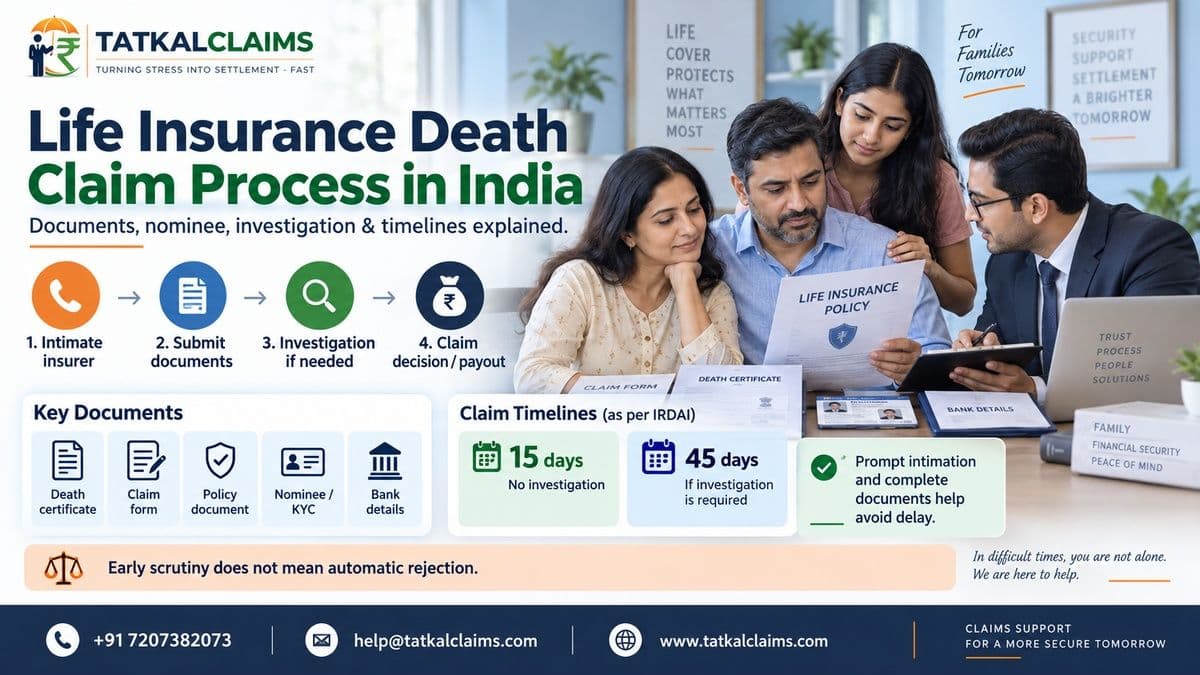
Step 1: Intimate the Insurer
Give the insurer the policy number, name of the life assured, date and cause of death, claimant details and contact information. LIC's current guidance, as one insurer example, asks the nominee or assignee to intimate the servicing branch in writing with the policy number, policyholder name, date of death and cause of death.
Core Documents Commonly Requested
| Document | Purpose |
|---|---|
| Death claim form / claimant statement | Provides claimant and death details. |
| Certified death certificate / death-register extract | Official proof of death. |
| Policy document and policy details | Identifies the contract and benefits. |
| KYC and bank details of claimant | Supports claimant verification and payment. |
| Evidence of title / succession where required | May be needed if there is no effective nomination/assignment or entitlement is disputed. |
| Age proof, if not already admitted | May be requested under the insurer's process. |
LIC's published claim requirements list Claim Form A, a certified extract from the Death Register, age proof where age is not admitted, evidence of title where the policy is not nominated/assigned or under the M.W.P. Act, and the original policy document. Other life insurers may use different forms or digital processes.
Accidental or Unnatural Death
Additional evidence is commonly requested, such as FIR, post-mortem report, inquest or police investigation records, depending on the circumstances and policy benefits. LIC specifically says FIR and post-mortem documents are normally insisted on for accidental-benefit claims.
Why Early Claims Get More Scrutiny
Insurers may request additional medical, hospital, employer or investigation records when death occurs relatively soon after commencement, reinstatement or revival. LIC's public claim requirements state that additional requirements apply when death occurs within three years from the date of risk or revival/reinstatement. This is an operational example, not a universal rule that every insurer uses exactly the same forms.
Section 45 and the Three-Year Window
Life-insurance contestability is governed by Section 45 of the Insurance Act. The legal effect depends on the date from which the statutory three-year period is counted, including relevant revival circumstances. Tatkal Claims' dedicated Section 45 guide should be used for the detailed legal analysis rather than assuming that an 'early claim' is automatically rejectable.
How Long Should a Death Claim Take?
Do not judge a claim only by the number of calendar days since death. The more useful timeline is: date of intimation, date the insurer acknowledged the claim, date the complete required document set was supplied, dates of any additional requirements, whether an investigation was opened, and date of the final decision. Ask the insurer to identify all outstanding requirements in one written list where possible.
These are current regulatory turnaround-time benchmarks, but the claimant should still submit the required documents promptly and respond to legitimate queries. Keep the claim-intimation acknowledgement because the current circular measures these death-claim timelines from the date of intimation.
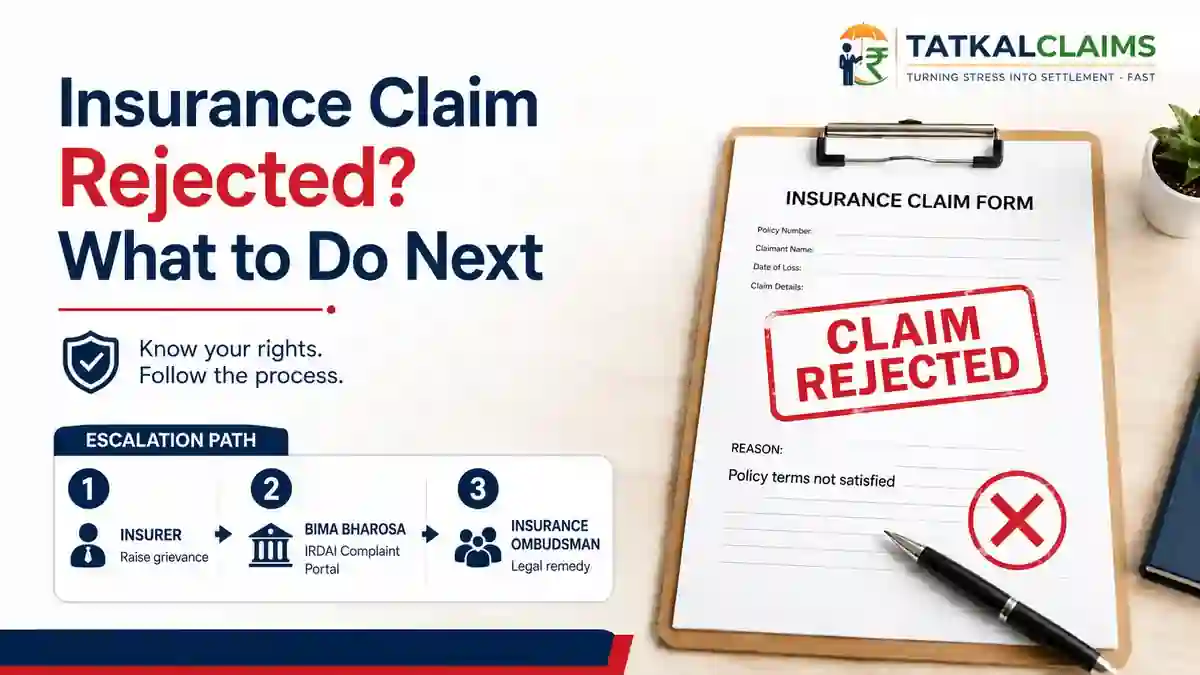
If the insurer keeps the claim pending without a clear reason, use its grievance mechanism. IRDAI's Bima Bharosa platform can register and track grievances, and an eligible delay or repudiation dispute may later be taken to the Insurance Ombudsman.
A Practical Claim Timeline to Maintain
- Day of intimation: record claim number and servicing office.
- Document submission: keep a dated index and acknowledgement.
- Additional requirements: answer each query with the exact document or a written explanation of why it is unavailable.
- Investigation: cooperate with reasonable requests, but keep copies and ask what issue is being examined.
- Decision: insist on a reasoned written settlement or repudiation letter.
- Delay: escalate through the insurer's grievance officer, then Bima Bharosa and other eligible remedies.
If the Claim Is Rejected
A separate dispute can arise when a bank deducts premium for loan-linked life cover but the family is later told no cover existed. Our bank-premium refund case explains a consumer-commission decision involving a premium deducted before death and reversed afterwards.
The repudiation letter should be analysed against the policy, proposal form, medical records and applicable law. Common dispute areas include alleged non-disclosure, policy lapse or revival, suicide clauses, accidental-death exclusions and questions about nomination or entitlement. Do not respond to all of these with the same generic appeal.
Common Mistakes
- Submitting documents without keeping a copy or acknowledgement.
- Ignoring revival or premium-history records.
- Assuming nomination alone resolves every succession issue.
- Treating an investigation as proof the claim will be rejected.
- Waiting months without demanding a written status and outstanding-document list.
Frequently asked questions
Who should notify the insurer after the policyholder dies?
The nominee, assignee, legal heir or other legally entitled claimant can notify the insurer as applicable. Check the policy record and insurer process.
Are FIR and post-mortem documents always needed?
Not for every natural death. They are commonly required for accidental or unnatural deaths and for certain additional benefits or investigations.
Does death within three years mean the claim can be automatically rejected?
No. Early claims may receive additional scrutiny, but admissibility depends on the policy, evidence and applicable law including Section 45.
What should I do if the claim is simply shown as pending?
Ask for a written status, the exact outstanding requirements and whether an investigation is open. Then use the insurer grievance process if the delay is not properly explained.