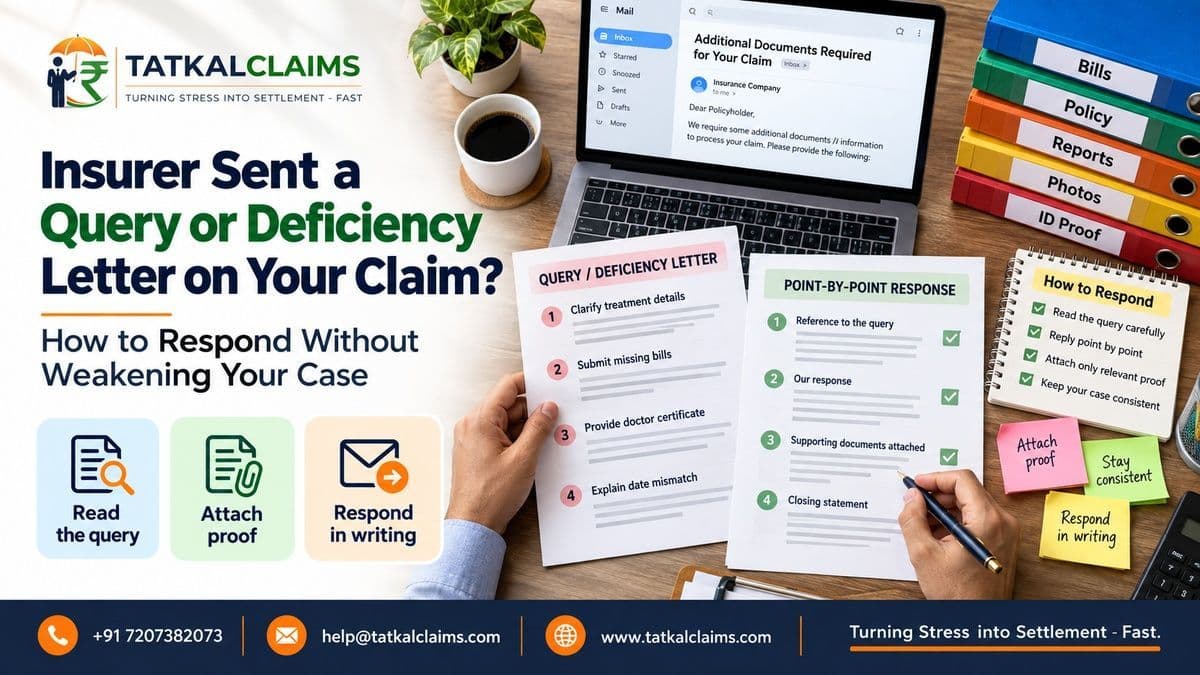
Your insurer or TPA has not rejected the claim. Instead, it has sent a “query”, “deficiency”, “pending document”, “additional information” or “requirement” letter and says the claim cannot move until you respond. This stage matters because a rushed or incomplete reply can create new contradictions, while an ignored query can leave the claim unresolved.
The right response is not to send every document you can find. First identify exactly what is being asked, why it is relevant to the claim, who actually holds that record, whether you already submitted it, and what alternative evidence exists if the requested document is unavailable.
Current IRDAI protections also matter. The 2024 policyholder-protection framework says claims should not be rejected or closed merely for want of documents and that customers should submit documents directly related to the claim. For health claims, the current framework specifically requires insurers and TPAs to collect required hospital documents from the hospital after claim intimation.
What Is an Insurance Claim Query or Deficiency Letter?
A claim query is a request for information, clarification or evidence before the insurer takes a final decision. The label varies by insurer and product. You may see terms such as deficiency memo, pending requirement, document shortfall, query letter, additional information request, clarification required or claim kept pending for documents.
A query does not by itself mean the claim has been rejected. It means the insurer says it does not yet have enough information to complete its assessment—or wants clarification on a fact it considers material.
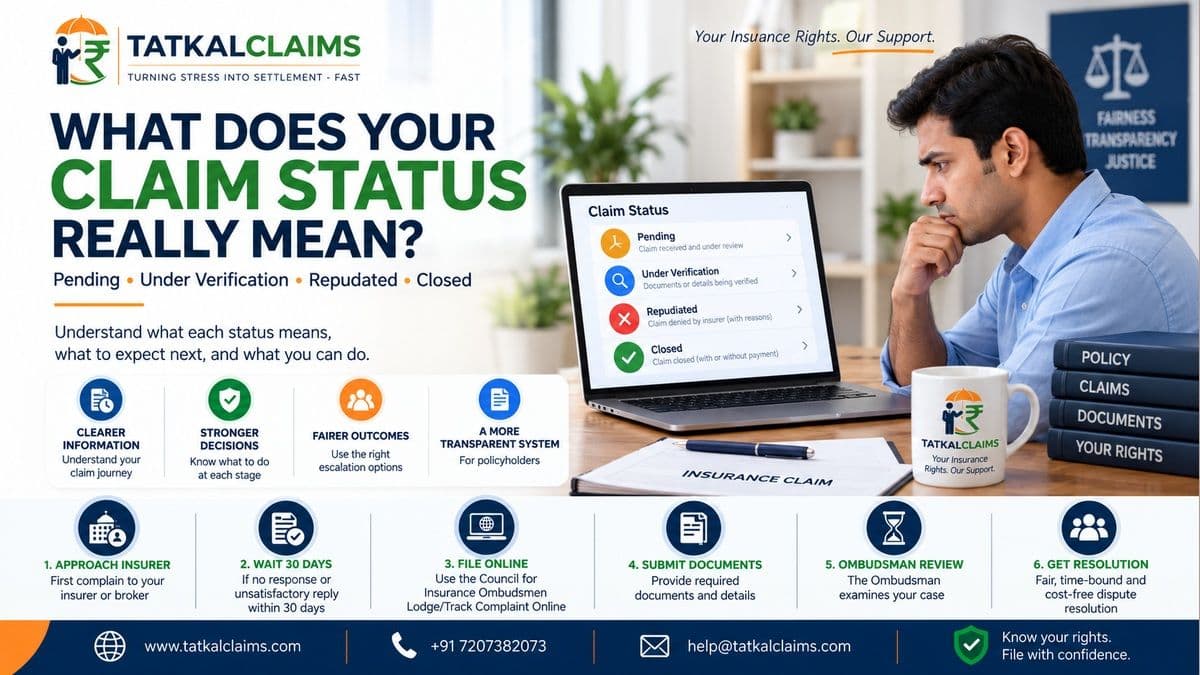
| Status | What it usually means | What you should do |
| Query / deficiency | Insurer says information or evidence is missing/unclear | Respond point by point and preserve proof |
| Under verification / investigation | Insurer is checking facts or records | Ask what is being verified and what, if anything, is required from you |
| Pending | A broad status that may hide a specific dependency | Ask who owns the next action and what exact item is pending |
| Repudiated / rejected | Insurer has taken an adverse claim decision | Obtain the written reason and policy clause, then evaluate appeal |
| Closed | File has been administratively closed or disposed of | Ask whether this is final rejection, closure for non-response or another status |
If your portal only shows a vague label such as pending, under verification, closed or repudiated, use our insurance claim status guide.
First Read the Query as a List of Separate Requirements
Do not answer a five-point query with one general paragraph. Number each insurer requirement and answer it separately. This makes it easier to prove what you supplied and harder for the file to remain vaguely “deficient.”
| Insurer asks for | Your response should state | Attach |
| Document you have | Provided now | Document + clear filename |
| Document already submitted | Submitted earlier on [date/mode] | Earlier email/portal receipt + document again if useful |
| Hospital-held record | Hospital/insurer/TPA should obtain it; you have also requested it if appropriate | Hospital request acknowledgement if available |
| Document that does not exist | Does not exist; explain why | Alternative evidence, if any |
| Document impossible to obtain | Explain attempts and obstacle | Emails, refusal, closure certificate or alternative record |
| Clarification/questionnaire | Short factual answer tied to records | Supporting records where relevant |
| Request you believe is irrelevant | Ask how it relates to claim assessment | Policy/query reference; avoid refusing without explanation |
What the 2024 Policyholder-Protection Framework Says About Claim Documents
IRDAI's September 2024 Master Circular on Protection of Policyholders' Interests applies across life, general and health insurers. At claim stage, it says no claim shall be rejected or closed for want of documents or delayed claim intimation. It also states that documents needed for acceptance of risk should have been called for at underwriting, and that at claim stage the customer should submit only documents directly related to the claim.
This does not mean an insurer must pay a claim with no evidence. A claimant still has to establish the insured event and provide claim-related material that is reasonably available. The practical protection is against treating unrelated underwriting material, impossible paperwork or an open-ended document chase as an automatic substitute for deciding the claim.
Health Claims Have an Extra Protection for Hospital-Held Documents
For health claims, the May 2024 Master Circular on Health Insurance Business goes further. After claim intimation, insurers and TPAs are required to collect the required documents from hospitals; the policyholder is not required to submit those hospital documents.
This distinction is important. Hospital-held material can include records such as indoor case papers, nursing notes, operation notes, diagnostic reports maintained by the hospital, treatment records and other records that the insurer/TPA can obtain from the treating institution.
But this does not mean you can ignore every health-claim query. Documents that are personal to you—such as a claim form, identity/KYC details, bank details, prior-policy records in your possession, invoices you paid outside the hospital system or an explanation of your own history—may still reasonably need a response depending on the claim and policy.
| Type of record | Usually held by | Practical response |
| Indoor case papers / hospital clinical records | Hospital | Ask insurer/TPA to collect; copy hospital if needed |
| Discharge summary / operation notes | Hospital and often patient | Provide if you have it; do not let insurer ignore its hospital-collection duty |
| Hospital final bill / itemised bill | Hospital and patient | Attach your copy; insurer/TPA can verify with hospital |
| Diagnostic reports generated by hospital | Hospital/patient | Attach if available; identify hospital if not |
| Claim form / bank details / KYC | Policyholder/claimant | Provide directly if legitimately required |
| Prior-policy or portability record | Insurer(s)/policyholder | Identify existing insurer and provide records you hold |
| Treating doctor's clarification | Doctor/hospital | Ask insurer to specify the medical question so the doctor can answer accurately |
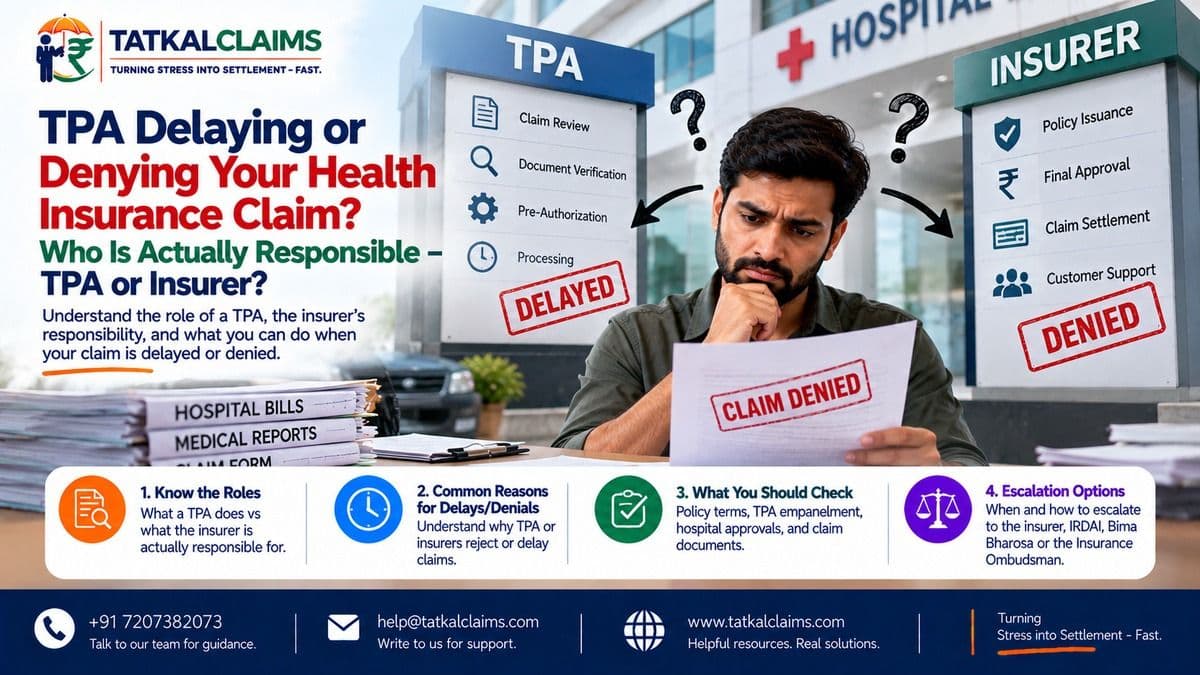
If the TPA and insurer keep sending you back to each other for the same hospital record, see our TPA delay and insurer-responsibility guide.
Common Claim Queries—and How to Respond
| Query type | What the insurer may be testing | How to respond carefully |
| Missing claim form / signature | Administrative completeness | Submit completed form; keep copy and receipt |
| Original/certified document requested | Authenticity | Ask whether digital/certified copy is acceptable; retain originals unless surrender is genuinely required |
| Doctor clarification | Diagnosis, causation, medical necessity or history | Ask for the exact question; obtain a factual treating-doctor response |
| Past medical records | PED/non-disclosure or chronology | Provide relevant records; do not speculate about conditions not documented |
| FIR / police / fire / untraced report | Occurrence and circumstances of loss | Provide applicable authority record; explain if not legally generated for that event |
| Driving licence / permit / fitness | Motor entitlement/compliance | Provide record for relevant date; explain renewal/endorsement timeline if disputed |
| Invoices / stock / books of account | Quantum of commercial/property loss | Provide contemporaneous business records and explain gaps |
| Nominee / legal-heir documents | Entitlement to receive benefit | Provide succession/nomination records applicable to the case |
| Proposal form / disclosure question | Possible non-disclosure | Request the signed proposal/question relied on before giving a broad narrative |
| Repeat copy of a document already filed | File-handling or indexing problem | Resend if practical, but attach proof of earlier submission and ask them to update the deficiency status |
Be Careful With Medical Clarification Requests
A common health-claim deficiency asks for a treating-doctor certificate such as “duration of diabetes,” “cause of hypertension,” “why admission was necessary,” “whether condition existed before policy,” or “whether illness is related to pregnancy/PED.” These are not clerical questions; the answer can become central evidence.
Do not draft a medical conclusion for the doctor or ask the doctor to change records to fit the policy. Give the doctor the insurer's exact written question and ask for a medically accurate clarification based on contemporaneous records.
If the insurer asks you personally to state a medical duration you do not know, say that you cannot independently certify it and refer to the treating records. Guessing a date or diagnosis can create an inconsistency that later gets treated as non-disclosure.
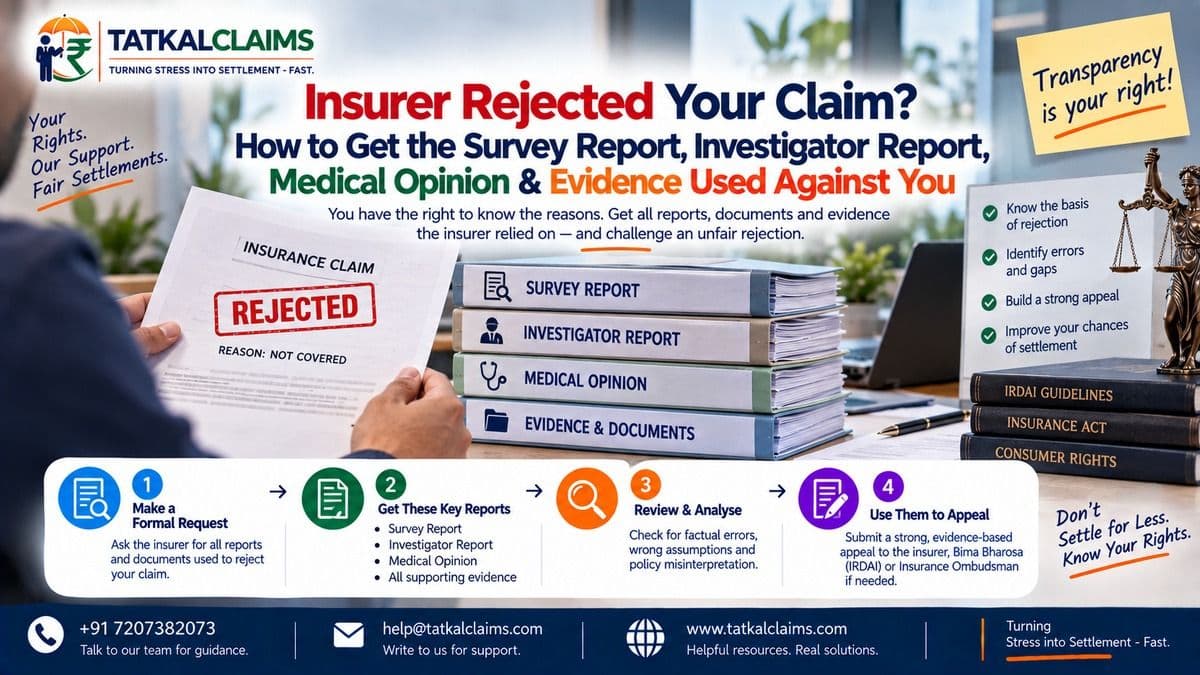
If the insurer later relies on an internal medical opinion, investigation or other evidence you have not seen, use our claim-file evidence guide.
If the Query Is Really About Non-Disclosure, Get the Proposal Question First
Some deficiency letters look like document requests but are actually building a non-disclosure case. For example, the insurer may ask for years of old medical records, details of prior consultations or a statement about symptoms before policy inception.
Before giving a broad narrative, obtain the signed proposal form or proposal record and identify the exact question the insurer says was answered incorrectly or incompletely. The relevance of old medical history depends on what was asked, what was known, the product and applicable legal/regulatory framework.
Answer factually and chronologically. Distinguish a diagnosed condition from a symptom, an isolated consultation from continuing treatment, and what you knew at proposal stage from what was diagnosed later.
If the insurer has already converted the query into a rejection or repudiation, move to our insurance claim rejection guide rather than continuing to treat it as an open document query.
What If the Insurer Keeps Asking for Documents in Pieces?
Repeated one-by-one queries are especially problematic because the claimant may answer one request only to receive a new requirement days later. Older IRDAI health-claim guidance expressly required necessary claim documents to be called for at one time rather than piecemeal; the current 2024 framework strengthens the broader principle that claim-stage documents should be directly related to the claim and, for health claims, hospital records should be collected by the insurer/TPA.
If you receive a second or third deficiency letter, create a chronology. List every query date, every item requested, your response date, proof of delivery and whether the new request could reasonably have been raised earlier.
Then ask the insurer to confirm in writing whether your response completes the outstanding requirements and, if not, to provide a consolidated list of the exact remaining claim-related deficiencies.
If repeated queries have turned into an extended claim-processing delay, see our claim delay guide.
What If the Requested Document Does Not Exist or Cannot Be Obtained?
Do not create, backdate, alter or manufacture a document. An unavailable record should be explained, not invented.
| Situation | Response |
| Hospital says old record was destroyed/not retained | Obtain hospital's written response if possible; offer available discharge/bill/test records |
| Police/authority never issued requested document | Explain why it does not exist and provide the closest official record |
| Original lost but copy exists | Provide copy and explain loss; ask whether certified/electronic copy is acceptable |
| Third party refuses to release record | Show your request/refusal and ask insurer to obtain it directly where it has authority |
| Record predates reasonable retention period | State the dates and preservation efforts; provide alternative contemporaneous evidence |
| Insurer asks for a document irrelevant to the claim | Ask it to explain relevance and policy/regulatory basis while supplying other undisputed requirements |
Where alternative evidence exists, identify what fact it proves. For example, a payment receipt may prove payment, a discharge summary may prove admission and diagnosis, an FIR may prove reported occurrence, and prior policy schedules may prove continuity. Alternative evidence is strongest when you explicitly connect it to the missing fact.
What If You Already Submitted the Document?
Do not reply only “already sent.” Reattach the document if practical and add the submission trail: date, channel, email subject, portal acknowledgement, courier receipt or claim-desk acknowledgement.
Ask the insurer to mark that requirement as received and provide the updated deficiency list. This converts a memory dispute into an auditable record.
| Date | Insurer/TPA request | Your response | Proof | Status |
| 12 Sep | Discharge summary | Resent same day | Email + portal receipt | Should be closed |
| 15 Sep | Indoor case papers | Requested insurer to collect from hospital; copied hospital | Email chain | Pending hospital/insurer |
| 18 Sep | Prior policy schedule | Provided | Email attachment | Closed |
What Not to Do When Replying to a Deficiency Letter
| Mistake | Why it can hurt |
| Ignoring the query | Creates avoidable delay and may lead to administrative closure/escalation |
| Sending a huge unstructured document dump | Makes it harder to prove which query was answered |
| Guessing dates, diagnoses or facts | Can create contradictions used later in assessment |
| Changing hospital records | Creates authenticity and credibility problems |
| Signing blank declarations | You lose control over what is ultimately recorded |
| Giving a broad non-disclosure statement without seeing proposal questions | May concede facts beyond what was actually asked at underwriting |
| Surrendering originals without receipt | Creates evidence-recovery risk |
| Relying only on phone calls | Leaves no reliable chronology |
A Strong Deficiency-Letter Response Structure
Keep the covering response short, numbered and documentary. A useful structure is: claim/policy details; date of insurer query; item-by-item reply; attached-document index; explanation of unavailable records; prior-submission proof; and a request for confirmation that no further deficiency remains.
| Section | What to write |
| Subject | Claim number + response to deficiency/query dated [date] |
| Opening | Confirm receipt and state you are responding item by item |
| Item 1, 2, 3... | Quote/summarise each insurer request, then give your answer |
| Attachments | Use numbered filenames matching the query items |
| Unavailable items | Explain why unavailable and identify alternative evidence |
| Previously submitted items | Give prior submission date/mode and attach proof |
| Closing request | Ask insurer to confirm completeness and specify any remaining claim-related requirement in one consolidated response |
Avoid emotional accusations in the first technical response. The objective is to close the evidence gap. If the insurer keeps repeating or expanding irrelevant requirements after a complete response, that is the point to convert the matter into a formal grievance.
How Long Should a Query Keep a Claim Pending?
There is no single universal claim timeline across every insurance product and claim type. Current rules differ across life, general and health business, and some claims may involve investigation.
For health insurance, IRDAI's current policyholder guidance publishes a 15-day turnaround time for claims other than cashless. For other classes, applicable policyholder-protection rules and product-specific claim timelines should be checked.
Do not assume that every fresh query automatically gives the insurer an unlimited new processing period. If a claim remains pending after you have answered the stated deficiencies, ask the insurer to identify the exact outstanding requirement, who is responsible for obtaining it and the applicable claim TAT.
When a Deficiency Query Should Become a Formal Grievance
Escalate when the insurer or TPA repeatedly asks for the same record without acknowledging receipt, demands hospital-held health records from you despite being able to collect them, keeps adding unrelated requirements, refuses to explain why a document is relevant, or leaves the claim pending after the documented deficiency has been addressed.
Write to the insurer's Grievance Redressal Officer with the query chronology, your item-by-item response, proof of submission and the specific remedy you want—for example, acknowledge completeness, collect hospital records directly, stop duplicate requirements, or decide the claim.
Bima Bharosa's current FAQ says an insurer should resolve a grievance within 15 days of receipt. If the response is unsatisfactory or the grievance is not resolved, you can escalate through Bima Bharosa/IRDAI. The grievance timeline is separate from the underlying claim-assessment timeline.
Compare escalation routes in our Bima Bharosa vs Insurance Ombudsman guide.
The Insurance Ombudsman may become relevant for an eligible complaint after the insurer-first step, especially once the issue has matured into claim rejection, partial settlement, unreasonable delay or a policy-term dispute. Preserve the deficiency correspondence because it can show what the insurer asked for and how you responded.
For the Ombudsman process and eligibility conditions, see our Insurance Ombudsman complaint guide.
A Practical 48-Hour Action Plan
| Time | Action |
| First 2 hours | Save the original query, note deadline and split every request into separate items. |
| Same day | Mark each item: available, already submitted, hospital-held, unavailable, or needs clarification. |
| Within 24 hours | Collect available documents and obtain proof of any prior submissions. |
| Within 24 hours | For health hospital records, ask insurer/TPA to collect them and copy the hospital where useful. |
| Within 36 hours | Get factual doctor/third-party clarifications only for precise written questions. |
| Within 48 hours | Send numbered response + attachment index + unavailable-document explanation. |
| After submission | Obtain acknowledgement and ask the insurer to confirm the exact remaining deficiency, if any. |
How Tatkal Claims Can Help
Tatkal Claims can review the deficiency/query letter, policy wording, proposal form, claim documents, prior submission trail, medical/hospital records and insurer/TPA communications to identify what is genuinely missing, what has already been provided, what the insurer should obtain directly and what answer could create an unnecessary contradiction.
Where the query process has become unreasonable or the claim remains stuck after a complete response, assistance can include preparing the item-by-item deficiency response, evidence index, hospital-record request, insurer/GRO grievance and Bima Bharosa or Ombudsman record where appropriate. The aim is to close genuine evidence gaps—not to manufacture documents or guarantee claim acceptance.
Frequently Asked Questions
Frequently asked questions
Does a deficiency letter mean my insurance claim is rejected?
No. A deficiency or query normally means the insurer says information, documents or clarification are still required before a final decision. Ask for the exact outstanding requirement and respond in writing.
Can an insurer reject my claim only because a document is missing?
IRDAI's 2024 policyholder-protection framework says claims should not be rejected or closed for want of documents. That does not remove the need to prove the claim; provide relevant available evidence and explain genuinely unavailable records.
In a health claim, do I have to collect all hospital records myself?
Current IRDAI health guidance says that after claim intimation insurers and TPAs should collect required documents from hospitals. You may still need to provide claimant-held documents such as claim forms, KYC/bank details or records outside the hospital.
What should I do if the insurer asks for a document I already sent?
Resend it if practical, attach proof of the earlier submission, state the date/mode and ask the insurer to mark that deficiency as completed.
What if the hospital refuses to give me indoor case papers?
For a health claim, tell the insurer/TPA that the record is hospital-held and ask it to collect the document directly. Preserve the hospital refusal or your request as evidence.
Should I answer medical-history questions myself?
Only state facts you actually know. If the question requires a medical conclusion or duration of disease, ask the insurer for the exact issue and obtain a medically accurate clarification from the treating doctor/records rather than guessing.
Can the insurer keep raising new queries one after another?
A genuine new issue may require clarification, but repeated piecemeal requests should be documented and challenged where they become unreasonable. Ask for a consolidated list of the exact remaining claim-related deficiencies.
What if the requested document does not exist?
Say so clearly, explain why, document your attempt to obtain it and offer alternative evidence that proves the relevant fact. Never create or alter a document.
How quickly should a health reimbursement claim be decided?
IRDAI's current health-insurance guidance publishes a 15-day turnaround time for claims other than cashless. If the claim remains pending after your deficiency response, ask what exactly remains outstanding and escalate unreasonable delay.
When should I complain through Bima Bharosa?
First raise a written grievance with the insurer/GRO. Bima Bharosa states that insurers should resolve grievances within 15 days. Escalate if the query process remains unresolved or the insurer's response is unsatisfactory.
Sources and Methodology
Disclaimer: This guide explains current regulatory guidance and practical claim-response steps in general terms. The relevance of a requested document depends on the type of insurance, policy wording, insured event, claim chronology, applicable law/regulation and the evidence reasonably available. Do not fabricate, alter or backdate records. This guide is not legal, medical or financial advice for a specific claim.