
Your hospital says the TPA has not approved the cashless request. The TPA says the file is “pending with insurer”. The insurer says to contact the TPA. Meanwhile, discharge is delayed, the hospital is asking for money, or your reimbursement claim has been sitting in the same status for days. This is the classic TPA–insurer blame loop.
The first step is to identify who is actually responsible for the next action. IRDAI’s current health-insurance guidance defines a TPA as a company engaged by an insurer to provide services such as cashless and claims administration and customer service. It describes the TPA as an intermediary between the insured and insurer—not as a separate insurance company.
That distinction matters. A TPA can process, query, coordinate and communicate stages of a claim on behalf of the insurer, but the insurer remains the entity that issued the policy and must monitor TPA service levels. Current IRDAI cashless turnaround times are also stated as obligations of the insurer.
What Exactly Is a TPA in Health Insurance?
IRDAI’s current Health Department guidance says a Third Party Administrator is a company registered with the Authority and engaged by an insurer, for a fee, to provide health services such as cashless and claims administration and customer service. The TPA acts as an intermediary between the insured and the insurer.
The insurer is different. It underwrites and issues the policy, accepts the insurance risk and remains the contractual counterparty. That is why a policyholder should not treat “the TPA said no” as the end of the analysis without understanding what decision the insurer has actually made.
A practical way to think about it is: the TPA often runs the claims workflow; the insurer owns the insurance contract. The exact split of functions depends on the insurer–TPA arrangement, but IRDAI requires insurers to have Board-approved criteria for monitoring TPA performance, customer servicing, turnaround times and service-level parameters.
| Stage | Typical role to identify |
| Hospital sends cashless pre-authorisation | Hospital desk sends documents into insurer/TPA workflow |
| Initial medical/administrative review | TPA or insurer claims team may process/query the case |
| Query for missing documents | TPA or insurer may communicate the requirement |
| Cashless authorisation communication | May be processed through TPA on behalf of insurer |
| Insurer concurrence / final claim decision | Confirm whether insurer approval or concurrence has been obtained |
| Reimbursement processing | TPA may administer the file, but policy obligation remains with insurer |
| Payment | Ask whether insurer has authorised and released payment |
| Grievance | Escalate formally to insurer/GRO; describe the TPA conduct in the complaint |
Cashless Claims: The Current 1-Hour and 3-Hour Benchmarks
IRDAI’s current Health Department guidance states that the insurer should decide a cashless pre-authorisation request immediately, but not later than one hour from receipt of the request.
For final discharge authorisation, the insurer should grant final authorisation within three hours from receipt of the hospital’s discharge-authorisation request. These are decision timelines; they do not make an otherwise excluded or inadmissible expense payable.
If the TPA is the operational channel, the practical mistake is to argue only with the TPA helpdesk after the regulatory clock has crossed. Send the insurer a written escalation at the same time, because the current benchmark is framed around the insurer’s obligation.
| Time/event | Evidence to save |
| Hospital submitted pre-auth | Submission timestamp / acknowledgement / hospital screenshot |
| TPA acknowledged request | Claim/pre-auth number and timestamp |
| Query raised | Exact query text and time |
| Hospital replied | Upload/email acknowledgement and timestamp |
| TPA says pending with insurer | Screenshot/email plus date sent for insurer concurrence |
| Discharge request sent | Hospital submission timestamp |
| Final authorisation received | Time, approved amount and conditions |
| Authorisation delayed/denied | Written reason, clause or query status |
For the broader regulatory timeline framework, see our IRDAI claim-delay and turnaround-time guide.
If the hospital has not actually submitted the request—or has not answered the TPA’s medical query—the insurer’s delay analysis may be different. Before alleging a breach, verify when the complete request was received and what remained outstanding.
If the TPA Says “Denied”, Find Out What That Word Means
A TPA portal may use words such as denied, rejected, repudiated, query closed or awaiting insurer concurrence. Those labels do not always describe the same legal stage.
Ask whether the message means: cashless facility was not authorised at that moment; the TPA has recommended rejection; insurer concurrence is still pending; or the insurer has taken a final adverse decision under the policy.
This distinction is important because cashless denial and final claim repudiation are not necessarily the same thing. A cashless facility concerns the mode of payment during treatment. Depending on policy terms and admissibility, a policyholder may still be able to pay the hospital and submit a reimbursement claim.
If cashless has been refused and you need the reimbursement route, use our cashless-rejection and reimbursement guide.
If the portal says “repudiated – awaiting insurer concurrence” or something similar, do not treat the portal screenshot as the entire decision. Ask when the TPA recommendation was sent to the insurer, whether the insurer has concurred, and for the insurer’s formal reasoned communication if the adverse decision is final.
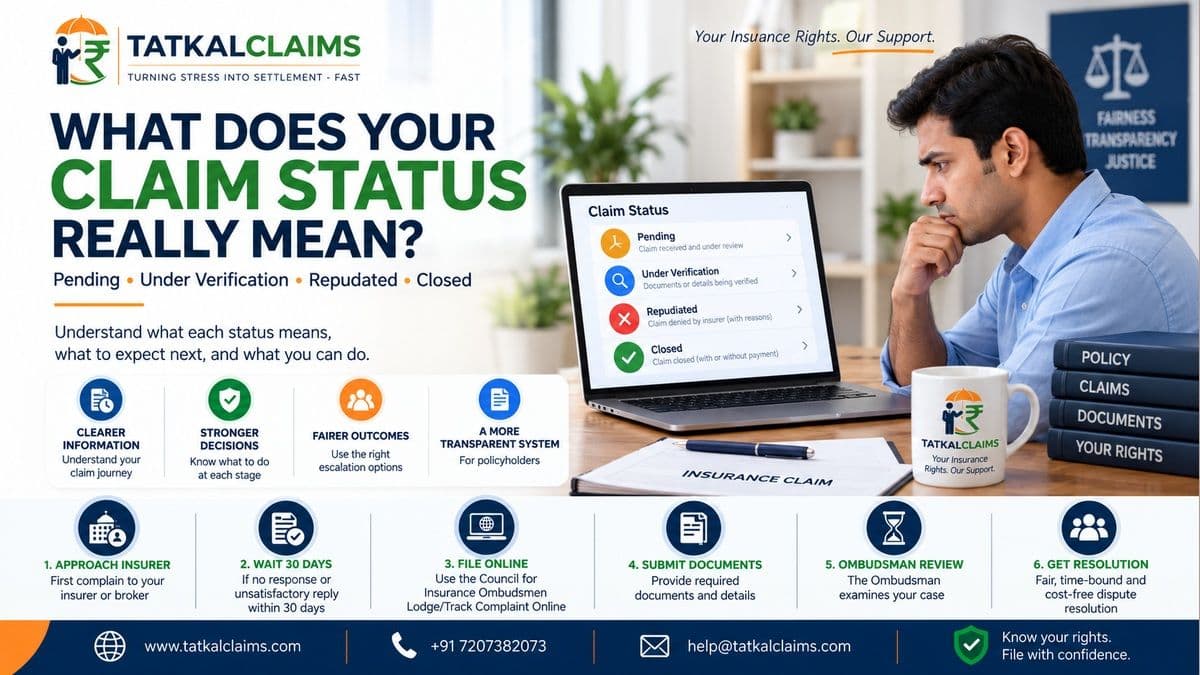
For confusing portal labels such as pending, verification, repudiated, closed or awaiting insurer concurrence, use our insurance claim-status guide.
TPA Says “Pending With Insurer”; Insurer Says “Contact TPA”
This is the most common accountability failure. The way out is to force both parties onto one written timeline.
Send one email or grievance to the insurer and copy the TPA. State the claim/pre-auth number, hospital, date and time of submission, every query and response, the last status shown and the exact question you need answered: “Who currently owns the next action, and what action remains pending?”
If the TPA says it sent the file to the insurer, ask for the date/time of that handoff and whether insurer concurrence is pending. If the insurer says the TPA is still processing, ask what specific TPA task remains incomplete and whether anything is required from you or the hospital.
| Question | Why ask it |
| What exact stage is the claim at? | Separates query, medical review, concurrence and payment |
| Who owns the next action? | Names the responsible party |
| When was the file handed to that party? | Creates an accountable timeline |
| Is anything pending from the hospital or claimant? | Prevents hidden document gaps |
| If a medical query is open, what exactly is the query? | Stops generic ‘documents pending’ responses |
| Has insurer concurrence been requested or received? | Tests whether TPA processing is complete |
| If denied, what policy clause and medical/factual reason apply? | Creates an appealable decision |
| If approved, has payment/final authorisation been released? | Separates adjudication from payment |
TPA Keeps Raising New Document Queries
Repeated or piecemeal queries can make a claim appear permanently incomplete. Do not answer only by phone. Maintain a query register with date, exact request, who raised it, who replied, what document was supplied and whether the query was closed.
Ask the TPA to consolidate outstanding requirements in one written list where possible. If the request is medical, ask the hospital’s insurance desk or treating team to respond directly with the relevant discharge summary, indoor case paper, investigation, doctor clarification or other record.
If a requested document does not exist, say so and offer the closest available record rather than leaving the portal silent. For example, if the TPA asks for an old prescription that is unavailable, explain that in writing and provide whatever medical history or treating-doctor clarification can reasonably address the question.
If the query appears unrelated to the policy issue, ask why the document is necessary for adjudication. That question is more useful than simply refusing to cooperate.
If you need the insurer’s or claim administrator’s underlying medical opinion, investigation material or claim-file evidence, use our claim-file evidence guide.
TPA Delaying a Reimbursement Claim
IRDAI’s current Health Department guidance lists 15 days as the turnaround time for claims other than cashless. Again, first identify the correct trigger and whether required claim material is complete; do not count blindly from the day you first called the helpdesk.
For a reimbursement claim, ask for the claim-receipt date, whether the file is complete, any outstanding query, date of last document received, current adjudication stage and who currently owns the file.
If the TPA says “approved” but payment has not arrived, you have moved into a different problem: approval/payment authorisation and banking trace. Ask for the insurer-approved amount, payment-authorisation status and transaction reference rather than continuing to chase the TPA for medical review.
If the claim is already approved but the money has not reached you, use our approved-but-payment-not-received guide.
If reimbursement is finally rejected or short-settled, switch from delay language to a decision challenge. Obtain the settlement sheet or repudiation reason and attack the exact deduction, exclusion or medical conclusion.
What If the Hospital Says “The TPA Is Not Responding”?
Ask the hospital insurance desk for the actual submission evidence, not only a verbal statement. You need the pre-auth/discharge request time, portal acknowledgement, query history and last communication.
Sometimes the hospital has submitted an incomplete form, missed a query, used the wrong package or diagnosis code, or has not uploaded the final bill. In that situation, the TPA may genuinely be waiting for the hospital. The patient needs the bottleneck identified, not a blame narrative.
If the hospital shows that it submitted a complete request and the TPA/insurer has not acted within the applicable cashless timeframe, escalate in writing to the insurer with the hospital’s timestamps attached.
At discharge, also ask whether the hospital can provide a printout or screenshot of the pending cashless request and any query. That record can be important if you later have to pay and seek reimbursement.
Who Should You Complain To: TPA or Insurer?
For operational troubleshooting, contact both if that is the established claims channel. But for a formal unresolved grievance, do not rely on a TPA ticket alone. Raise the complaint with the insurer’s Grievance Redressal Officer and identify the TPA, claim number and service failure in the facts.
IRDAI’s Bima Bharosa FAQ says that where you have a grievance against an insurance company or its intermediary/agent, you should approach the insurer’s Grievance Redressal Officer, give the complaint in writing with supporting documents and obtain acknowledgement. The insurer should resolve the complaint within 15 days of receipt.
This is especially important where the complaint is not merely “the TPA did not answer my call” but that the policy benefit, cashless timeline, claim decision or reimbursement settlement is affected.
| Problem | Primary escalation record |
| TPA call-centre/service issue only | TPA complaint + copy insurer if unresolved |
| Cashless pre-auth/final discharge delay | Insurer/GRO + TPA + hospital timestamps |
| TPA says denied but insurer decision unclear | Ask insurer for final position and clause |
| Repeated document queries | Insurer/GRO with complete query-response log |
| Reimbursement delay | Insurer/GRO with claim receipt and last-document timeline |
| Approved claim not paid | Insurer payment escalation; obtain UTR/payment status |
| Final rejection/short settlement | Insurer grievance challenging exact reason/calculation |
When to Use Bima Bharosa
If the insurer does not resolve the grievance within the prescribed grievance timeline or the response is unsatisfactory, Bima Bharosa provides IRDAI’s grievance-registration and tracking route.
Upload a clean evidence pack: policy number, claim/pre-auth number, insurer complaint acknowledgement, TPA correspondence, hospital timestamps, query-response log, denial/settlement communication and the remedy you want.
Do not send a hundred screenshots without a chronology. A one-page date table showing who held the file on each date makes the complaint much easier to understand.
For choosing between regulatory grievance escalation and the Ombudsman route, see our Bima Bharosa vs Insurance Ombudsman guide.
When the Insurance Ombudsman May Be Relevant
The Insurance Ombudsman route is directed at grievances against an insurer or insurance broker, not a standalone service ticket against a TPA. That is another reason to frame the policy dispute against the insurer while documenting the TPA’s conduct as part of the evidence.
The current CIO complaint portal says you should first have complained to the insurance company or broker. An eligible complaint can then proceed if you are dissatisfied with the response or there is no reply within one month, subject to the one-year filing rule, ₹50 lakh compensation limit and restriction on the same subject matter already being before or disposed of by a court, consumer forum or arbitrator.
If the case has reached that stage, use our Insurance Ombudsman complaint guide.
A live cashless emergency is usually not helped by waiting for an Ombudsman process to solve tonight’s discharge. Use the immediate insurer escalation first; preserve the record for formal redress if the delay or denial remains unresolved.
Sample TPA–Insurer Escalation Wording
A concise escalation can say: “Claim/pre-authorisation no. ___ was submitted by ___ Hospital at ___ on ___. The TPA currently shows/statuses the matter as ___. The hospital/claimant supplied the requested documents at ___ on ___. Please confirm (1) the exact current stage, (2) whether anything remains pending from the hospital or claimant, (3) who currently owns the next action, (4) whether insurer concurrence has been sought/received, and (5) the expected decision time under the applicable IRDAI turnaround requirement.”
If the TPA says the claim is denied, add: “Please confirm whether this is only a cashless/TPA operational decision or the insurer’s final claim decision. If final, please provide the insurer’s written reason, the policy clause relied on and the medical/factual basis.”
Do not threaten every forum in the first email. The objective is to create an answerable record: stage, owner, missing item, decision and remedy.
A Practical 48-Hour Action Plan
| Time | Action |
| Hour 0 | Get the claim/pre-auth number and hospital submission timestamp. |
| Hour 1 | Ask for exact status, query and owner of next action; save screenshot/email. |
| If query raised | Get hospital response submitted immediately and save acknowledgement. |
| If pre-auth/discharge TAT crossed | Escalate to insurer in writing and copy TPA/hospital. |
| Same day | Ask whether insurer concurrence is pending and when TPA handed over the file. |
| If cashless denied | Get written reason; decide whether reimbursement must be filed. |
| Within 24 hours | Open insurer GRO grievance if blame-shifting/delay remains unresolved. |
| Within 48 hours | Organise chronology and prepare Bima Bharosa record if the grievance route is not resolving the issue. |
How Tatkal Claims Can Help
Tatkal Claims can review the policy, cashless/reimbursement record, TPA portal history, hospital submissions, query trail and insurer communications to identify where the claim is actually stuck and who should be taking the next action.
Where the issue has become a formal dispute, assistance can include reconstructing the TPA–insurer handoff, checking the applicable IRDAI turnaround time, obtaining a reasoned insurer decision, organising the evidence pack and preparing the insurer grievance, Bima Bharosa record or Ombudsman complaint where eligible. Every claim depends on its policy and medical facts, and no outcome can be guaranteed.
Frequently Asked Questions
Frequently asked questions
Is a TPA the same as my health insurance company?
No. IRDAI’s current guidance describes a TPA as a registered company engaged by an insurer to provide services such as cashless and claims administration. It acts as an intermediary; the insurer is the entity that issued and underwrites the policy.
Can a TPA reject my cashless request?
A TPA can administer the cashless workflow and may communicate an operational denial or recommendation within the insurer’s process. Do not assume every portal ‘denied’ label is the insurer’s final repudiation. Ask whether insurer concurrence exists and request the insurer’s reasoned final position if the adverse decision is final.
Who is responsible if the TPA delays cashless approval?
IRDAI’s current cashless TATs are framed as insurer obligations, and insurers must monitor TPA performance and service levels. If the TPA is the operational bottleneck, escalate to the insurer with the hospital submission and query timestamps rather than chasing only the TPA.
How long can a cashless pre-authorisation take?
IRDAI’s current Health Department guidance says the insurer should decide a cashless pre-authorisation request immediately but not later than one hour from receipt of the request.
How long can final discharge authorisation take?
IRDAI’s current guidance says the insurer should grant final authorisation within three hours from receipt of the hospital’s discharge-authorisation request.
What if the TPA keeps asking for documents one by one?
Maintain a written query-response log, ask for a consolidated list of outstanding requirements where possible, and copy the insurer if repeated queries are delaying the claim. Ask why any unusual document is necessary for adjudication.
If cashless is denied, is my health claim finally rejected?
Not necessarily. Cashless is a payment facility. Depending on policy terms and admissibility, you may still be able to pay the hospital and file a reimbursement claim. Obtain the cashless denial reason and preserve the full claim file.
What if the TPA says ‘pending with insurer’?
Ask when the file was sent to the insurer, whether insurer concurrence is pending, what exact action the insurer must take and whether anything remains pending from you or the hospital. Send the same questions to the insurer in writing.
Should I complain to the TPA or the insurer?
Use the TPA for operational troubleshooting, but raise a formal unresolved grievance with the insurer’s GRO and describe the TPA conduct in the complaint. Bima Bharosa’s current FAQ directs policyholders with grievances against an insurer or its intermediary/agent to the insurer’s grievance channel first.
Can I approach the Insurance Ombudsman for a TPA delay or denial?
The Ombudsman complaint is framed against an insurer or insurance broker. If the TPA conduct affected your policy claim, complain first to the insurer and preserve the TPA evidence. Then check the current Ombudsman eligibility, monetary, limitation and parallel-proceeding conditions.
Sources and Methodology
Disclaimer: This guide explains current IRDAI policyholder guidance, TPA accountability principles and practical escalation steps in general terms. The insurer–TPA workflow, medical-admissibility decision, applicable turnaround trigger, reimbursement requirements and grievance remedy depend on the policy, hospital submissions, claim documents and facts. A cashless denial is not automatically proof that the underlying reimbursement claim is payable. This is not a substitute for case-specific legal or medical advice.