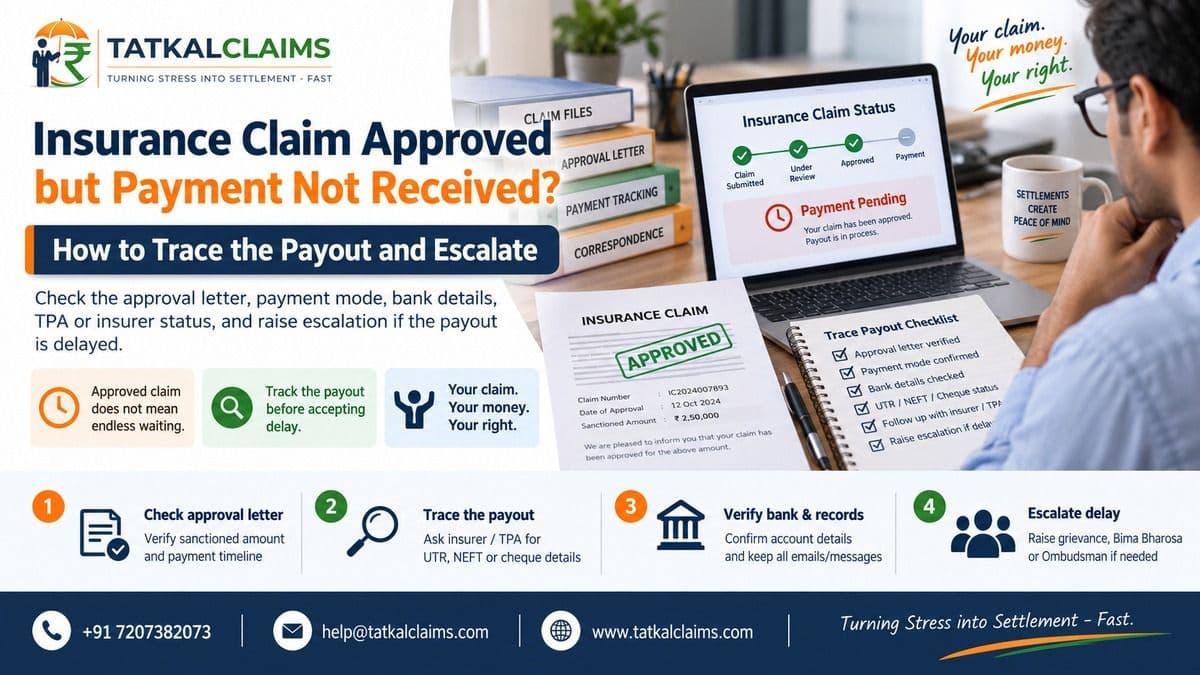
Your insurer says the claim is approved, admitted, settled or ready for payment—but the money has not reached your bank account. That is not the same problem as a claim that is still under assessment, and it is not automatically a rejection. The immediate task is to separate the claim decision from the payment process and find the exact point where the payout has stalled.
Do not keep asking only, “When will I get the money?” Ask for evidence of each stage: the approved amount, approval or settlement date, payment-authorisation date, transfer mode, UTR or transaction reference, value date, beneficiary details used and any bank-return or failure reason. A portal label such as “approved”, “settled”, “released” or “closed” is useful evidence, but it is not the same as actual credit.
This guide is for an ordinary insurance claim where the insurer has already accepted the claim or an amount but the claimant has not received the payout. If the payment is due under an Insurance Ombudsman award, a different post-award compliance framework applies.
What Does “Claim Approved” Actually Mean?
Insurance systems use status words differently. “Approved” may mean that the claim is admissible, that a particular amount has been approved, that a TPA has recommended payment, that an insurer has authorised payment, or simply that one internal stage is complete. Those are not interchangeable.
The safest approach is to identify who gave the approval, what amount was approved, whether the approval is final or provisional, and whether the payment instruction has actually left the insurer. If a TPA is involved, ask whether the status is only the TPA’s recommendation or the insurer’s final decision.
| Status or message | What it may establish | What to ask next |
|---|---|---|
| Approved / admitted | Claim or amount has been accepted at some stage | Approved amount, approving authority and whether approval is final |
| TPA approved / recommended | TPA has completed its part or made a recommendation | Has the insurer concurred and authorised payment? |
| Payment authorised | Internal authority to pay may exist | When was the transfer instruction created? |
| Payment initiated / released | Transfer may have been sent to the banking channel | UTR/reference, value date, beneficiary account and transfer status |
| Payment failed / returned | Banking transaction did not complete | Failure code, return reason and re-initiation date |
| Settled / closed | System considers the claim concluded | Settlement sheet, amount paid, UTR and proof of credit |
| Paid | Insurer records payment as completed | UTR, value date and bank trace if your account shows no credit |
First Prove Exactly What the Insurer Approved
Before escalating, preserve the strongest evidence of the insurer’s decision. A call-centre assurance is weaker than a written approval letter, settlement advice, email, portal screenshot or claim-status record showing the admitted amount.
Check whether the approved amount is the full claim, a partial settlement, or a provisional figure subject to a remaining formality. If the amount itself is disputed, the issue may be a short-settlement dispute rather than only a payment delay. If the insurer has accepted the amount and only the transfer is missing, keep the complaint narrowly focused on payment.
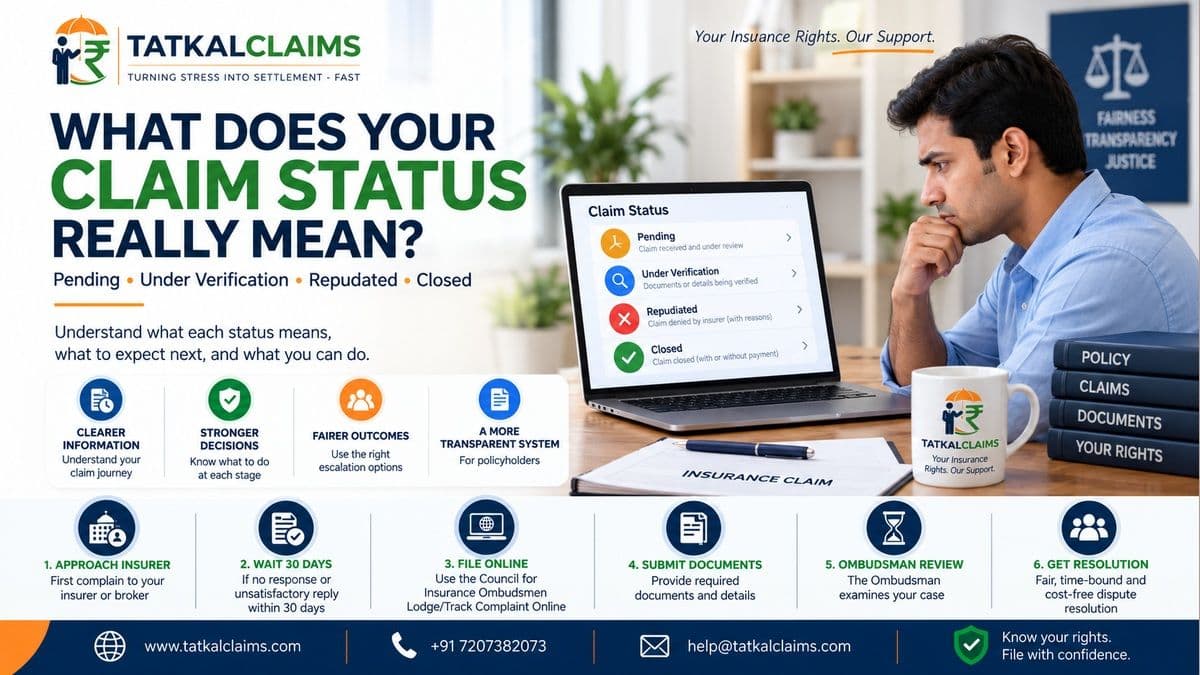
If the portal language itself is unclear—such as approved, under process, repudiated, closed or awaiting insurer concurrence—use our insurance claim status guide to identify whether you really have a final approval or only an intermediate workflow status.
Build an Approved-but-Unpaid Payment File
Create one folder or indexed PDF containing the claim decision and the payment evidence. This prevents the insurer from treating every follow-up as a new customer-care query and gives the grievance team a clean chronology.
| Document | Why it matters |
|---|---|
| Approval / settlement letter or portal screenshot | Shows that the insurer has admitted the claim or amount |
| Settlement sheet / calculation | Shows the exact approved amount and deductions |
| Policy and claim number | Identifies the contract and claim record |
| Bank details already submitted | Helps test whether payment failed because of beneficiary data |
| Cancelled cheque / bank proof / KYC acknowledgement, if requested | Shows whether payment formalities were completed |
| Emails, SMS and complaint acknowledgements | Creates the date-wise payment trail |
| Bank statement covering the expected payment period | Shows non-receipt or a later credit |
| UTR / transaction reference, if supplied | Allows payment tracing with the bank |
| Bank-return or failure message, if any | Identifies whether the transfer failed and why |
Ask the Insurer These Questions in Writing
A useful follow-up forces the insurer to answer the payment mechanics rather than repeat “your claim is settled”. Ask for a written response to each point.
| Question | Why ask it |
|---|---|
| What exact amount has been approved? | Separates payout delay from a dispute over quantum |
| On what date was the amount approved or admitted? | Fixes the insurer’s decision chronology |
| Has payment been authorised by the insurer’s finance/payment team? | Separates claim approval from payment approval |
| On what date was the transfer instruction created? | Shows whether payment processing actually started |
| What is the UTR or transaction reference? | Lets you trace a claimed transfer |
| What value date and transfer mode were used? | Helps the bank locate the transaction |
| Which beneficiary account details were used? | Detects account, IFSC or beneficiary mismatch |
| If the transfer failed or was returned, what was the failure reason and re-initiation date? | Forces a concrete correction plan |
Common Reasons an Approved Insurance Claim Is Still Unpaid
1. Approval Has Not Yet Reached the Payment Team
Some insurers separate claim adjudication from finance or treasury processing. The claim may be approved while the payment instruction is still waiting for internal authorisation. Ask for the payment-authorisation date and the expected transfer date, not another copy of the approval message.
2. Bank Details Failed Validation
A closed account, wrong account number, invalid IFSC, beneficiary-name mismatch or incomplete bank/KYC record can stop or reverse a transfer. Ask the insurer to state the exact beneficiary details used and whether the bank returned the transaction. If you need to correct details, send the correction through the insurer’s documented channel and keep the acknowledgement.
3. The Insurer Has a UTR but Your Account Shows No Credit
A UTR or equivalent banking reference gives you something concrete to trace. Give the reference, amount and value date to your bank and ask for a written trace. At the same time, ask the insurer whether the transaction shows success, pending, returned or reversed in its banking record.
4. The Portal Says “Settled” or “Closed” Without Payment
Do not assume “closed” proves payment. Ask for the closure reason, settlement amount, payment date, transfer reference and beneficiary details. If the insurer cannot provide payment evidence, state in writing that the claim may be administratively closed but the approved amount remains unpaid.
5. The TPA Has Recommended the Claim but the Insurer Has Not Paid
In health insurance, a TPA can process claims and communicate workflow stages, but the insurer remains central to the final claim decision and payment obligation. Ask whether the TPA’s approval is merely a recommendation, whether insurer concurrence has been received, and who currently owns the payment action.
6. A Settlement or Discharge Form Is Still Pending
If the insurer says payment is blocked because a settlement voucher, discharge form or acceptance is pending, first check whether you agree with the amount and wording. Do not sign a “full and final” document mechanically if the settlement amount itself is disputed. Ask the insurer to identify exactly what document is required and why. A separate dispute can arise where the claimant says a discharge voucher was obtained under pressure or was not a genuine settlement; that is different from a simple payment-processing delay.
7. An Older Settled Amount Has Become Unclaimed
For older cases, especially where contact or bank details changed, check whether the amount is reflected through the insurer’s unclaimed-amount mechanism. Bima Bharosa provides links for checking unclaimed amounts with insurers. This is a useful fallback for stale payouts, but it does not replace a live payment grievance where the insurer has just approved the claim.
How Long Can an Insurer Take After a Claim Is Approved?
There is no single universal rule that says every insurer must credit every approved claim within a fixed number of days from the date a portal first shows “approved”. The regulatory clock depends on the product and claim type. The approval date is still useful evidence, but it may not be the legal trigger for the applicable settlement timeline.
IRDAI’s current policyholder-protection framework sets different turnaround times for life, health and retail general insurance. Where the claim is not settled within the applicable specified timeline, the framework provides for interest at the bank rate plus 2 percent from the date of receipt of claim intimation until payment, to be paid suo motu with the claim amount.
| Type of claim | Current regulatory timeline / trigger | Why it matters here |
|---|---|---|
| Health cashless pre-authorisation | Decision within 1 hour of request | This is an authorisation TAT, not proof that a later bank transfer to you has occurred |
| Health cashless final bill authorisation | Within 3 hours of discharge-authorisation request | Relevant to hospital cashless settlement, not the same as reimbursement credit |
| Health claim other than cashless | 15 days | If the reimbursement is approved but unpaid, check whether this settlement TAT has already expired |
| Life death claim not requiring investigation | Within 15 days from claim intimation | Approval does not stop the settlement clock |
| Life death claim requiring investigation | Within 45 days from claim intimation | Use the investigation category actually applicable to the claim |
| Life surrender / partial withdrawal | Within 7 days of request | Payment timing follows the specific life-service rule |
| Life maturity / survival / annuity / income benefit | On due date | A missed due payment should be treated as a payment problem, not a fresh claim decision |
| Retail general claim involving survey | Insurer decision within 7 days of survey report or expiry of 15 days from surveyor allocation, whichever is earlier, subject to stated exceptions | After admission, keep tracing the actual payment until credit |
Do not copy a deadline from a different insurance product. For example, the current health-insurance TAT for non-cashless claims is 15 days, while life and retail general insurance use different triggers. If you are claiming delay interest, identify the rule that applies to your specific policy and claim first.
For a broader product-by-product explanation of the current regulatory deadlines and delay-interest framework, see our IRDAI claim timelines and delay rules guide.
Can You Claim Interest on an Approved but Unpaid Insurance Claim?
Potentially, yes—if the claim has crossed the settlement timeline applicable to that product and claim. The current IRDAI framework provides for interest at the bank rate plus 2 percent in delayed-settlement situations covered by the relevant rules. Do not calculate interest simply from the internal approval date unless that date is also the correct regulatory trigger.
In your grievance, identify the claim-intimation date, the applicable regulatory timeline, the date the insurer approved or admitted the claim, the date payment was actually credited, and the interest period you say follows from the applicable rule. Ask the insurer to provide its own interest calculation and explain any difference.
Avoid hard-coding a rupee interest rate into a complaint unless you have checked the bank rate that applies for the relevant period. The safer demand is to cite the regulatory formula, dates and principal amount and ask for the insurer’s calculation.
How to Escalate an Approved Claim When the Payment Still Does Not Arrive
Step 1: Send a Payment-Trace Request to Claims / Customer Service
Attach the approval proof and ask for the approved amount, transfer date, UTR/reference, value date, beneficiary details and failure reason. Give a short deadline for a substantive written response. Avoid relying only on phone calls.
Step 2: Escalate to the Insurer’s Grievance Redressal Officer
If the claims team does not resolve the payment issue, file a formal grievance with the insurer’s GRO. State that the claim has already been approved and the grievance concerns non-receipt of the admitted amount. Attach the decision, bank proof and all payment-trace requests.
Step 3: Register the Grievance on Bima Bharosa / IRDAI
Bima Bharosa creates a formal grievance trail that flows to the insurer and the IRDAI repository. Use the insurer complaint acknowledgement, approval record, payment evidence and bank statement. Ask for release of the admitted amount, payment trace and applicable delay interest rather than reopening the merits unnecessarily.
If you are deciding how Bima Bharosa differs from the Insurance Ombudsman and when each route fits, use our Bima Bharosa vs Insurance Ombudsman comparison.
Step 4: Consider the Insurance Ombudsman if the Preconditions Are Met
The Insurance Ombudsman Rules expressly include delay in settlement beyond regulatory timelines among the matters the Ombudsman can consider. You must first make a written/electronic/online representation to the insurer. A complaint can then become maintainable where the insurer rejects the complaint, gives an unsatisfactory response, or does not reply within one month, subject to the other jurisdictional and timing conditions.
The current rules generally require the Ombudsman complaint within one year from the relevant rejection, unsatisfactory decision, or expiry of the one-month no-reply period, with a power to condone delay in appropriate cases. The same subject matter also cannot already be pending before or disposed of by a court, consumer forum or arbitrator.
Before filing, check the eligibility, monetary limit, documents and procedure in our Insurance Ombudsman complaint guide.
What If the Unpaid Amount Comes From an Insurance Ombudsman Award?
That is a different stage. Once an Ombudsman has passed an award in your favour, the issue is no longer merely an ordinary approved claim waiting for payment. Rule 17 contains a specific post-award compliance framework, including a 30-day period from the insurer’s receipt of the award.
If your payment is due under an Ombudsman award, use our dedicated Ombudsman award non-compliance guide rather than treating the matter as an ordinary payout delay.
What to Write in an Approved-but-Unpaid Claim Grievance
Keep the grievance short enough to read and precise enough to investigate. State: “The insurer has approved/admitted ₹___ under claim no. ___. The amount has not been credited. Please confirm the payment-authorisation date, UTR/transaction reference, value date, beneficiary account details used, current transfer status and any failure/return reason. If the applicable settlement timeline has expired, please also calculate and pay the delay interest required under the applicable IRDAI framework.”
If the insurer now gives a new reason that appears to withdraw or reduce an earlier approval, ask for the revised decision in writing, the policy clause or factual basis relied on, and an explanation of why the previously communicated approval has changed. A portal approval can sometimes be provisional, so the exact written record matters.
A Practical 7-Day Action Plan
| Day | Action |
|---|---|
| Day 1 | Save the approval/settlement proof, approved amount and claim number |
| Day 2 | Check the bank account and confirm the beneficiary details previously supplied |
| Day 3 | Send a written request for payment authorisation date, UTR/reference, value date and transfer status |
| Day 4 | If a UTR exists, ask your bank to trace it; if payment failed, send corrected bank details through the insurer’s official channel |
| Day 5 | Calculate whether the product-specific regulatory settlement timeline has already expired |
| Day 6 | Escalate to the insurer’s GRO with the complete chronology and payment evidence |
| Day 7 | If unresolved, prepare the Bima Bharosa / appropriate external escalation record and preserve all acknowledgements |
If the insurer has not actually approved the claim and the file is still being assessed, use our general claim-delay guide instead; it covers pending documents, verification, investigation and decision-stage delay.
How Tatkal Claims Can Help
Tatkal Claims can review the approval or settlement communication, reconstruct the claim and payment timeline, identify whether the problem is an internal payment hold, bank-transfer failure, TPA-versus-insurer handoff, short settlement or a wider regulatory delay, and prepare a focused escalation record.
Where delay interest may apply, the first step is to identify the correct product-specific timeline and trigger rather than making a generic demand. Where the insurer says payment was made, the next step is to trace the transaction against the UTR, value date and beneficiary details. Every case depends on its documents, policy and claim history, and no outcome can be guaranteed.
Frequently Asked Questions
Frequently asked questions
Does “claim approved” mean the insurer has already paid me?
No. Approval can refer to admissibility or an approved amount, while payment authorisation and bank transfer may still be separate stages. Ask for the approved amount, payment-authorisation date, UTR or transaction reference, value date and beneficiary details used.
How many days does an insurer have to pay after approval?
There is no single universal deadline counted from an internal “approved” status for every insurance product. The applicable settlement timeline depends on the product and claim type. Check the current IRDAI rule that applies to your claim rather than using a blanket number.
What is a UTR and why should I ask for it?
A UTR or equivalent transaction reference identifies a bank transfer. If the insurer says payment was released but you did not receive it, the reference, amount and value date can help your bank trace whether the transfer succeeded, is pending, was returned or was reversed.
What if the insurer says the claim is paid but my bank account shows nothing?
Ask for the transaction reference, value date, transfer mode, beneficiary account details and transfer status. Then ask your bank to trace the transaction. If the transfer failed or was returned, ask the insurer for the failure reason and re-initiation date.
What if the TPA says the health claim is approved but the insurer has not paid?
Ask whether the TPA has only recommended or processed the claim, or whether the insurer has given final concurrence and payment authorisation. Request the insurer’s written decision and the payment reference rather than relying only on the TPA portal status.
Can the insurer change its mind after showing the claim as approved?
It depends on what the status actually represented. A portal approval can sometimes be an intermediate or provisional stage. If the insurer has issued a final written approval or admitted a specific amount and later changes position, ask for the revised decision, factual basis and policy clause in writing.
Can I claim interest if an approved claim is not paid on time?
Potentially, if the claim has crossed the settlement timeline applicable to that product and claim. Current IRDAI policyholder-protection rules provide for bank rate plus 2 percent in specified delayed-settlement situations. Identify the correct trigger and period before calculating the demand.
What if the payment failed because my bank details were wrong or the account was closed?
Give corrected bank details through the insurer’s official process, preserve the acknowledgement, and ask for the failed-transfer reference and re-initiation date. A corrected bank record should turn the problem into a traceable payment task.
Should I sign a discharge voucher before the insurer pays?
Read the wording and check whether you agree with the approved amount. If the document is described as full and final settlement and you dispute the quantum, do not treat the signature as a routine formality. Ask the insurer to explain the purpose and obtain case-specific advice where necessary.
When should I approach the Insurance Ombudsman for an approved but unpaid claim?
First make a written or electronic representation to the insurer. Under the Ombudsman Rules, the route can become available after rejection, an unsatisfactory response, or no reply within one month, subject to the monetary, limitation, jurisdiction and parallel-proceeding conditions. If you already hold an Ombudsman award, use the separate post-award compliance process.
Sources and Methodology
Disclaimer: This guide explains current regulatory principles and practical evidence steps in general terms. The applicable settlement timeline, interest entitlement, payment process, grievance route and legal remedy depend on the type of insurance, policy terms, claim facts, documents and forum. It is not a substitute for case-specific legal advice.