Winning an Insurance Ombudsman award should normally be the end of the dispute. But some policyholders face a second problem: the Ombudsman has decided in their favour, yet the insurer has not released the awarded amount.
This is a different problem from filing an Ombudsman complaint or appealing a rejected claim. The merits have already been decided at the Ombudsman stage. The immediate questions are whether the insurer received the award, whether the 30-day compliance period has expired, whether any challenge has been filed, whether there is an actual stay, and what amount is now due.
Do not treat silence after an award as an ordinary customer-service delay. Preserve the award, establish the insurer's receipt date, create a written non-compliance record and escalate the regulatory breach in a structured way.
What Does the Law Require After an Insurance Ombudsman Award?
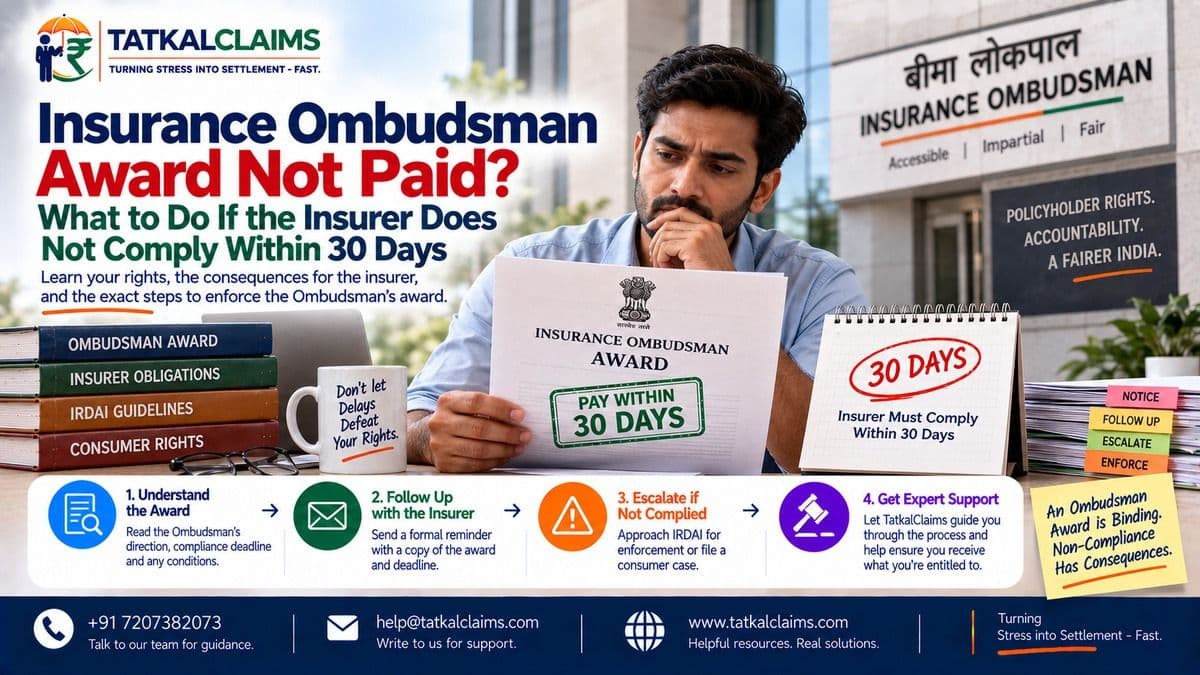
Rule 17(6) of the Insurance Ombudsman Rules, 2017, as amended, requires the insurer or insurance broker to comply with the award within 30 days of receipt and intimate compliance to the Ombudsman. The current rules also state that the award is binding on the insurer or insurance broker.
IRDAI's 2024 Master Circular on Protection of Policyholders' Interests adds an important enforcement consequence: where an insurer does not honour the Ombudsman award, ₹5,000 per day is payable to the complainant for each day of delay, in addition to penal interest under the Ombudsman framework. The circular separately addresses cases where the insurer chooses to challenge the award.
| Date | Why it matters | Where to verify |
|---|---|---|
| Award date | Shows when the Ombudsman decided the matter | Signed award |
| Date you received the award | Helps reconstruct the communication timeline | Email, portal, post or covering letter |
| Date insurer received the award | Starts the 30-day compliance period | Ombudsman record, email delivery, insurer acknowledgement or dispatch proof |
| Date payment actually reaches you | Determines whether delay continued after compliance deadline | Bank statement / payment reference |
First Check: Is Your Document a Recommendation or an Award?
The Ombudsman framework distinguishes mediation from an adjudicated award. A mediation recommendation under Rule 16 and an award under Rule 17 are not the same procedural document. This guide is about a Rule 17 award that decides the complaint after mediation has not resolved it.
Read the heading, operative directions and rule cited in the document. If it is a recommendation arising from mediation, follow the acceptance and compliance mechanism applicable to that recommendation rather than automatically applying the Rule 17 award timeline.
If it is a Rule 17 award in your favour, the award should state the compensation granted after deducting any amount already paid. That stated relief is the starting point for the compliance calculation.
Step 1: Confirm the Insurer Actually Received the Award
Before alleging non-compliance, establish the insurer's receipt date. The Ombudsman Rules require a copy of the award to be sent to the complainant and the insurer. In practice, the award may have been delivered through the Ombudsman system, email or other official communication.
If the receipt date is not clear from your copy, write to the Ombudsman office and the insurer asking for the recorded date of receipt. A clean timeline is important because the 30-day deadline and any later delay calculation depend on it.
| Document | Why keep it |
|---|---|
| Signed Ombudsman award | Primary proof of the decision and amount awarded |
| Covering email / dispatch communication | Helps establish transmission and receipt |
| Insurer acknowledgement | Can prove when the compliance clock began |
| Earlier complaint and claim file | Useful if the insurer later disputes calculation or scope |
| Bank details already supplied | Helps rebut claims that payment was delayed for want of payment instructions |
| Post-award emails / call logs | Shows follow-up and reasons given for non-payment |
| Bank statement | Shows whether and when the awarded amount was actually credited |
If you have not yet reached the award stage and are still preparing the complaint, use our Insurance Ombudsman complaint guide instead.
Step 2: Check Whether the Insurer Has Challenged the Award
An insurer may try to challenge an Ombudsman award before a competent court. IRDAI's current policyholder-protection circular requires insurers that prefer an appeal or challenge to act within the stated compliance framework. Do not accept a vague statement such as 'the matter is under legal review' as enough information.
Ask for the case number, court or forum, filing date, current status and—most importantly—whether any interim order or stay has actually been granted.
This distinction matters. In Oriental Insurance Co. Ltd. v. Office of Insurance Ombudsman, decided on 9 December 2024, the Bombay High Court criticised years of non-compliance and stated that merely instituting a petition did not operate as a stay on the Ombudsman award. The insurer had not secured interim relief.
Why the Bombay High Court Decision Matters
The 2024 Oriental Insurance case shows why policyholders should verify litigation rather than accept a generic 'appeal filed' response. The award in that case was dated 3 May 2021. The policyholder later approached the Bombay High Court seeking implementation, while the insurer filed its own challenge months after the award.
The High Court noted that the insurer had not obtained interim relief and that merely filing the petition did not suspend the award. It criticised the prolonged non-compliance and the absence of timely steps to challenge or secure a stay.
The practical lesson is narrow but important: ask for documentary proof of the challenge and the interim order. Whether a particular award is presently enforceable still depends on the actual court record and directions in that case.
| Question | Why it matters |
|---|---|
| What is the case number? | Confirms that a proceeding was actually filed |
| Which court or forum? | Lets you independently verify the case |
| What was the filing date? | Relevant to the regulatory 30-day framework |
| Has notice been issued? | Shows the procedural stage |
| Is there an interim stay? | A filing by itself is not the same as a stay |
| What part of the award is stayed? | A stay may be limited rather than covering the entire award |
| What is the next date? | Lets you track the challenge rather than relying on verbal updates |
Step 3: Work Out What May Be Payable After Non-Compliance
There can be more than one monetary component. First is the amount awarded by the Ombudsman. Second is interest contemplated by Rule 17(7), linked to the rate specified under the applicable regulatory framework from the date the claim ought to have been settled until payment. Third, IRDAI's current policyholder-protection framework provides for ₹5,000 per day for failure to honour the Ombudsman award within the applicable period.
Do not combine these into a rough lump-sum demand without showing the calculation. State the awarded amount separately, identify the interest basis separately, and calculate any per-day non-compliance amount from the correct trigger date.
| Component | What to verify |
|---|---|
| Ombudsman award amount | Exact amount and directions in the signed award |
| Interest under Rule 17(7) | Applicable rate, start date and end date |
| ₹5,000-per-day non-compliance amount | Whether the 30-day period expired without compliance and whether the challenge exception applies |
| Costs / other directions | Only if expressly included in the award or applicable order |
What If the Insurer Pays Only Part of the Award?
Partial payment does not automatically prove full compliance. Match the amount received against the exact operative directions in the award. Check whether the insurer has paid only the principal amount while leaving interest, costs or another expressly directed component unpaid.
Ask the insurer for a written settlement sheet showing how it calculated the payment. If it has deducted tax, set-off, prior payment or another amount, ask for the legal or contractual basis and supporting calculation.
If the award directs reconsideration or another non-cash action rather than a simple lump-sum payment, verify whether the insurer has actually performed that direction. Compliance should be tested against the operative part of the award, not merely against whether some money was transferred.
| Check | Question to ask |
|---|---|
| Principal amount | Does the credit equal the amount directed in the award? |
| Interest | Was applicable interest included through the actual payment date? |
| Other directions | Did the insurer perform any reconsideration, restoration or document action ordered? |
| Deductions | Is every deduction explained and supported? |
| Payment proof | Do UTR, value date and beneficiary details match your account? |
Build a Post-Award Enforcement Packet Before You Escalate
Keep one indexed PDF or folder containing the award, proof of insurer receipt, the original claim and grievance references, your bank details, insurer post-award correspondence, proof of non-receipt or partial receipt, and any court papers supplied by the insurer.
This prevents the dispute from fragmenting across customer-care tickets. Every escalation—to the GRO, Ombudsman office, Bima Bharosa or a legal forum—should rely on the same chronology and evidence set.
| Section | Documents |
|---|---|
| A. Award | Signed award, covering communication, complaint/award number |
| B. Receipt proof | Email delivery, acknowledgement, dispatch/portal record |
| C. Payment record | Bank details supplied, statement, UTR if any, settlement sheet |
| D. Non-compliance correspondence | GRO notice, insurer replies, call/email chronology |
| E. Court challenge | Petition, case number, filing date, interim/stay order if any |
| F. Calculation | Award amount, interest basis, delay days and claimed regulatory consequence |
Step 4: Send a Formal Non-Compliance Notice to the Insurer
Once the 30-day period has expired and you have no evidence of compliance or a valid stay, send a concise written notice to the insurer's Grievance Redressal Officer and appropriate claims/compliance team. Avoid sending only repeated customer-care emails.
Your notice should identify the policy number, claim number, Ombudsman complaint number, award number and date, the insurer's receipt date if known, the 30-day deadline, the unpaid amount, and the relief you now seek. Attach the award and earlier follow-up.
Ask for a written response stating either: (a) payment reference and value date; or (b) details of any challenge, including the case number and interim order. This turns an open-ended delay into a defined compliance question.
For ordinary claim delays before an Ombudsman award exists, use our general claim-delay guide; this guide specifically addresses the post-award stage.
Step 5: Notify the Ombudsman Office of Non-Compliance
Rule 17(6) does more than require payment: the insurer must intimate compliance to the Ombudsman and upload the compliance details in the complaints-management system. If you remain unpaid after the deadline, notify the Ombudsman office that issued the award and provide your award number, insurer receipt date if available, follow-up correspondence and bank proof showing non-receipt.
Ask the office to record the non-compliance against the complaint and confirm whether the insurer has reported compliance or communicated any challenge. The Ombudsman office may not function as an execution court, but the compliance record itself can be important evidence.
Step 6: Escalate the Regulatory Non-Compliance Through Bima Bharosa / IRDAI
Bima Bharosa can be used to create a formal regulatory grievance trail and request review of an insurer's conduct. Frame the issue accurately: the complaint is no longer merely that the original claim was rejected or delayed; it is that an Ombudsman award has allegedly not been complied with within the regulatory timeframe.
Upload the award, proof of the insurer's receipt if available, your post-award notice, insurer responses, and proof that payment has not been received. State the exact compliance rule you rely on and ask the insurer to disclose any pending legal challenge and stay.
If you are deciding between grievance channels before an Ombudsman award, see our Bima Bharosa vs Insurance Ombudsman comparison.
Bima Bharosa should not be described as a substitute execution court or as a guarantee that IRDAI will directly recover money for you. Its value here is regulatory escalation, documentation and insurer accountability.
Do Not Accidentally Reopen the Original Claim Merits
Once you already hold an Ombudsman award in your favour, a post-award non-compliance complaint should normally focus on implementation: receipt date, deadline, amount due, payment status, challenge status and stay status.
Re-arguing every medical record, survey finding or policy exclusion can obscure the issue. Keep the original merits file available, but lead the new escalation with the award and the compliance failure unless the insurer's court challenge makes the underlying merits directly relevant again.
Step 7: Consider Formal Legal Enforcement if the Award Still Is Not Honoured
If payment still does not follow, the next legal route depends on the facts: the nature of the policy, the wording of the award, whether the insurer has filed a court challenge, whether there is a stay, the amount involved, limitation considerations and what relief is being sought.
The Bombay High Court's 2024 Oriental Insurance decision is particularly useful because the policyholder had approached the High Court seeking implementation of an Ombudsman award while the insurer later challenged the same award. The Court criticised the insurer's prolonged non-compliance without interim relief.
That does not mean every policyholder should automatically file the same proceeding. Consumer remedies, writ or other legal proceedings can raise different jurisdictional and procedural questions. Obtain case-specific legal advice before choosing the forum.
Keep the complete award and post-award record together with the underlying claim file. If you still need survey reports, investigator findings or other insurer evidence, use our claim-file evidence guide.
What If the Insurer Says 'Payment Is Approved' but Nothing Has Reached Your Account?
Post-award non-payment can sometimes be disguised as a payment-processing issue: 'approved', 'released', 'NEFT initiated', 'awaiting finance approval' or 'bank validation pending'. Ask for the UTR or transaction reference, value date, beneficiary details used and the amount transferred.
A status label is not proof of payment. The practical endpoint is credit of the correct amount, together with any interest or other amount lawfully due.
Our claim-status guide explains why an internal status such as approved or closed does not necessarily mean money has been received.
Common Mistakes After Winning an Ombudsman Award
| Mistake | Better approach |
|---|---|
| Counting 30 days from the wrong date | Establish when the insurer received the award |
| Only calling customer care | Create a written non-compliance record |
| Accepting 'legal review' without details | Ask for case number, filing date and stay order |
| Demanding one unexplained lump sum | Separate award, interest and per-day consequences |
| Assuming a filed petition automatically stays payment | Verify whether interim relief actually exists |
| Starting multiple legal proceedings without advice | Check jurisdiction, limitation and effect of parallel proceedings |
| Losing bank/payment records | Preserve proof of non-receipt and any later credit |
A Practical 7-Day Action Plan
| Day | Action |
|---|---|
| Day 1 | Collect the signed award, award number, policy/claim numbers and all post-award correspondence |
| Day 2 | Confirm the insurer's receipt date and calculate the 30-day deadline |
| Day 3 | Check whether the insurer claims to have filed a court challenge; ask for case and stay details |
| Day 4 | Prepare a written compliance calculation separating award amount, interest and any additional regulatory consequence |
| Day 5 | Send a formal non-compliance notice to the GRO / claims / compliance team |
| Day 6 | Notify the Ombudsman office and lodge/update the regulatory grievance trail |
| Day 7 | If unresolved, review the appropriate legal enforcement route with the complete record |
How Tatkal Claims Can Help After an Ombudsman Award Is Not Paid
Tatkal Claims can review the Ombudsman award, reconstruct the compliance timeline, identify what amount is actually outstanding, organise the insurer's post-award correspondence, and prepare a focused escalation record.
Where the insurer claims to have challenged the award, the first task is to verify the proceeding and any interim order rather than relying on a verbal statement. Where there is no effective compliance or stay, the next step can then be assessed on the actual documents and forum options.
Frequently asked questions
How long does an insurer have to comply with an Insurance Ombudsman award?
Rule 17(6) requires compliance within 30 days of the insurer receiving the award. The insurer must also intimate compliance to the Ombudsman and upload the details in the complaints-management system.
Is an Insurance Ombudsman award binding on the insurer?
Yes. Rule 17(8) states that the award is binding on the insurer or insurance broker, subject to the legal framework governing any court challenge.
Does the 30-day period start from the award date?
Not necessarily. The rule uses receipt of the award by the insurer as the trigger. Establish that receipt date before calculating default.
What happens if the insurer does not pay within 30 days?
IRDAI's current policyholder-protection framework provides for ₹5,000 per day payable to the complainant for non-compliance, in addition to applicable penal interest, subject to the provisions dealing with an insurer's challenge to the award.
Can an insurer challenge an Ombudsman award?
Insurers have approached constitutional courts to challenge Ombudsman awards. If the insurer says it has challenged your award, ask for the case number, filing date, forum and any interim or stay order.
Does filing a court case automatically stay the Ombudsman award?
Do not assume so. In a 2024 Bombay High Court decision, the Court expressly noted that merely instituting a petition did not operate as a stay where no interim relief had been secured.
Should I contact the Ombudsman office again after the award?
Yes, if the insurer has not complied. Notify the issuing Ombudsman office, provide the award and non-payment record, and ask whether the insurer has reported compliance or any challenge.
Can I use Bima Bharosa after receiving an Ombudsman award?
You can use the IRDAI grievance framework to create a regulatory record of alleged non-compliance. Describe the issue as failure to implement the Ombudsman award rather than reopening the original claim merits.
What if the insurer says payment was released but I did not receive it?
Ask for the UTR or transaction reference, value date, beneficiary account details used and amount transferred. An internal 'paid' or 'released' status is not the same as actual credit.
Should I go directly to consumer court or High Court to enforce the award?
The correct forum depends on the award, policy, amount, any insurer challenge, interim orders, limitation and relief required. Obtain case-specific legal advice before starting proceedings.
Sources
Disclaimer: This guide explains the current regulatory framework and practical evidence steps in general terms. Enforcement options can vary with the award, policy, insurer challenge, interim orders, limitation and forum. It is not a substitute for case-specific legal advice.