
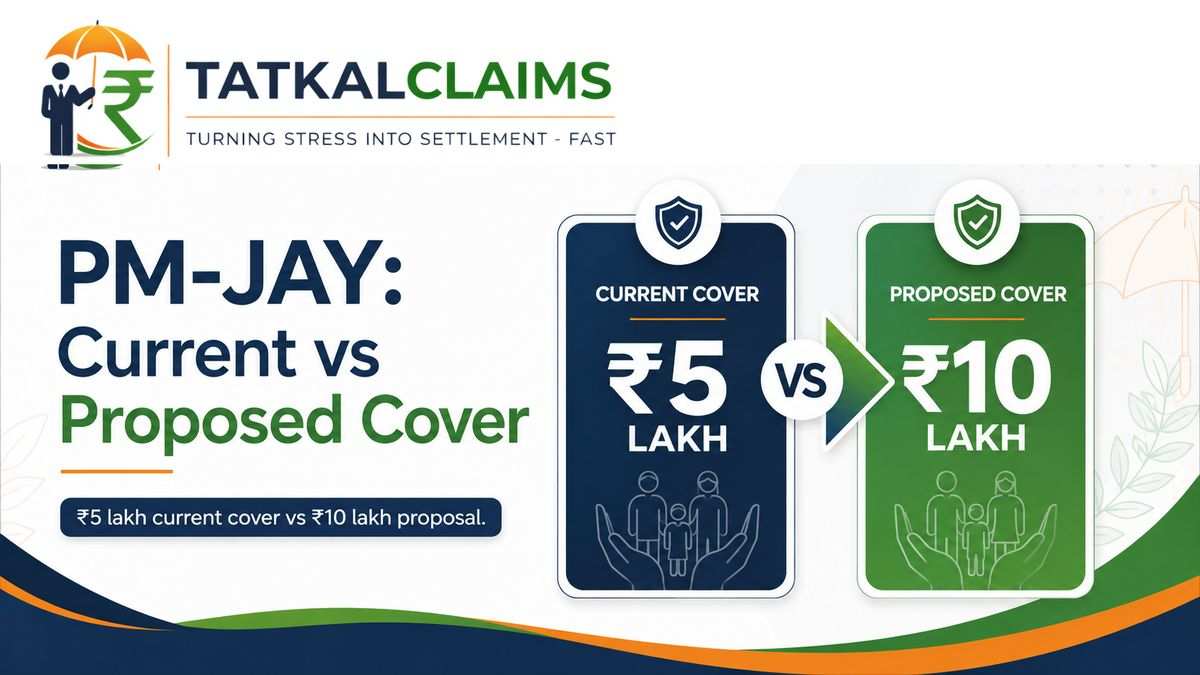
The Rs 5 Lakh Limit Is No Longer Enough
A Parliamentary Standing Committee on Health and Family Welfare recommended raising the AB PM-JAY coverage ceiling from Rs 5 lakh to Rs 10 lakh per family per year. This is a recommendation, not an implemented central entitlement. Government releases in August 2026 continued to state that AB PM-JAY provides Rs 5 lakh per family per year.
This recommendation, if implemented, would affect over 55 crore beneficiaries across the country. It would also reshape the landscape for health insurance claims, particularly for families who currently find themselves paying substantial out-of-pocket expenses despite being covered under the scheme.
Why the Current Rs 5 Lakh Cover Falls Short
The committee observed that rapid advancements in medical technology and the rising cost of high-end procedures have pushed treatment expenses well beyond the scheme's current coverage limit. Specific treatments cited include organ transplants, advanced cardiac surgeries, cancer immunotherapy, and other specialised critical care procedures.
Medical inflation in India is estimated at 12 to 14 percent annually, among the highest globally. A single organ transplant or advanced cancer treatment can easily cost Rs 10 lakh to Rs 20 lakh or more. Under the current Rs 5 lakh cap, families covered by Ayushman Bharat are forced to borrow, sell assets, or simply forgo treatment when costs exceed the limit.
The committee noted that despite being covered under the scheme, many beneficiaries continue to incur substantial out-of-pocket expenditure. This defeats the fundamental purpose of a cashless health insurance programme: to protect economically vulnerable families from catastrophic healthcare spending.
What Doubling the Cover Would Change
If the government accepts the committee's recommendation, several important shifts would occur for beneficiaries and their claims.
If a higher ceiling were implemented, it could increase the financial headroom available for eligible packages. But a larger annual limit would not by itself make every advanced treatment fully cashless; coverage still depends on the applicable Health Benefit Package, package rates, empanelment and scheme rules.
Second, the financial burden on states would increase, but so would the protection for families. The current scheme operates on a 60:40 cost-sharing agreement between the centre and states. Doubling the cover would require proportional increases in budgetary allocation, but the committee argued that the alternative, leaving families to bear crushing medical debt, is far worse.
Third, the recommendation includes a call for periodic review of insurance limits in line with medical inflation. This is crucial. A static coverage amount, even Rs 10 lakh, will become inadequate again within a few years if medical costs continue rising at their current pace. The committee wants the scheme to remain effective and relevant through regular upward revisions.
The Claim Rejection Problem Under PM-JAY
At Tatkal Claims, we handle health insurance disputes across all categories, including government-sponsored schemes. While Ayushman Bharat has been transformative in expanding healthcare access, beneficiaries still face significant claim-related challenges.
The most common issues include hospitals refusing cashless treatment despite empanelment, delays in pre-authorisation approvals, disputes over package rates, and arbitrary exclusions for procedures that should be covered. When the coverage limit is only Rs 5 lakh, these disputes become even more devastating because the family's financial margin for error is razor-thin.
If the recommendation were implemented, a higher coverage ceiling could reduce the share of a family's annual PM-JAY limit consumed by a given covered treatment. But as of August 2026 the central scheme still provides Rs 5 lakh per family per year, so the Rs 10 lakh figure should remain clearly hypothetical.
What the Committee Also Recommended
Beyond doubling the cover, the committee highlighted the importance of strengthening healthcare infrastructure, expanding the network of empanelled hospitals, and ensuring timely claim settlements. These are not afterthoughts. They are essential complements to higher coverage.
A higher limit would matter only if beneficiaries can actually access empanelled care and covered packages. AB PM-JAY has a dedicated grievance system through the Centralised Grievance Redressal Management System and helpline 14555, with district, state and national grievance mechanisms.
Who Is Currently Covered Under PM-JAY
Ayushman Bharat PM-JAY, launched in September 2018, is the world's largest government-funded health assurance programme. It currently covers over 10.74 crore poor and vulnerable families, approximately 50 crore beneficiaries, based on deprivation and occupational criteria from the Socio-Economic Caste Census 2011.
The scheme provides cashless secondary and tertiary care hospitalisation across a network of public and empanelled private hospitals. There is no cap on family size, no age restrictions, and all pre-existing conditions are covered from day one. Benefits are portable across the country.
In September 2024, the Union Cabinet expanded the scheme to include all senior citizens above 70 years of age, irrespective of their socio-economic status. These seniors receive a separate Rs 5 lakh coverage exclusively for themselves, which does not need to be shared with other family members below 70.
What Is Not Covered Under PM-JAY
Even with doubled coverage, beneficiaries must understand the scheme's exclusions. The following are not covered under Ayushman Bharat PM-JAY.
PM-JAY coverage is package-based rather than a simple list of universal exclusions. Routine outpatient care is generally outside the hospitalisation-focused scheme, but it is incorrect to state that organ transplants are categorically excluded: the National Health Authority's Health Benefit Package 2.1 includes organ and tissue transplant packages such as renal transplant, and the Government has separately confirmed inclusion of kidney transplantation under PM-JAY.
The transplant point therefore needs qualification. Kidney or renal transplant packages are included under PM-JAY, while coverage of other transplant-related care depends on the current Health Benefit Package and scheme rules. Beneficiaries should verify the relevant package rather than rely on a blanket statement that transplants are excluded.
How to Check Your Eligibility and Access Benefits
If you believe you may be eligible for Ayushman Bharat PM-JAY, here is how to verify and access your benefits.
Visit the official PMJAY website at pmjay.gov.in and click on Am I Eligible. Enter your mobile number or ration card number for instant confirmation. If eligible, you can generate your Ayushman Card through the portal or by visiting a nearby Common Service Centre or Ayushman Mitra kiosk at an empanelled hospital.
You will need your Aadhaar card or government-approved photo ID, along with your ration card or family ID if applicable. Biometric verification is required at the kiosk. Once verified, your Ayushman Card with a unique AB-PMJAY ID is printed and can be used for cashless treatment at any empanelled hospital across India.
For inquiries or support, contact the PMJAY helpline at 14555 or 1800-111-565.
What to Do If Your PM-JAY Claim Is Denied or Delayed
Despite the scheme's benefits, claim disputes occur. If you or your family member faces a denial or delay in PM-JAY cashless treatment, take the following steps.
First, demand a written reason for the denial from the hospital's PM-JAY desk or the insurer's representative. The reason must cite the specific package or exclusion that justifies the refusal.
Second, verify that the hospital is empanelled under PM-JAY and that the procedure you require is included in the scheme's package list. Over 1,929 procedures are covered across 25 specialities, but not all treatments fall within the scheme.
Third, if the hospital refuses cashless treatment without valid grounds, escalate to the district health authority or the state health agency responsible for PM-JAY implementation. Each state has a designated agency that oversees empanelled hospitals and can intervene in disputes.
Fourth, if pre-authorisation is delayed beyond the prescribed timeline, contact the PMJAY helpline and register a formal complaint. Delays in critical care can be life-threatening, and the scheme has mechanisms to fast-track emergency approvals.
Fifth, use PM-JAY's own grievance channels if an empanelled hospital denies eligible treatment or a package dispute arises: CGRMS, helpline 14555, and the district/state/national grievance structure. Do not assume that every PM-JAY dispute falls within the Insurance Ombudsman system; jurisdiction depends on the underlying arrangement and legal route.
Bottom Line
The Parliamentary Standing Committee's recommendation to double Ayushman Bharat PM-JAY coverage from Rs 5 lakh to Rs 10 lakh is a recognition of a reality that millions of Indian families already know: healthcare costs have outpaced insurance protection. For families facing organ transplants, cancer therapies, and advanced cardiac procedures, the current limit is simply inadequate.
If implemented, a Rs 10 lakh ceiling could provide additional financial protection. But as of August 2026 the central AB PM-JAY cover remains Rs 5 lakh per family per year, and the article should not describe kidney transplantation as excluded because it is already included in the scheme's health benefit packages.
For policyholders navigating the complex world of health insurance claims, whether under private policies or government schemes, the fundamental principle remains the same: know your coverage, understand your exclusions, document everything, and do not accept an unjust denial without a fight.
Facing a health insurance claim denial, delay, or dispute under Ayushman Bharat PM-JAY or a private policy? Contact our legal team at Tatkal Claims for expert assistance in securing the benefits you and your family deserve.


