
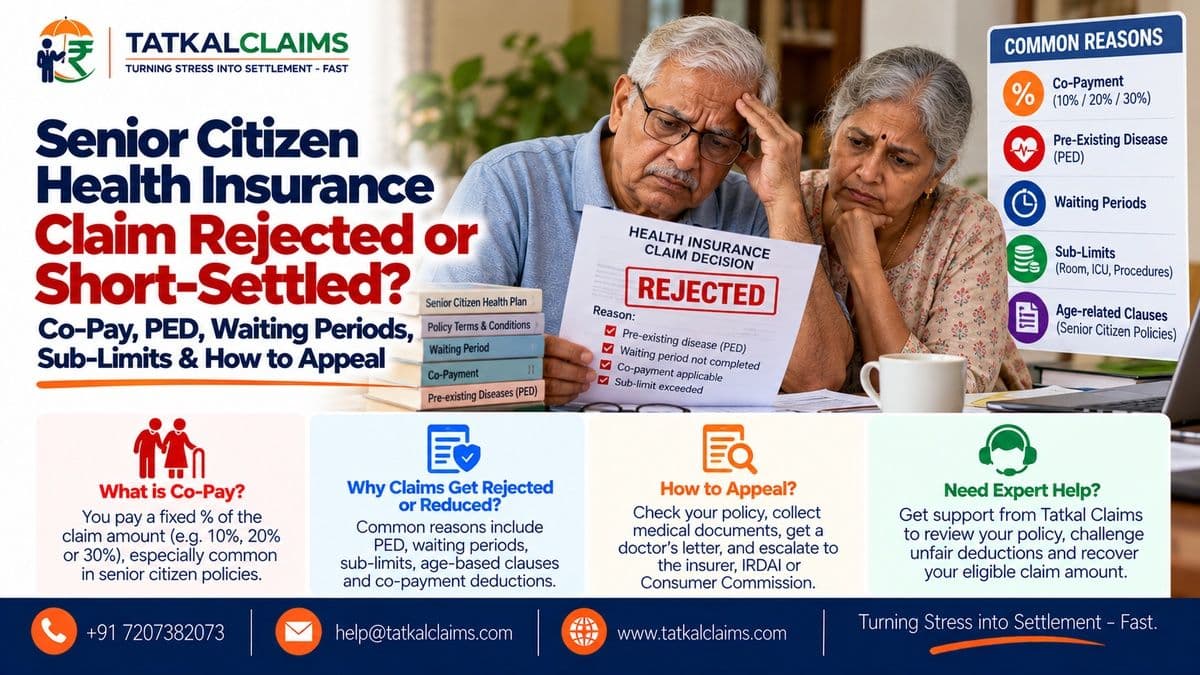
A parent has been paying health-insurance premiums for years. After a hospital admission, the family receives a message saying “pre-existing disease”, “20% co-payment”, or “cataract sub-limit”. Sometimes the insurer rejects the claim entirely; sometimes cashless is approved but the settlement leaves a bill the family did not expect. When an older person is recovering, it is difficult to work out whether the deduction reflects an actual policy condition or a mistake.
The most useful first step is not a generic appeal accusing the insurer of treating senior citizens unfairly. Get the insurer's written reason, the issued policy schedule for the treatment date, and the claim assessment. Then separate the possible issues: an undisclosed medical condition, a waiting period that may or may not have expired, a contractual share of an admissible claim, a treatment-specific ceiling, or an unexplained change at renewal.
This guide covers Indian private and group health insurance for older policyholders and their families. Ayushman Bharat PM-JAY and Ayushman Vay Vandana are separate government-scheme arrangements; their beneficiary, package and grievance rules are not interchangeable with private policy terms.
Written by: Tatkal Claims, Claims Review Team
Reviewed by: Ankit L Kanoi, Founder
Can an Insurer Reject a Senior Citizen's Claim Just Because of Age?
Being 65, 70 or 80 is not, by itself, a sound reason to reject an otherwise covered hospital claim under an active policy. The question is whether the treatment meets that policy's insured events and conditions. IRDAI's 2024 product framework also requires insurers to offer a range of health-insurance products for all age groups; its current Health Department FAQs clarify that this is about product availability, not a guarantee that every proposed insured qualifies for every product without underwriting.
Distinguish buying a new plan from maintaining an existing one. An insurer may assess a new proposal and the products available; a continuously renewed policy carries different protections. The insurer cannot simply treat a policyholder's increasing age or a previous claim as a universal reason to disregard an existing contract. Keep renewal receipts and the prior policy schedule if the refusal mentions an age threshold.
IRDAI's current FAQs instruct insurers to maintain a separate channel specifically for senior citizens' health-insurance claims and grievances. The channel can help a family obtain an accountable response, but it does not automatically remove a valid co-pay or policy exclusion.
First Identify Why the Senior Citizen's Claim Was Rejected or Reduced
| What the insurer says | What it may actually mean | The most useful verification |
| 'PED not disclosed' | Alleged pre-existing disease or inaccurate proposal answers | Specific proposal question, answer, medical records and insurer's evidence |
| 'PED waiting period' | Specified coverage waiting period may not have ended | Policy start, prior coverage credits, waiting clause and dates |
| '20% senior co-pay' | Policyholder bears a contractual share of an admissible claim | Applicable member/age trigger, actual rate and calculation base |
| 'Cataract / joint replacement limit' | A procedure- or disease-specific payment ceiling may apply | Policy schedule, sub-limit, eligible amount and any other deductions |
| 'Room limit / non-payable charges' | Separate claim-assessment rules reduced payment | Room category, final bill, package rules and line-item explanation |
| 'Age / renewal change' | Different terms or unclear continuation may have been asserted | Prior and current schedules, endorsements, notices and premium receipts |
These grounds are not interchangeable. A diagnosis written in a discharge summary does not establish that a condition was known before taking the policy. Nor does a co-pay figure prove that the hospitalisation itself was excluded. Ask for separate reasons and calculations where several adjustments were applied.
Pre-Existing Disease (PED): Was the Condition Actually Pre-Existing?
IRDAI's current health FAQs describe a pre-existing disease as a condition diagnosed by a physician, or one for which medical advice or treatment was recommended or received, within 36 months before commencement of the policy. Do not assume that a condition discovered during the present admission qualifies merely because it may have developed gradually. Identify what the treating records and documents actually establish, and check the relevant historical policy and regulatory terms for an older inception date.
A doctor mentions a long history of hypertension or diabetes
That phrase can trigger scrutiny, but it needs context. The insurer should identify the physician's earlier diagnosis, medical advice or treatment and the proposal question alleged to have been answered inaccurately. Ask whether the family declared the condition, whether a pre-policy medical test showed it, whether the insurer accepted and priced the risk, and whether later records are being used to assume earlier knowledge.
A new diagnosis is inferred from a routine prescription
Compare dates rather than attaching a label. A medicine, abnormal test, clinical note or family recollection might be relevant evidence, but it is not proof of an earlier diagnosed condition or a particular misleading answer without context. Request the document the insurer relies on and allow the treating doctor to clarify an incorrect or ambiguous history statement.
The insurer says the illness was undisclosed
Obtain a complete copy of the signed proposal and medical questionnaire, sales or tele-underwriting recordings if available, pre-policy examination, insurer queries and original underwriting decision. State exactly which answer the insurer considers wrong, when the insured knew of the condition, and why it was material under the applicable rules. Concealment can have serious consequences; a family should not assume every non-disclosure allegation is frivolous.
For the deeper issue of disclosure and the moratorium, see our PED rejection and five-year moratorium guide. This senior-citizen guide focuses on interpreting several simultaneous claim grounds without repeating the full PED analysis.
The 36-Month Waiting-Period Rule and What 'Continuity' Changes
Under the IRDAI 2024 framework described in its current FAQs, the maximum waiting period, including PED and specified-disease waiting periods, is 36 months. A shorter waiting period may apply to the particular product. This does not mean every condition is always covered after 36 months irrespective of other lawful exclusions; the insured event, policy period and applicable wording still govern.
Example: a person buys a policy for the first time on 1 January 2025 and is hospitalised in October 2026 for a condition falling within the policy's properly applied 36-month PED waiting clause. Only about 21 months have elapsed; that waiting period would not yet be completed. In contrast, if the person had a qualifying earlier policy and carried waiting-period credits through a properly completed portability or migration, the insurer must assess those credits rather than automatically treating the latest policy's issuance as a fresh starting point.
Be careful with different clocks: an initial waiting period, PED waiting period, specified-disease waiting period and post-enhancement waiting period are not the same clause. Cataract or joint replacement may be the subject of a specific waiting period even where the relevant condition is not a PED. Check the policy's treatment definition, exceptions (including accident-related wording where applicable), effective date and the specific insured member.
What if the policy was ported or migrated?
IRDAI's current guidance describes portability as transfer between insurers and migration as movement to another product with the same insurer. For qualifying indemnity policies, the credits transferred can include waiting-period, PED, no-claim bonus and moratorium credits up to the applicable insured limits. Ask for the porting proposal, the old schedules, the new insurer's portability acceptance and any credit statement, and reconcile the continuous-coverage dates. Do not assume every limit or newly increased sum insured gets the same accumulated credit automatically.
What if renewal was late?
A delay may create a dispute over whether continuity is preserved and whether the insured event occurred during valid coverage. The 2024 framework specifies grace periods, but how coverage operates depends on premium payment mode and the applicable rule. Avoid assuming that every late annual premium keeps hospitalisation cover active throughout the delay. Obtain the renewal demand, payment timestamp, grace-period notice and insurer's coverage timeline.
The 60-Month Moratorium: A Different Protection From Waiting Periods
After 60 continuous months of eligible health-insurance coverage—including recognised portability and migration credits—the 2024 regulatory moratorium prevents contesting a policy or claim on non-disclosure or misrepresentation grounds, except for established fraud. It is not identical to the 36-month PED waiting period; a particular PED clause can expire before the moratorium is reached.
For instance, a policy continuously maintained from 2019 may already satisfy the 60-month clock even if the insurer changes at a later qualifying port. But if the sum insured was increased more recently, the enhanced portion has its own moratorium clock under the 2024 framework. Compare the original and enhanced limits and dates before alleging that every rupee of a large claim must receive the same treatment.
The moratorium does not transform an otherwise excluded medical service into covered care, automatically erase a contractual co-pay, or stop the insurer from examining an eligible claim calculation. When a repudiation cites non-disclosure after five continuous years, ask the insurer to identify its evidence of established fraud and its calculation of the coverage period.
For supporting dates and document preparation, refer to our pre-existing disease and non-disclosure article.
Senior Citizen Co-Pay: When a 10%, 20% or 30% Deduction May Be Wrong
Co-payment is the share of the admissible claim that the policyholder or insured must bear under an applicable clause. IRDAI does not impose one universal co-pay rate merely because someone is a senior citizen. Some issued products use age-linked cost sharing or a voluntary option, while others have different arrangements. To judge a deduction, read the actual schedule for that member, plan, treatment and period.
Illustration: on a ₹2,00,000 hospital bill, suppose ₹20,000 is separately excluded on assumed, itemised contractual grounds, leaving ₹1,80,000 admissible before an applicable 20% co-pay. With no other limits, the insured share from co-pay is ₹36,000 and the insurer share is ₹1,44,000; the patient's combined out-of-pocket burden would be ₹56,000, including the ₹20,000 exclusion. Those are illustrative figures—not an assertion that the excluded ₹20,000 was rightly rejected or that all products use this order.
If the actual schedule for the insured member says 10%, an unexplained 20% deduction needs a written clause and rate justification. If a 20% clause was valid and correctly applied, an appeal saying the customer is elderly is unlikely to reverse it by itself. The stronger objection is a wrong age trigger, incorrect plan variant, missed waiver, double-counted item or a percentage applied to a base contrary to the contract.
For the complete breakdown of co-pay arithmetic and member-specific clauses, use our Co-Payment Deductions guide.
Disease and Procedure Sub-Limits: Cataract, Implants, Joint Replacement
The ₹10 lakh or ₹20 lakh sum insured is not always the amount payable for every operation. A policy can define a smaller ceiling for specified diseases, surgeries, room categories or devices. IRDAI's Health Department FAQs expressly advise prospective policyholders to check hospitalisation sub-limits and exclusions. A sub-limit can be valid if it is actually part of the applicable contract; the insurer still needs to show the clause and correct arithmetic.
Suppose a cataract procedure has a contractual ceiling of ₹40,000 per eye and the otherwise admissible treatment costs ₹68,000. Without any other adjustments, the cap may leave ₹28,000 above it. That is a hypothetical cap—not a standard amount fixed by IRDAI, nor an insurer-wide limit. In a real claim, confirm whether the cap is per eye, per surgery, per policy year, or defined differently, and whether the hospital's claimed operation fits that benefit category.
For joint replacement, compare implant invoices, surgeon/OT charges, specialised consumables, overall procedure cap and any separate prosthesis provision. For room-rent proportionate deduction, verify room eligibility and the particular costs to which the ratio was applied. Do not describe these as a single generic 'senior-citizen deduction'; they involve different calculations.
If room-rent entitlement reduced several bill items, consult our room-rent and proportionate deduction analysis.
If the insurer accepted surgery but paid a smaller amount overall, use the health claim short-settlement checklist to reconcile individual deductions.
Renewal, Age-Related Changes and Earlier Claims: What to Check
A family may say: 'We paid for this cover for ten years. Why is the insurer applying a different rule now?' A meaningful review begins with the prior year's schedule, the renewal notice, the current schedule and any endorsements or product migration notices. The fact that a document says 'senior citizen' does not by itself tell you whether the policy was renewed on the same terms, modified, or replaced with another product.
Under the 2024 renewal framework, health insurance renewal generally cannot be denied just because the insured filed claims in preceding years; specific exceptions and withdrawn-product arrangements still matter. The framework also restricts fresh underwriting on renewal where sum insured is unchanged. It does not mean premiums can never change with age, that every insurer must sell every plan to an applicant of any age, or that a previously excluded condition becomes covered at renewal.
If an insurer says cover ended due to age, ask whether it is relying on an actual termination provision, product withdrawal and migration arrangement, non-payment or an unsupported blanket age rule. Keep an exact premium-payment timeline. A senior policyholder considering switching insurers should also evaluate loss of product-specific benefits, accepted portability credits, new limits and coverage gaps rather than replacing cover solely because the new premium looks lower.
How to Build the Evidence File for a Parent's Claim
| Document | Why it matters |
| Original proposal and answers | Tests the exact non-disclosure allegation and earlier information supplied |
| Pre-policy check-up / insurer queries | Shows what the insurer knew or sought at underwriting |
| Current and previous policy schedules, CIS and endorsements | Identifies rate, member, waiting clause, sub-limit and changes at renewal |
| Renewal receipts and portability/migration records | Establishes dates and continuity credits |
| Discharge summary, treating notes and prior medical records | Tests diagnosis timing, care required and inaccurate history entries |
| Hospital itemised bill and receipts | Shows charged services, package and amounts personally paid |
| Insurer/TPA authorisation, decision and assessment sheet | Separates rejection from short settlement and identifies disputed rupees |
| Written grievance and acknowledgement | Documents what was challenged and when the insurer replied |
If an older parent has difficulty locating a forgotten policy document, obtain a duplicate from the insurer rather than relying on a salesperson's verbal memory of the cover. For group cover, request the member certificate and relevant master-policy clauses from the employer or administrator. Before circulating medical records to third parties, remove Aadhaar and other unnecessary identifiers where possible and use official, secure submission channels.
Reconsideration: Address the Actual Decision, Not Every Insurance Rule
For a PED rejection, provide a timeline showing the first documented diagnosis, what the proposal asked, what was disclosed and the policy's continuity or moratorium position. For a waiting-period dispute, show start dates and credits. For co-pay or procedure caps, attach a side-by-side comparison of the applicable policy clause and insurer's arithmetic. Where several reasons appear in the decision letter, reply to each one separately and specify the amount that should be reassessed.
An example of a focused question: 'The claim for my mother's hospitalisation was reduced by a 30% senior-citizen co-payment, but the schedule issued for this insured member states 20%. Please identify the endorsement that authorises 30%, explain the calculation base and provide a revised line-item settlement, or reassess the difference.' Use the actual percentages and documentation—this example is not a real TatkalClaims client case.
Keep cashless refusal and final reimbursement separate. A denial of cashless service does not necessarily decide reimbursement eligibility. Conversely, cashless authorisation does not automatically waive a policyholder's valid co-pay, deductible or exclusion.
IRDAI's current health FAQ lists service standards for cashless pre-authorisation, discharge decisions and non-cashless settlements. For an ongoing hospital discharge, save the time the hospital actually sent the complete authorisation request, not just the hour the family called customer support. These service standards do not create cover for an excluded treatment.
Where Can a Senior Citizen Escalate an Unresolved Health Claim?
Start with a written complaint to the insurer's Grievance Redressal Officer and ask for its dedicated senior-citizen health-claims and grievance contact. Send only the core claim documents, a summary of the disputed clause or calculation, and a request for a reasoned response. Retain the acknowledgement and any final insurer decision.
IRDAI's Bima Bharosa platform provides registration and tracking for unresolved insurance grievances and mirrors the insurer's status updates. IRDAI's current health FAQ lists a 14-day complaint action/intimation standard, while some Bima Bharosa FAQ text refers to 15 days or two weeks. Follow the applicable current instructions without confusing those grievance service standards with the Insurance Ombudsman's separate insurer-first requirement.
For the Ombudsman, the Council's procedure requires an insurer/broker complaint first. If the outcome is unsatisfactory or there is no response within 30 days, an eligible complainant may apply subject to jurisdiction, the ₹50 lakh monetary ceiling, the one-year filing framework and restrictions on the same dispute being litigated elsewhere. Confirm the precise starting date for limitation from the insurer's rejection or non-response, and preserve correspondence.
For forms, monetary limits and the filing sequence, see How to File an Insurance Ombudsman Complaint in India.
How TatkalClaims Can Help a Family Review the Decision
When a parent is recovering, families often have an insurer email, a discharge summary, and half a dozen unexplained deductions. Tatkal Claims can help arrange the file chronologically, compare waiting periods and continuity, examine the alleged non-disclosure and test the rate and calculation behind co-pay and treatment caps. Sometimes the assessment is contractually correct; the goal is to identify a specific provable error when one exists.
For assistance, call +91 7207382073 or email help@tatkalclaims.com. Keep the claim number, rejection or settlement letter, original policy and recent renewal schedules, and hospital bills available. No claim reversal, cashless approval or Ombudsman result can be guaranteed.
Frequently asked questions
Can a health insurer reject a claim only because the insured is over 65?
Not merely because of age, if the hospitalisation is otherwise covered by a valid policy. Evaluate the actual policy terms and insurer's written reason. Availability of new cover and renewal of existing cover are different questions.
Does every senior citizen have a compulsory 20% or 30% co-pay?
No. IRDAI does not prescribe a single universal senior-citizen co-payment percentage. Check the specific member's issued schedule, applicable rate, trigger, waiver and admissible amount.
How long is the PED waiting period under current IRDAI guidance?
The current health-insurance framework limits PED waiting periods to a maximum of 36 months. An individual product may have a shorter period, and eligible portability or migration credits can matter.
If my parent had diabetes for years, can every later claim be rejected?
No automatic conclusion follows from the diagnosis alone. Consider the contract, relevant medical records, disclosure history, any waiting-period or exclusion clause, treatment relationship and whether the moratorium applies.
Does the five-year moratorium make every treatment payable?
No. The 60-month moratorium limits contesting a policy or claim on non-disclosure or misrepresentation grounds except for established fraud. It does not erase valid coverage limits, exclusions or co-payments.
Does the moratorium restart if an old policy is ported?
Recognised portability and migration credits can count toward the 60-month continuity period. Enhanced sum insured may have a separate moratorium clock on the increase. Verify the insurer's credit record.
Can the insurer refuse renewal because my father made several claims?
The 2024 renewal framework generally prohibits declining renewal merely because claims were made in earlier years, subject to specified product and regulatory exceptions. Review the full policy and renewal correspondence.
Can cataract surgery be capped even with ₹10 lakh health cover?
An applicable procedure-specific sub-limit may restrict payment even with a larger overall sum insured. The insurer must identify the policy clause and correct limit. IRDAI does not impose the hypothetical caps used in this article.
Is cashless approval proof that no amount is payable by the family?
No. Cashless approval can coexist with valid co-pay, deductibles, excluded items or limits. Ask for the final assessment and compare it with the hospital's bill and receipts.
Where can a senior citizen complain about an insurer?
Ask for the insurer's dedicated senior-citizen health claim/grievance channel and submit a written complaint to its GRO. Bima Bharosa can track a grievance; the Insurance Ombudsman has separate eligibility, prior-complaint, deadline and monetary-limit rules.
Official Sources and Scope of Review
Regulatory references checked in October 2026. The current IRDAI Health Department FAQs were the primary source for PED and waiting-period definitions, co-payment, sub-limits, portability/migration, moratorium and senior-citizen grievance channels. IRDAI's 2024 Insurance Products framework and 29 May 2024 Master Circular underpin renewal and product availability discussion. Historical policies or coverage beginning before the current standardisation requirements must be examined against the documents and law relevant to that period. The examples are hypothetical and should not be mistaken for published insurer caps or actual TatkalClaims cases.
Disclaimer: This is general India health-insurance information, not a medical opinion or personalised legal or financial advice. A senior citizen's age does not by itself establish coverage or non-coverage. The issued policy, its inception and renewal history, medical and billing evidence, applicable legal provisions and the actual insurer decision control each case. Do not postpone medically necessary care merely to resolve an insurance dispute.