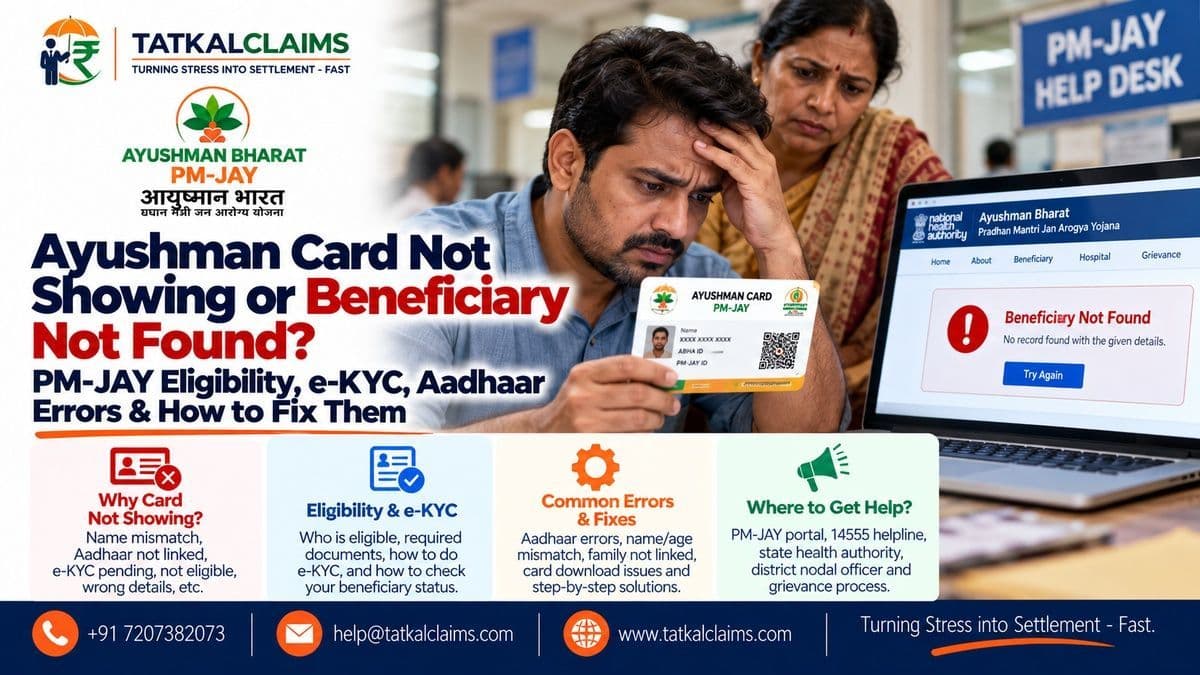
You reach an Ayushman Bharat hospital with a card screenshot or family details, but the desk says “beneficiary not found”, “e-KYC pending”, “Aadhaar mismatch”, “card not generated” or simply “your name is not in the system”. These messages sound similar, but they can mean very different things.
The first distinction is crucial: for the ordinary AB PM-JAY beneficiary base, the scheme is entitlement-based. A person is searched against an entitled source database and then verified. A missing result is therefore not automatically fixed by filling a fresh form. By contrast, the 70+ Ayushman Vay Vandana expansion has its own enrolment route for eligible senior citizens, with Aadhaar-based e-KYC and a distinct card.
This guide explains what the different statuses mean, what the Ayushman Mitra or verification desk should check, why a changed mobile number is usually not an eligibility problem, when Aadhaar/e-KYC becomes the issue, and how to escalate if an eligible beneficiary is blocked from treatment.
Written by: Tatkal Claims, Claims Review Team
Reviewed by: Ankit L Kanoi, Founder
Ayushman Card Not Showing: First Identify Which Problem You Actually Have
“Card not showing” is not a formal PM-JAY status. It can describe several different failures: the person is not found in the entitled database, the source record is found but the identity details do not match, e-KYC has not completed, the card request is pending/rejected, or the hospital cannot authenticate a beneficiary who was previously verified.
| What you are told | What it may mean | What to ask for |
| “Beneficiary not found” | Search did not locate the person/family in the relevant entitled database | Which database/search field was used, and was the family/name searched through all relevant identifiers? |
| “e-KYC pending” | Identity authentication has not completed | Which e-KYC method failed or is still pending? |
| “Aadhaar mismatch” | Aadhaar demographic/identity data does not match the source record closely enough for the workflow | Which field is mismatching: name, age/date of birth, gender or another identifier? |
| “Card approval pending” | The linked beneficiary record has been sent for approval/checking | What is the application/reference status and which authority is holding it? |
| “Card rejected” | The verification/approval workflow did not accept the linked record | What is the written rejection reason and whether it has been reviewed by the State Health Agency? |
| “Card exists but hospital cannot verify” | Treatment-time authentication or system access may be failing | What does the hospital's beneficiary-verification screen show? |
How PM-JAY Beneficiary Identification Works
NHA's Beneficiary Identification System (BIS) is designed to verify people from entitled databases and create an authenticated beneficiary registry. The PM-JAY operational manual describes a maker-checker workflow: an operator such as a Pradhan Mantri Arogya Mitra or authorised centre searches the beneficiary database, links identity/family documents to the matched record, and sends it for approval.
The operational manual says searches can use fields such as name, location, ration-card number, identifiers from the PM letter, RSBY URN or integrated state-scheme IDs, depending on the source database and state implementation. A failed search using one spelling or one identifier therefore does not necessarily prove ineligibility.
If a record is found, the identity information is linked and sent for verification. The approving authority can approve or recommend rejection with a reason. NHA's manual states that cases recommended for rejection are scrutinised by the State Health Agency, which can accept the rejection or approve the record with reasons.
PM-JAY Is Entitlement-Based — You Usually Cannot Just Add Yourself
For the traditional PM-JAY beneficiary base, Government guidance describes the scheme as entitlement-based rather than an open enrolment scheme. That matters when someone says, “My neighbour has an Ayushman card, so please add my family too.”
Eligibility depends on the applicable beneficiary databases and later Government-approved expansions. If the household is genuinely outside those categories, the hospital or CSC cannot simply create eligibility by entering a new mobile number or making a fresh card request.
However, that does not mean every “not found” result is correct. Spelling, family identifiers, state-linked databases and search method can matter. The right next step is to determine whether the person is absent from the entitled data or the search/identity-linking process has failed.
Important Exception: People Aged 70+ Have a Separate Vay Vandana Route
Senior citizens aged 70 years and above are different. The Ayushman Vay Vandana expansion covers them irrespective of socio-economic status and uses a specific enrolment process with Aadhaar-based e-KYC.
So a 72-year-old who is not found in the older vulnerable-family PM-JAY list should not be dismissed on that basis alone. The question becomes whether Vay Vandana enrolment has been completed and whether the distinct senior-citizen card/beneficiary record is active.
For a 70+ beneficiary, use our dedicated Ayushman Vay Vandana treatment-denial and eligibility guide.
What Aadhaar e-KYC Does — and What It Does Not Do
Government clarification says PM-JAY beneficiary identification uses Aadhaar-based e-KYC: details fetched from Aadhaar are matched against the source beneficiary record, and the card request is then approved or rejected based on the beneficiary details.
Aadhaar e-KYC verifies identity; it does not by itself create ordinary PM-JAY entitlement for a person who is not in an eligible source category. This is why a valid Aadhaar number and successful OTP do not automatically guarantee that an ordinary PM-JAY card will be generated.
At the same time, a genuine mismatch can block a person who does have an entitled record. Ask which field is causing the mismatch. If the source record and Aadhaar record differ materially, the correction route may depend on whether the error is in Aadhaar, the underlying beneficiary/state database or the PM-JAY-linked record.
Do not upload random edited documents or repeatedly create fresh attempts to force a match. Preserve the rejected/pending reference and get the mismatch reason before correcting the source data.
Changed Mobile Number? That Should Not Decide PM-JAY Eligibility
A changed, inactive or shared mobile number is a common source of confusion. The Ministry of Health has expressly clarified that a mobile number is not what decides PM-JAY beneficiary eligibility or verification.
The Government said mobile numbers are mainly collected for communication and feedback, and that beneficiary verification is based on identity/e-KYC rather than ownership of a particular mobile number. It also stated that treatment cannot be withheld only because the beneficiary does not carry a valid mobile number or because the number has changed.
NHA has supported authentication methods beyond mobile OTP, including fingerprint, iris and face authentication. The exact method available at a hospital or centre can depend on the current system and equipment.
What If the Name, Age or Date of Birth Does Not Match?
Small spelling differences and material identity mismatches should not be treated the same way. Ask the operator to show which data is coming from the entitled/source record and which data is coming from Aadhaar or the identity document.
If the mismatch is in Aadhaar itself, the correction normally has to be made through the Aadhaar/UIDAI process rather than by asking the hospital to alter Aadhaar data. If the Aadhaar record is correct but the PM-JAY/source record is wrong or incomplete, ask which State Health Agency or beneficiary-verification channel controls that source record.
For a 70+ Vay Vandana application, age recorded in Aadhaar is particularly important because NHA's senior-citizen FAQ uses Aadhaar age for the eligibility test. Do not assume the general PM-JAY family-data rules and the 70+ enrolment workflow are identical.
Card Request Pending or Rejected: Ask for the Reason, Not Just the Status
A pending status can mean the operator has located the family/person and sent the record into the approval workflow, but the checker has not completed the decision. A rejection should have an identifiable reason.
NHA's operational manual describes approval by the insurer/trust/state-verification side and further scrutiny by the State Health Agency where rejection is recommended. That makes the reference number and rejection reason essential if you need to challenge the result.
| Record to collect | Why it matters |
| Beneficiary/card application reference | Lets the authority trace the exact record |
| Search result or screenshot | Shows whether the person/family was found |
| e-KYC/authentication status | Separates identity failure from eligibility failure |
| Mismatch or rejection reason | Tells you what needs correction or review |
| Aadhaar / permitted identity document details | Shows the identity used in verification |
| Family/source identifier used | Helps locate the entitled household record |
| Hospital/CSC/PMAM name and date | Shows where and when verification was attempted |
| 14555/CGRMS grievance number | Creates the escalation trail |
What the Ayushman Mitra at the Hospital Should Help Check
NHA describes Arogya/Ayushman Mitras as facilitators at empanelled hospitals for beneficiary enrolment/verification, patient admission and the claim process. If treatment is urgent, go to the PM-JAY/Ayushman Mitra desk rather than relying only on the general registration or billing counter.
Ask the Mitra to identify whether the problem is beneficiary search, e-KYC/authentication, card approval or treatment-time verification. If the person is eligible and verified but treatment is still refused, the dispute has moved beyond card generation and into hospital service delivery.
If the beneficiary is already verified but an empanelled hospital refuses cashless treatment or demands money, use our PM-JAY treatment denied and hospital complaint guide.
Can the Hospital Refuse Treatment Because the Verification System Is Down?
A technical outage and a genuine eligibility rejection are not the same thing. NHA has maintained contingency guidance for poor-connectivity scenarios and technical support channels for PM-JAY systems.
If the hospital says the portal is down, ask whether the patient is already a verified beneficiary and whether the current offline/helpline contingency process can be used. Record the time and error. For an emergency, medical care should not be delayed while a family tries to diagnose an IT problem on its own.
If the hospital is empanelled and an eligible beneficiary is denied treatment, the Ministry of Health says the beneficiary can complain through CGRMS or the 24×7 helpline 14555.
How to Check and Escalate: 14555, Hospital Desk and CGRMS
NHA's current technical-support site lists the national PM-JAY helpline as 14555 / 1800-111-565. Government material also directs beneficiaries to empanelled hospitals and official PM-JAY channels for eligibility checks.
When escalating a beneficiary-verification problem, do not submit only “Ayushman card not showing”. State exactly what happened: which family/person was searched, which identifier was used, whether a source record appeared, whether e-KYC completed, and whether the status is pending or rejected.
If an empanelled hospital refuses treatment after eligibility has been established, register a service-delivery grievance through CGRMS/14555. The Ministry has confirmed that PM-JAY grievances are handled through District, State and National levels.
A Practical Sequence When the Card Is Not Showing
| Step | Action |
| 1 | Confirm whether the patient falls under the ordinary PM-JAY beneficiary base or the separate 70+ Vay Vandana expansion. |
| 2 | Ask the hospital/PMAM/authorised channel to search the beneficiary using the relevant family/source identifiers, not only one spelling or mobile number. |
| 3 | If found, identify whether e-KYC/authentication is complete and what identity mismatch, if any, is shown. |
| 4 | If the card request is pending or rejected, obtain the application/reference number and written reason. |
| 5 | Correct the underlying identity/source-data issue through the authority that owns that data; do not create contradictory duplicate attempts. |
| 6 | If an eligible patient is being denied treatment because the verification process is mishandled, call 14555 and register a CGRMS grievance. |
| 7 | If the beneficiary becomes verified but treatment/package approval is then refused, move to the PM-JAY treatment-denial process. |
What TatkalClaims Can Review in a Beneficiary-Verification Dispute
TatkalClaims can help when the hospital, CSC/verification desk and family records are giving different answers. We can review the beneficiary search result, card/application status, e-KYC or mismatch message, family/source identifiers, hospital notes and existing 14555/CGRMS grievance to determine where the record is actually failing.
Where the documents support a challenge, we can help prepare an evidence-indexed representation to the appropriate State Health Agency or PM-JAY grievance authority. We will also flag cases where the documents show that the person is outside the ordinary entitled beneficiary base and therefore needs a different route rather than repeated card-generation attempts.
For an initial review, call +91 7207382073 or email help@tatkalclaims.com. Send the beneficiary/card/application reference, screenshots of the error or status, Aadhaar/identity details with sensitive numbers masked where appropriate, family/source identifier used, hospital/verification-centre details and any grievance number already generated.
Frequently asked questions
Why is my Ayushman Card not showing even though my family says we are eligible?
First determine whether the family/person is actually being found in the entitled source database. If it is found, the problem may instead be identity matching, e-KYC, approval or treatment-time verification. Ask for the exact stage and reference number.
Can I create a PM-JAY card just by entering Aadhaar?
Not for the ordinary entitlement-based PM-JAY beneficiary base. Aadhaar/e-KYC verifies identity against an eligible source record; it does not by itself create ordinary PM-JAY eligibility. The separate 70+ Vay Vandana expansion has its own enrolment route.
Does a changed mobile number make my Ayushman Card invalid?
No. The Ministry of Health has clarified that mobile number is not what decides PM-JAY eligibility or beneficiary verification, and treatment should not be withheld merely because the number is missing or has changed.
What should I do if Aadhaar e-KYC fails?
Ask which authentication method failed and whether the issue is an Aadhaar identity mismatch, source-record mismatch or technical authentication problem. Get the error or reference before changing records or submitting another attempt.
What if my name is not found in the PM-JAY beneficiary database?
Ask which database and identifiers were searched. A search failure is not the same as a formal rejection. If the person is outside the ordinary entitled beneficiary base, the system cannot simply add eligibility; if the person is 70+, check the separate Vay Vandana route.
Who reviews a rejected beneficiary-verification case?
NHA's operational manual states that cases recommended for rejection are scrutinised by the State Health Agency, which can accept the rejection or approve the case with reasons.
Can a hospital deny treatment because I do not have the old mobile number linked to PM-JAY?
The Government has said treatment cannot be withheld only because a beneficiary does not carry a valid mobile number or the number has changed. Ask the hospital what alternative beneficiary-authentication method is available.
Where can I complain about Ayushman beneficiary verification or treatment denial?
The national PM-JAY helpline is 14555, and NHA's support site also lists 1800-111-565. For treatment denial or service irregularities at an empanelled hospital, use CGRMS/14555 and keep the grievance reference.
Sources & Methodology
Reviewed 9 October 2026. This guide uses National Health Authority and Government of India material for BIS beneficiary identification, source-database search, approval/rejection workflow, Aadhaar e-KYC, the limited role of mobile numbers, 70+ Vay Vandana enrolment, hospital/Ayushman Mitra support and PM-JAY grievance routes. Older operational manuals are used only for workflow concepts that remain reflected in the current NHA support ecosystem; current 2026 Government material is used for live helplines and treatment-denial escalation.
Disclaimer: This guide explains the central PM-JAY beneficiary-verification framework in general terms. States and Union Territories may use additional beneficiary databases, state schemes or implementation workflows. A “not found”, pending or rejected status should be checked against the actual source record and State Health Agency process. Do not share full Aadhaar numbers or unnecessary sensitive personal data in informal complaints.