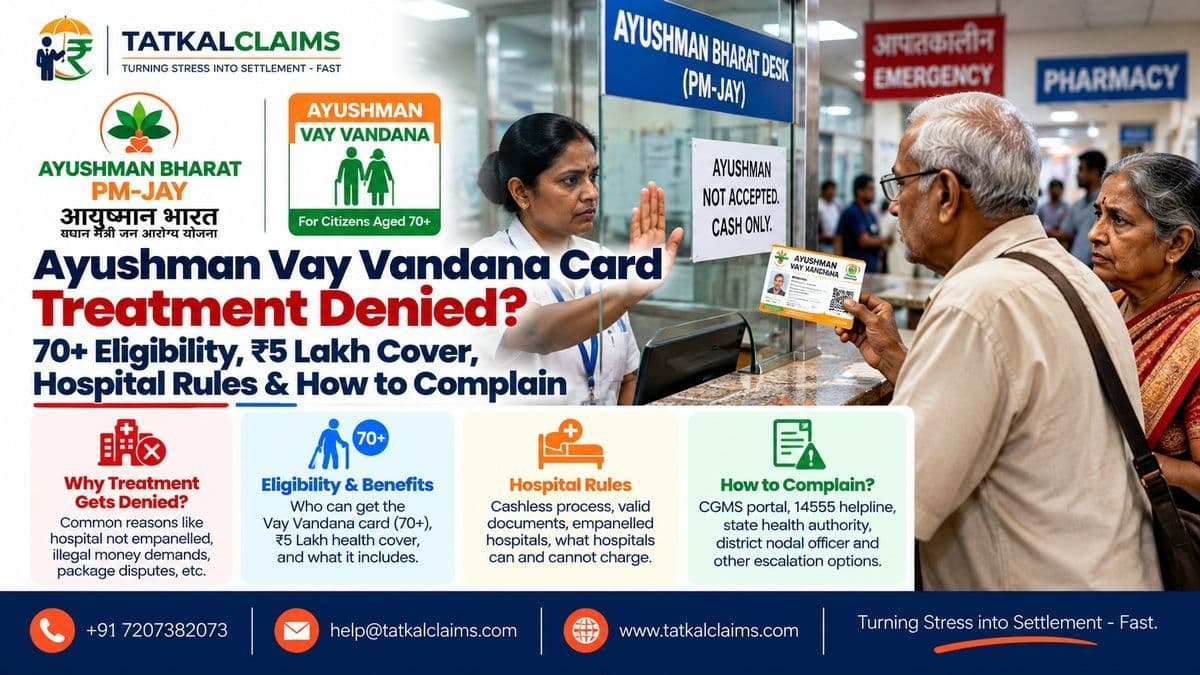
A senior citizen is 72, has an Ayushman Vay Vandana card, and reaches an empanelled hospital expecting cashless treatment. The hospital desk then says the card is not active, the patient is not eligible, the package is unavailable, the ₹5 lakh cover is exhausted, or money must be paid first. For a family in the middle of an admission, those statements can sound final even when they are not.
The first thing to separate is eligibility from transaction failure. Ayushman Vay Vandana extends AB PM-JAY to all senior citizens aged 70 years and above irrespective of socio-economic status. But treatment still has to move through the beneficiary record, an empanelled hospital, an applicable treatment package and the PM-JAY transaction system. A card can therefore exist while a hospital transaction still gets stuck for a very different reason.
This guide is for that dispute: a 70+ beneficiary is eligible or enrolled, but treatment is being refused, delayed or made conditional on payment. It explains the special ₹5 lakh structure for senior citizens, what to check at the hospital, when other government schemes matter, how portability works, and how to build a useful complaint rather than leaving with only a verbal refusal.
Written by: Tatkal Claims, Claims Review Team
Reviewed by: Ankit L Kanoi, Founder
Who Qualifies for Ayushman Vay Vandana?
The central eligibility rule is unusually broad: senior citizens aged 70 years and above are covered irrespective of income or socio-economic status. The 2024 Cabinet approval estimated that the expansion would cover about six crore senior citizens in roughly 4.5 crore families.
This is different from the original AB PM-JAY beneficiary base, which is tied to specified vulnerable families and other later-added groups. A 70+ person therefore should not be rejected merely because the household was not in the earlier PM-JAY list.
Registration is still necessary. Government material says eligible senior citizens can register through the Ayushman App, the beneficiary portal or an empanelled hospital, and that Aadhaar is required for registration. If the hospital says the person is 'not eligible', first confirm whether the issue is actual age/enrolment status or simply that the Vay Vandana record has not been created or verified correctly.
How the ₹5 Lakh Cover Works for 70+ Beneficiaries
The phrase '₹5 lakh cover' needs careful reading because the structure depends on whether the senior citizen belongs to a family already covered under AB PM-JAY.
| Family situation | Current central position |
| Family already covered under AB PM-JAY | The senior-citizen group receives an additional top-up cover up to ₹5 lakh per year, reserved for the 70+ members rather than shared with family members below 70. |
| Family not previously covered under AB PM-JAY | Eligible senior citizens receive cover up to ₹5 lakh per year on a family basis under the 70+ expansion. |
| More than one 70+ member in the family | Do not assume each card creates a separate ₹5 lakh individual wallet; verify the family/70+ group balance in the transaction record. |
| Hospital says cover is exhausted | Ask for the current authorised-utilisation/balance record and which admissions have been counted against the relevant senior-citizen cover. |
That last point is important. A hospital statement that '₹5 lakh is over' should be traceable to the scheme record. Ask the Ayushman Mitra to show or confirm the available balance and the prior authorisations that reduced it. Do not rely only on a handwritten estimate or a verbal statement from the billing desk.
No Waiting Period for Pre-Existing Diseases
Government guidance on Vay Vandana says pre-existing diseases are covered from the first day and there is no waiting period for disease or treatment under the senior-citizen expansion. This is a major difference from many retail health-insurance policies.
So if the hospital says a 72-year-old cannot use Vay Vandana because diabetes, heart disease, kidney disease or another condition existed before enrolment, ask it to identify the actual PM-JAY package or transaction rule being relied upon. A pre-existing diagnosis by itself is not the same as a waiting-period exclusion.
That does not mean every proposed treatment must be approved. The procedure still has to fall within the PM-JAY benefit package system, the hospital must be empanelled for the relevant service, and any required clinical/pre-authorisation criteria still have to be satisfied.
Vay Vandana Card Exists but Hospital Says 'Not Eligible'
Start at the Ayushman Mitra or PM-JAY desk, not the general cashier. Ask whether the beneficiary record is being found in the transaction system and what exact error appears. A card image on a phone is useful evidence, but the hospital still needs the beneficiary record to process the admission.
Common operational problems can include an uncompleted registration, a mismatch in the identity record used at the hospital, a technical verification failure, or confusion between the ordinary family PM-JAY record and the Vay Vandana entitlement. Ask for a screenshot, error message or written note where possible.
If Aadhaar details appear to be the obstacle, remember that Government material describes Aadhaar as the registration document for Vay Vandana. Correcting a source identity record may be different from appealing a treatment-package denial, so identify which problem you actually have before escalating.
The Hospital Is Empanelled — But Is It Empanelled for This Treatment?
Seeing an Ayushman Bharat board at the entrance does not prove that every specialty and every procedure is available under PM-JAY at that hospital. Treatment depends on the hospital's empanelment and the applicable Health Benefit Package.
If the hospital says 'we take Ayushman but not for this treatment', ask which specialty/package is unavailable. The latest central PM-JAY material says the national package master contains 1,961 procedures across 27 medical specialties, but individual hospital capability and empanelment still matter.
If another empanelled hospital offers the required package, portability may allow the senior citizen to receive treatment there. Do not let the search for another hospital erase the evidence of an improper refusal if the first hospital was in fact empanelled for the relevant service.
Treatment in Another State: Portability Still Applies
A Vay Vandana beneficiary is not limited to the state of residence. Government material confirms that AB PM-JAY portability extends to Vay Vandana beneficiaries, allowing treatment at empanelled hospitals across the country subject to the normal scheme transaction.
This is particularly relevant when an elderly parent is staying with children in another state. If a hospital says 'your card belongs to another state', ask the Ayushman Mitra to process the case through the national portability workflow rather than treating residence alone as a disqualification.
Portability does not override package or empanelment requirements. The receiving hospital still needs to be empanelled for the service, and the treatment still has to be processed under the scheme.
What If the Senior Citizen Already Has CGHS, ECHS or CAPF Cover?
The 70+ expansion includes a special choice rule for senior citizens already using specified Central Government health schemes. The Cabinet decision states that a senior citizen already availing CGHS, ECHS or Ayushman CAPF may choose either the existing public scheme or AB PM-JAY.
This is not the same as holding a private mediclaim policy. Government guidance says a senior citizen with private health insurance or Employees' State Insurance can still be eligible for AB PM-JAY. The public-scheme choice rule and private-insurance eligibility rule should not be mixed together.
| Existing cover | Vay Vandana position |
| CGHS | Beneficiary must choose between the existing scheme and AB PM-JAY under the central rule. |
| ECHS | Beneficiary must choose between the existing scheme and AB PM-JAY under the central rule. |
| Ayushman CAPF | Beneficiary must choose between the existing scheme and AB PM-JAY under the central rule. |
| Private health-insurance policy | Does not by itself make a 70+ senior ineligible for AB PM-JAY. |
| Employees' State Insurance (ESI) | Does not by itself make a 70+ senior ineligible for AB PM-JAY. |
If a hospital rejects Vay Vandana only because the patient also has private insurance, ask for the scheme basis in writing. If the patient is under CGHS/ECHS/CAPF, first confirm which scheme has actually been chosen and activated.
Pre-Authorisation Rejected for a 70+ Patient
A valid Vay Vandana card does not bypass the PM-JAY treatment-approval process. For packages requiring pre-authorisation, the hospital has to submit the clinical details and package request through the transaction system.
When the desk says 'approval rejected', ask for the pre-authorisation or transaction number, the package selected, the submission time, any query raised and the stated reason for the decision. That record is far more useful than arguing from the existence of the card alone.
| What the hospital says | What to obtain |
| “Card not working” | Beneficiary-verification result or system error |
| “Not eligible” | The exact enrolment/eligibility reason shown in the system |
| “₹5 lakh exhausted” | Current balance and prior authorised utilisation |
| “Package not available” | Package/procedure searched and the hospital's relevant specialty status |
| “Pre-auth rejected” | Transaction/pre-auth ID, query and rejection reason |
| “Out-of-state card not accepted” | Written reason and confirmation whether portability processing was attempted |
| “You already have private insurance” | Written scheme basis for treating private insurance as a bar |
| “Pay first” | Written reason, estimate/receipt and whether a PM-JAY transaction was initiated |
Hospital Asking an Elderly Patient to Pay Cash
For a covered and approved PM-JAY package, the scheme is intended to provide cashless hospital treatment. A demand for money therefore needs to be documented carefully, especially where an elderly patient or family member is being told that payment is necessary to avoid delaying surgery or discharge.
Ask what the money represents. Is it for a service outside the package, a treatment not approved under PM-JAY, a package that the hospital cannot provide, or an item the hospital says is not part of the scheme transaction? Obtain the estimate or bill and the PM-JAY package/pre-auth status.
If payment is unavoidable because treatment is urgent, take a proper receipt and preserve the beneficiary ID, hospital details, transaction/pre-auth reference, medical records and grievance number. A later refund request is much stronger when the money can be tied to the specific PM-JAY admission rather than described simply as 'hospital charges'.
For the broader PM-JAY treatment-denial and money-demand process, use our Ayushman Bharat PM-JAY treatment denied and hospital complaint guide.
Emergency Admission: Do Not Let Documentation Delay Necessary Care
Older NHA transaction guidance provides emergency processes for beneficiary identification and telephonic approval when immediate treatment is required. Because operational systems change, I would not build an appeal around an invented universal deadline. The practical issue is whether the hospital used the current emergency workflow and whether the beneficiary record and package were regularised through the PM-JAY system.
Record the arrival time, medical emergency, who dealt with the Vay Vandana card, whether an Ayushman Mitra was contacted, and any helpline/grievance reference. If the hospital refuses to attempt PM-JAY processing during an emergency, call 14555 while the patient is still there if circumstances permit.
How to Complain: 14555, CGRMS and State Health Agency Escalation
The national PM-JAY helpline is 14555, and NHA's support site also lists 1800-111-565. PM-JAY grievances are managed through the Centralized Grievance Redressal Management System (CGRMS) and the District/State/National grievance structure.
A useful complaint should identify the senior citizen, Vay Vandana/Ayushman beneficiary record, hospital and branch, date and time, medical specialty, package or pre-auth reference, exact refusal or cash demand, and the remedy requested. Upload or retain the card, hospital estimate, receipts, written refusal, medical papers and any system error screenshot.
If the issue is a state-specific implementation problem, the State Health Agency may need to resolve it. Keep one consistent chronology and grievance reference rather than opening multiple complaints with different descriptions of what happened.
What the Latest 2026 Numbers Tell Us
Vay Vandana is no longer a small pilot. Government data published in September 2026 says more than 1.36 crore senior citizens had Ayushman Vay Vandana cards as of 21 September 2026. Broader AB PM-JAY data also shows a network of more than 38,000 empanelled public and private hospitals.
That scale matters for consumers: the scheme is widely used, but a large national programme will inevitably generate beneficiary-verification, package, portability, pre-authorisation and hospital-conduct disputes. Families should document the exact transaction problem rather than treating every refusal as proof that the entire scheme does not work.
What to Send Before Challenging a Vay Vandana Denial
A short, organised file is more useful than twenty screenshots with no chronology. Start with the senior citizen's card/beneficiary ID and the hospital name. Add the treatment advised, admission date, package or pre-auth reference, and the exact statement made by the hospital.
Then attach the records that answer the dispute: beneficiary-verification result, available-cover information, hospital estimate or demand, receipts, clinical papers, any rejection/query screenshot, and the 14555/CGRMS grievance acknowledgement. If the issue concerns CGHS/ECHS/CAPF, include proof of the scheme choice or status.
The appeal should ask for a concrete outcome: correct the beneficiary record; confirm available cover; direct the hospital to process the eligible package; review a pre-auth rejection; apply portability; or investigate money collected during a covered PM-JAY admission.
How TatkalClaims Can Help With a Vay Vandana Treatment Dispute
TatkalClaims can review the Vay Vandana beneficiary record, hospital empanelment, package/pre-authorisation trail, cover-utilisation information, bills, receipts and existing grievance responses to identify what is actually blocking treatment.
Where the documents support a challenge, we can help prepare an evidence-indexed representation for the appropriate PM-JAY grievance authority or State Health Agency. We will also distinguish a genuine scheme limitation—such as a non-empanelled specialty or unavailable package—from a beneficiary-verification error, portability problem or unexplained hospital cash demand.
For an initial review, call +91 7207382073 or email help@tatkalclaims.com. Send the Vay Vandana/Ayushman card details, hospital name, treatment advised, date of denial, any package/pre-auth reference, bills or receipts and the grievance number if one has already been raised.
Frequently asked questions
Who is eligible for the Ayushman Vay Vandana Card?
All senior citizens aged 70 years and above are covered under the central Vay Vandana expansion irrespective of socio-economic status. Registration is still required before treatment can be processed.
Does a 70+ person need to belong to an existing PM-JAY family?
No. The 70+ expansion covers senior citizens irrespective of whether their family was previously part of the original vulnerable-family PM-JAY beneficiary base.
Does every senior citizen get an individual ₹5 lakh cover?
Not necessarily in that form. Existing PM-JAY families receive an additional top-up up to ₹5 lakh reserved for the 70+ group, while newly covered senior-citizen families receive up to ₹5 lakh per year on a family basis. Verify the actual scheme balance rather than assuming each card is a separate wallet.
Are pre-existing diseases covered immediately?
Government guidance states that pre-existing diseases are covered from the first day under the Vay Vandana expansion, with no disease-specific waiting period. The treatment still has to fall within PM-JAY package and hospital rules.
Can a Vay Vandana beneficiary take treatment in another state?
Yes. AB PM-JAY portability applies to Vay Vandana beneficiaries at empanelled hospitals across the country, subject to the applicable package and transaction requirements.
Can a senior citizen with private health insurance also use Vay Vandana?
Yes. Government guidance says private health insurance or ESI does not by itself make a 70+ senior ineligible for AB PM-JAY.
What if the senior citizen already has CGHS or ECHS?
For specified public schemes such as CGHS, ECHS and Ayushman CAPF, the central rule requires the senior citizen to choose between the existing scheme and AB PM-JAY.
Where should I complain if a hospital refuses Vay Vandana treatment?
Call the national PM-JAY helpline 14555 and use CGRMS for a formal grievance. Preserve the beneficiary details, hospital, package/pre-auth reference, written refusal or payment demand, medical papers and grievance number.
Sources & Methodology
Reviewed 8 October 2026. This guide uses Government of India, Ministry of Health & Family Welfare and National Health Authority material for the 70+ eligibility expansion, additional top-up structure, other-scheme choice, private-insurance/ESI eligibility, no-waiting-period treatment, registration channels, portability, current network scale and PM-JAY grievance routes. State implementation can add operational details, so a live hospital dispute should also be checked against the current State Health Agency and transaction record.
Disclaimer: This article explains the central Ayushman Vay Vandana/AB PM-JAY framework in general terms. States and Union Territories can have additional implementation procedures, package decisions, hospital networks and grievance contacts. Treatment depends on the beneficiary record, scheme choice where applicable, hospital empanelment, available cover, package rules, clinical facts and the current transaction. Urgent medical care should not be delayed while a grievance is being prepared.