
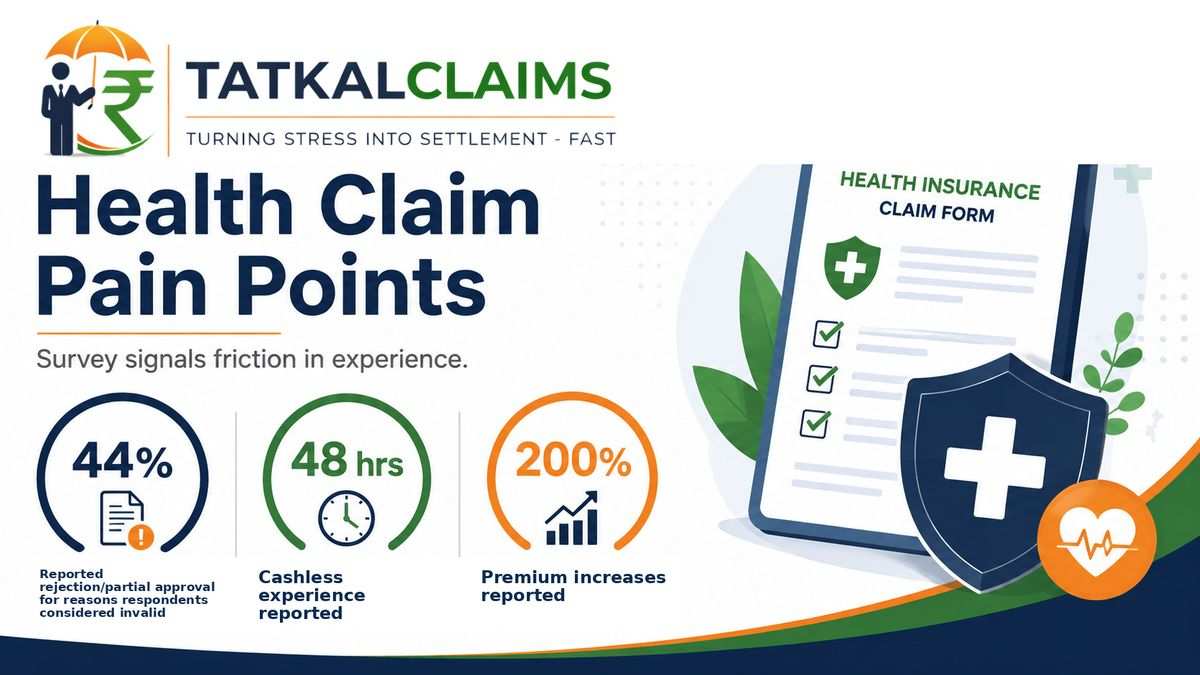
Survey Finding: 4 in 10 Claimants Reported Rejection or Partial Approval for Reasons They Considered Invalid
When you pay a health insurance premium year after year, you expect one thing above all else: that when illness strikes, your insurer will stand by you. For millions of Indians, that expectation is being shattered.
A LocalCircles survey published on March 7, 2026 examined policyholders' recent health-insurance claim and premium experiences. Its findings point to significant friction around claim outcomes, discharge timing and renewal costs, but they are survey responses rather than an independent adjudication of whether individual claim decisions were legally valid.
LocalCircles said the survey received more than 54,000 responses from consumers across 323 districts. For the claim-outcome question, 18,989 respondents who had experienced a health-insurance claim in the previous three years were asked about the result; 44% said the claim was rejected or only partially approved for reasons they considered invalid.
What the Survey Reported
The following figures are the respondents' reported experiences in the LocalCircles survey, not independently verified determinations about individual insurer decisions.
Of the respondents who had filed a health insurance claim between 2023 and 2025:
- 15% said their claim was rejected with invalid reasons.
- 29% said their claim was only partially approved with invalid reasons.
- 15% said their claim was only partially approved with valid reasons.
- 32% said their claim was fully approved.
- 9% said their claim was fully approved but only after some back and forth with the insurance company.
Add the first two categories together, and you get a staggering statistic: 44% of policyholders — nearly half — faced either a full rejection or a partial approval that they believed was unjustified. Only one-third experienced a smooth, full approval process. If you are dealing with a full rejection, use our guide to challenging a rejected insurance claim.
Cashless Claims: IRDAI's 1-Hour / 3-Hour Timelines vs. the 6-to-48-Hour Survey Experience
IRDAI's current health-insurance turnaround times distinguish two cashless stages: a decision on pre-authorisation within one hour, and final authorisation within three hours of receiving the hospital's discharge authorisation request.
In the LocalCircles survey, 18,119 respondents answered the discharge-time question. About 5 in 10 said the process took between 6 and 48 hours for claim approval and discharge. That is a survey-reported experience and should not be read as proof that every such case breached the regulatory turnaround time, because the regulatory clocks depend on when the relevant hospital request was received. If your claim is stuck beyond the applicable timeline, follow our claim-delay evidence and escalation guide.
Long waits at discharge can create practical and financial stress for patients, families and hospitals. When a delay appears to exceed the applicable IRDAI turnaround time, policyholders should preserve the hospital request and insurer-response timestamps and raise the issue through the insurer's grievance process.
Premiums Up 50-200% or More: What Respondents Reported
The premium findings also come from the LocalCircles survey and describe respondents' cumulative increases over the three years from 2022 to 2025.
Of the 17,200 respondents who answered the premium question, more than 7 in 10 reported cumulative increases of at least 50%; this included 21% who reported increases of 200% or more.
- 21% reported premium increases of 200% or more.
- 11% reported increases of 150-200%.
- 21% reported increases of 100-150%.
- 21% reported increases of 50-100%.
Only 10% of respondents reported premium increases of 0-25% over the three-year period.
These responses indicate substantial renewal-cost pressure for many of the people surveyed. The figures do not by themselves establish why a particular premium changed or whether an individual increase complied with the applicable product and regulatory framework.
IRDAI Data Adds Official Context
Official IRDAI data provides a separate, industry-wide view of claim volumes and payouts and should be read alongside — rather than as proof of — the survey respondents' experiences.
In FY2023-24, health insurers registered about 3.26 crore claims with an aggregate claim amount of roughly Rs 1.17 lakh crore.
- About 2.69 crore claims were paid, with approximately Rs 83,493 crore paid out.
- That corresponds to a claims-paid ratio of 82.46% by number and about 71.29% by amount.
IRDAI data also recorded about Rs 15,100 crore in disallowed claims and about Rs 10,937 crore in repudiated claims. These categories should not automatically be treated as wrongful denials; individual outcomes depend on policy terms, facts and applicable rules.
The average amount paid per settled claim was about Rs 31,086, and roughly two-thirds of claims were handled through cashless mode in FY2023-24.
Official Grievance Data Adds Context
According to a March 2026 Ministry of Finance release citing IRDAI's Bima Bharosa portal, 1,37,361 general and health insurance grievances were reported in FY2024-25, of which 1,27,755 — about 93% — were disposed of during the same financial year.
That 1,37,361 figure covers general and health insurance together, so it should not be presented as a health-insurance-only complaint count. It nevertheless shows the scale of grievance handling across those segments.
Senior Citizens: Premium Controls and Regulatory Oversight
In January 2025, IRDAI directed general and health insurers offering indemnity-based individual health products to senior citizens not to revise premiums by more than 10% per annum. If an insurer proposes an increase above 10%, or proposes to withdraw an individual health product offered to senior citizens, prior consultation with IRDAI is required.
The circular was issued after IRDAI noted steep premium increases in some senior-citizen health products and described the issue as a regulatory concern. Whether a particular renewal increase complies with the circular depends on the product and the applicable regulatory treatment, so policyholders facing a sharp increase should seek the insurer's written basis and escalate a grievance where appropriate.
Common Reasons Claims May Be Reduced or Denied
Claim outcomes can turn on policy wording, disclosed facts, waiting periods, exclusions, sub-limits, deductibles and other documented conditions. The sections below describe common dispute areas; they are not a ranked list and the article does not assign unsupported industry-wide rejection percentages to them.
1. Non-Disclosure of Pre-Existing Conditions
Non-disclosure disputes arise when an insurer alleges that material health information was not disclosed when the policy was taken. A repudiation should be tied to the policy terms and legally tenable evidence. Under the current policyholder-protection framework, after 60 continuous months of health coverage a policy or claim cannot be contested for non-disclosure or misrepresentation except in cases of established fraud.
2. Waiting Period Violations
Waiting periods vary by policy. Under IRDAI's current health-insurance framework, waiting periods — including pre-existing-disease and specific waiting periods — can be up to 36 months from policy commencement. The exact waiting period and its application must be checked against the policy wording.
3. Policy Exclusions and Coverage Gaps
A claim can also be affected where the treatment or expense falls outside the policy's covered benefits or within a valid exclusion. Coverage should be assessed against the actual policy wording rather than assumed from the treatment name alone.
4. Incomplete or Incorrect Documentation
Insurers may need documents to assess a claim, and policyholders should submit available records promptly. However, IRDAI's 2024 policyholder-protection framework states that a claim should not be rejected or closed merely for want of documents; the insurer must process claims under the applicable rules and policy terms.
5. Late Claim Intimation
Policyholders should intimate a claim at the earliest possible time. But under IRDAI's 2024 policyholder-protection framework, a claim should not be rejected or closed merely because claim intimation was delayed.
6. Policy Lapse at the Time of Hospitalisation
If premium is not paid within the applicable grace period, the policy can lapse and coverage may cease. During the grace period, coverage depends on the payment mode and policy terms: IRDAI states that coverage is available during the grace period when premium is paid in instalments during the policy period, while in other cases coverage during the grace period depends on the policy terms.
7. Sub-Limits and Copayment Clauses
Sub-limits, co-payments, deductibles, room-rent limits and similar cost-sharing provisions can reduce the admissible amount under a claim where the policy terms permit them. The effect should be calculated from the actual policy wording rather than assumed to apply uniformly to every expense.
What This Means for You: Know Your Rights
If you are facing a health insurance claim rejection, delay, or partial settlement, know that you have rights — and you have options.
Right 1: Cashless Pre-Authorisation and Final Authorisation
IRDAI states that insurers should decide cashless pre-authorisation requests within one hour and grant final authorisation within three hours of receiving the hospital's discharge authorisation request. Preserve the relevant timestamps if you believe these turnaround times were exceeded.
Right 2: Reimbursement Claims Within 15 Days
For claims other than cashless, IRDAI's current health-insurance turnaround time is 15 days. Where the applicable settlement timeline is exceeded, interest may be payable under the governing policyholder-protection rules.
Right 3: A Written Reason for Rejection
When a health claim is denied or repudiated, the insurer should communicate the reasons and refer to the corresponding policy conditions, along with available grievance-redressal avenues.
Right 4: Insurer Grievance Action Within 14 Days
IRDAI's current health-insurance turnaround-time table specifies immediate acknowledgement of a complaint and action on the complaint with intimation of the decision within 14 days.
Right 5: Free Ombudsman Resolution
The Insurance Ombudsman provides a cost-effective grievance-redressal mechanism for eligible insurance disputes. The maximum compensation it may award is Rs 50 lakh, including relevant expenses. Eligibility and timing requirements should be checked before filing.
What to Do If Your Health Insurance Claim Is Rejected
Here is your step-by-step action plan.
Step 1: Read the rejection letter carefully. Note the exact reason cited. Determine whether the rejection is procedural (missing documents, late intimation) or substantive (waiting period, exclusion, non-disclosure).
Step 2: Gather counter-evidence. If the rejection is based on non-disclosure, obtain a clarification from your treating doctor. If it is based on documentation, collect the missing documents and resubmit.
Step 3: File a formal grievance with the insurer's GRO. Include your policy number, claim reference, the reason you believe the rejection is incorrect, and all supporting documents. Send it by email and registered post.
Step 4: If the insurer's grievance response is unsatisfactory, you can consider escalation through IRDAI's Bima Bharosa portal. Bima Bharosa states that insurer complaints should be attended to within 14 days and allows policyholders to track and escalate unresolved grievances.
Step 5: The Insurance Ombudsman may also be available for eligible disputes. You may approach the Ombudsman after an unsatisfactory insurer decision; if the insurer gives no reply, the CIO states that one month must have elapsed from the last written representation. The process carries no filing fee, and a lawyer is not required under the Ombudsman scheme.
Step 6: For large-value claims or clear cases of bad faith, approach the District Consumer Disputes Redressal Commission under the Consumer Protection Act, 2019. Consumer courts can award the claim amount, interest, compensation for mental agony, and litigation costs.
The Bottom Line
India's health-insurance market exceeded Rs 1.2 lakh crore in premiums in FY2024-25. Separately, the LocalCircles survey found that 44% of claim-outcome respondents said their claim was rejected or partially approved for reasons they considered invalid, while half of discharge-time respondents reported a 6-to-48-hour process. Those survey findings describe respondent experience; they are not a substitute for case-by-case legal or regulatory assessment.
IRDAI's current framework includes one-hour cashless pre-authorisation, three-hour final discharge authorisation, a 15-day turnaround time for non-cashless claims, grievance timelines and additional protections around delayed claim intimation and senior-citizen premium revisions. Effective enforcement in an individual case depends on the facts, timestamps, policy terms and grievance record.
At Tatkal Claims, we believe that paying premiums is a promise, and that promise must be honoured. If your health insurance claim has been rejected, delayed, or underpaid — whether for invalid reasons, shifting grounds, or technical objections — our legal team is here to help you fight for the settlement you deserve. We review policy wordings, challenge arbitrary rejections, escalate to the Ombudsman, and represent you in consumer court.
If you believe a claim was wrongly denied, delayed or underpaid, preserve the policy wording, claim documents, hospital requests, insurer communications and timestamps. Those records are central to evaluating whether the insurer followed the policy and applicable rules.
Sources and Methodology
Facing a rejected, delayed, or underpaid health insurance claim? Contact our legal team at Tatkal Claims for expert assistance in challenging unfair denials and securing the settlement your family deserves.


