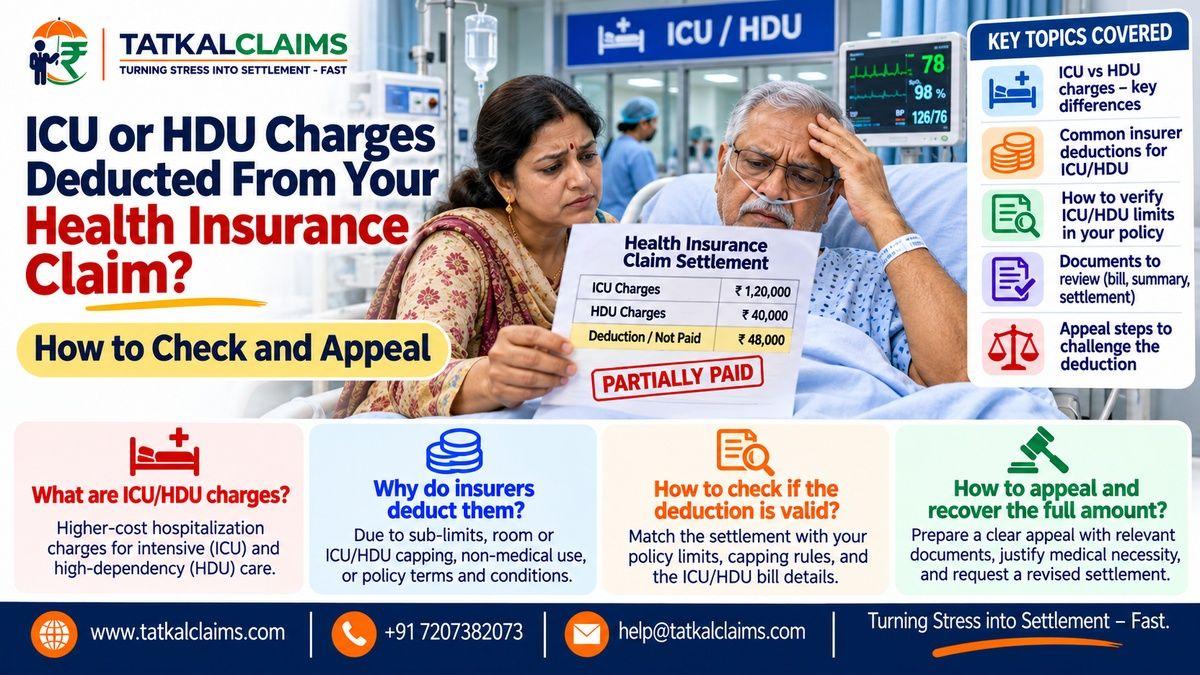
Your hospital billed for an Intensive Care Unit (ICU) or High Dependency Unit (HDU) stay, but the insurer paid less than expected. Perhaps the insurer applied an ICU daily limit, called an ICU bed an HDU bed, questioned whether the patient still needed close monitoring, or used a proportionate-deduction formula on other medical expenses.
Those are four different disputes. They require different evidence. Before submitting an appeal, ask for the precise claim calculation and policy clause rather than arguing that the entire ICU bill must always be paid.
ICU, HDU and Ward: The Label Alone Does Not Decide Coverage
An ICU generally provides higher-intensity monitoring and specialist care for critically ill patients. An HDU is commonly a step-down or higher-observation setting between intensive care and a regular ward. Hospital naming, equipment and billing structures differ, so the definition in your own policy and the actual treatment records are important.
An HDU is not automatically an ICU, but neither does the label "HDU" automatically mean that an admission is uninsured. Check whether the policy has a separate HDU provision, treats critical-care charges under its ICU definition, or applies a specified room-category or daily limit.
If the invoice says ICU while the bed register says HDU, request a factual reconciliation. Do not ask anyone to backdate a hospital record or reclassify treatment without supporting contemporaneous evidence.
Four Reasons an ICU/HDU Claim May Be Reduced
| Insurer's explanation | What must be checked | Useful evidence |
|---|---|---|
| "ICU charges exceed your limit" | Per-day or category limit in the actual issued policy and CIS | Policy schedule, itemised invoice, settlement sheet |
| "Patient was in HDU or ward, not ICU" | Bed allocation and the policy's category definition | Transfer register, nursing notes, hospital tariff |
| "ICU/HDU stay was unnecessary for these dates" | Specific days and clinical basis for the objection | Vitals, treatment charts, consultant notes and medical review |
| "Other costs reduced in proportion to the ICU/room rate" | Exact formula, affected expense categories and applicable contractual and regulatory basis | Itemised calculation, policy wording, tariff |
1. ICU Daily Limit Versus a Proportionate Deduction
Some products state an ICU limit as a percentage of the sum insured per day; others use a rupee cap, category rule or no separate limit. Compare the UIN, policy schedule, endorsements, CIS and the wording applicable to your dates of hospitalisation.
For illustration only, four ICU days billed at ₹12,000 per day total ₹48,000. If the actual policy expressly caps the relevant ICU charge at ₹8,000 per day, that line would be restricted to ₹32,000, making a ₹16,000 difference before other applicable terms.
But a reduction to that line is not itself an explanation for additionally reducing surgery, investigations or consultation charges. Ask the insurer to calculate and justify those separately. When those additional deductions are tied to room eligibility or a proportionate formula, our room-rent capping guide explains how to check the policy wording, ratio and affected charges.
2. ICU Versus HDU Classification
A hospital may bill the ICU bed, intensivist, monitoring equipment and nursing support as separate lines—or bundle them into one charge. An insurer may then compare those lines against a different tariff or category.
Obtain a date-by-date bed-category chronology: where was the patient admitted, when did transfers occur, what care was actually provided, and what did the hospital charge for that category? Ask for the bed-allocation record, ward-transfer sheet, nursing chart, intensivist orders and the applicable hospital rate card.
A discrepancy can affect both sides. A claimant may have been underpaid for genuine ICU treatment, or the hospital may have billed a more intensive category than the records show. The evidence—not the preferred outcome—should govern the correction.
3. A Dispute About Medical Necessity or Length of Stay
The insurer may accept the first day of ICU admission but question later days when vital signs improved. A stable reading alone is not a complete assessment, just as a doctor's one-line certificate is not conclusive proof that every day of ICU care was needed.
Ask the insurer for the exact disputed dates, medical records it considered, any internal or external medical opinion and the clinical reasoning behind the deduction. A useful treating-doctor explanation should address the contemporaneous chart: oxygen or ventilatory support where relevant, adverse-event risks, treatment intensity, investigations, observation frequency and the reasons for continued higher-level monitoring.
4. Proportionate Deductions: Check the Current Regulatory Position
There is an important historical detail that should not be overlooked.
IRDAI's circular IRDAI/HLT/REG/CIR/151/06/2020, dated 11 June 2020, restricted proportionate deductions in health-insurance products, including ICU-related deductions. However, the 29 May 2024 Health Insurance Master Circular expressly superseded the circulars listed in its Annexure 6—and item 19 lists that June 2020 circular.
It is therefore incorrect to cite the 2020 circular alone as a currently binding blanket prohibition on ICU proportionate deductions.
For a dispute today, check the policy wording and any applicable newer regulatory provision or interpretation. Published policy wordings show that ICU limits and medical-expense calculation provisions can vary by product. The fact that an insurer printed a formula does not itself settle whether it is valid or correctly applied; that legal assessment needs the relevant policy version, coverage dates and current rules.
Worked Example: Audit Each Line Rather Than the Total Alone
Suppose the hospital bill lists:
| Expense | Billed amount |
|---|---|
| Four ICU days | ₹48,000 |
| Diagnostic tests | ₹20,000 |
| Medicines | ₹18,000 |
| Consultation and treatment charges | ₹30,000 |
The insurer allows ₹32,000 for ICU days and also reduces the consultation charge. Ask two distinct questions: which policy limit produced the ₹16,000 ICU difference, and what independently justifies the consultation reduction? For a wider line-by-line check of a partial payout, see our health-insurance short-settlement guide before preparing a written appeal.
Do not presume that either calculation is automatically correct or unlawful. The figures are illustrative, not taken from a real claimant's file.
Documents to Collect Before You Appeal
Prepare one file with the policy schedule, the CIS, full product wording and endorsements, and the final settlement communication. Preserve the claim number, any cashless approval and discharge authorisation, claim queries and insurer/TPA replies.
From the hospital, request the original itemised invoice, applicable ICU/HDU tariff, bed-transfer details, nursing/medical charts, and the relevant consultant or intensivist's explanation. If an entry is wrong, ask for a dated correction that preserves the original record and the correction trail.
Create a small reconciliation table with the date, billed bed category, documented treatment and monitoring, rate billed, rate allowed by the insurer, difference and corresponding evidence.
Under the IRDAI Health Insurance Master Circular of 29 May 2024, a partially disallowed claim should be explained with reference to the specific policy terms. The circular also addresses the insurer's and TPA's responsibility for obtaining hospital records after claim intimation. These requirements help you seek a reasoned decision; they do not automatically make every disputed expense payable.
A Focused Written Request to the Insurer
Subject: Request for itemised reconsideration of ICU/HDU deductions — Claim [number]
I dispute the deduction of [amount] for [dates of hospitalisation]. Please provide:
- The exact policy clause, UIN/product wording and per-day or category limit applied to each deducted item.
- The billed and eligible ICU/HDU rates, day count and complete calculation.
- The hospital bed classification and medical evidence relied upon for each disputed date.
- The clause and current regulatory basis for proportionately reducing any other hospital or treatment expenses.
- The medical review and its reasoning, if ICU/HDU medical necessity was questioned.
I enclose the dated hospital records, itemised invoices and reconciliation. Please issue a reasoned written claim-review decision.
Escalating an Unexplained Deduction
If the insurer gives only a blanket percentage or a vague statement such as "HDU not admissible", ask for an itemised written response and raise a grievance through the insurer's formal grievance channel. Preserve the dates and acknowledgement numbers.
If it remains unresolved, consider Bima Bharosa and, where eligible, the Insurance Ombudsman. Check current monetary limits, prerequisites, deadlines and forum suitability before filing. No complaint procedure guarantees additional payment.
How Tatkal Claims can help: We can compare the contract and final settlement against the hospital's bed-category records, test the insurer's line-item calculations, identify evidence gaps and help prepare a focused reconsideration or grievance. The objective is a substantiated dispute, not a promise that all ICU charges must be paid.
To request a claim-deduction review, call +91 7207382073 or email help@tatkalclaims.com with the policy schedule, settlement sheet and hospital bill. Avoid sharing unnecessary personal identifiers.
Frequently asked questions
Is HDU always covered as ICU?
No automatic equivalence applies. Check the issued contract and the bed and treatment records.
Can a health insurer set an ICU daily limit?
Some policies do. Verify the actual schedule, CIS and applicable wording rather than accepting an insurer's generic policy description.
Is the 2020 IRDAI ICU proportionate-deduction circular current?
It appears in Annexure 6 of the May 2024 Master Circular's superseded list. Do not use it alone to make a current-law claim.
What if the insurer says the last two ICU days were unnecessary?
Ask for the dates and medical assessment; have the treating team explain the contemporaneous monitoring and clinical needs.
What if the final bill and discharge summary disagree about the room type?
Obtain the original bed-transfer and billing records and a dated factual clarification. Never backdate records.
Can the insurer reduce all other charges because the ICU limit was exceeded?
Do not assume so. Ask for every item affected, the calculation and its current contractual and regulatory basis.
Does cashless authorisation guarantee final ICU payment?
No. Compare the approval, the final authorisation and the written basis for any later deduction.
What should Tatkal Claims review first?
The insurer's calculation, the current issued policy and CIS, the hospital's bed-category chronology, and the medical records for the disputed days.