A father is admitted with chest pain. Days later, his family receives a rejection letter alleging an undisclosed kidney disease. They open the discharge summary and discover one sentence saying he had “CKD for five years”—although the family says the treating team only noticed an abnormal kidney-function result during this admission. The insurer may have relied heavily on that sentence. What should the family do now?
The answer is not to ask the hospital to erase the diagnosis or quietly issue a cleaner discharge summary. The right approach is to identify exactly what was documented, establish who recorded it and on what clinical basis, and ask the treating doctor and hospital for a signed, dated clarification or traceable correction where the entry is demonstrably wrong. Then submit both the original and corrective documents to the insurer, together with the relevant older records.
The example above is hypothetical. Not every medical-record discrepancy is a clerical error: sometimes a history entry is accurate, a doctor makes a provisional diagnosis, or a genuinely established older condition was not disclosed. A challenge should distinguish those situations rather than assume every unfavourable entry must be removed.
Written by: Tatkal Claims, Claims Review Team
Reviewed by: Ankit L Kanoi, Founder
Can Wrong Medical Records Cause a Health Insurance Claim Rejection?
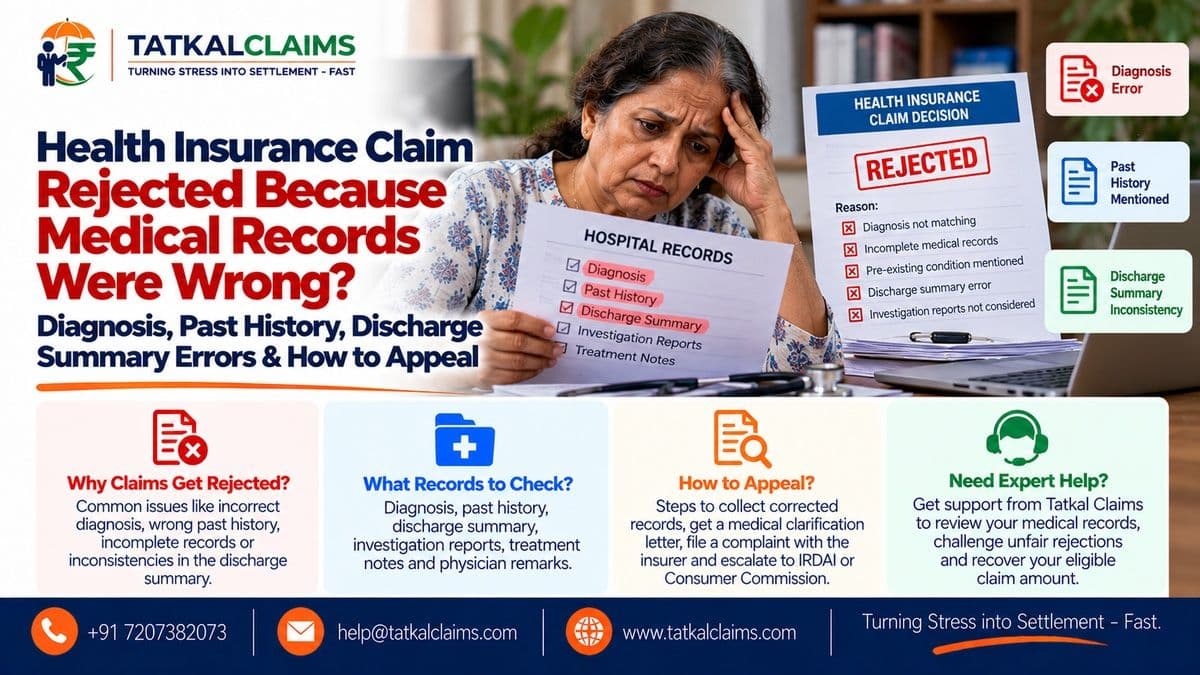
Yes. A diagnosis, patient history, duration-of-illness phrase, operation name or mismatch between reports and discharge summary can change how an insurer assesses medical necessity, pre-existing disease (PED), non-disclosure, waiting periods or billed treatment. The insurer may be looking at a brief summary while the original treatment notes tell a more complicated story.
A particularly consequential entry is “known case of diabetes for ten years”, “hypertension since childhood”, “chronic kidney disease for five years” or “alcohol-related liver disease”. Those phrases could be accurate, provisional, copied from another document, reported by an attendant without confirmation, or simply recorded for the wrong patient. Which explanation is supported by the contemporaneous evidence matters more than the family's preferred wording.
A medical-record correction by itself does not compel the insurer to approve an otherwise excluded claim. Conversely, the presence of a disputed label in one document should not be treated as conclusive without comparing the original clinical notes, relevant investigations, signed proposal answers, policy history and applicable policy clauses.
Which Hospital Record Errors Matter Most?
| Possible discrepancy | Why it may affect the insurer's decision | Best supporting records |
| Past-history duration: 'diabetic since 2015' | May be used to allege an undisclosed PED | Prior consultation notes, prescriptions, diagnostic reports, proposal forms |
| Wrong diagnosis or provisional diagnosis shown as final | May trigger a condition exclusion, waiting period or incorrect treatment classification | Treating physician's notes, investigation sequence, final clinical assessment |
| Incorrect procedure or surgery name | May lead to wrong procedure sub-limit or denial | Operation note, consent form, OT register, procedure and implant invoice |
| Incorrect admission/discharge dates or times | May affect hospitalisation/day-care eligibility or policy-date questions | Admission register, nursing chart, discharge order, billing timestamps |
| Copy-paste from another patient's history | May introduce a serious illness that does not belong to this patient | Hospital patient IDs, clinician verification, original case sheets |
| Unexplained conflicting treatment dates or codes | May prompt an insurer query or fraud review | Medication administration record, diagnostic timestamps, invoice reconciliation |
Do not describe all discrepancies as harmless clerical errors. A wrongly coded procedure can be administrative; an inaccurate history of cancer or chronic disease could be a serious medical-record quality issue. If the recorded condition may still be clinically possible, ask the physician for a reasoned clarification rather than demanding an unqualified statement that the patient never had it.
Wrong Diagnosis Versus Wrong Medical History: Two Different Appeals
A suspected diagnosis was later ruled out
An admission note may correctly record “suspected stroke” or “rule out kidney disease” before tests are complete. The final diagnosis may reasonably change. If the discharge summary wrongly presents a ruled-out condition as confirmed, seek an addendum explaining the sequence: initial differential diagnosis, investigations, revised clinical conclusion and final diagnosis. Preserve the initial notes; they are part of the medical history.
The diagnosis was correct, but the stated duration was wrong
Suppose the clinician diagnosed hypertension during this admission, but the discharge summary says “hypertension for eight years”. The correction request should focus on the unsupported duration, not deny a real current diagnosis. Ask who supplied the eight-year history, whether any earlier record supports it, and whether the wording was meant as confirmed medical history, patient-reported history or an estimate.
The insurer disagrees with the clinical classification
An abnormal creatinine value, high blood glucose or an ultrasound finding may be clinically important, but it does not always establish that a named chronic disease had been diagnosed years earlier. Whether the evidence supports a particular diagnosis is for a qualified clinician to clarify; neither the claimant nor TatkalClaims should replace the doctor's assessment with an insurance-friendly diagnosis.
These differences shape the request. A discharge-summary typo needs a verified correction. A contested clinical diagnosis may require the treating consultant's written reasoning or another legitimate medical opinion. A genuine pre-policy diagnosis may instead require analysis of disclosure and waiting-period rules.
How to Request the Complete Hospital Medical Records
Start with a written request to the hospital's Medical Records Department (MRD), medical superintendent or designated patient-records officer. Ask for a copy of the complete inpatient record relevant to the dispute: case sheet and admission history, signed progress notes, consultation entries, nursing observations, medicines administered, investigation reports, consent and procedure notes, discharge summary and relevant corrections or addenda.
Under clause 1.3.2 of the Indian Medical Council (Professional Conduct, Etiquette and Ethics) Regulations, 2002, as published by the National Medical Commission, requests for medical records by patients or authorised attendants should be acknowledged and documents issued within 72 hours. The NMC's 23 August 2023 amendment held its newer 2023 professional-conduct regulations in abeyance and adopted the 2002 rules as operative. This 72-hour record-access provision is not a legal promise that the treating doctor must alter a disputed diagnosis within that time.
If the patient cannot make the request personally, follow the hospital's requirements for an authorised attendant, consent, identity verification or legal representative. Keep the written request and receipt. An insurer's TPA may already have a summary, but request your own complete record rather than relying solely on the extracts it received.
If records are not supplied, send a follow-up to hospital administration citing the record-access clause and ask for a written response. Separate that access complaint from any disagreement over the actual diagnosis. A hospital's internal amendment process may require the original treating consultant's approval; you cannot compel a doctor to certify a fact they cannot clinically support.
How to Correct a Wrong Discharge Summary Without Damaging Your Case
Write down the exact line, page and date you dispute. Attach specific evidence, such as an earlier consultation note, an original lab report, the doctor's signed progress note or the operative record. Ask the hospital to review the issue against the source record, not simply to retype the discharge summary to match the claim.
A sound correction or addendum should identify the patient and admission, the entry being clarified, the corrected fact or the clinician's uncertainty, the supporting clinical basis, the name/designation of the author and the date it was issued. Ask that it be placed in the official hospital record and linked to the earlier entry. Keep both versions. A hospital may issue a revised summary or an addendum; use its documented process and preserve the version history.
Do not delete, photoshop, backdate or independently edit a hospital document. Do not ask the doctor to falsely state that an illness did not exist merely to avoid a policy exclusion. An unexplained replacement created after repudiation can make a legitimate correction look unreliable and may deepen an insurer's investigation.
What if the doctor refuses to change the record?
Ask for a clinical explanation, not a confrontation. The doctor may reasonably stand by a diagnosis or may be unable to confirm when a prior condition started. Request a signed clarification identifying the limits of what can be established and obtain your previous records. If you believe the hospital has failed to handle a demonstrable documentation error, escalate within the hospital or through an appropriate professional-standards channel; the insurer claim and medical-record grievance remain separate questions.
What if the patient was treated at several hospitals?
A receiving hospital may have copied an earlier admission's history. Trace the disputed phrase back to the original document, and ask the authoring institution or relevant clinician to clarify its source. A later hospital cannot always certify that an earlier hospital's observation was wrong; it can, however, explain what its own doctors verified.
Past Medical History, PED and Alleged Non-Disclosure
India's current IRDAI health-insurance FAQ describes a pre-existing disease using a 36-month look-back: a condition diagnosed by a physician, or for which medical advice or treatment was recommended or received, within the 36 months before commencement of the policy. Separate from that definition is the applicable PED waiting period, which under the 2024 framework is capped at 36 months. Historical policy start dates and applicable prior regulatory wording require separate attention.
An insurer citing “known case for six years” should be asked to identify the source of that duration and the relevant signed proposal question. The family should compare the proposal's actual answers, pre-insurance tests, contemporaneous clinical notes and dates of diagnosis. The hospital's later note may reveal evidence, but by itself it is not the signed proposal or a determination of deliberate misrepresentation.
The current 2024 framework also recognises a 60-month moratorium after continuous eligible coverage, including qualifying portability or migration credits: the insurer cannot contest a policy or claim for non-disclosure or misrepresentation after that period except on grounds of established fraud. Enhanced sum insured may have its own 60-month clock on the increased limits. This protection does not turn an inaccurate medical record into a valid one, nor does it automatically override all otherwise applicable coverage limits and exclusions.
For waiting periods, disclosure, policy continuity and moratorium analysis, use our PED claim rejection guide. The present article focuses on how to establish whether the underlying hospital record is accurate.
What to Do if the Insurer Has Already Rejected Your Claim
Preserve the insurer's final repudiation or deficiency letter. It should tell you whether the issue is an alleged undisclosed condition, a waiting-period exclusion, medical necessity or a contradiction in clinical records. Request the exact policy condition and the documents or medical assessment supporting that conclusion; a telephone statement that “the discharge summary shows an old disease” is not enough to understand the full decision.
Send the hospital a separate, targeted clarification request and copy the insurer. Make clear that the medical-record review is pending and ask whether the claim can be reassessed when the hospital issues a documented response. Do not wait indefinitely for the hospital before protecting complaint deadlines or obtaining the insurer's written decision.
When the addendum or clinician letter arrives, submit it alongside the original discharge summary, relevant case-sheet excerpts, diagnostic evidence and proposal/continuity records. Identify every apparent contradiction instead of sending an unindexed bundle. Ask the insurer to tell you specifically whether the new records alter its finding, and if not, which evidence or contract clause still supports repudiation.
If the hospital confirms that the original record was correct, review the policy implications rather than insisting on a fabricated correction. There may still be other issues: the insurer's reading of a policy term, whether the disease is actually connected with the claimed treatment, or whether the waiting period or moratorium is being applied correctly.
A Worked Illustration: The Difference Between an Error and a Genuine PED Dispute
Imagine an insurer repudiates a ₹3,20,000 hospitalisation claim, saying the discharge summary records “chronic kidney disease since 2019” but the policy began in 2022 without that declaration. This is a hypothetical illustration—not an actual TatkalClaims client's claim or a judicial decision.
| Hospital's documented finding | Appropriate next action |
| Original notes show only a newly detected abnormal lab result; consultant confirms the discharge-summary duration was entered in error | Obtain signed, dated MRD-linked addendum; provide original and corrected clinical record; ask insurer to reassess the alleged earlier diagnosis |
| Earlier nephrology prescriptions or lab records establish a diagnosed condition before cover began | Review the proposal question/answer, underwriting disclosures, PED waiting period, portability credits and any applicable moratorium or fraud finding; do not seek a false record correction |
The insurer may still examine whether the hospitalisation was otherwise eligible and whether all billed items were payable. Success is not determined by which row seems more convenient; it depends on what the evidence proves.
What if Wrong Records Lead to a Short Settlement Rather Than Rejection?
An error can change the amount rather than the admission decision. A wrong surgery name or billing procedure code might trigger a treatment-specific sub-limit, an incorrect diagnosis could cause an avoidable disallowance, or a wrong admission/discharge timestamp could change how a hospital stay is classified. Request the itemised insurer assessment and hospital bill, then reconcile each disputed line to the actual clinical record.
Where the difference comes from non-payable consumables, room rent, co-payment or another valid benefit limit rather than a documentation error, use the relevant separate policy analysis. Do not call every reduced payment a 'medical-records error'.
Our short-settled health insurance claim guide explains how to reconcile claim amounts.
If admission was marked unnecessary based on incomplete notes, consult the medical-necessity rejection guide.
If the hospital's summary incorrectly shows a stay under 24 hours, check the day-care and under-24-hour claim guide.
A Specific Written Request to the Hospital
A useful message is: “I request copies of the inpatient record for admission [date to date], including the admission history, relevant progress notes and discharge summary. The discharge summary dated [date], page [number], states '[exact words]'. I believe this does not match [identified original note or investigation]. Please have the treating consultant review the source record and, if clinically justified, issue a signed and dated correction or clarification that identifies the original entry and is retained in the official hospital record. Please provide the underlying records regardless of the correction decision.”
Use the real dates and wording from the case, not generic allegations. An authorised relative can add their relationship and authority to request information. If the question concerns a provisional diagnosis rather than a typo, request an explanation of the final diagnostic conclusion rather than insisting it be removed.
A Focused Reconsideration Request to the Insurer
A concise claim request could say: “The repudiation dated [date] relies on '[quoted medical history]'. I dispute the recorded duration/diagnosis because [precise reason]. I have requested the complete hospital record and attach the treating consultant's dated clarification, the relevant earlier medical records, the policy schedule and original proposal. Please identify the policy clause relied upon, the documents establishing the alleged pre-policy diagnosis or non-disclosure, and provide a reasoned reassessment after considering both the original and amended records.”
If a prior diagnosis is genuine, do not make that statement. Narrow the dispute to what can be established: whether the condition was disclosed, what the insurer asked, applicable waiting or moratorium provisions, or whether the diagnosis reasonably relates to the current claim. The objective is an evidence-based decision, not an artificially tidied file.
If Neither the Hospital Nor the Insurer Resolves the Dispute
For the hospital-record issue, keep the written request trail and any response from MRD, the treating consultant or hospital administration. Where appropriate, a patient may raise a professional conduct or record-access concern through the relevant hospital or medical regulator. That process is distinct from an insurance payment dispute; do not assume the Insurance Ombudsman orders hospitals to revise clinical notes.
For the insurance dispute, write to the insurer's Grievance Redressal Officer and obtain an acknowledgement. IRDAI's current Health Department FAQs describe a 14-day action and intimation standard for complaints, while the Bima Bharosa FAQ still describes 15 days or two weeks. Check the current service-standard information and save actual dates. Bima Bharosa registers and tracks grievances with insurers; it does not itself guarantee payment.
The Council for Insurance Ombudsmen's current published procedure says complain to the insurer or broker first, then approach the Ombudsman if the reply is unsatisfactory or no response arrives within 30 days, subject to other eligibility rules. The published ceiling is ₹50 lakh, and its FAQ explains the one-year filing framework and restrictions on parallel court/consumer-forum/arbitration proceedings concerning the same dispute. For complex medical-record allegations, get case-specific advice about the correct forum and evidence.
See our claim query and deficiency-letter response guide for replying clearly while the hospital is still gathering records.
For filing requirements and deadlines, see our Insurance Ombudsman complaint guide.
How TatkalClaims Helps Organise a Medical-Record Rejection Appeal
For a family, the hardest part is often that the hospital and insurer each point to the other. Tatkal Claims can help identify the exact disputed sentence, build a chronology of actual medical evidence, compare the original policy and signed proposal, review the insurer's ground for rejection, and present the clarification in a structured reconsideration or grievance. We do not create medical certificates or tell doctors what diagnosis to record.
If your claim has been rejected or reduced because the discharge summary, case sheet or medical history appears wrong, contact +91 7207382073 or help@tatkalclaims.com. Keep the original records and insurer letter; share only what is necessary, through a secure channel, with unnecessary identifiers masked. Neither a corrected note nor a filed complaint guarantees a reversal.
Frequently asked questions
Can a wrong discharge summary cause health insurance claim rejection?
Yes. An inaccurate diagnosis, past-history duration, admission date or procedure description can affect how an insurer assesses pre-existing disease, non-disclosure, waiting periods, medical necessity or benefit limits. The entry needs to be checked against original hospital records.
Can the hospital simply delete an incorrect diagnosis after claim rejection?
You should seek a factual, signed and dated correction or addendum through the hospital's authorised process, preserving the original record and an audit trail. Do not alter, backdate or conceal medical records.
How quickly can I obtain a copy of my hospital medical records?
Clause 1.3.2 of the NMC-published 2002 medical ethics regulations provides for acknowledging patient/authorised-attendant requests and issuing medical records within 72 hours. That is a record-access rule, not a 72-hour guaranteed diagnosis-change procedure.
What if the doctor won't say that the recorded illness was wrong?
Ask for the clinical evidence, context and limits of the diagnosis. The doctor should not be asked to certify a false statement. Obtain the underlying reports and, where appropriate, a legitimate further medical opinion.
Does an abnormal blood test prove I had chronic kidney disease before buying insurance?
Not by itself. The diagnosis and timing require clinical interpretation and evidence. Obtain the treating doctor's assessment and earlier relevant records; do not assume that a newly recorded abnormal value establishes an undisclosed pre-policy illness.
Will a corrected discharge summary automatically force the insurer to pay?
No. The insurer must still evaluate the admissible claim under the applicable policy. A documented correction can address a mistaken basis for rejection, but independent policy grounds may remain.
What is the current pre-existing disease waiting period?
Under IRDAI's 2024 health insurance framework, PED waiting periods cannot exceed 36 months, with the actual product wording and appropriate continuity credits governing the case. Historical policies may need their original regulatory and contractual context checked.
Can a five-year-old continuous health policy still be contested for non-disclosure?
The 2024 moratorium generally restricts contesting on non-disclosure or misrepresentation after 60 continuous months of eligible cover, except for established fraud. Increased sum insured may have a separate clock on the enhanced portion.
What if a hospital refuses to issue the full case sheet?
Make a written request to MRD or the medical superintendent, retain proof, refer to the applicable medical-record access rule and escalate the access issue through hospital administration or an appropriate professional channel. Preserve insurer complaint deadlines separately.
Can I approach the Insurance Ombudsman about wrong medical records?
An eligible insurer claim repudiation or short-settlement dispute may go to the Ombudsman after the insurer-first complaint stage. The Ombudsman is not the hospital's records-correction authority; follow the Council's eligibility, monetary-limit and limitation rules.
Sources and Editorial Notes
Research reviewed on 15 October 2026. The NMC-published 2002 medical ethics rules and its 2023 abeyance notification support the record-access framework; they do not establish an unconditional right to have any disputed diagnosis removed. IRDAI's current health FAQ informs the PED, waiting and moratorium explanation. Grievance stages were checked against Bima Bharosa and the Council for Insurance Ombudsmen. The hypothetical medical case and request examples above are instructional illustrations, not identified real cases or reported judgments.
Disclaimer: This article provides general Indian health-insurance information, not individual legal, financial or medical advice. Only an authorised clinician/hospital can make and authenticate clinical-record clarifications. A written correction does not automatically establish coverage, and a legitimate recorded diagnosis should not be concealed. The claim outcome depends on authentic evidence, applicable policy terms and regulatory provisions. Do not delay necessary medical treatment to pursue an insurance-record dispute.