
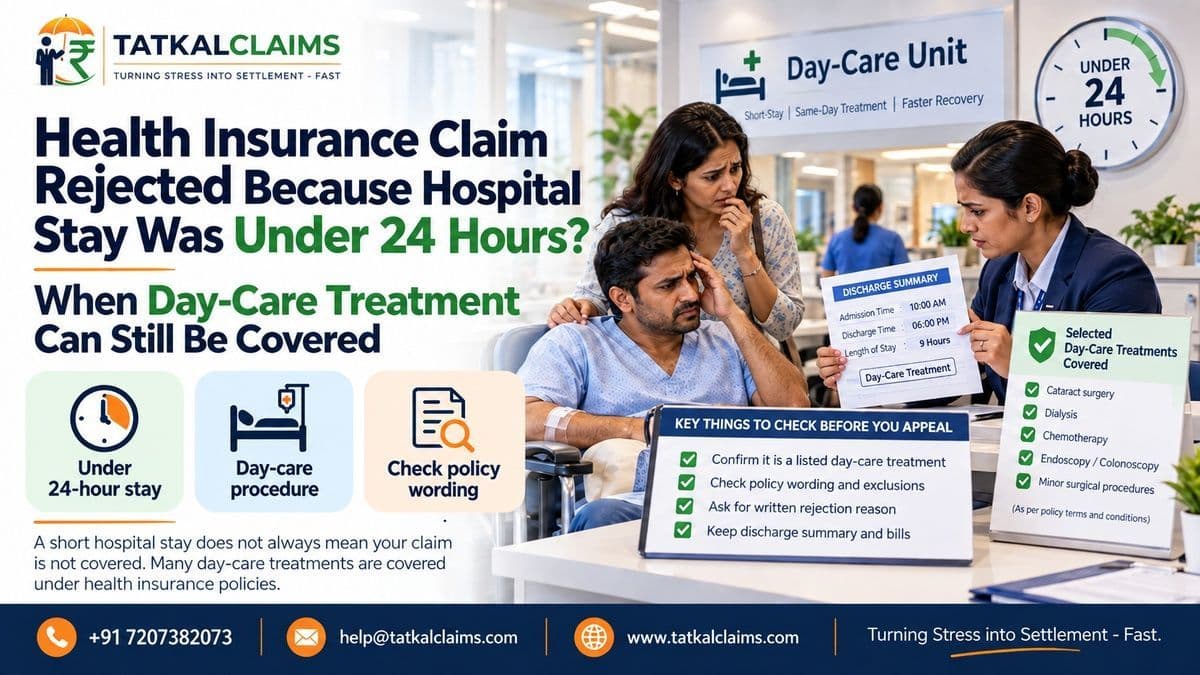
Your health insurer rejected or reduced a claim because the hospital stay was less than 24 hours. That reason is not automatically correct.
Many health policies require at least 24 consecutive hours of inpatient hospitalisation for ordinary inpatient claims. But day-care treatment is a recognised exception: certain medical or surgical procedures can be completed in less than 24 hours because of medical or technological advancement and may still be covered if they satisfy the policy’s day-care terms.
The difficult part is distinguishing a genuine day-care procedure from OPD treatment, short observation, diagnostic admission or a same-day hospital visit that never met the policy definition of day care.
What the 24-Hour Rule Actually Means
In many indemnity health policies, ordinary inpatient hospitalisation requires admission for a minimum period of 24 consecutive hours. This is the general inpatient threshold.
The same policy may separately say that this 24-hour minimum does not apply to eligible day-care treatment. Current policy examples from major insurers continue to distinguish inpatient treatment of 24 hours or more from day-care treatment completed in less than 24 hours.
| Situation | Typical duration | Possible treatment category |
| Ordinary inpatient admission | 24 hours or more | Inpatient hospitalisation |
| Eligible procedure completed same day | Less than 24 hours | Day-care treatment, if policy conditions are met |
| Consultation / observation / routine OPD | Minutes or hours | Usually OPD/observation unless separately covered |
What Counts as Day-Care Treatment?
A standard day-care concept used across health-insurance policy wordings is treatment or surgery completed in less than 24 hours because medical or technological advancement makes a longer admission unnecessary, even though the treatment would otherwise have required longer hospitalisation.
Policy wordings commonly distinguish day-care treatment from ordinary OPD treatment. A procedure is not day-care merely because you entered a hospital in the morning and left the same evening.
| Question | Why it matters |
| Was there an actual medical/surgical procedure or structured treatment? | Separates day-care from simple consultation/observation |
| Was it performed in a hospital or eligible day-care centre? | Venue requirements may be part of the policy definition |
| Could the treatment now be completed in under 24 hours because of modern treatment methods? | Core day-care concept |
| Would the procedure historically/otherwise have required hospitalisation? | Helps distinguish day-care from routine OPD |
| Does your exact policy cover that procedure/category? | Coverage may be all day-care or list-based |
| Was the treatment medically necessary and documented? | Coverage still depends on claim facts and policy terms |
Same-Day Treatment Is Not Automatically Day Care
One of the most common mistakes is treating every hospital visit under 24 hours as day-care. Routine consultations, injections, dressings, diagnostic workups, brief emergency observation or outpatient procedures may remain OPD unless your policy separately covers them.
The key is the nature of the treatment, not simply the clock. If the insurer says the treatment was OPD rather than day-care, ask it to identify the policy definition and explain which condition of day-care treatment was not met.
If the insurer’s real argument is that hospitalisation was unnecessary or the treatment could have been done as OPD, use our separate guide on medical-necessity and OPD rejection.
Does Your Policy Cover All Day-Care Procedures or Only a Listed Set?
This is one of the most important policy-specific checks. Some current health products advertise or state coverage for all day-care procedures. Other products—especially older or narrower wordings—may refer to a schedule or annexure of specified day-care procedures.
For example, current Care product pages describe coverage for all day-care procedures, and current Star policy wording examples state that all day-care procedures are covered. HDFC ERGO product materials also describe coverage for day-care procedures completed in less than 24 hours. These examples show the market direction, but they do not override your own issued policy.
| Wording | Practical meaning |
| “All day-care procedures are covered” | Focus on whether your treatment meets the day-care definition and other policy conditions |
| “Day-care procedures listed in Annexure...” | Check whether the exact procedure or medically equivalent wording appears in the list |
| Named procedures only | Coverage may be restricted to those specified procedures |
| Separate advanced-technology benefit | The treatment may belong under a different benefit rather than day-care |
| No clear day-care section | Check policy schedule, CIS and endorsements before assuming exclusion |
Common Procedures Often Treated as Day Care
Day-care coverage commonly includes procedures that no longer require an overnight stay because treatment technology has advanced. Examples frequently seen in current health-insurance materials include cataract surgery, chemotherapy, dialysis, radiotherapy, certain endoscopies, lithotripsy and similar procedures.
These are examples, not a universal list. Coverage depends on the exact product and treatment facts.
| Procedure/treatment | What to verify |
| Cataract surgery | Day-care wording, cataract sub-limit if any, procedure code |
| Chemotherapy | Whether hospital/day-care administration qualifies and any benefit conditions |
| Dialysis | Day-care benefit, frequency and policy limits |
| Radiotherapy | Day-care/advanced-treatment wording |
| Endoscopy / minor surgery | Whether procedure is covered as day-care vs diagnostic OPD |
| Lithotripsy / stone procedure | Day-care wording and procedure-specific limits |
| Short surgical admission | Whether surgery meets the policy’s day-care definition |
When a Less-Than-24-Hour Rejection Is More Worth Challenging
| Red flag | Why it matters |
| Rejection letter only says “hospitalisation less than 24 hours” | May ignore the policy’s day-care exception |
| Policy states all day-care procedures are covered | Insurer must explain why this treatment falls outside that definition |
| Procedure appears in the policy’s day-care annexure | Simple duration-based rejection may be inconsistent with wording |
| Cashless pre-authorisation identified the case as day care | Final rejection needs a clear reason for the changed assessment |
| Doctor/hospital documented a surgical/procedural admission | Supports day-care character rather than ordinary OPD |
| Insurer calls treatment OPD without explaining why | Ask which day-care criterion failed |
| Insurer applies 24-hour inpatient rule but never analyses day-care clause | Possible incomplete policy assessment |
When the Insurer May Still Have a Valid Reason to Reject
A day-care benefit is not a blanket waiver of all policy conditions. A claim may still fail if the treatment is excluded, falls within a waiting period, is not medically necessary, was only observation/diagnosis, was taken at an ineligible facility, exceeds a sub-limit or does not satisfy the policy’s specific day-care wording.
| Issue | What to check |
| Routine OPD / consultation | Whether the treatment involved a qualifying procedure at all |
| Observation only | Whether there was active treatment/procedure rather than monitoring |
| Procedure not covered under list-based policy | Exact annexure and procedure wording |
| Waiting period / exclusion | Whether a disease/procedure-specific waiting period applies |
| Facility eligibility | Hospital/day-care centre definition in the policy |
| Medical necessity | Treating records and clinical reason for the procedure |
| Sub-limit | Whether claim is payable but capped rather than fully rejected |
Documents That Can Prove It Was a Day-Care Procedure
| Document | What it proves |
| Admission and discharge record | Same-day admission chronology |
| Procedure / operation note | Shows an actual procedure was performed |
| Anaesthesia record, where applicable | Supports procedural nature |
| Doctor’s advice | Shows medical necessity and planned treatment |
| Hospital day-care bill / package bill | Shows how hospital classified the episode |
| Diagnostic reports | Supports diagnosis and procedure indication |
| Cashless pre-authorisation | Shows insurer/TPA’s initial understanding of treatment |
| Policy schedule / CIS / wording | Shows applicable day-care benefit |
| Day-care annexure, if policy is list-based | Shows whether procedure is named/covered |
| Final rejection / assessment sheet | Shows exact insurer reasoning |
Procedure Name vs Medical Coding Can Matter
Hospitals and insurers may use different names for the same or similar procedure. A claim can be rejected because the hospital description does not exactly match the insurer’s day-care list or internal code.
If the policy is list-based, ask the hospital for the precise procedure name, operative note and coding. Then ask the insurer whether it treats that procedure as equivalent to a listed day-care treatment.
Do not assume equivalence yourself. A treating hospital clarification is stronger than simply arguing that two procedure names sound similar.
What If Cashless Was Approved but the Final Claim Was Rejected?
An initial cashless approval can be provisional. The insurer may still reassess the final diagnosis, procedure and policy conditions at discharge.
But if the pre-authorisation expressly treated the admission as an eligible day-care procedure and the final rejection later relies only on “less than 24 hours”, ask the insurer to reconcile the two positions.
If the broader problem is that cashless was approved at admission and later denied at discharge, use our separate approved-today, denied-tomorrow guide.
What If You Paid the Hospital and Cashless Was Denied?
Cashless denial does not automatically decide whether the underlying treatment is covered. If you paid the hospital, you may still be able to submit or pursue a reimbursement claim subject to the policy and claim requirements.
For the reimbursement route after cashless denial, see our cashless rejection and reimbursement guide.
What If the Insurer Asks for More Documents Before Deciding?
Day-care disputes often trigger requests for operation notes, anaesthesia records, indoor case papers, doctor certificates or proof that the procedure was not routine OPD.
Respond point by point and ask the insurer to state whether the outstanding issue is duration, procedure classification, facility eligibility, medical necessity or another policy condition.
If the claim is still at the query/deficiency stage rather than rejected, use our claim query and deficiency-letter response guide.
How to Appeal a Day-Care Claim Rejection
A strong appeal should not merely say “day-care is covered.” It should connect the treatment facts to the exact policy wording.
| Step | What to show |
| 1 | Quote the rejection reason exactly |
| 2 | Quote the policy’s inpatient 24-hour rule and day-care exception |
| 3 | Identify whether the policy covers all day-care procedures or a specified list |
| 4 | Name the actual procedure and attach operation/procedure records |
| 5 | Explain why it was completed in less than 24 hours |
| 6 | Show hospital/day-care centre eligibility |
| 7 | Address any separate exclusion, waiting period or medical-necessity issue |
| 8 | Ask for claim reconsideration and a clause-specific written response |
If the insurer says the procedure is not on the covered list, ask it to identify the exact annexure/version applicable on the treatment date. If your product says all day-care procedures are covered, ask why the treatment fails the day-care definition instead of accepting a generic duration rejection.
If the Claim Is Partly Paid Instead of Fully Rejected
Sometimes the insurer accepts the day-care procedure but reduces the claim because of a sub-limit, co-pay, non-medical items, room/package calculation or reasonable-and-customary adjustment. That is a short-settlement dispute, not a pure 24-hour rejection.
For those calculations, use our health-insurance short-settlement guide.
If deductions specifically involve consumables/non-medical items, see our non-medical and consumables deduction guide.
Escalation: Insurer/GRO, Bima Bharosa and Ombudsman
Start with a written reconsideration or grievance to the insurer/GRO. Attach the policy wording, rejection letter, procedure note, admission/discharge record and any day-care annexure.
If the grievance is not resolved satisfactorily, Bima Bharosa can be used to escalate and track the complaint with IRDAI. Bima Bharosa’s current FAQ states that insurers should resolve grievances within 15 days of receipt.
The Insurance Ombudsman may be available for eligible claim-rejection or partial-settlement disputes after the insurer-first step, subject to its monetary, filing-period and parallel-proceeding conditions.
Compare the escalation routes in our Bima Bharosa vs Insurance Ombudsman guide.
For Ombudsman filing requirements, see our Insurance Ombudsman complaint guide.
A Practical 5-Day Action Plan
| Day | Action |
| Day 1 | Get the rejection letter, policy wording, CIS and day-care annexure if any. |
| Day 2 | Collect admission/discharge, procedure/operation note, doctor advice and cashless records. |
| Day 3 | Classify the episode: inpatient, day-care, OPD, observation or advanced-treatment benefit. |
| Day 4 | Prepare a clause-by-clause appeal showing why the procedure qualifies under the actual policy. |
| Day 5 | File reconsideration/GRO grievance and request a written clause-specific response. |
How Tatkal Claims Can Help
Tatkal Claims can review the rejection letter, policy wording, day-care annexure, procedure records, hospital classification, cashless authorization and claim assessment to determine whether the insurer has incorrectly applied the 24-hour inpatient rule to an eligible day-care procedure.
Where a challenge is supportable, assistance can include matching the procedure to the applicable policy benefit, preparing the clause-by-clause reconsideration, obtaining missing hospital clarification, drafting the insurer/GRO grievance and organising Bima Bharosa or Ombudsman escalation where eligible. If the episode was genuinely OPD or outside the policy’s day-care definition, that should be identified rather than promising a successful appeal.
Frequently Asked Questions
Frequently asked questions
Can a health insurance claim be rejected only because hospitalisation was less than 24 hours?
Not automatically. Ordinary inpatient cover may require 24 consecutive hours, but eligible day-care treatment can be covered in less than 24 hours if the policy conditions are met.
What is day-care treatment in health insurance?
It generally refers to a medical or surgical procedure that can be completed in less than 24 hours because of medical or technological advancement and would otherwise have required longer hospitalisation. Exact wording varies by policy.
Is every same-day hospital treatment a day-care claim?
No. Routine OPD consultation, observation, diagnostic visits or minor outpatient treatment do not automatically become day-care merely because they occur in a hospital.
Are cataract surgery, chemotherapy and dialysis covered if completed in less than 24 hours?
They are commonly treated as day-care procedures in health-insurance products, but you must check the exact policy, limits and treatment conditions.
What if my policy says all day-care procedures are covered?
Then the key question is usually whether your treatment actually satisfies the policy’s day-care definition and other conditions, rather than whether it appears on a fixed procedure list.
What if my policy has a day-care procedure list?
Check the annexure applicable to your policy version and treatment date. If the hospital uses a different procedure name, ask for a medical/coding clarification before claiming equivalence.
Does a few hours of observation in hospital count as day care?
Usually not by duration alone. There generally needs to be a qualifying treatment/procedure under the policy rather than observation or routine OPD care.
Can cashless be denied but reimbursement still succeed?
Possibly. Cashless is a payment mechanism. If the treatment is otherwise covered, a reimbursement claim may remain available subject to policy terms and claim requirements.
What evidence is strongest in a day-care appeal?
The exact policy wording, procedure/operation note, admission-discharge record, treating-doctor advice, hospital day-care classification and any cashless authorization are usually central.
Can I approach the Insurance Ombudsman if the insurer wrongly applies the 24-hour rule?
Potentially, after first complaining to the insurer, if the dispute falls within the Ombudsman’s eligibility, monetary, filing-period and parallel-proceeding rules.
Sources and Methodology
Disclaimer: This guide explains current health-insurance principles, common day-care wording and selected product examples in general terms. Whether a claim is payable depends on the exact issued policy, endorsements, procedure, facility, medical necessity, waiting periods, exclusions and facts of the admission. This is not medical, legal or financial advice for a specific claim.