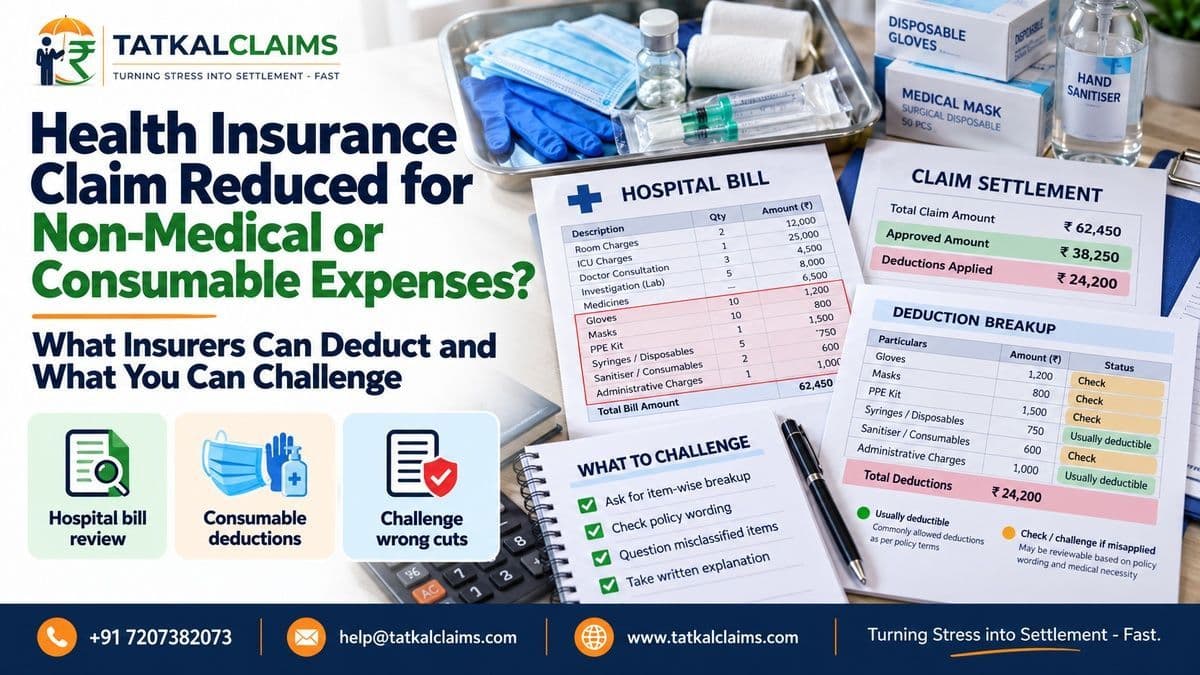
Your health insurer has accepted the claim but deducted ₹5,000, ₹20,000 or more under labels such as “non-medical”, “consumables”, “non-payable items”, “administrative charges” or “disposables”. Some deductions can be valid—but not every line item on a hospital bill can automatically be shifted to the patient just because it is a consumable.
IRDAI’s standardisation framework separates these expenses into different buckets. Some items are optional items that may remain outside cover unless the policy includes them. Other items are meant to be absorbed into room charges, procedure charges or treatment costs rather than separately billed to the policyholder.
So the correct question is not simply “Are consumables covered?” It is: which list does the item belong to, what does your policy or add-on say, was the item already part of a room/package/procedure rate, and did the insurer explain the deduction correctly?
Not Every “Consumable” Is Treated the Same Way
The word “consumable” is used loosely in hospital billing. Gloves, masks, ECG electrodes, gauze, cotton, surgical tape, admission kits, disinfectants, urine bags and administrative charges may all be described as consumables or non-medical items—but IRDAI’s standardisation framework does not place all of them in the same category.
The 2019 Modification Guidelines on Standardization in Health Insurance divide the old optional-item list into four groups: List I optional items; List II items to be subsumed into room charges; List III items to be subsumed into procedure charges; and List IV items to be subsumed into treatment costs.
| IRDAI list | What it means in the standardisation framework | Typical examples |
| List I | Optional items for which insurers may offer cover | Gloves, mask, ECG electrodes, mineral water, attendant charges, diapers, braces, nebuliser kit |
| List II | Costs to be absorbed into room charges | Gown, hand wash, housekeeping, admission kit, documentation/admin expenses, pulse oximeter charges |
| List III | Costs to be absorbed into procedure charges | Gauze, cotton, surgical tape, surgical blades, eye pad, theatre booking, arthroscopy/endoscopy instruments |
| List IV | Costs to be absorbed into treatment costs | Admission/registration, disinfectants, infusion pump cost, alcohol swabs, urine bag, dietician/nutrition planning, HIV kit |
List I: Items That May Remain Non-Payable Unless Your Policy Covers Them
List I contains optional items that insurers may choose to cover. The 2019 IRDAI list includes items such as gloves, mask, ECG electrodes, mineral water, attendant charges, laundry, diapers, braces, nebulisation kits, certain walking aids and other convenience or consumable items.
If your base policy excludes List I and you did not buy a consumables/non-medical benefit that brings those items back into cover, a deduction may be consistent with the policy. But you should still verify the exact item and amount rather than accept a blanket percentage deduction.
| Item | What to check |
| Gloves | Is List I covered by your policy/add-on? Was this item separately billed or part of a package? |
| Mask | Same check: actual policy benefit + package structure |
| ECG electrodes | Whether policy/add-on covers List I items |
| Mineral water / guest services | Usually personal-convenience type items unless specifically covered |
| Attendant charges | Whether separately covered under another benefit |
| Nebuliser / braces / supports | Whether excluded as List I or covered because of a specific policy benefit |
| Diapers / sanitary items | Policy wording and whether any special benefit applies |
Lists II, III and IV: These Are Not the Same as Ordinary Non-Payables
The most important audit point is that Lists II–IV are not simply a second set of patient-payable exclusions. IRDAI’s 2019 framework says these costs are to be subsumed into room charges, procedure charges or treatment costs.
The guidelines further state that insurers should put measures in place so these items are not billed separately to policyholders, and that this should form part of the insurer’s service-level arrangement with network hospitals for cashless cases. For reimbursement at non-network hospitals, settlement remains subject to policy terms.
| Bucket | Examples | Audit question |
| List II — room | Gown, housekeeping, admission kit, documentation/admin expenses, file opening, pulse oximeter | Was the hospital already charging room rent/package that should absorb this item? |
| List III — procedure | Gauze, cotton, surgical tape, surgical blades, eye pad, theatre booking | Was the item already part of the surgery/procedure package? |
| List IV — treatment | Admission/registration, infusion pump, disinfectants, alcohol swabs, urine bag, dietician charges | Was it already built into treatment cost or separately charged again? |
A separate line on the hospital bill does not automatically prove that the insurer must reimburse it directly to you. But it does create a legitimate reconciliation question: should the hospital have absorbed the charge into the applicable room/procedure/treatment cost, and has the insurer/hospital arrangement already priced it into the package?
Package Rates Can Change the Analysis
In many cashless admissions, the hospital and insurer operate under agreed package rates for procedures. A package may already include a range of disposables, room-linked items, theatre costs and standard consumables.
If the hospital separately charges an item that should already be inside the package, deducting it from the patient without explaining the package reconciliation can create a double-counting problem. Ask for the insurer-approved package, the hospital’s final itemised bill and the claim assessment sheet.
| Document | What it tells you |
| Hospital itemised bill | What the hospital actually billed line by line |
| Insurer/TPA assessment sheet | What was admitted, disallowed and why |
| Package / tariff / authorization record | Whether the disputed item should already be inside the agreed package |
Consumables Cover or Non-Medical Benefits Can Change What Is Payable
Some health products now include or offer coverage for List I non-medical items. This can be built into the base product or provided through an optional benefit/add-on.
For example, current Star Health policy wordings for products such as Health Premier and Star Health Assure state that, where there is an admissible claim, specified List I non-medical items become payable under the product’s consumables benefit. HDFC ERGO’s Optima Secure materials similarly describe a Protect benefit for specified non-medical expenses related to an admissible claim.
These examples do not mean every policy covers consumables. The issued policy schedule, UIN, product wording and add-on selection for your own policy control.
| Check | Why it matters |
| Policy schedule | May show an included consumables/non-medical benefit |
| Base policy wording | Shows whether List I remains excluded |
| Add-on/rider schedule | May restore specified non-medical items |
| Benefit limit | Some covers may have caps or conditions |
| Admissible-claim condition | Consumables benefit may operate only if the underlying hospitalisation claim is admissible |
| Effective date | Add-on must have been in force for that admission |
When a Non-Medical Deduction Is More Worth Challenging
| Red flag | Why it deserves review |
| Insurer gives only one lump-sum “non-medical” figure | You cannot identify which items were excluded |
| A List II/III/IV item is treated as if it were automatically List I | May be a classification error |
| Policy/add-on expressly covers List I but items are still deducted | Possible benefit-application error |
| Same item appears inside a package and again as a separate deduction | Possible double counting |
| Hospital and insurer classify the same item differently | Requires reconciliation |
| Medicine/implant/diagnostic material is casually labelled “non-medical” | May be miscoded or require a different policy analysis |
| Deduction exceeds the actual item amount | Arithmetic/assessment error |
| Cashless authorization and final deduction use inconsistent treatment of the same item | Needs explanation from insurer/TPA |
If your settlement also includes room-rent, co-pay, sub-limit or reasonable-and-customary deductions, use our broader health-insurance short-settlement guide.
Is the Hospital at Fault, the Insurer, or Both?
Sometimes the hospital separately bills an item that the standardisation framework says should be absorbed into room, procedure or treatment cost. Sometimes the insurer then deducts that separate line rather than resolving the billing structure with its network hospital. In other cases, the item is genuinely List I and excluded under the policy.
That is why these disputes often require two parallel questions: why did the hospital bill this item separately, and why did the insurer treat it as patient-payable?
For network cashless cases, the 2019 framework specifically advised insurers to build the subsuming requirements into service-level agreements with network hospitals. That gives you a basis to ask the insurer to reconcile the billing with the hospital rather than simply passing every disputed line to you.
| Question | Hospital | Insurer/TPA |
| Why was this item billed separately? | Yes | Ask insurer whether separate billing matches network/package terms |
| Which IRDAI/policy list does this item fall under? | Can explain billing code | Insurer should explain assessment basis |
| Was the item already inside the package? | Provide tariff/package details | Confirm approved package |
| Does my policy/add-on cover List I? | Not decisive | Insurer must confirm |
| Who should refund/correct the amount? | If billing error | If claim-assessment error or network reconciliation issue |
Cashless vs Reimbursement: The Same Item Can Create a Different Practical Dispute
In cashless claims, the insurer and network hospital already have a contractual/service relationship, so package and SLA reconciliation is often central. If a hospital collects an amount from you for something that should have been absorbed into the package, ask the insurer to intervene.
In reimbursement claims—especially from non-network hospitals—the insurer may assess the hospital’s itemised bill directly against the policy. The IRDAI framework expressly says reimbursement settlement at non-network providers remains subject to policy terms.
If the hospital is asking you to pay despite an approved cashless authorization, see our separate guide on cashless approval with hospital deposit demands.
Demand an Itemised Claim Assessment, Not Just the Final Payable Amount
A settlement letter that says “non-medical deduction ₹18,450” is not enough to audit the claim properly. Ask for the assessment sheet showing each deducted item, its hospital bill amount, admitted amount, disallowed amount and the policy/list basis.
| Field | Why it matters |
| Hospital line-item description | Lets you identify the actual item |
| Hospital amount | Prevents arithmetic inflation |
| Insurer admitted amount | Shows whether partly allowed |
| Deducted amount | Quantifies dispute |
| Reason code / policy basis | Explains why it was disallowed |
| IRDAI list / policy annexure category | Helps distinguish List I from Lists II–IV |
| Add-on/benefit check | Shows whether a consumables cover was applied |
| Package-rate treatment | Tests duplicate or subsumed charging |
Common Misclassification Problems
A hospital description may not match the standard terminology exactly. “Mask”, “face mask”, “oxygen mask” and procedure-specific masks may sit in different contexts. Likewise, “kit” can mean a generic recovery kit, a procedure bundle or a medically necessary device.
Do not challenge only by keyword. Ask what the item actually was, why it was used, whether it is separately listed in the policy annexure, and whether it was already embedded in another charge.
The same applies to devices and medical supplies. An implant, prescribed drug or diagnostic material should not be casually accepted as “non-medical” just because the hospital billing code is vague. Obtain the item description, invoice and assessment basis.
Watch for Duplicate Deductions
Consumables disputes can overlap with room-rent proportionate deduction, co-payment, deductible and package caps. Make sure the same rupee amount is not effectively reduced twice.
For example, an item can first be removed as non-payable and the remaining bill can then be subjected to a co-pay. That may be correct if the policy says so. But if the same excluded amount is also embedded in a proportionate-deduction base or package adjustment in a way that duplicates the reduction, the calculation should be challenged.
If room entitlement or proportionate deduction is also involved, use our room-rent capping and proportionate deduction guide.
How to Audit a Consumables Deduction Step by Step
| Step | Action |
| 1 | Obtain the hospital’s fully itemised final bill. |
| 2 | Obtain the insurer/TPA assessment sheet with line-level deductions. |
| 3 | Pull the exact policy wording, schedule and consumables/non-medical add-on if any. |
| 4 | Classify each disputed item into List I, II, III, IV or outside the standard list. |
| 5 | For Lists II–IV, ask whether the item was already subsumed into room/procedure/treatment/package cost. |
| 6 | For List I, confirm whether your policy/add-on covers it. |
| 7 | Check for duplicate arithmetic, co-pay, room-rent and package interactions. |
| 8 | Send a line-by-line reconsideration request with the amount you say should be restored. |
How to Write a Strong Appeal Against Non-Medical Deductions
Do not write only “these consumables were medically necessary.” Medical necessity alone does not automatically make a List I item payable if the policy excludes it. Your appeal should instead identify the contractual or classification error.
| Ground | Evidence |
| Item should be List II/III/IV, not List I | IRDAI list + policy annexure + itemised bill |
| Policy/add-on covers List I | Schedule/add-on wording + UIN/effective date |
| Item already inside procedure/package | Hospital package/tariff + insurer authorization |
| Item misdescribed or miscoded | Hospital clarification + invoice/product description |
| Duplicate deduction | Assessment arithmetic and settlement sheet |
| Wrong amount | Hospital bill vs insurer deduction |
| Network-hospital billing issue | Cashless authorization + hospital bill + insurer/network complaint trail |
State the amount under dispute and show the calculation. A ₹14,280 challenge supported by 12 identified line items is stronger than asking the insurer to “recheck all non-medical deductions.”
Evidence to Collect Before Escalating
| Document | Why it matters |
| Policy schedule and wording | Shows base coverage/exclusions |
| Consumables/non-medical add-on | Shows whether List I is restored |
| Hospital itemised bill | Shows each disputed item |
| Cashless authorization/final approval | Shows package and approved amount |
| Insurer/TPA assessment sheet | Shows deductions and reason codes |
| Hospital package/tariff, if available | Tests whether item should have been absorbed |
| Purchase invoice/implant sticker/medicine bill where relevant | Helps correct misclassification |
| Hospital clarification | Explains vague billing codes or package inclusion |
| Your line-by-line calculation | Shows the exact amount sought |
Escalation: Insurer/GRO, Bima Bharosa and Ombudsman
Start with a written reconsideration or grievance to the insurer/GRO. Attach the assessment sheet, your classification table, policy/add-on wording and the exact amount you want restored.
Bima Bharosa can be used if the insurer grievance remains unresolved or the response is unsatisfactory. Its current FAQ states that the insurer should resolve a grievance within 15 days of receipt.
The Insurance Ombudsman may consider eligible complaints involving partial repudiation/short settlement and policy-term disputes, subject to the insurer-first requirement, monetary limit, filing period and parallel-proceeding rules.
Compare the escalation routes in our Bima Bharosa vs Insurance Ombudsman guide.
For the Ombudsman filing process, see our Insurance Ombudsman complaint guide.
A Practical 7-Day Action Plan
| Day | Action |
| Day 1 | Get the itemised hospital bill and insurer/TPA assessment sheet. |
| Day 2 | Pull the exact policy, schedule and consumables/non-medical benefit. |
| Day 3 | Map each disputed item to List I, II, III, IV or outside the list. |
| Day 4 | Ask hospital/insurer to clarify package inclusion and vague billing codes. |
| Day 5 | Check duplicate deductions, co-pay, room-rent and package calculations. |
| Day 6 | Prepare a line-by-line reconsideration with the exact amount sought. |
| Day 7 | Escalate to GRO/Bima Bharosa if the insurer does not correct or explain the deduction. |
How Tatkal Claims Can Help
Tatkal Claims can review the policy, non-medical/consumables benefit, hospital itemised bill, cashless package, insurer assessment sheet and settlement calculation to identify which deductions are likely to be contractual List I exclusions and which may reflect misclassification, package duplication or an incorrect application of Lists II–IV.
Where a challenge is supportable, assistance can include preparing a line-by-line deduction audit, quantifying the disputed amount, obtaining clarifications from the hospital/insurer, drafting the GRO grievance and organising Bima Bharosa or Ombudsman escalation where eligible. A genuine policy exclusion should be identified as such rather than presented as automatically recoverable.
Frequently Asked Questions
Frequently asked questions
Are all consumables excluded from health insurance?
No. IRDAI’s standardisation framework places different items in different categories. Some List I items may remain optional/non-payable unless covered, while Lists II–IV are intended to be absorbed into room, procedure or treatment costs. Your actual policy wording still controls.
Are gloves covered by health insurance?
Gloves appear in IRDAI’s List I optional-items list. They may be excluded under a base policy but can be covered where the product or add-on expressly includes specified non-medical/consumable items.
Are gauze, cotton and surgical tape always non-payable?
Not necessarily. Under the 2019 standardisation framework, gauze, cotton and surgical tape are among items to be subsumed into procedure charges. Check the hospital package and policy assessment rather than treating them automatically as List I exclusions.
Can the insurer deduct admission or registration charges?
IRDAI’s standardisation framework places admission/registration charges in List IV, to be subsumed into treatment costs. The exact reimbursement outcome still depends on policy terms and the hospital billing structure.
What is a consumables add-on?
It is a benefit that can make specified non-medical/List I items payable when the underlying hospitalisation claim is admissible. Coverage varies by product, so check the issued schedule and wording.
Can a hospital charge me separately for items already included in a package?
That should be questioned. Ask the hospital and insurer to reconcile the package. In network cashless arrangements, IRDAI’s framework expects insurers to address subsumed items through their hospital service-level arrangements.
What if the insurer only says “non-medical deduction” without a breakup?
Ask for the itemised assessment sheet showing each deducted item, amount and policy/list basis. Without that, you cannot meaningfully audit the short settlement.
Can I challenge a deduction just because the item was medically necessary?
Medical necessity alone does not make every List I item payable. A stronger challenge identifies a policy benefit, misclassification, package inclusion, duplicate deduction or calculation error.
Are non-medical deductions different in cashless and reimbursement claims?
The same policy terms apply, but the practical dispute differs. Network cashless claims may involve hospital package/SLA reconciliation, while reimbursement claims are assessed against the itemised bill and policy terms.
Can I approach the Insurance Ombudsman over consumables deductions?
Potentially, if the dispute qualifies as an eligible partial-repudiation/short-settlement or policy-term complaint and the insurer-first, monetary, limitation and parallel-proceeding conditions are met.
Sources and Methodology
Disclaimer: This guide explains IRDAI standardisation guidance, current health-claim principles and selected policy examples in general terms. Whether a particular non-medical or consumable item is payable depends on the exact issued policy, add-ons, hospital billing structure, package arrangement, claim admissibility and facts of the case. This is not medical, legal or financial advice for a specific claim.