
The USD 16.5 Trillion Estimate Comes From 2019 Mortality-Protection Research
India's insurance market has continued to grow, but historical protection-gap research should be kept separate from current market-growth statistics. A widely cited Swiss Re estimate of India's mortality protection gap comes from 2019, not 2026.
Swiss Re estimated India's mortality protection gap at about USD 16.5 trillion in 2019, representing roughly 83% of estimated mortality protection need. This was a mortality-protection model focused on the financial consequences of losing a breadwinner; it should not be restated as '83% of every family's financial needs are uninsured' or treated as a current 2026 measurement without newer comparable data.
This is not an abstract economic statistic. It is the reason why, when a breadwinner dies, the family collapses financially. It is the reason why millions of policyholders who do have insurance discover, at the moment of claim, that their coverage is a fraction of what their family actually needs. And it is the reason why claim disputes, underinsurance disputes, and family financial crises are far more common than the industry admits.
What the Protection Gap Actually Means
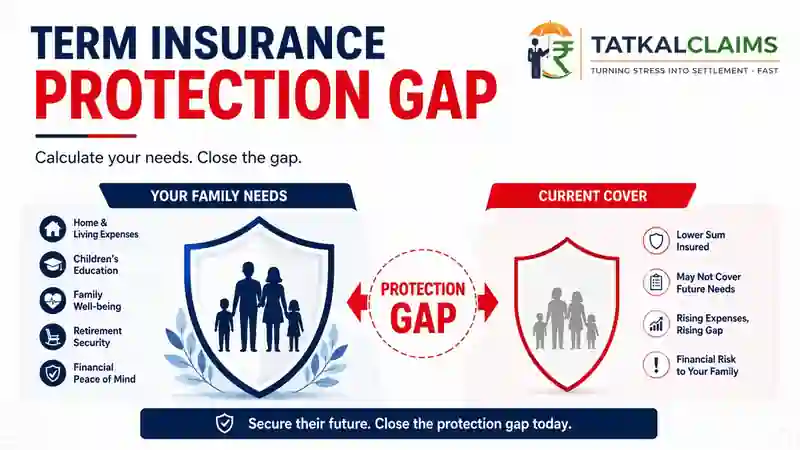
The protection gap is the difference between the financial protection a household needs to maintain its standard of living after the loss of a breadwinner, and the actual life insurance coverage in place. For India, this gap represents 14.5 times the average annual household income.
Think about what that means. If your family needs Rs 50 lakh to maintain its lifestyle, pay off loans, fund children's education, and cover daily expenses after your death, and your current life insurance covers only Rs 8 lakh, your protection gap is Rs 42 lakh. Your policy is not just inadequate. It is almost worthless in the context of your family's actual needs.
At Tatkal Claims, we see this reality every day. Families who believed they were insured because they held a policy, only to discover that the payout covers two years of expenses when they needed twenty. Nominees who receive Rs 5 lakh and must choose between paying off a home loan and funding a child's education. Widows who are forced to sell assets, take on debt, or drastically downgrade their lifestyle because the insurance they trusted was never designed to meet their needs.
Why Rising Incomes Are Not Closing the Gap
One of the most puzzling aspects of India's protection gap is that it persists and widens even as household incomes rise. Amrit Singh, Chief Financial Officer at Axis Max Life Insurance, flagged this troubling trend. Despite impressive economic growth and rising household incomes, increased earnings are frequently channelled into immediate consumption rather than long-term financial protection.
When middle-class Indian families experience income growth, the money typically flows toward upgrading from a two-wheeler to a car, moving to a larger apartment, purchasing the latest smartphones, and increased spending on dining and travel. These expenditures improve quality of life, but they do nothing to address the protection gap. Worse, they often create a lifestyle that requires sustained high income to maintain, making the loss of a breadwinner even more catastrophic for families who lack adequate coverage.
Young professionals earning six-figure salaries often carry term insurance worth only 5 to 10 times their annual income, when financial advisors recommend 15 to 20 times. Middle-income families may have no term insurance at all, relying instead on traditional endowment policies that provide minimal death benefits while locking their money away for decades.
The Behavioral Barriers That Keep Families Unprotected
Beyond economics, deeply rooted psychological and cultural factors significantly impede efforts to close India's protection gap.
Procrastination and present bias are powerful forces. Humans are hardwired to value immediate rewards over distant benefits. Spending money today on a vacation provides instant gratification, while paying insurance premiums involves parting with money for a benefit that, hopefully, will not be needed for decades.
Financial literacy remains severely underdeveloped. Insurance literacy drops below 15 percent in rural and semi-urban areas, despite these regions being more vulnerable to income shocks. Families do not understand what term insurance is, how much coverage they need, or how to compare products across insurers.
Cultural reluctance to discuss death plays a major role. Indian culture generally discourages open discussion about mortality and financial planning around it. Families do not discuss income replacement needs openly. The primary breadwinner avoids acknowledging their own mortality. And life insurance is sometimes seen as inviting bad luck rather than responsible planning.
Preference for tangible assets over intangible protection is deeply ingrained. Indian households have traditionally favoured investments in gold, real estate, and fixed deposits, assets you can see and touch. Life insurance, by contrast, is intangible. The result is that families over-invest in gold and property while remaining dangerously underinsured.
Who Is Most at Risk
The protection gap does not affect all demographics equally.
Young professionals aged 25 to 35 have the longest earnings potential to protect, yet show the lowest insurance adoption rates. Only 18 percent of the eligible population subscribed to pure retail term offerings as of financial year 2020.
Self-employed and gig workers face irregular income that makes premium payments feel burdensome. They have no employer-provided group insurance, and limited access to affordable products designed for variable incomes.
Rural and semi-urban households represent more than 60 percent of India's population, yet over 92 percent of insurance agents are in Tier 1 and Tier 2 cities. This distribution gap leaves rural families particularly exposed.
Single-income families are dependent on one breadwinner, yet paradoxically often carry less insurance than dual-income households. The catastrophic risk of losing that single income source is not matched by adequate coverage.
The Market Paradox: Growth Without Protection
The Indian insurance market is anticipated to expand at 6.9 percent annually over the next five years. The life insurance segment grew at 18 percent in financial year 2023. But the protection gap continues to widen because much of the premium growth comes from savings-oriented products like unit-linked insurance plans and endowment plans, rather than pure protection term insurance.
The 2019 Swiss Re study also discussed structural and behavioural barriers to adequate life protection. Any statement that the gap is currently growing at a fixed annual rate should be sourced to a current comparable study rather than carried forward automatically from older research.
This is the central paradox of Indian insurance. The industry is selling more policies, collecting more premiums, and reporting higher growth. But it is not selling more protection. It is selling more investment products disguised as insurance, more complex plans with hidden charges, and more policies that pay the agent's commission while leaving the family underinsured.
How Underinsurance Leads to Claim Disputes
At Tatkal Claims, we see a direct connection between the protection gap and the claim disputes we handle. When a policyholder is significantly underinsured, the claim process becomes fraught with tension for several reasons.
First, the family expects a payout that matches their financial need, not the policy's contractual limit. When the actual payout is a fraction of what the family requires, they feel cheated, even if the insurer has technically honoured the contract. This creates disputes that are not about claim rejection, but about claim inadequacy.
Second, underinsured policyholders often buy complex products like endowment plans or money-back policies that combine insurance with investment. When the breadwinner dies, the family discovers that the death benefit is a small fraction of the total premiums paid, because most of the money was directed into investment components with low returns. The family feels they paid for protection and received an investment.
Third, agents selling inadequate coverage often gloss over exclusions, waiting periods, and claim conditions. When the claim arises, the family discovers technicalities they were never told about, leading to disputes over non-disclosure, pre-existing conditions, or policy lapses.
What You Should Do to Close Your Own Protection Gap
If you are reading this and wondering whether your own family is adequately protected, here are the steps you must take.
Calculate your actual protection need. Do not guess. Add your outstanding loans, your children's education costs, your family's annual living expenses multiplied by the years they would need support, and any other liabilities. The total is your target coverage. Most financial planners recommend 15 to 20 times your annual income as a starting point.
Separate insurance from investment. If you need protection, buy pure term insurance. It offers the highest coverage per rupee of premium. If you need investment, use mutual funds, fixed deposits, or the Public Provident Fund. Do not let an agent convince you that an endowment plan or unit-linked insurance plan is the best of both worlds. It is usually the worst of both.
Review your coverage annually. Your life changes, and your coverage must change with it. Marriage, children, new loans, salary increases, and health diagnoses all alter your protection needs. A policy adequate five years ago is likely inadequate today.
Disclose everything honestly. Material non-disclosure is the leading cause of claim rejection. When in doubt, disclose. A slightly higher premium for honest disclosure is far better than a rejected claim for concealed information.
Nominate correctly and keep documents accessible. Ensure your nominee details are accurate and updated. Keep your policy document, premium receipts, and claim procedure information in a place your family can find. The best insurance is useless if your family does not know it exists.
Bottom Line
The USD 16.5 trillion figure remains useful as a historical illustration of India's mortality-protection challenge, but it is a 2019 estimate. It should be used to explain underinsurance risk, not presented as a current 2026 measurement of all household financial needs.
The behavioral, cultural, and structural barriers are real and deep-rooted. Procrastination, financial illiteracy, cultural taboos around discussing mortality, and preference for tangible assets all contribute to the problem. But these barriers are not insurmountable.
At Tatkal Claims, we fight for families who have been let down by the protection gap, whether through claim rejection, underinsurance, or mis-selling. But the best protection is prevention. Buy adequate coverage. Buy the right product. Review it regularly. And ensure your family knows what you have and how to claim it.
If you are unsure whether your insurance actually protects your family, review it today. If your claim has been rejected, underpaid, or disputed, challenge it. And if you need help navigating the system, we are here.
Facing a claim rejection or unsure whether your insurance coverage is adequate for your family's needs? Contact our legal team at Tatkal Claims for expert assistance in protecting your rights and securing the benefits you deserve.