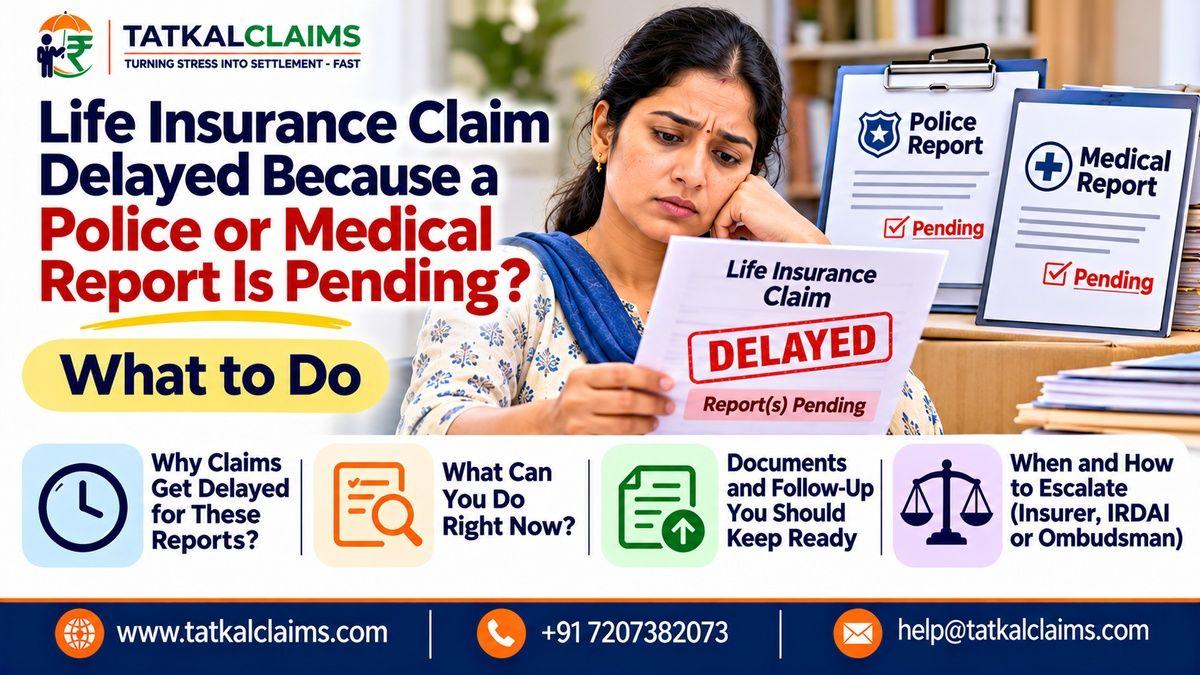
A family member has died, and you have filed a life insurance claim. But the insurance company keeps saying, “We are waiting for the police report,” “The post-mortem report is pending,” or “The FSL report has not arrived.” Does this mean your claim will not be paid? What can you do instead of waiting without answers?
First, ask exactly which report the insurer needs and why. Is the company checking the normal life insurance payment, or an extra payment available only for accidental death? Find out when the insurer received your claim and whether the report exists, is still being prepared, or simply has not reached the insurer.
If you have not informed the insurer about the death yet, do so now through its official phone number, website, app or other accepted channel. Save the claim reference number and date. You do not need to wait for the police or hospital to finish every report before notifying the insurer.
What Do “FSL”, “Viscera” and “Post-Mortem” Mean?
These words sound complicated, but they describe different steps. A post-mortem is a medical examination after death to help establish the cause. “Viscera” means samples of organs or other body material collected for testing. FSL stands for Forensic Science Laboratory—the government laboratory that may test those samples, for example for poison or intoxicants. A police final report is about the police investigation. These are different reports, and one may be ready while another is pending.
For example, the doctor may finish the post-mortem but write that the final cause of death will be decided after laboratory tests. In that situation, the post-mortem report may exist even though the laboratory test and doctor's final opinion are not ready. Or the police may already have the laboratory report but may not have shared it with the insurer. Ask which of these situations applies.
Is the Insurer Checking the Normal Death Payment or an Extra Accident Benefit?
| Benefit or issue | What the insurer needs to assess | Why forensic evidence may matter |
|---|---|---|
| Ordinary life-policy death benefit | Policy in force, insured person’s death, benefit conditions and any legally valid defences | Unnatural-death investigation can raise an exclusion, contestability or factual question, but accident proof may not be an independent element of the basic benefit |
| Accidental-death rider or add-on | Whether death meets the rider's definition of accident and applicable exclusions | Cause and circumstances (for example, accident versus an excluded event) may be central |
| Accident-only cover such as PMSBY | Whether documentary evidence proves an insured accident under that scheme | A reserved medical opinion or conflicting evidence may leave the covered event disputed |
| Nominee, assignment or beneficiary dispute | Who is entitled to receive the insurance money | Normally a different issue from the forensic cause of death |
Ask the insurance company to say clearly whether it is questioning the normal life insurance payment, the extra accidental-death benefit, or both. If only the accident benefit is being checked, ask whether it can decide the normal payment separately. Whether it can pay part of the claim depends on the policy and evidence; separate payment is not automatically guaranteed.
If the insurer says the deceased person did not disclose an illness when buying or restarting the policy, that is a different issue. Ask for the exact policy question and evidence. Do not confuse an investigation into earlier health declarations with a delay in getting the police or medical report.
For contestability, proposal declarations and investigation deadlines, read Life Insurance Claim Under Investigation After an Early Death; this article focuses on forensic and police-document bottlenecks.
How Long Can a Life Insurance Company Take to Decide a Death Claim?
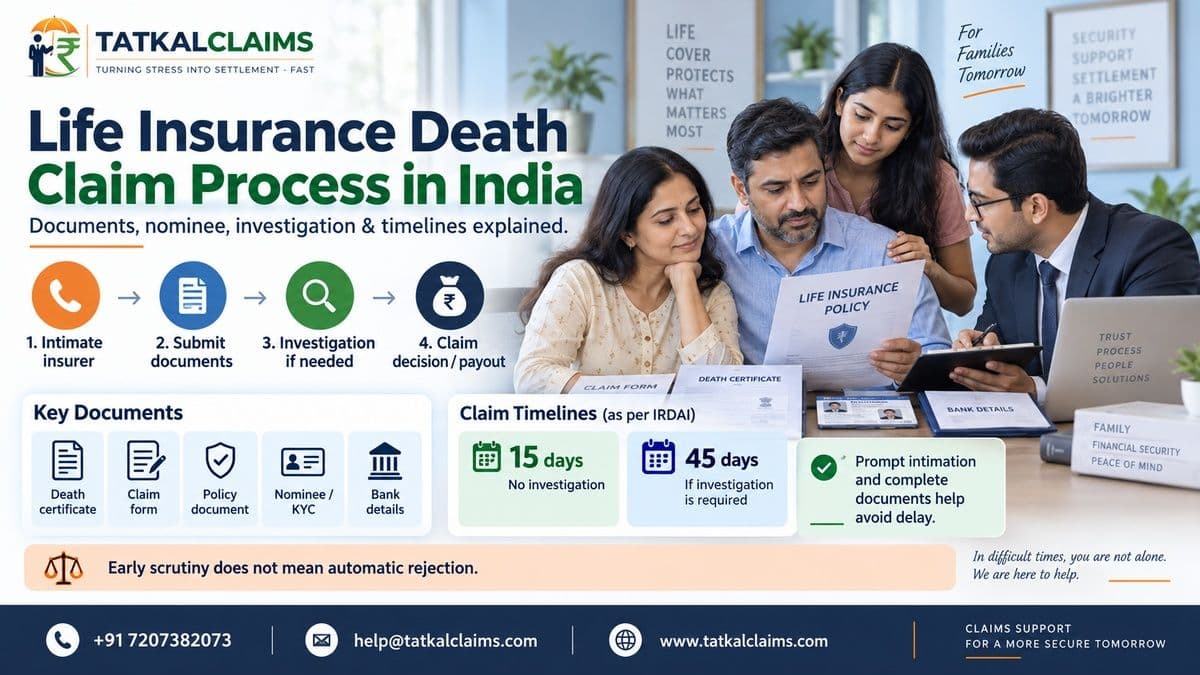
India's insurance regulator, IRDAI (Insurance Regulatory and Development Authority of India), issued rules on 5 September 2024. They say a life insurance death claim should normally be settled within 15 days of the insurer receiving the first claim notification. If an investigation is needed, the rule allows 45 days from that notification. The circular also deals with interest for delayed settlement, at the bank rate plus 2 percentage points, to be paid by the insurer when applicable. Keep the date and reference number of your first notification.
A pending laboratory or police report is not described as permission to keep a claim open indefinitely. At the same time, the insurer may need important evidence to decide a genuinely disputed cause of death. If 45 days have passed, ask in writing which fact is still unclear, what the insurer has done to obtain the report, when it expects to decide, and whether interest applies.
You may find older articles quoting 30 days plus 90 days for an investigation. Do not assume those older rules still apply to a current claim. Different rules may need checking for a claim from an earlier period.
Which Report Is Missing—and Who Should You Contact?
| Document | Who may issue or hold it | What to ask |
|---|---|---|
| FIR, inquest or panchnama | Police/investigating agency | Number, station, date, copy available and relevance to the death claim |
| Post-mortem report (PMR) | Post-mortem hospital/forensic medical department, sometimes via police | Was a post-mortem conducted? Is there a preliminary PMR? Was the medical opinion reserved? |
| Viscera or chemical-analysis report | Forensic laboratory, generally through the investigating police/medical process | Were samples sent, on what date, with what forwarding reference, and has the report returned? |
| Final cause-of-death opinion | Post-mortem doctor/medical officer after relevant examination | Has the doctor issued a final opinion? What evidence is still required? |
| Police investigation final report | Investigating police authority / applicable court process | Is the investigation closed? Was a final report submitted? Is the insurer asking for this rather than the PMR? |
| Insurer's investigation report | Insurer's appointed investigator | Which verified facts or documents remain material to the insurer's decision? |
If a doctor writes “cause of death reserved”, it means the doctor has not yet given the final medical reason for the death. It does not mean there is no proof that the person died. A death certificate confirms the death, but may not prove that it was caused by an accident for an extra accident benefit.
What if the Police or Medical Report Is Not Ready?
Ask the insurer to name the missing document, explain why it matters for your policy, and say when it requested the report. If it is with the police or a government laboratory, ask whether the insurer or its investigator has contacted that office. Request written updates rather than accepting “report awaited” again and again.
The nominee (the person named to receive the policy money) can also ask the investigating police officer or hospital whether a copy or written status is available. Some records cannot be released until the investigation allows it. Do not assume an RTI application will give you an unfinished or restricted report. Keep any written response you receive.
If no such report was ever prepared, ask for written confirmation and find out what other official records the insurer can consider. If tests are still pending, do not guess what the result will say. If the final medical report conflicts with what the family believes happened, ask for an expert explanation rather than hiding the disagreement.
Does Every Death Claim Need a Post-Mortem or Police Report?
No. A normal death claim does not automatically require a post-mortem or police report. The records needed depend on the kind of death and insurance cover. IRDAI's 2024 circular lists documents such as a death certificate and, where applicable for accidental death, a police FIR or post-mortem report. Insurers should explain which documents apply to your particular claim and policy.
Read the actual wording in your policy. If it says a report is needed “if available” or “where conducted”, point that out when the insurer demands a report that was never made. That is different from a report which exists but has not yet been collected.
Case Example 1: The Accident Benefit Was Paid Without an FIR or Post-Mortem
In a decision on 8 September 2026, the National Consumer Disputes Redressal Commission considered a Canara HSBC Life case involving a death by electric shock. The insurer had paid the normal ₹15 lakh death benefit but disputed an additional ₹15 lakh accident benefit because there was no FIR or post-mortem. Other government and hospital records supported the accidental cause. In these specific circumstances, the Commission upheld payment of the additional benefit.
The lesson is not that police or post-mortem reports never matter. It is that an insurer should not insist on a document that was never prepared without considering other reliable evidence. A case where a lab test is still pending and the cause of death is unclear may have a different result.
Case Example 2: A Missing Lab Result Left the Cause of Death Unclear
In another case decided on 19 February 2026, a Punjab consumer commission considered a claim under PMSBY (Pradhan Mantri Suraksha Bima Yojana), an accident-only insurance scheme. The person may have died from poisoning, but the post-mortem doctor had not given a final cause of death because a lab test was needed. Without that result, there was a dispute about accident versus suicide. The State Commission set aside the earlier payment order and allowed the dispute to be taken to an appropriate forum for a fuller examination.
This second case involved accident-only insurance, not the normal death benefit under a life policy. It shows why a missing medical test can matter when the policy pays only for accidental death. It does not give every life insurer permission to delay claims indefinitely.
What if the Insurer Still Says “Under Investigation” After 45 Days?
Ask four questions in writing: When did you receive our first claim notification? Are you checking the normal death payment, the accident benefit or both? Which police or medical report is missing, and when did you request it? On what date will you give us a written decision? Simply calling a claim “under investigation” does not explain the delay.
If the insurer says the police case is not closed, ask what specific fact it cannot decide without that report. If some part of the claim can already be assessed, ask for a separate written decision on that part. Do not assume the insurer is always legally required to make an immediate part-payment.
Documents the Family Should Keep Ready
Keep the policy papers, claim form, first claim reference number, death certificate, nominee's identity and bank details, and any additional accident-benefit terms. If the death was investigated, keep available hospital records, post-mortem findings, FIR or police papers, lab-report status and any final medical opinion. You do not need to invent a document that was never prepared.
Make a simple date-wise list: when the person died, when you informed the insurer, what papers you submitted, when the insurer asked for a report, and when you contacted the hospital or police. This helps identify what is really causing the delay. Share private medical records only with authorised people through secure channels.
Sample Letter to Ask the Insurer Why the Claim Is Delayed
Subject: Death claim delayed because police/medical report is pending — request for written update
I am the nominee or claimant for policy [number], claim [reference]. I informed your company about the death on [date]. You have told me that [name of report] is pending. Please explain why this report is needed, whether it affects the normal death payment, the extra accident benefit or both, and which policy term applies.
Please tell me when you requested the report, which police or medical office has it, what follow-up your team has made, and whether you considered the records already available. Please also confirm the claim deadline under IRDAI's 15-day/45-day rules, the present status, and whether delay interest applies.
I attach my claim acknowledgement, death certificate and available hospital or police papers. Please give me a written reply explaining what I can obtain myself and what your company will request from the relevant office.
Where to Complain if the Insurer Keeps Delaying the Claim
First, send a written complaint to the insurer's Grievance Redressal Officer (the officer responsible for complaints). Include the claim number, date of first notification and the missing report. Ask for the reason for delay, what the insurer is doing and when it will decide. If the problem remains unresolved, you can register a complaint through IRDAI's Bima Bharosa portal and keep the complaint number.
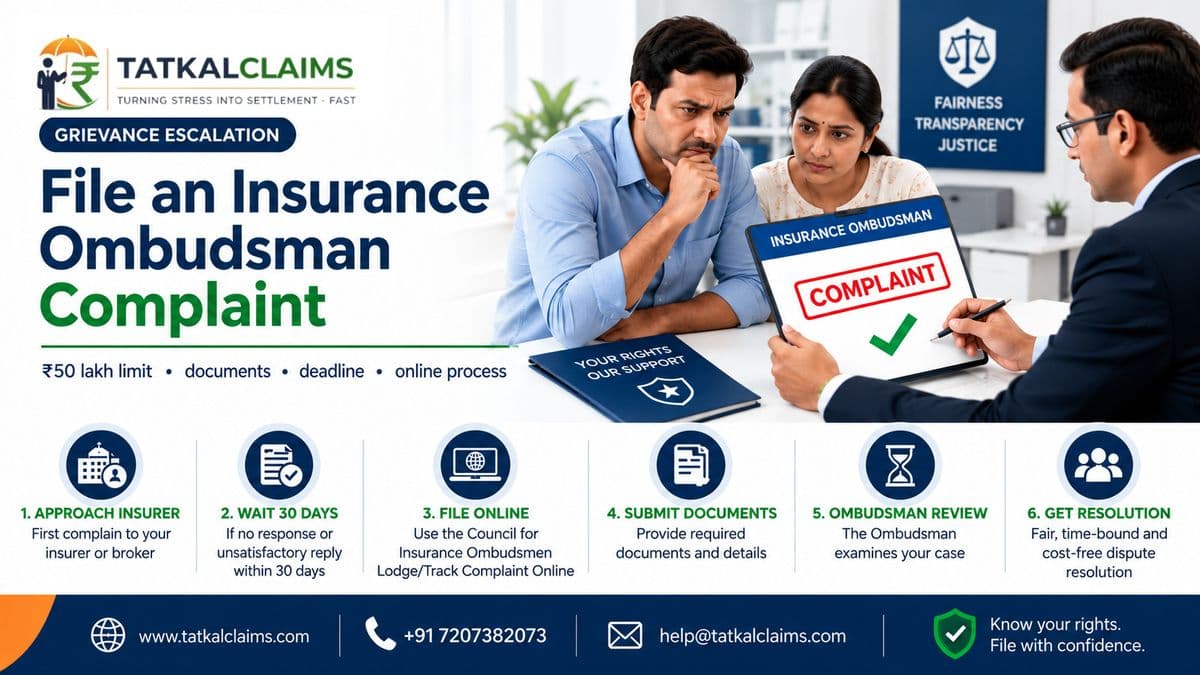
The Insurance Ombudsman is an independent complaint forum for certain insurance disputes, including delays and rejections. Usually you must complain to the insurer first; you may then approach the Ombudsman if you are dissatisfied or the insurer has not replied within 30 days. Check the current ₹50 lakh limit, filing deadlines and rules about cases already before courts or other forums.
If doctors, police records or lab results seriously disagree about the cause of death, the dispute may require medical experts or more detailed legal proceedings. Get advice before filing the same dispute in several forums.
For eligibility and the complaint process, see the Insurance Ombudsman complaint guide; do not miss the deadline while waiting for informal updates.
What to Do in the Next Seven Days
Day 1: collect the policy and claim acknowledgement. Day 2: ask the insurer to name the exact missing report. Day 3: ask the appropriate police officer or hospital whether the report exists and when it may be available. Day 4: write a date-wise record of everything that has happened. Day 5: send a written complaint to the insurer, clearly separating the normal death benefit from any accident benefit. Days 6–7: follow up, save the replies and decide whether formal escalation is needed.
How Tatkal Claims Can Help
Tatkal Claims can review your policy, the insurer's letters and available medical or police records. We can help you understand why payment is delayed, identify the missing evidence and prepare a clear complaint or appeal. We cannot guarantee payment without reviewing the policy and facts.
Frequently asked questions
Can a life insurance company keep my claim pending while a medical test report is missing?
The insurer may need a relevant test result to decide a disputed cause of death, but should explain in writing exactly what is missing and why. IRDAI's September 2024 circular provides 15 days from claim notification for ordinary death claims and 45 days when investigation is needed. A pending test is not described as permission to delay forever.
Does the 45-day deadline begin only after the police report is ready?
No. Under the September 2024 IRDAI circular, the 15-day or 45-day time period runs from when the insurer first receives the claim notification, not from the day the police or lab completes its report.
Is a post-mortem report needed for every life insurance claim?
No. A post-mortem is not needed for every natural-death claim. It may matter for an accident or unnatural death. Ask the insurer which report the policy requires and why it applies in this case.
What if the police never filed an FIR or no post-mortem was done?
Ask the police or hospital to confirm that the report was never made, and collect other available official records. In one 2026 case, other evidence supported an accident even without an FIR or post-mortem. The outcome will still depend on the policy and evidence.
Can the normal life insurance payment be released while the extra accident benefit is under review?
Ask the insurer to make clear which benefit is being questioned. It may be possible to decide the normal payment separately, but this is not guaranteed under every policy.
What does it mean if the viscera test report is still pending?
Viscera means samples of body material collected for a lab test. A pending result means the test is not yet available; it does not, by itself, prove accident, poisoning, suicide or any other cause.
Who can give me a copy of the FSL or police report?
Ask the investigating police officer or the hospital where the post-mortem was done. FSL reports are often sent through the police, and an unfinished or restricted report may not be available directly to the family.
Can I ask for interest if the insurer delays payment beyond 45 days?
IRDAI's September 2024 circular includes a rule about interest for settlement beyond the applicable claim timeline, at bank rate plus 2 percentage points, when payable. Ask the insurer for a written explanation of the delay and how the interest rule applies to your claim.
Can I complain to the Insurance Ombudsman before the insurer makes a decision?
Delay complaints may be eligible, but normally you must first complain to the insurer. If it rejects your complaint or does not answer within 30 days, check the Ombudsman's limits, filing deadlines and other eligibility rules.
Sources and Case References
This guide covers life insurance death claims in India and extra accidental-death benefits. The two consumer cases show different outcomes because their facts and types of cover differed. They are examples, not guarantees. Read the actual policy and documents before deciding what steps to take.