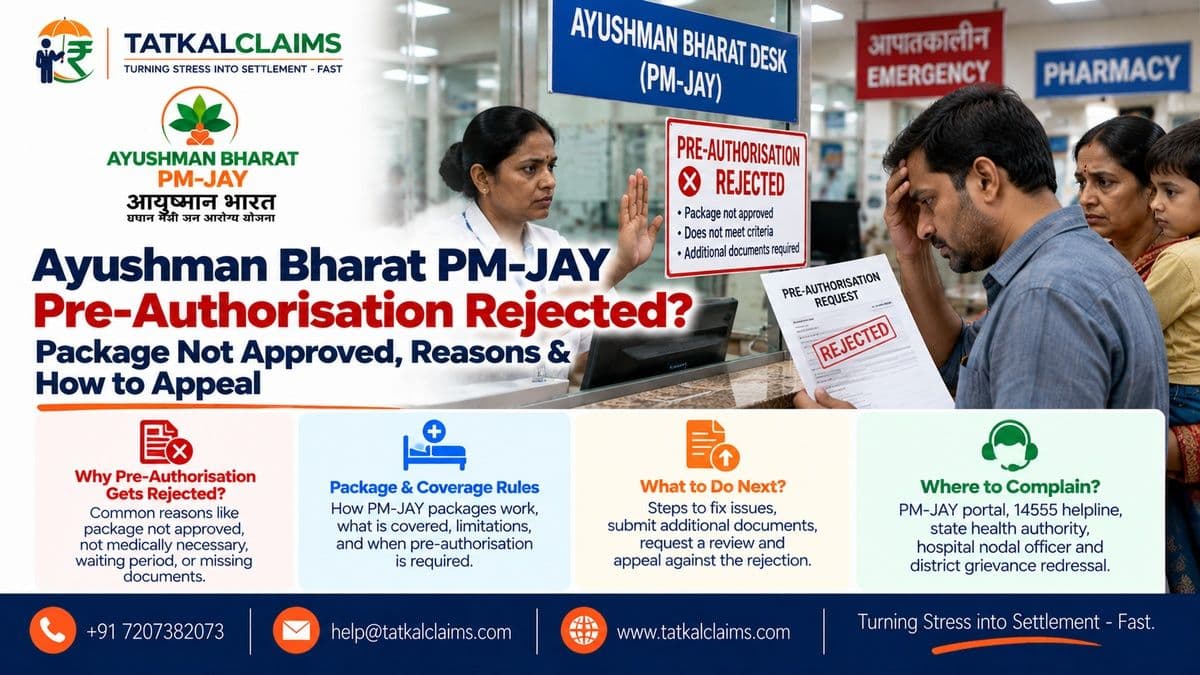
Your Ayushman Bharat beneficiary record is valid, the hospital is empanelled, and the treating doctor has advised admission or a procedure—but the PM-JAY desk says the package is “not approved”, “pre-auth rejected”, “query raised” or “procedure not selectable”. Those messages do not mean the same thing, and the next step depends on which one actually happened.
PM-JAY treatment is processed through defined Health Benefit Packages (HBPs), hospital empanelment and the Transaction Management System. Some packages require pre-authorisation, and package-specific Standard Treatment Guidelines (STGs) can require clinical records, investigations, photographs or other mandatory documents before the processing team can approve the case.
This guide focuses on the middle-stage dispute: eligibility is not the main problem, but treatment approval has stalled or failed. It explains how to distinguish a query from a rejection, package mismatch from hospital-specialty limitations, missing documents from clinical criteria, and how to build an evidence-based escalation.
Written by: Tatkal Claims, Claims Review Team
Reviewed by: Ankit L Kanoi, Founder
What PM-JAY Pre-Authorisation Actually Means
Pre-authorisation is the treatment-approval stage used for packages that require review before the hospital proceeds under the scheme transaction. The empanelled hospital's medical coordinator or authorised team submits the package, clinical information and required documents through the PM-JAY system for processing.
NHA's Standard Treatment Guideline framework is specifically designed to guide Pre-authorization Processing Doctors and Claims Processing Doctors. It identifies package-specific clinical pointers and mandatory documents so that the processing team can assess whether the request fits the scheme package and documentation rules.
The fact that a beneficiary has an Ayushman Card does not remove this step. Beneficiary eligibility answers 'is this person entitled to use PM-JAY?' Pre-authorisation answers a different question: 'does this proposed treatment at this hospital fit the package and approval requirements?'
If the real problem is that the patient cannot be found, e-KYC is failing or the Ayushman Card itself is not verifying, first use our Ayushman Card beneficiary-not-found and e-KYC guide.
Pending, Query Raised, Rejected and Package Not Available Are Different
| Hospital says | What it may mean | What you should ask for |
| “Pre-auth pending” | Request exists but a final processing decision has not been recorded | Transaction/pre-auth number, submission time and current status |
| “Query raised” | Processing team needs more information or a missing/unclear document answered | Exact query text, document requested and deadline/status |
| “Pre-auth rejected” | Processing team has recorded a negative decision under the applicable adjudication workflow | Written rejection reason and package/clinical basis |
| “Package not available” | The procedure may not map to the selected HBP, may need another package/unspecified route, or hospital may lack the required specialty | Package searched, procedure code and hospital specialty status |
| “Procedure cannot be selected” | TMS/package configuration, specialty empanelment or package restriction may be blocking selection | Screenshot/error and the package/specialty attempted |
| “Not medically justified” | Clinical records may not satisfy package-specific criteria or STG pointers | Which clinical criterion or document was considered insufficient |
Missing Documents Should Not Be Treated Like a Silent Rejection
NHA's STG manual is useful here. It says mandatory documents are built into package guidance to help pre-auth and claims processing and reduce unnecessary queries and delays. It also states that where a mandatory document has not been uploaded or the wrong document has been uploaded, the processing doctor should raise a query, seek clarification from the hospital and then follow the applicable rejection process if the problem remains unresolved.
That means a family should ask the hospital whether a query was raised before being told simply that 'Ayushman rejected the case'. If there is a query, get the exact wording and check whether the hospital has answered it with the correct document.
Common documentary gaps can include incomplete clinical notes, missing investigation reports, procedure-specific forms, inconclusive images, or documents that do not establish the package criteria. The exact requirement depends on the package and specialty; there is no single universal document list for every PM-JAY treatment.
Wrong Package Selected or Treatment Does Not Match the Package
A rejection can occur even where the patient clearly needs hospital care if the wrong PM-JAY package has been selected. The scheme is package-based, and the medical coordinator has to map the diagnosis/procedure to the appropriate code and package rules.
NHA's STG framework integrates package-specific clinical pointers, mandatory documents and questionnaires into the transaction system partly to prevent booking the wrong package. If the rejection reason points to package mismatch, ask the hospital which code was selected and whether another listed package better matches the planned treatment.
Do not assume that the package title used by the billing desk is necessarily the final clinical mapping. Ask the treating doctor and PM-JAY medical coordinator to confirm the diagnosis, procedure and package submitted.
Hospital Empanelled, but Not for the Required Specialty
Hospital empanelment is not always all-or-nothing. A hospital can participate in PM-JAY but still be unable to book a particular package if it is not empanelled or equipped for the relevant specialty.
If the TMS does not allow the procedure to be selected, check whether the problem is package availability or specialty empanelment. NHA's support guidance separately recognises situations where hospitals cannot select certain procedures and processes for updating specialties after facility upgrades.
Where the hospital genuinely lacks the required specialty/package eligibility, the practical solution may be referral to another empanelled provider rather than an appeal arguing that the first hospital must process a package it is not authorised to provide.
Clinical Criteria or Medical-Necessity Dispute
Some packages are governed by detailed Standard Treatment Guidelines and clinical key pointers. These are used by the processing team to assess whether the submitted records support the requested procedure and package.
A clinical rejection should therefore be tested against the actual medical record. Ask which criterion was considered unmet and what clinical document was reviewed. Then compare that reason with the treating doctor's notes, investigation results and package-specific requirement.
Do not reduce a clinical disagreement to 'doctor advised it, therefore PM-JAY must approve it'. The treating doctor's recommendation is important, but the scheme transaction can still require package-specific evidence. The appeal should show why the existing records satisfy those criteria or why the processing conclusion is factually wrong.
What If the Procedure Is Not in the Standard Package List?
NHA's HBP guidance provides mechanisms for certain unspecified procedures, but these are not a substitute for every unavailable package. The HBP manual places restrictions on when unspecified packages can be used and excludes treatments that fall outside PM-JAY's covered scope.
If the hospital says 'there is no package', ask whether it checked the applicable listed HBP first and whether the case is eligible for the unspecified-procedure route under current State/NHA rules. Also ask whether the service is excluded, government-reserved or subject to another restriction.
An appeal is weak if it simply demands that PM-JAY create a package for an excluded service. It is stronger when the hospital has selected the wrong route, overlooked an available package or failed to use an applicable approved mechanism.
Pre-Authorisation Rejected Because the Hospital Submitted Weak or Incorrect Information
The hospital controls much of the pre-authorisation submission. A beneficiary may have no visibility into the form, uploaded documents, diagnosis, procedure code or doctor contact details unless they ask.
NHA's operational manual warns hospitals against incomplete or inconclusive clinical photographs and incorrect treating-doctor or beneficiary contact details because these can delay pre-authorisation. It also makes clear that pre-authorisation is obtained through the hospital rather than by sending the beneficiary to NHA or the State Health Agency office for approval.
| Check | Why it matters |
| Pre-auth / transaction number | Confirms that a request was actually created |
| Package/procedure code | Shows what treatment was submitted for approval |
| Diagnosis entered | Must align with the clinical record and package |
| Treating-doctor details | Incorrect data can create avoidable processing problems |
| Mandatory documents uploaded | Missing or wrong documents can trigger queries/rejection |
| Query response sent by hospital | Shows whether the hospital cured the defect |
| Final rejection reason | Defines what the appeal must answer |
Emergency or Connectivity Delays: What Families Can Do
PM-JAY has maintained contingency provisions for emergency and connectivity situations, and Government clarification has recognised that hospitals may need to raise pre-authorisation after admission in some such cases. Operational workflows, however, vary by transaction system, state model and package.
Do not rely on a blanket claim that every PM-JAY pre-authorisation must be approved within a fixed number of hours. Older HBP guidance and separate convergence documents describe timelines for particular workflows, but the relevant rule must be checked against the applicable State, package and transaction before it is used in a complaint.
For an emergency, prioritise care and preserve the admission time, clinical emergency, when the hospital attempted the PM-JAY transaction, any technical error and the 14555/CGRMS grievance reference if approval processing becomes the reason treatment is being withheld.
Can an Empanelled Hospital Deny Treatment Because Pre-Auth Was Rejected?
The scheme distinction can become complicated here. A pre-authorisation rejection means the requested PM-JAY transaction has not been approved as submitted. It does not erase the patient's medical need.
The Ministry of Health stated in March 2026 that empanelled hospitals cannot deny treatment to eligible AB PM-JAY beneficiaries under the empanelment framework, and treatment-denial grievances can be raised through CGRMS or 14555. But whether a particular treatment is payable under PM-JAY still depends on package, hospital and transaction rules.
So the complaint should be precise: if the hospital refuses all care without helping resolve a query, correct a package or arrange an appropriate referral, raise that service-delivery issue. Separately challenge the pre-auth reason on its medical/package/document merits.
For the broader hospital-denial and cash-demand process, see our Ayushman Bharat PM-JAY treatment denied and hospital complaint guide.
Do Not Appeal the Word “Rejected” — Challenge the Actual Reason
Start with the exact decision, not a general complaint. Obtain the pre-auth number, package code, hospital, date/time, query history and final rejection reason. Ask the hospital PM-JAY desk for a copy or screenshot of the status where possible.
Then classify the reason. If documents are missing, ask the hospital to upload the required records and respond to the query. If the wrong package was selected, request correct package mapping. If the hospital lacks the specialty, check another empanelled hospital. If the clinical criteria are disputed, ask the treating team to provide notes and investigations that answer the specific point.
If the hospital has corrected the submission but the case remains improperly rejected, register a grievance through 14555/CGRMS and ask for review by the appropriate PM-JAY/State Health Agency grievance authority. Keep the grievance tied to the same transaction number and chronology.
| Rejection/query reason | Better response |
| Mandatory document missing | Upload the required document and show it answers the query |
| Wrong/incomplete clinical record | Provide complete notes, investigations or procedure-specific evidence |
| Package mismatch | Explain the diagnosis/procedure and request correct package mapping |
| Hospital specialty not empanelled | Seek referral/alternate empanelled hospital rather than forcing an invalid package booking |
| Clinical criteria not met | Address the exact criterion with treating-doctor evidence |
| Beneficiary verification problem | Resolve BIS/e-KYC eligibility separately before arguing package approval |
| Technical/TMS error | Preserve screenshot/error, hospital ticket and transaction details |
What to Send TatkalClaims for a Pre-Auth Review
For a useful review, send the Ayushman Card/beneficiary ID, hospital and branch, diagnosis, treatment advised, pre-auth/transaction number, package selected, query or rejection screenshot, clinical records and any documents the hospital uploaded in response.
If the hospital says no package exists or it cannot select the procedure, include the error screenshot and the hospital's specialty/empanelment information. If you have already called 14555 or filed CGRMS, include that grievance reference and response.
TatkalClaims can help reconstruct whether the dispute is really about beneficiary verification, package mapping, missing documents, clinical criteria, hospital specialty or an unexplained processing decision. Where the record supports a challenge, we can help prepare an evidence-indexed representation to the appropriate PM-JAY/State Health Agency grievance authority.
For an initial review, call +91 7207382073 or email help@tatkalclaims.com. Mask unnecessary Aadhaar digits and other sensitive identifiers in documents you share informally.
Frequently asked questions
What does PM-JAY pre-authorisation rejected mean?
It means the treatment request submitted through the PM-JAY transaction workflow was not approved as submitted. Ask for the pre-auth number, package, query history and exact rejection reason before deciding how to challenge it.
Is 'query raised' the same as pre-auth rejection?
No. A query means the processing team is asking the hospital for more information or clarification. The hospital should answer that query with the required records before treating the case as finally rejected.
Can PM-JAY reject pre-authorisation because a document is missing?
NHA's STG guidance says the processing doctor should raise a query and seek clarification where a mandatory or correct document has not been uploaded, then follow the applicable rejection process if the issue remains unresolved.
What if the hospital says the package is not available?
Ask which procedure/package was searched and whether the hospital is empanelled for the required specialty. The issue may be wrong package mapping, an unavailable/excluded package, specialty restrictions or a technical selection problem.
Can a valid Ayushman Card still have a treatment pre-auth rejected?
Yes. Beneficiary eligibility and treatment-package approval are different stages. A valid beneficiary can still face package, document, specialty or clinical-criteria issues.
Can I appeal a PM-JAY clinical rejection?
You can challenge the decision through the scheme grievance route, but the strongest challenge addresses the exact clinical criterion or document relied on and attaches treating-doctor evidence that answers it.
Is there one fixed PM-JAY pre-authorisation approval time for every case?
Do not assume one universal deadline. Different PM-JAY operational and convergence documents use different timelines and emergency workflows. Verify the rule applicable to the specific state, package and transaction.
Where do I complain if pre-auth is rejected and the hospital will not help?
Use the PM-JAY helpline 14555 and CGRMS for grievance escalation. Preserve the beneficiary details, hospital, pre-auth number, package, query/rejection reason, clinical records and any hospital response.
Sources & Methodology
Reviewed 10 October 2026. This guide uses National Health Authority and Government of India material for Health Benefit Packages, Standard Treatment Guidelines, mandatory-document queries, pre-authorisation workflow, hospital responsibilities, emergency/connectivity handling and PM-JAY grievance escalation. Older NHA operational and STG documents are used for workflow concepts still reflected in the current NHA support ecosystem; current 2026 Government material is used for treatment-denial and grievance channels. No universal pre-authorisation response deadline is asserted because different PM-JAY/convergence documents contain different timelines.
Disclaimer: This article explains the central PM-JAY pre-authorisation and package-processing framework in general terms. States/UTs can use different implementation models, package customisations, adjudication workflows and IT systems. A pre-auth rejection should be checked against the actual package, hospital specialty, clinical record, query history and State Health Agency process. Urgent medical care should not be delayed while an administrative appeal is prepared.