A road accident causes serious injury or death and the family hears three different things: “claim the vehicle insurer”, “go to MACT”, and “the driver had no valid licence so insurance will not pay.” These statements mix together different parts of India’s third-party motor compensation system.
For bodily injury or death caused by the use of a motor vehicle, the Motor Vehicles Act creates a statutory compensation framework. The claim is different from the vehicle owner’s own-damage claim for repair of the insured vehicle, and it is also different from a personal accident benefit under an insurance contract.
The practical questions are: which compensation route applies, who can file, which Claims Tribunal has jurisdiction, whether negligence must be proved, what evidence is needed, how compensation is calculated, and what happens if the insurer alleges a licence, permit or policy breach.
What Is a Third-Party Motor Accident Claim?
Third-party liability arises when the use of a motor vehicle causes death, bodily injury or covered property damage to someone other than the insured person whose liability is being covered.
Section 146 of the Motor Vehicles Act generally requires a motor vehicle used in a public place to have insurance against third-party risk. Section 147 defines the minimum statutory coverage framework.
IRDAI’s current policyholder guidance distinguishes third-party liability from own-damage cover and states that third-party liability for death or bodily injury is not capped in the same way as vehicle own-damage cover.
| Claim | Typical forum / basis |
| Third-party injury or death compensation | Motor Accident Claims Tribunal under the Motor Vehicles Act |
| Damage to your own insured vehicle | Own-damage claim under the motor policy |
| Contractual personal accident benefit | Insurance policy wording; contractual claim |
| Hit-and-run where offending vehicle cannot be identified | Separate statutory hit-and-run compensation scheme |
What Is MACT?
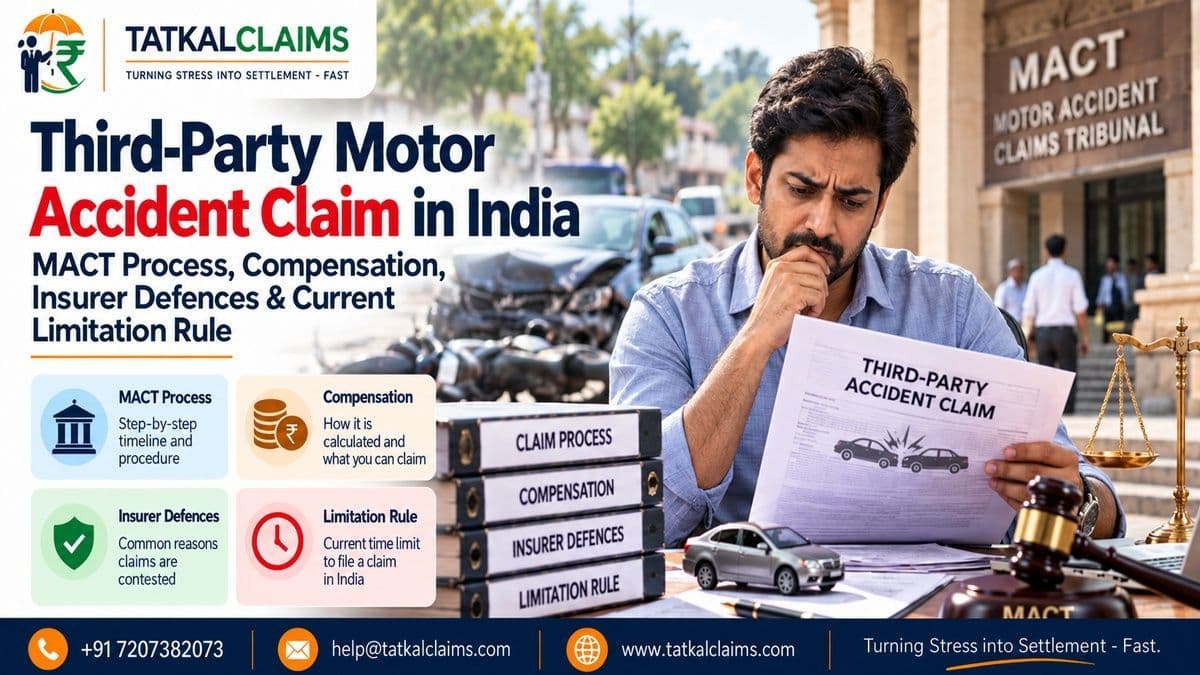
MACT means Motor Accident Claims Tribunal. Section 165 allows State Governments to constitute Claims Tribunals to decide compensation claims arising from motor vehicle accidents involving death, bodily injury or qualifying third-party property damage.
MACT is a specialised statutory forum. It is not the same as the insurer’s grievance department, Bima Bharosa, the Insurance Ombudsman or a consumer commission.
A claim involving third-party bodily injury or death should therefore be analysed as a Motor Vehicles Act compensation claim first, not merely as an insurer-service complaint.
Who Can File a MACT Claim?
Section 166 expressly identifies who may apply for compensation.
| Situation | Who can apply |
| Person injured in the accident | The injured person |
| Third-party property damage | Owner of the damaged property |
| Death caused by accident | All or any legal representatives of the deceased |
| Claimant unable to act personally | Duly authorised agent, where permitted by the section |
Where not all legal representatives join a death claim, Section 166 says the application is to be made for the benefit of all legal representatives and those not joining are to be impleaded as respondents.
Do not confuse “legal representative” for MACT purposes with the narrower insurance-policy question of who is the nominee. MACT compensation and life-insurance nomination are different legal frameworks.
Three Important Compensation Routes After an Identified-Vehicle Accident
The post-2019 Motor Vehicles Act framework provides more than one route. The correct route affects what must be proved and how the case proceeds.
| Route | Core feature |
| Section 164 | Fixed no-fault compensation for death or grievous hurt |
| Section 166 | Fault/negligence-based claim for just compensation |
| Section 149 settlement process | Insurer-designated officer may make a settlement offer before the Tribunal |
The routes should not be treated as interchangeable. In particular, Section 166 contains a proviso that where compensation under Section 164 is accepted in accordance with the Section 149 process, the Section 166 claim petition lapses.
Section 164: Fixed No-Fault Compensation
Section 164 currently provides fixed compensation of ₹5 lakh in case of death and ₹2.5 lakh in case of grievous hurt arising out of the use of a motor vehicle.
For this route, Section 164 says the claimant does not have to plead or establish that death or grievous hurt was caused by a wrongful act, neglect or default of the owner, vehicle or another person.
That simplicity is the advantage of Section 164. But claimants should understand the effect of accepting a Section 164 settlement before treating it as merely an interim payment.
Section 166: Fault-Based Compensation
Section 166 is the ordinary route for a claimant seeking compensation based on the wrongful act or negligence that caused the accident.
The claimant typically proves the accident, involvement of the offending vehicle, negligence, injury/death, and the financial/non-financial consequences for which compensation is sought.
A criminal conviction is not a prerequisite to a MACT award. The Tribunal decides the compensation case on the evidence before it under the statutory claims process.
| Issue | Typical evidence |
| Accident occurred | FIR/FAR/IAR/DAR, site plan, photographs, witnesses |
| Vehicle involvement | Registration details, police records, CCTV, seizure/mechanical inspection |
| Negligence / fault | Police investigation, eyewitnesses, scene evidence, driving conduct |
| Injury | MLC, treatment records, imaging, disability evidence |
| Death | Death certificate, post-mortem where applicable |
| Income / dependency | Salary, tax records, business evidence, occupation proof |
| Expenses / future impact | Medical bills, future-treatment evidence, disability and care needs |
Section 149: Insurer Settlement Offer Before MACT
Under the current Act, the insurance company must designate an officer after receiving information about the accident from the claimant, accident information report or another source.
The designated officer may make a settlement offer before the Claims Tribunal within 30 days in the prescribed manner.
If the claimant accepts the offer, the Tribunal records the settlement and the insurer is to make payment within a maximum of 30 days from receipt of that settlement record. If the offer is rejected, the Tribunal fixes the matter for adjudication on merits.
Do not accept a settlement merely because it is labelled an insurer or Tribunal offer. Compare it against the injury, income, dependency, disability, future prospects, medical evidence and established compensation principles before deciding.
FAR, IAR and DAR: The Police Accident-Report System
The current statutory scheme gives the police a major role in initiating and documenting the compensation process. Section 159 requires an accident information report to be prepared and submitted to the Claims Tribunal.
The Central Motor Vehicles Rules/Detailed Accident Report framework uses the First Accident Report (FAR), Interim Accident Report (IAR) and Detailed Accident Report (DAR). The Supreme Court in Gohar Mohammed directed implementation of this structured system, including early accident intimation and DAR filing.
The detailed-accident-report forms also identify victim rights such as receiving copies of the FIR, FAR, IAR, DAR, MLC/post-mortem record and obtaining free legal aid from the State Legal Services Authority.
Section 166(4) is particularly important: the Claims Tribunal is to treat an accident report forwarded under Section 159 as an application for compensation under the Act.
| Record | Why it matters |
| FIR | Initial criminal/accident record |
| FAR | Early accident information |
| IAR | Interim investigation and party/vehicle details |
| DAR | Detailed accident, insurance, driver, victim and claim information |
| Insurance Form | Policy and insurer details |
| Victim Impact Report | Impact of accident on victim/family |
| MLC / post-mortem | Medical/cause-of-death evidence |
Which MACT Can Hear the Claim?
Section 166(2) gives the claimant a choice among specified territorial connections.
| Connection | Examples |
| Place where accident occurred | Tribunal for accident area |
| Place where claimant resides or carries on business | Claimant-side territorial option |
| Place where defendant resides | Owner/driver or other relevant defendant-side option |
Because the police/Section 149 process may begin at the place of accident, duplicate proceedings should be avoided. The Supreme Court’s Gohar Mohammed directions address coordination when proceedings are initiated in different places.
The Six-Month Section 166(3) Limitation: Current Position in September 2026
The text of Section 166(3), brought into force from 1 April 2022, states that no application for compensation shall be entertained unless made within six months of the accident.
However, the legal effect of that provision—especially condonation and its interaction with the mandatory police accident-report process—is presently under consideration by the Supreme Court in proceedings including Bhagirathi Dash v. Union of India and ICICI Lombard v. Ayiti Navaneetha.
The Supreme Court issued an interim direction in November 2025 that Tribunals and High Courts should not dismiss claim petitions on the ground of Section 166(3) limitation while the issue is pending. Recent High Court orders in 2026 continue to apply that interim direction.
So the safest practical advice is still to file immediately and aim well within six months. But a person already beyond six months should not assume the case is automatically dead without checking the current Supreme Court status and whether the Section 159/166(4) accident-report mechanism applies.
Can the Insurer Refuse Liability Because of a Licence, Permit or Policy Breach?
Section 150 sets out the insurer’s statutory duty to satisfy qualifying third-party awards and the specified grounds on which the insurer may defend.
Current statutory defences include specified use/permit breaches, driving by a person who is not duly licensed or is disqualified, driving under the influence within the statutory provision, certain war/civil-commotion conditions, material non-disclosure/false representation affecting the policy, and non-receipt of premium under Section 64VB of the Insurance Act.
A successful insurer defence does not always produce the same result for the accident victim. Depending on the breach, proof and binding precedent, courts may in appropriate third-party cases direct the insurer to satisfy the award first and recover the amount from the owner/driver.
That “pay and recover” protection is for third-party statutory compensation; it should not be confused with whether the vehicle owner’s own-damage repair claim must be paid.
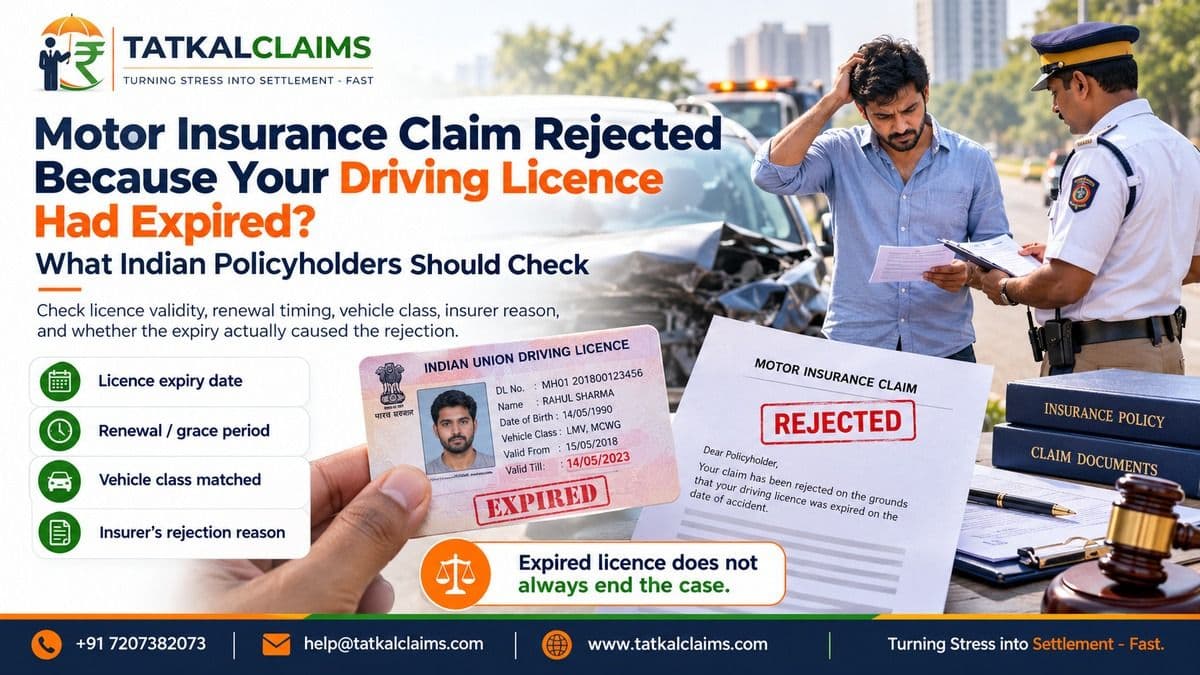
For the licence issue and the distinction between own-damage and third-party liability, see our expired driving-licence motor claim guide.
Commercial Vehicle Permit and Fitness Breaches
Transport-vehicle claims can involve permit, route and fitness issues. These can matter to insurer liability and recovery rights.
Do not assume that a permit or fitness breach automatically deprives the injured third party of compensation. Third-party liability and the insurer’s right to recover from the vehicle owner can be separate questions.
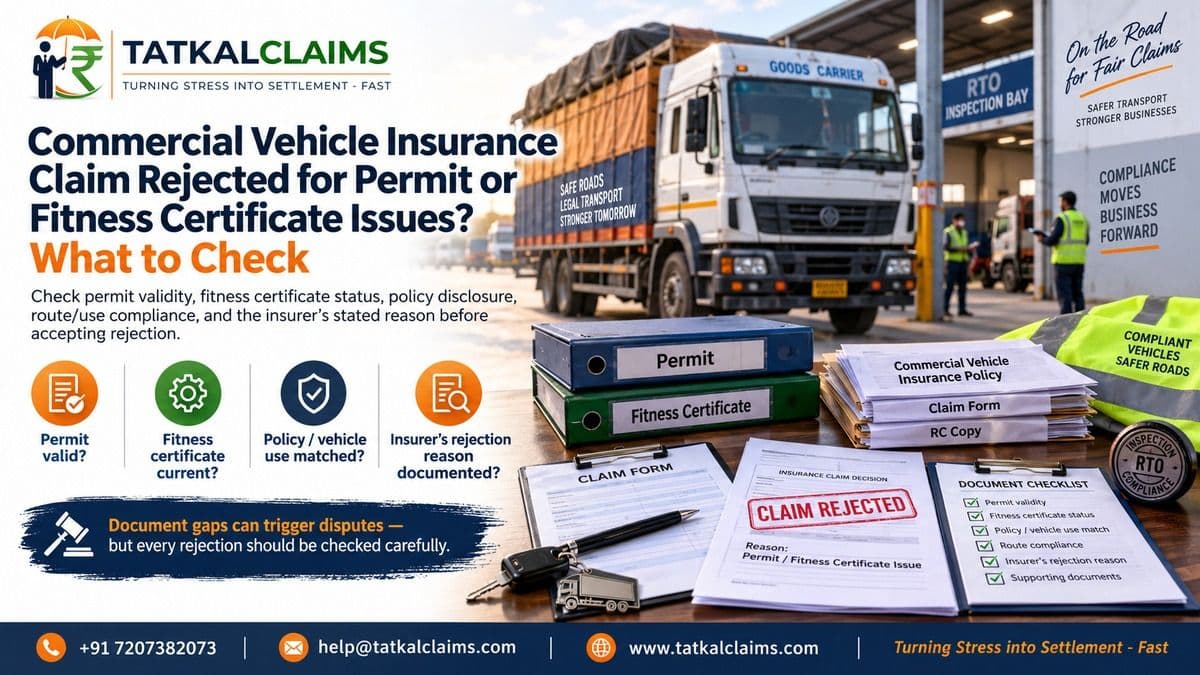
For the permit/fitness distinction, see our commercial vehicle permit and fitness claim guide.
Who Is Not Automatically a “Third Party”?
The expression “third party” does not mean every person physically present in a vehicle.
An owner-driver, borrower/permissive user stepping into the owner’s position, employee, gratuitous passenger in a goods vehicle, or another special category can raise different statutory and contractual questions.
The exact vehicle, seating capacity, passenger status, employment relationship and policy must therefore be checked before assuming third-party coverage.
For a recent example where the family of a person driving a borrowed vehicle could not use Section 166 MACT proceedings to obtain a contractual policy benefit from that vehicle’s insurer, see our borrowed-car fatality case study.
How MACT Compensation Is Calculated
Section 166 compensation is not a fixed table in the way Section 164 is. The Tribunal must award just compensation on the evidence and established Supreme Court principles.
For death claims, courts commonly analyse income, future prospects, personal-expense deduction, multiplier based on age, dependency and conventional heads such as consortium, loss of estate and funeral expenses.
For injury claims, the analysis can include medical expenses, loss of income during treatment, future earning loss, functional disability, future treatment/attendant needs and non-pecuniary consequences.
| Death claim | Injury claim |
| Income and future prospects | Medical expenses |
| Dependency after personal-expense deduction | Past loss of income |
| Age-based multiplier | Future earning loss / functional disability |
| Spousal/parental/filial consortium where applicable | Future treatment and attendant care |
| Funeral expenses | Pain, suffering and loss of amenities |
| Loss of estate | Prosthesis / assistive needs where proved |
Recent Supreme Court awards continue to apply the Pranay Sethi framework for future prospects and multiplier-based loss calculations, while injury cases focus on the actual functional impact of disability rather than simply copying a medical percentage.
What If the Deceased or Injured Person Had No Salary Slip?
Lack of a formal salary slip does not mean income must be treated as zero. The claimant should produce the best available evidence: bank credits, tax records, invoices, business records, employer evidence, occupation proof, skill records or other contemporaneous material.
Where precise income is not proved, the Tribunal may have to assess income from the evidence and applicable judicial standards. Do not invent a salary figure simply to increase the claim.
Medical Disability vs Functional Disability
In a serious injury case, the medical disability percentage and the loss of earning capacity are not automatically identical.
The Tribunal examines how the injury affects the claimant’s actual occupation and ability to earn. A relatively smaller anatomical impairment can have a much larger functional effect for a person whose work depends on the injured limb or capacity.
Recent Supreme Court decisions continue to emphasise reasoned assessment of functional disability and future prospects, supported by medical and occupational evidence.
What If the Injured Person Was Also Partly at Fault?
In a Section 166 negligence claim, contributory negligence can reduce compensation where the claimant’s own negligence contributed to the accident or injury.
That is different from composite negligence, where two or more wrongdoers contribute to the accident and the innocent claimant is not at fault. Liability allocation in multi-vehicle cases is fact-specific.
Helmet/seat-belt or other safety allegations should be analysed on evidence and causation rather than automatically converted into a fixed deduction.
What If the Offending Vehicle Had No Insurance?
If the vehicle is identified but uninsured, that is not automatically a hit-and-run case. The claimant can still pursue the persons legally liable, including the vehicle owner/driver as applicable, but there may be no third-party insurer available to satisfy the award.
Where the offending vehicle cannot be identified despite reasonable efforts, the separate Section 161 hit-and-run scheme becomes relevant.
The current hit-and-run statutory compensation is ₹2 lakh for death and ₹50,000 for grievous hurt. That scheme has its own procedure and should not be confused with an identified-vehicle MACT claim.
Documents to Preserve Immediately After the Accident
| Document / evidence | Why it matters |
| FIR and police acknowledgement | Accident and vehicle identification |
| FAR / IAR / DAR | Structured statutory accident record |
| Site plan / photographs / CCTV | How collision occurred |
| Vehicle registration and insurance details | Owner/insurer identity |
| Driver licence and permit/fitness records | Potential liability/defence issues |
| MLC and hospital records | Injury and treatment |
| Post-mortem / death certificate | Fatal claim evidence |
| All medical bills and receipts | Actual expenses |
| Disability certificate + treating specialist evidence | Permanent impact |
| Income/tax/employer/business records | Earning loss / dependency |
| Age proof | Multiplier calculation |
| Witness contacts | Negligence and accident proof |
| Loan/dependency/education evidence where relevant | Financial impact evidence |
Should You Accept an Early Insurer Settlement Offer?
An early settlement can reduce litigation time, but it should be assessed against the evidence and likely statutory compensation.
Before accepting, verify whether future treatment, permanent disability, future earning loss, dependency, future prospects and applicable conventional heads have been accounted for.
Where medical recovery is incomplete or disability has not stabilised, an early lump-sum offer may be especially difficult to evaluate.
Ask for the insurer’s calculation in writing and understand whether acceptance will finally settle the statutory claim.
Is Bima Bharosa or the Insurance Ombudsman a Substitute for MACT?
No. Bima Bharosa and the Insurance Ombudsman deal with insurance grievances within their respective frameworks. They are not substitutes for MACT’s statutory jurisdiction to adjudicate third-party motor accident compensation.
An insurance-service complaint—for example, failure to provide policy details or a separate contractual motor claim—may have a grievance route. But the victim’s statutory compensation claim should not be allowed to miss MACT procedural steps while waiting for an insurer grievance response.
If there is uncertainty about forum or limitation, obtain accident-compensation legal advice quickly.
A Practical 7-Day Action Plan After a Serious Motor Accident
| Day | Action |
| Day 1 | Ensure FIR/accident reporting, treatment and preservation of vehicle/witness details. |
| Day 2 | Get insurance, RC, driver and police accident-report details. |
| Day 3 | Collect MLC, hospital records, bills, death/post-mortem records where applicable. |
| Day 4 | Preserve income, occupation, age and dependency evidence. |
| Day 5 | Check whether the case is Section 164 no-fault, Section 166 fault-based, or hit-and-run. |
| Day 6 | Check the MACT jurisdiction and current Section 166(3) limitation position; do not delay filing. |
| Day 7 | Review insurer settlement communication, DAR status and whether specialised MACT legal representation is required. |
How Tatkal Claims Can Help
Tatkal Claims can help organise the accident and insurance record, identify the applicable motor-policy and statutory issues, separate own-damage disputes from third-party compensation, and review licence/permit/insurer-defence documents.
For a MACT matter, the core compensation proceeding is a legal adjudication. Where specialist representation is required, the claimant should use an advocate experienced in motor-accident compensation. Tatkal Claims can assist with document readiness, insurer correspondence and related insurance-claim issues without presenting an insurer grievance as a substitute for Tribunal proceedings.
Frequently Asked Questions
Frequently asked questions
What is a MACT claim?
It is a statutory compensation claim before the Motor Accident Claims Tribunal for qualifying death, bodily injury or third-party property damage arising from the use of a motor vehicle.
Do I have to prove negligence in every MACT claim?
No. Section 164 provides a fixed no-fault route for death or grievous hurt. A Section 166 claim, by contrast, ordinarily requires proof of wrongful act or negligence.
How much is compensation under Section 164?
The current statutory amount is ₹5 lakh for death and ₹2.5 lakh for grievous hurt, subject to the Motor Vehicles Act framework.
Is there a six-month time limit for filing a Section 166 claim?
Section 166(3) currently states six months from the accident. However, the Supreme Court is considering the validity/operation and condonation issue and has directed in the interim that claims should not be dismissed solely on this limitation ground. File without delay and obtain current legal advice if six months has passed.
Can the police DAR itself start the compensation case?
Section 166(4) says the Claims Tribunal shall treat an accident report forwarded under Section 159 as an application for compensation. The FAR/IAR/DAR system is therefore an important part of the current process.
What if the offending driver had no valid licence?
The insurer may raise a statutory defence, but that does not automatically mean the third-party victim receives nothing. Depending on the facts and precedent, the insurer may still be directed to satisfy the award with recovery rights against the owner/driver.
What if the vehicle had no insurance at all?
If the vehicle is identified, liability can still be pursued against legally responsible persons such as the owner/driver as applicable. It is not automatically a hit-and-run claim merely because insurance was absent.
Can I claim through MACT if I was driving a borrowed vehicle?
Not automatically against that vehicle’s insurer as a third party. Borrower/owner-driver cases raise different statutory and contractual issues and must be checked against the facts and policy.
How does MACT calculate compensation for death?
The Tribunal commonly considers proved income, future prospects, personal-expense deduction, an age-based multiplier, dependency and applicable conventional heads, following Supreme Court compensation principles.
Can the Insurance Ombudsman award MACT compensation?
The Ombudsman is not a substitute for the Motor Accident Claims Tribunal. Statutory third-party accident compensation is adjudicated through the MACT framework.
Sources and Methodology
Disclaimer: This guide explains the current Motor Vehicles Act framework and selected recent court decisions in general terms. Motor accident liability, negligence, insurer defences, limitation, compensation calculation and forum questions are fact-specific and can change with statutory amendments or binding court decisions. The Section 166(3) limitation issue is under active Supreme Court consideration as of September 2026. This is not legal advice for a specific accident or MACT case.