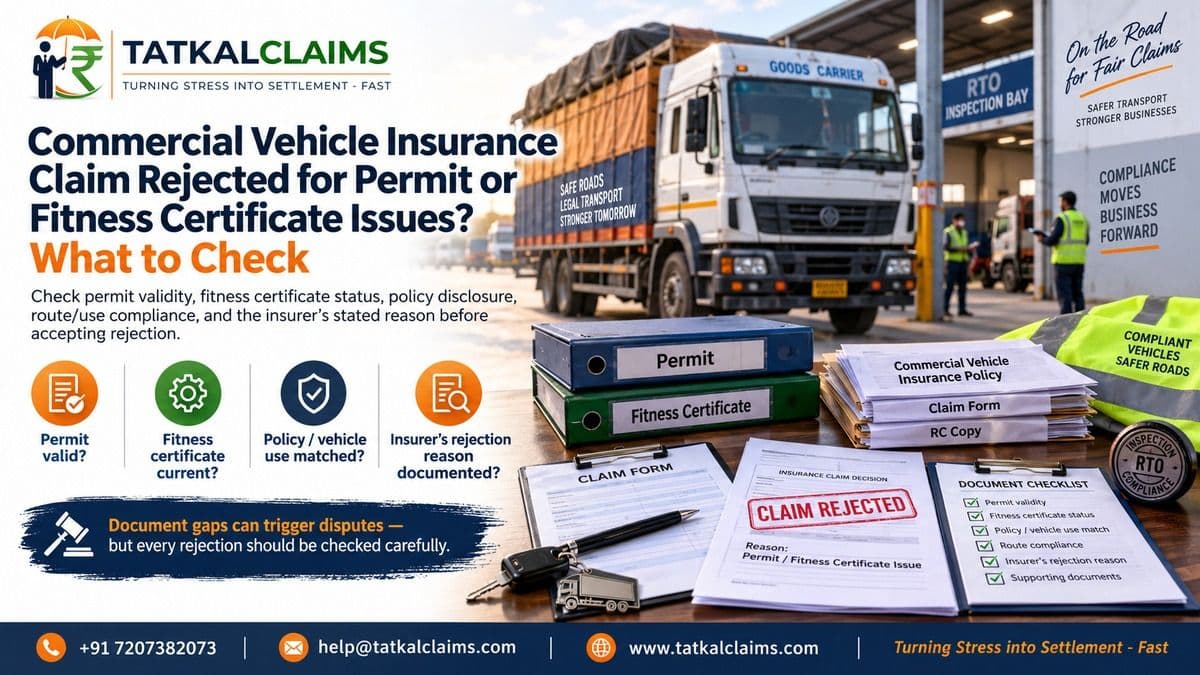
A commercial-vehicle insurance claim can be rejected when the insurer says the vehicle did not have a valid permit, route authorisation or fitness certificate on the date of loss. These objections are serious because permit and fitness requirements come from the Motor Vehicles Act as well as the insurance contract.
But the phrase 'permit/fitness issue' can hide very different situations: no permit at all, an expired permit, the wrong route or state, an expired fitness certificate, a renewal application pending, a temporary authorisation problem, or a claim where the vehicle was not even being used on the road at the time of loss.
This guide focuses on the commercial vehicle owner's own-damage claim. That is different from a third-party accident claim, where courts may direct the insurer to pay the victim first and recover from the owner. A pay-and-recover order for third-party compensation does not automatically mean the owner's own-damage claim must also be paid.
What the Motor Vehicles Act Requires
Section 56 of the Motor Vehicles Act provides that a transport vehicle is not deemed to be validly registered for the purposes of Section 39 unless it carries a valid certificate of fitness. The fitness certificate is therefore not merely a workshop document; it is tied to the legal roadworthiness status of the transport vehicle.
Section 66 separately provides that an owner must not use or permit the use of a vehicle as a transport vehicle in a public place except in accordance with the conditions of a permit granted or countersigned by the appropriate transport authority, subject to statutory exceptions.
Parivahan distinguishes different commercial permits, including goods-carrier, national, stage-carriage, contract-carriage, tourist and temporary permits. Permit conditions can therefore involve more than expiry date alone: vehicle class, route, territory, purpose and authorisation may matter.
Why Insurers Ask for Permit and Fitness Documents
Commercial motor claim checklists commonly ask for a fitness certificate and route permit in addition to the RC, driving licence, policy, repair estimate and other ordinary motor-claim documents. This reflects the statutory and policy conditions that apply specifically to transport vehicles.
A current commercial-vehicle policy document hosted by HDFC ERGO, for example, lists fitness certificate and route permit among the additional documents required for commercial-vehicle own-damage claims. The specific documents and policy wording can vary by insurer and vehicle class, so the insured's own schedule and wording must be checked.
If the insurer relies on a surveyor or investigator conclusion you have not seen, use our guide to getting the survey report, investigator findings and evidence behind a claim rejection.
Own-Damage Claim vs Third-Party Claim: Do Not Confuse Them
| Claim type | Who is seeking payment? | Why the permit/fitness issue matters |
|---|---|---|
| Own-damage accident claim | Vehicle owner/insured | Insurer may rely on statutory/policy breach to repudiate or reduce the owner's claim |
| Own-damage theft claim | Vehicle owner/insured | Permit/fitness status can still be raised even though the vehicle was parked or not moving |
| Third-party injury/death claim | Victim or legal heirs | Courts may protect the third party through pay-and-recover even where the owner breached permit/fitness requirements |
| Third-party property damage | Third party | Statutory liability analysis applies; it is not the same as the insured's OD entitlement |
Recent third-party cases continue to apply the pay-and-recover principle where a transport vehicle lacked a valid permit or fitness certificate. That protects the victim, but the insurer may retain recovery rights against the owner.
For the vehicle owner's own-damage claim, the analysis is different. The insurer may argue that the statutory breach also breaches the insurance contract and defeats indemnity. That is why an owner should not rely on a third-party 'insurer must pay first' judgment as proof that the OD claim is payable.
The Six Permit/Fitness Scenarios You Need to Separate
| Scenario | Typical insurer objection | What to verify |
|---|---|---|
| No permit existed | Vehicle was not legally authorised as a transport vehicle | Whether a permit was actually required; Section 66 exceptions; vehicle class and use |
| Permit expired | Vehicle was operating after expiry | Exact expiry, renewal application, renewal date and insurer's own claim guidelines if any |
| Wrong route / wrong state | Vehicle was outside authorised area | Permit wording, countersignature/national authorisation, accident location and actual use |
| Fitness certificate expired | Transport vehicle was not validly fit/registered for road use | Exact fitness validity, renewal/test records and whether loss occurred while vehicle was being used |
| Permit valid but authorisation inactive | Underlying permit existed but operational authorisation/tax/endorsement had lapsed | VAHAN/permit records, tax/authorisation receipts and applicable state rules |
| Theft while parked | Vehicle was not being driven at moment of theft | Whether absence of permit/fitness is treated as a fundamental statutory breach under applicable precedent |
1. No Permit at All: Highest-Risk Situation
Where a commercial vehicle required a permit and none existed on the date of loss, insurers have strong grounds to allege both statutory and policy breach.
Section 66 is framed broadly: it prohibits use or permitted use of a transport vehicle in a public place except in accordance with a valid permit. Courts have repeatedly treated absence of a required permit as a serious breach in motor cases.
Before accepting repudiation, however, verify that the vehicle actually fell within the permit requirement, that no statutory exception applied, and that the insurer has correctly identified the vehicle class and permit status. Do not assume the insurer's database printout is necessarily complete without checking the transport record.
2. Permit Expired Before the Accident
An expired permit is not always analysed identically to a vehicle that never had any permit. The renewal history, duration of the gap, insurer's internal claim guidelines and the exact policy wording may become relevant.
Some consumer decisions have considered non-standard settlement where the breach was treated as limited or where insurer guidelines contemplated compromise settlement. But those insurer circulars are company-specific and date-specific; they are not a universal legal right available against every insurer.
If your permit had expired shortly before the loss, collect the old permit, renewal application, fee receipt, renewed permit and proof of the date on which the authority accepted or processed the renewal. The insurer should be asked whether it treats the case as 'no permit' or 'expired permit' and on what contractual basis.
3. Wrong Route, Territory or State
A vehicle may have a valid permit but still operate outside the route, district, state or territory authorised by that permit. Parivahan's permit guidance makes clear that goods-carrier and passenger permits are tied to their authorised area and conditions, while national and interstate operations require the relevant broader authorisation.
Case law on route/territory violations is fact-sensitive. In Oriental Insurance v. Ranidan Singh, the National Commission accepted 75% non-standard settlement where a Rajasthan-permit vehicle entered Gujarat for a private purpose and the breach was not treated as fundamental on those facts.
Other cases have upheld repudiation where the vehicle was commercially operating outside the authorised area or in breach of the permit conditions. Therefore, ask: Where exactly did the accident occur? What permit did the vehicle hold? What journey was being undertaken? Was the vehicle carrying goods or passengers? Did it have national/interstate authorisation?
If the motor dispute also involves an undeclared fuel conversion, see our CNG/LPG endorsement and claim rejection guide.
4. Fitness Certificate Expired
Section 56 gives the fitness certificate unusually strong legal significance: without a valid certificate, a transport vehicle is not deemed validly registered for the purposes of Section 39.
That makes an expired fitness certificate more than a minor paperwork lapse in many motor-insurance disputes. Recent consumer decisions have upheld repudiation of own-damage claims where fitness had expired, while other decisions have examined whether the lapse was fundamental in the facts of the case.
Collect the fitness certificate, renewal/test appointment, inspection result, fee receipt and any subsequent certificate. If the renewal was completed after the accident, do not assume the later certificate retrospectively validates the vehicle on the date of loss.
5. What If the Commercial Vehicle Was Stolen While Parked?
A common argument is that permit or fitness should not matter because the vehicle was parked and not being driven when it was stolen. That argument has intuitive force, but current consumer precedent does not make it safe to assume payment.
In Pramod Khushwah v. Oriental Insurance (NCDRC, 2024), the claimant argued that the lack of permit/fitness was irrelevant because the commercial vehicle had been stolen while parked. The National Commission nevertheless treated the statutory absence of valid permit and fitness as a fundamental breach supporting repudiation.
This is why a theft claim involving an expired commercial permit/fitness should be researched against the latest applicable precedent rather than relying only on the general rule that a breach unrelated to theft may be non-fundamental.
For the theft-document sequence itself, use our car theft insurance claim process guide.
6. Can You Demand 75% on a Non-Standard Basis?
Not automatically. The 75% figure comes from a line of cases involving certain breaches of policy conditions, including Amalendu Sahoo v. Oriental Insurance and later Supreme Court decisions discussing non-standard settlement where the breach was not fundamental enough to justify total repudiation.
But permit and fitness cases are not uniform. Some fora have allowed 75% for route or use-related breaches; others have treated absence of permit or fitness as a fundamental statutory violation and upheld total repudiation. The exact breach matters.
If you ask for non-standard settlement, identify the precise precedent, insurer guideline or factual reason that makes total repudiation disproportionate. Do not rely on the percentage alone.
What to Check Before Appealing the Rejection
| Check | Evidence to collect | Why it matters |
|---|---|---|
| Vehicle class | RC / VAHAN extract | Confirms whether vehicle is legally a transport vehicle |
| Permit type | Permit copy | Shows goods/passenger/national/stage/contract/tourist authority |
| Permit validity | Expiry and renewal records | Tests whether permit existed on date of loss |
| Route / territory | Permit conditions and accident location | Tests geographic compliance |
| Authorisation / countersignature | National/interstate documents | Important for cross-border operations |
| Fitness validity | Fitness certificate and test records | Tests Section 56 compliance |
| Actual use at loss | FIR, trip sheet, GPS, load/passenger records | Tests whether use matched permit and policy |
| Load / passenger count | Load challan, manifest, tickets | Can reveal separate overloading or use issues |
| Insurer wording | Policy schedule and commercial vehicle conditions | Shows contractual basis of repudiation |
| Survey findings | Survey report / investigator report | Tests what insurer actually relied on |
What to Ask the Insurer in Writing
| Question | Purpose |
|---|---|
| Which exact policy clause is breached? | Separates statutory allegation from contractual ground |
| Was the rejection based on no permit, expiry, wrong route or wrong use? | Prevents multiple issues being bundled together |
| What permit/fitness data did the insurer verify and from which authority? | Tests factual accuracy |
| Was the vehicle actually being used in a public place at the time of loss? | Relevant to the statutory/use analysis |
| Does the insurer rely on any Section 66 exception being inapplicable? | Clarifies legal basis |
| Why is 75% non-standard settlement being refused? | Forces insurer to address compromise/non-standard argument where relevant |
| What did the surveyor assess before the permit/fitness objection? | Separates physical loss valuation from coverage defence |
| Is the insurer relying on third-party case law for an own-damage claim? | Prevents mixing different liability frameworks |
How to Rebuild the Permit/Fitness Timeline
Create a one-page chronology with: permit issue date, permit expiry, any renewal application, renewal fee payment, renewed permit date, fitness expiry, fitness test appointment, certificate renewal date, accident/theft date and insurer intimation date.
Attach official VAHAN or transport-authority records where available. If the permit or fitness data on the insurer's record is wrong, obtain a certified or portal-generated record from the relevant transport authority.
If route or territory is disputed, attach the permit map/area, national permit or countersignature and evidence showing where the vehicle was actually travelling when the loss occurred.
If the insurer will not share the survey or investigation basis, use our insurance claim evidence guide.
How to Escalate a Permit/Fitness Claim Rejection
Start with the insurer's grievance mechanism and answer the precise ground relied upon. Do not send a generic request for sympathy. Attach the permit, fitness certificate, renewal records, route/territory authorisation, trip evidence and the policy wording.
If the grievance response remains unsatisfactory, the matter can be escalated through IRDAI's Bima Bharosa platform. Depending on eligibility, the Insurance Ombudsman may also consider complaints involving partial or total repudiation.
Compare Bima Bharosa and the Insurance Ombudsman before choosing the next route.
For eligibility and filing steps, use our Insurance Ombudsman complaint guide.
7-Day Action Plan After a Permit/Fitness Rejection
| Day | Action | Output |
|---|---|---|
| 1 | Obtain final repudiation letter, policy schedule and complete commercial-vehicle wording | Exact rejection ground |
| 2 | Download/obtain permit, route/territory and fitness records from transport authority | Regulatory status file |
| 3 | Build permit/fitness validity timeline around the date of loss | Chronology |
| 4 | Request survey report, investigator findings and insurer verification data | Insurer evidence |
| 5 | Collect trip sheet, GPS, load/passenger records and accident/theft documents | Actual-use evidence |
| 6 | File focused grievance addressing permit, fitness, route and non-standard settlement separately | Written reconsideration request |
| 7 | Prepare Bima Bharosa/Ombudsman file if insurer response remains unsatisfactory | Escalation bundle |
Can Tatkal Claims Help With a Commercial Vehicle Claim Rejection?
Tatkal Claims assists policyholders with rejected, delayed and short-settled motor claims. In a permit or fitness dispute, the review can include the vehicle class, permit validity, route/territory conditions, fitness certificate, actual use at the time of loss, survey findings, policy wording and the insurer's reliance on statutory breach.
No claim outcome can be guaranteed. A missing permit or fitness certificate can be a serious and sometimes fundamental problem. The strength of an appeal depends on the exact breach, the date and place of loss, the vehicle's actual use, the policy and the applicable precedent.
Frequently asked questions
Can a commercial vehicle insurance claim be rejected if the permit expired?
Yes, an expired permit can support repudiation, but the result depends on the exact facts, policy wording, renewal history and applicable precedent. Some cases have considered non-standard settlement; others have upheld full repudiation.
Can a claim be rejected if the fitness certificate expired?
Yes. Section 56 gives fitness certificate status direct statutory significance for transport vehicles. An expired fitness certificate is therefore a serious claim issue and has supported repudiation in own-damage cases.
Is a route permit violation the same as having no permit?
No. A vehicle may have a valid permit but operate outside its authorised area or conditions. Courts have treated route/territory breaches differently depending on the facts, so the permit wording and actual journey must be examined.
Can I get 75% of the claim on a non-standard basis?
Possibly in some cases, but 75% is not automatic. It depends on whether the breach is treated as fundamental, the policy and the precedent applicable to the particular permit or fitness issue.
What if the permit renewal was already applied for before the accident?
Keep the renewal application, fee receipt, authority acknowledgement and renewed permit. Whether that cures or reduces the breach depends on the legal effect of the renewal and the dates involved; do not assume retrospective validity.
What if the vehicle was stolen while parked and the permit had expired?
Do not assume the permit issue becomes irrelevant. NCDRC precedent has upheld repudiation in a commercial-vehicle theft case where valid permit and fitness documents were absent, despite the vehicle being parked at the time of theft.
Does a third-party pay-and-recover judgment mean my own-damage claim must be paid?
No. Pay-and-recover protects third-party victims. Your own-damage entitlement is a separate contractual dispute between you and the insurer.
What if my vehicle had a state permit but the accident happened in another state?
Check whether you had a national permit, countersignature, temporary authorisation or other permission. A territory mismatch can become a claim issue, but the outcome depends on the permit conditions and facts.
What documents should I get from the RTO or VAHAN for appeal?
Obtain the permit record, validity dates, route/territory authorisation, renewal history, fitness certificate and any official status/transaction record relevant to the date of loss.
Where can I complain if the insurer refuses to reconsider?
Raise a written grievance with the insurer first. If unresolved or unsatisfactory, consider Bima Bharosa and, where eligible, the Insurance Ombudsman.
Official and Legal Sources
Disclaimer: This article provides general information about commercial vehicle permits, fitness certificates and motor insurance disputes in India. Permit and fitness law, state transport procedures, policy wording and case law can produce different outcomes on different facts. Third-party liability cases should not be treated as automatic authority for an own-damage claim, and non-standard settlement is not guaranteed.