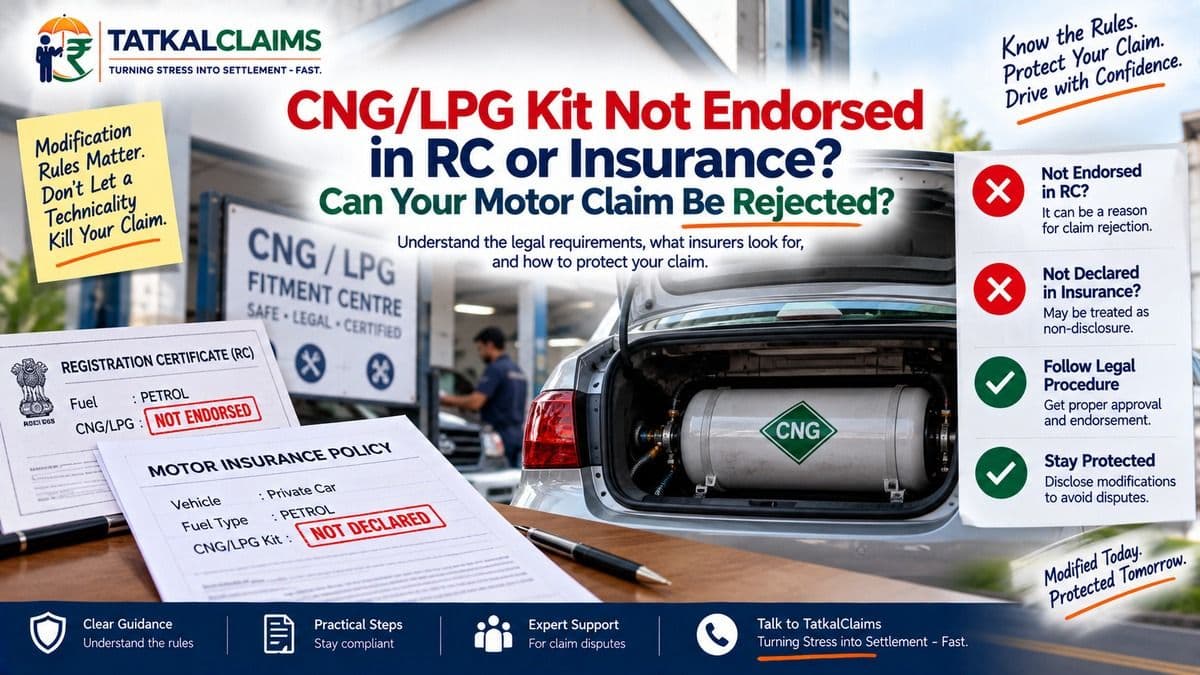
If your car has an aftermarket CNG or LPG kit but the fuel conversion is missing from the RC, the insurance policy, or both, an insurer may raise that issue during a motor claim. But that does not mean every claim involving such a vehicle is automatically payable or automatically rejectable.
The outcome usually turns on several separate questions: whether the conversion was legally recorded, whether the insurer was informed, whether the kit was included in the insurance cover, whether the loss involved the kit, what the policy says, and what the insurer can actually prove.
This guide explains the current IRDAI and Motor Vehicles Act position, how retrofit CNG/LPG endorsements work, why a fire claim can be very different from a theft or unrelated collision claim, and how to challenge a rejection that treats the missing endorsement as an automatic reason to deny the entire loss.
What IRDAI Says About Fitting a CNG or LPG Kit
IRDAI's current motor-insurance policyholder guidance is direct: when a CNG or LPG kit is fitted to a vehicle, the Road Transport Authority where the vehicle is registered should be informed so that the change is noted in the registration certificate. The insurance company should also be informed so that the kit can be covered on payment of additional premium.
IRDAI also explains that changes in an insurance policy are recorded through an endorsement. In practice, a retrofit fuel conversion should therefore not be treated as a workshop-only modification: the RC side and the insurance side both need attention.
If your insurer has already repudiated the claim, use this article together with our complete insurance claim rejection guide.
What Section 52 of the Motor Vehicles Act Means for Fuel Conversion
Section 52 of the Motor Vehicles Act permits modification of an engine or related vehicle part to facilitate operation by a different fuel or energy source, including compressed natural gas and liquefied petroleum gas, through a conversion kit subject to prescribed conditions.
The same section also deals with reporting alterations to the registering authority so that the registration particulars can be updated. The safest approach is therefore to use an approved conversion process and complete the alteration/RC endorsement through the registering authority rather than fitting a kit and leaving the original registration particulars unchanged.
Parivahan's current VAHAN service includes an 'Alteration of Motor Vehicle' process for updating registered vehicle details. State-specific documents, inspection and procedures can vary, so the actual RTO requirements should be checked for the vehicle's jurisdiction.
Factory-Fitted CNG vs Aftermarket CNG/LPG: Do Not Mix Them Up
| Situation | What to check | Main claim risk |
|---|---|---|
| Factory-fitted CNG/LPG vehicle | RC fuel type, exact model/variant and policy schedule | Mismatch in recorded vehicle/fuel details |
| Aftermarket approved retrofit | RC alteration endorsement, installer/approval records and insurance endorsement | Conversion disclosed to RTA but not insurer, or vice versa |
| Aftermarket kit not in RC | Installation documents, date of fitment and legal approval status | Vehicle particulars differ from registration record |
| Kit not in insurance policy | Insurer intimation, endorsement request and premium proof | Kit may not be insured; insurer may allege non-disclosure/material alteration |
| Kit fitted before policy purchase | What RC/proposal/inspection records insurer saw at inception | Dispute over whether insurer knew or should have known of conversion |
| Kit fitted after policy purchase | Date of installation, insurer notice and endorsement | Post-policy alteration not incorporated into contract |
For a factory-fitted CNG variant, do not assume the retrofit-kit rules apply in exactly the same way. The starting point is whether the registered fuel type, model/variant and insurance schedule correctly describe the vehicle.
The bigger risk arises when a petrol vehicle is later converted and the owner updates only one side of the record—or neither.
How CNG/LPG Kit Insurance Cover Usually Works
Current motor-policy wordings used by major insurers continue to include an IMT 25-style endorsement for a CNG/LPG kit in a bi-fuel system. The endorsement is designed to cover accidental loss or damage to the insured kit, subject to its declared value and the policy terms.
IRDAI's policyholder guidance says the insurer should be informed so the kit can be covered on payment of additional premium. A current HDFC ERGO change-of-policy page, for example, asks for an endorsed RC copy for CNG/LPG addition and additional premium; exact documentation and pricing can differ by insurer.
This is why 'the vehicle was insured' and 'the retrofit kit was insured' are not always the same thing. A policy can cover the car's own damage while leaving an undeclared accessory or retrofit outside its separately endorsed value. The harder dispute is whether the omission also permits rejection of the rest of the vehicle claim.
Can the Insurer Reject the Entire Claim?
There is no safe one-line answer. A missing CNG/LPG endorsement can be material, but older consumer decisions show that courts and commissions have looked closely at the policy wording, insurer knowledge, proof of the conversion and the connection between the conversion and the loss.
| Claim situation | Why the endorsement issue matters | What to investigate |
|---|---|---|
| Fire/explosion allegedly originating from kit | Strongest connection between conversion and loss | Fire report, survey report, kit installation, leak/electrical findings, policy endorsement |
| Collision unrelated to fuel system | Connection may be weaker | Accident cause, damaged components, whether insurer identifies a policy term making the omission decisive |
| Theft of entire vehicle | Kit usually did not cause the theft | Whether policy breach is being used to deny a loss unrelated to the conversion |
| Damage only to CNG/LPG kit | Separate kit cover becomes central | Whether kit had declared value/endorsement and premium |
| Total loss after fire with disputed origin | Causation becomes critical | Surveyor/fire brigade findings, forensic evidence and insurer's factual basis |
| Insurer cannot prove a kit existed | Repudiation basis itself may fail | Survey photos, surveyor affidavit/report, RC records, workshop records |
A Delhi State Commission decision in Reliance General Insurance v. Sunil Sharma is a useful example of proof. The insurer alleged that a CNG kit had been fitted without endorsement, but failed to place the survey report or other evidence proving the kit existed at the time of the fire. The repudiation was not upheld.
In another Delhi State Commission matter, United India Insurance v. J&K Sons, the Commission focused on the lack of correlation between an alleged CNG-related breach and theft of the car, observing that the conversion did not cause the theft. This is persuasive consumer-forum reasoning, not a universal rule that automatically binds every motor-claim dispute.
Other older decisions have also turned on whether the kit was already present when the policy was issued, whether the insurer or its agent had access to the RC/vehicle, and whether the alleged breach actually contributed to the loss. These cases are highly fact-specific, so they should be used to frame an appeal, not as a guarantee of payment.
If the Claim Is for Fire, the Causation Evidence Is Crucial
A fire claim involving an undeclared CNG/LPG conversion is much harder than a theft or unrelated collision claim because the insurer may allege that the uninsured or unauthorised kit caused the fire itself.
Do not accept 'CNG vehicle caught fire' as a complete technical conclusion. Ask what evidence connects the fire to the kit: leak detection, cylinder/valve condition, pipeline damage, regulator failure, electrical shorting, point of origin, fire-brigade findings, workshop inspection and survey photographs.
In National Insurance v. Kalpana Kumar, the consumer forum rejected the insurer's CNG theory where the record did not establish that a CNG kit was in fact installed or that it caused the fire. The point is evidentiary: an insurer relying on the modification should be able to prove the facts behind that defence.
If the rejection relies on a surveyor or investigator conclusion that you have not seen, use our guide to obtaining the survey report, investigation findings and evidence behind a claim rejection.
If the Vehicle Was Stolen, Ask What the CNG/LPG Issue Has to Do With the Theft
For theft, the key question is different: the vehicle disappeared because it was stolen, not because a gas kit malfunctioned. That does not erase a policy breach or registration problem, but it makes the insurer's reasoning worth testing carefully.
Ask the insurer to identify the precise policy condition relied upon, whether it is rejecting the whole theft claim or only declining cover for the undeclared kit, and why the missing endorsement is said to defeat indemnity for theft of the entire vehicle.
For the evidence sequence in a stolen-car claim, see our car theft insurance claim process guide.
If the Accident Was Unrelated to the Kit
Suppose a properly driven car with an unendorsed retrofit kit is hit from behind, or is damaged in a collision with no allegation of fuel-system failure. The insurer may still raise non-disclosure or alteration, but the appeal should separate the existence of the breach from its relevance to the accident.
Request the surveyor's finding on the actual cause of the accident, identify which damaged parts are unrelated to the kit, and ask the insurer to point to the policy wording that it says permits rejection of the entire own-damage claim.
Do not assume that 'no causal link' automatically wins every case. Insurance policies are contracts and the legal effect of a breach can depend on the condition breached, the governing law and the facts. The purpose of the appeal is to prevent a generic modification objection from substituting for an actual policy-and-evidence analysis.
What to Check Before Appealing a CNG/LPG Claim Rejection
| Check | Evidence to collect | Why it matters |
|---|---|---|
| Factory-fitted or aftermarket? | Invoice, model variant, installation record | Determines whether this is a retrofit endorsement issue |
| RC fuel type | RC / VAHAN particulars | Shows whether registration records were updated |
| Insurance schedule | Policy schedule and endorsements | Shows whether insurer recorded the fuel conversion |
| Additional premium | Receipt/endorsement/payment record | Shows whether kit cover was added |
| Date of fitment | Workshop invoice / installation certificate | Tests whether conversion pre-dated or post-dated policy |
| Insurer knowledge | Proposal, inspection, renewal records, emails | Can matter where insurer saw the converted vehicle/RC |
| Cause of loss | FIR, fire report, survey report, accident records | Separates breach from causation |
| Damage to kit vs vehicle | Survey assessment and repair estimate | Tests whether insurer is denying kit value or whole claim |
| Repudiation wording | Final rejection letter | Shows exact contractual ground actually taken |
What to Ask the Insurer in Writing
A useful grievance should force the insurer to answer the exact CNG/LPG issue. Ask the following questions in writing rather than arguing only that the rejection is 'unfair'.
| Question | Purpose |
|---|---|
| What exact policy clause was breached? | Prevents a vague non-disclosure allegation |
| Is the insurer denying only the kit or the entire vehicle claim? | Separates accessory cover from main OD cover |
| What evidence proves the kit was fitted on the date of loss? | Tests the factual premise |
| Was the conversion reflected in the RC or documents available at policy inception/renewal? | Tests insurer knowledge |
| What evidence shows the kit caused or contributed to the loss? | Important in fire/accident disputes |
| What did the surveyor assess before the CNG/LPG objection? | Shows underlying loss valuation |
| Would the claim have been payable if the endorsement had been present? | Clarifies whether omission is the sole ground |
| Can the claim be reconsidered excluding only uninsured kit value where appropriate? | Raises a narrower settlement alternative |
If There Has Been No Claim Yet: Fix the Records Before a Loss Happens
If you discover the mismatch before any claim, do not wait for renewal. Check the RC/VAHAN fuel particulars, contact the registering authority for alteration/endorsement where required, and ask the insurer for a policy endorsement.
Keep the approved kit/installation papers, invoice, RC endorsement, insurer endorsement and premium receipt together. If the insurer asks for inspection or photographs, preserve the acknowledgement after submission.
For an aftermarket conversion, do not assume the workshop or dealer automatically completed both the RTO and insurance changes on your behalf. Verify the final records yourself.
How to Escalate an Unfair CNG/LPG Claim Rejection
Start with the insurer's grievance channel. Attach the RC, policy schedule, endorsement request, installation records, survey/fire/accident evidence and a short explanation of why the insurer's stated breach does or does not relate to the loss.
If the insurer does not resolve the grievance satisfactorily, the dispute can be escalated through IRDAI's Bima Bharosa grievance system. Depending on eligibility, the Insurance Ombudsman can also consider complaints involving partial or total repudiation and policy servicing.
Use our comparison of Bima Bharosa vs the Insurance Ombudsman before choosing the external escalation route.
If the Ombudsman route fits your case, follow our Insurance Ombudsman filing guide.
7-Day Action Plan After a CNG/LPG-Based Claim Rejection
| Day | Action | Output |
|---|---|---|
| 1 | Get the final repudiation/short-settlement letter and complete policy schedule | Exact clause and endorsement issue |
| 2 | Download/check RC or VAHAN fuel details and collect installation documents | Registration evidence |
| 3 | Request survey report, fire report basis and causation findings | Insurer-side evidence |
| 4 | Collect proof of insurer knowledge, endorsement request or premium payment | Disclosure timeline |
| 5 | Separate kit damage from unrelated vehicle damage and reconstruct the loss | Claim-value matrix |
| 6 | File a focused insurer grievance answering breach, knowledge and causation | Written reconsideration request |
| 7 | Prepare Bima Bharosa/Ombudsman chronology if insurer response remains unsatisfactory | Escalation file |
Can Tatkal Claims Help With a CNG/LPG Motor Claim Dispute?
Tatkal Claims assists policyholders with rejected, delayed and short-settled motor claims. In a CNG/LPG dispute, the review can include the RC and policy endorsements, disclosure timeline, surveyor findings, cause of loss, kit-value treatment, policy wording and the insurer's grievance response.
No claim result can be guaranteed. An undeclared or unendorsed fuel conversion can be a genuine coverage issue, especially where the loss is connected to the kit. The strength of an appeal depends on the actual records, the policy and the evidence linking—or not linking—the conversion to the loss.
Frequently asked questions
Do I have to tell the insurer after fitting an aftermarket CNG or LPG kit?
Yes. IRDAI's motor-insurance guidance says the insurer should be informed when a CNG/LPG kit is fitted, and the RTA should also be informed so the change can be recorded in the RC.
Is updating the RC enough if I never updated the insurance policy?
No. The RC and insurance policy are separate records. A retrofit may be correctly recorded with the RTA but still absent from the insurance schedule, leaving a coverage and disclosure issue.
Can the insurer refuse to pay for the CNG/LPG kit itself if no extra premium was paid?
That is a significant risk. Current motor-policy wordings commonly provide separate CNG/LPG kit own-damage cover through an endorsement tied to the kit's declared value and premium.
Can my entire accident claim be rejected just because the CNG kit was not endorsed?
Not automatically in every factual situation. The policy wording, disclosure history, nature of the breach, cause of loss and evidence all matter. In an unrelated collision, ask the insurer to explain why the missing endorsement defeats the entire vehicle claim.
What if the car caught fire and the insurer says the CNG kit caused it?
Request the fire and survey evidence supporting that conclusion. Check the point of origin, leak or component findings, installation records and whether the insurer has technical evidence connecting the kit to the fire.
What if the car was stolen and the insurer rejects because CNG was not declared?
Challenge the insurer to identify the policy clause and explain how the missing endorsement affects indemnity for theft of the entire vehicle. Consumer decisions have treated the lack of connection between a conversion and theft as relevant, but each case remains policy- and fact-specific.
What if the CNG kit was already fitted before I bought the policy?
Collect the RC, proposal form, pre-inspection records, photographs and renewal documents. If the insurer or its agent had records showing the conversion, that knowledge can become important in a dispute over alleged concealment.
Does a factory-fitted CNG car need the same aftermarket-kit endorsement?
Do not assume so. For a factory CNG variant, first check that the RC fuel type, vehicle variant and insurance schedule correctly describe the factory configuration. Retrofit-specific requirements may not apply in the same way.
Can I add the CNG/LPG endorsement after a claim has already happened?
A post-loss endorsement generally cannot be treated as if it existed before the loss. You can correct the records for the future, but the existing claim will usually be assessed on the policy and vehicle records in force on the date of loss.
Where can I complain if the insurer refuses to reconsider the rejection?
Raise a written grievance with the insurer first. If the response is unsatisfactory, you can consider escalation through Bima Bharosa and, where eligible, the Insurance Ombudsman.
Official and Legal Sources
Disclaimer: This article provides general information about motor insurance, CNG/LPG endorsements and claim disputes in India. Consumer-forum decisions cited here are fact-specific and do not mean that every unendorsed-kit claim must be paid or rejected. The applicable policy wording, vehicle records, cause of loss, evidence and current law should be reviewed for the individual case.