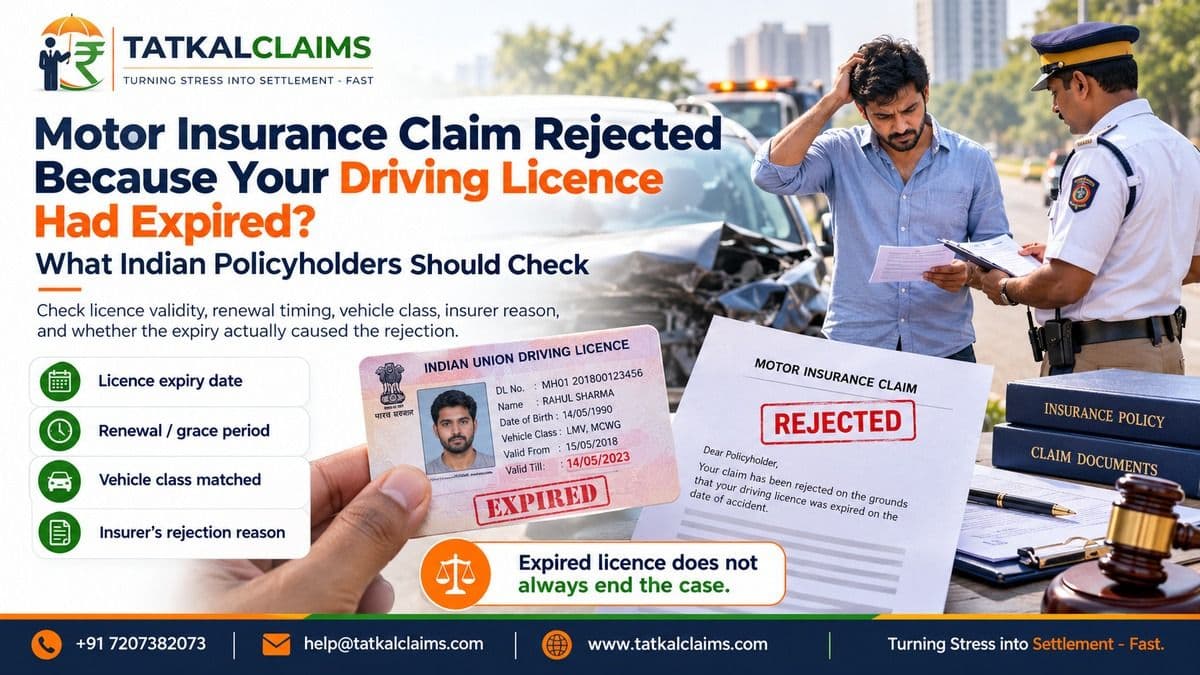
Your motor insurer has rejected an own-damage claim because the person driving the vehicle had an expired driving licence on the accident date. Before accepting that decision—or sending a generic appeal—check the exact dates, the licence record, the policy wording and the type of claim. “Expired licence” can describe several legally different situations.
A common mistake is to rely on old internet advice saying there is always a 30-day grace period after expiry. That was part of the older Motor Vehicles Act framework. The Motor Vehicles (Amendment) Act, 2019 changed Sections 14 and 15 with effect from 1 September 2019. Current law allows a renewal application within a wider one-year window, but that application window should not be confused with automatic licence validity throughout the expired period.
Another common mistake is to assume that the insurer must pay 75% on a non-standard basis whenever the licence problem is “technical”. There is no automatic 75% rule for an expired driving licence. Whether a claim is payable depends on the current statutory position, the policy’s driver clause, the licence’s effective dates, the accident facts and the remedy being claimed.
First: Identify Which Driving-Licence Problem the Insurer Is Alleging
“Driving licence issue” is too broad. Ask the insurer to state the precise defect and policy clause in writing. An expired licence is different from a fake licence, a licence suspended by an authority, a licence for the wrong vehicle class, a learner’s licence used contrary to the rules, or a case where no licence existed at all.
| Insurer’s allegation | What you should verify |
| Licence expired before the accident | Expiry date, accident date, renewal application, renewal effective date and current statutory framework |
| Licence renewed after the accident | Whether the renewal took effect only prospectively and whether any special historical rule applied to that accident date |
| Wrong class/category | Vehicle class on RC, classes authorised on licence and the legal classification of the vehicle |
| Transport authorisation issue | Whether the vehicle was a transport vehicle and what authorisation the licence actually carried |
| Licence suspended/disqualified | Order, effective period and whether disqualification covered the accident date |
| Fake or unverifiable licence | Original issuing authority record and the owner’s/insured’s verification evidence |
| Learner’s licence | Whether the learner’s licence was effective and Rule 3 conditions were met |
| No licence required for that vehicle | Vehicle classification and any statutory exemption—for example, certain low-speed electric vehicles |
Do not build an appeal around a problem the insurer did not actually rely on. If the rejection says only “invalid driving licence”, ask for the verification report, RTO response and exact policy condition. A date error, wrong licence number or mismatch in the insurer’s verification can sometimes be corrected quickly.
If the insurer relied on a verification report or other material you have not received, use our claim-file evidence guide.
What the Current Motor Vehicles Act Says About Expiry and Renewal
Section 3 of the Motor Vehicles Act requires a person driving a motor vehicle in a public place to hold an effective driving licence authorising that vehicle. Section 14 governs the currency of licences and Section 15 governs renewal.
The 2019 amendment matters because it changed the renewal framework. The earlier proviso to Section 14 that continued every driving licence for 30 days after expiry was omitted with effect from 1 September 2019. Section 15 was also amended: the renewal-application window was expanded from the older 30-day framework to a one-year framework.
Parivahan’s current renewal guidance says a driving-licence renewal application can be made within one year before or after expiry, and a licence expired for more than one year can require a driving test. But this should not be read as saying that an expired licence automatically remains effective for one year. The current statutory text must be read for the effective date of the renewal.
For a claim appeal, the safest evidence is therefore the official record showing whether the licence was actually effective on the accident date. Do not tell the insurer only that renewal was “allowed within one year”; show what date the renewed licence legally took effect from.
| Date | Why it matters |
| Original licence validity start | Confirms the underlying licence record |
| Original licence expiry | Shows when the earlier validity ended |
| Accident / loss date | The date the policy condition is tested |
| Renewal application date | Shows whether the renewal was sought before or after expiry |
| Renewal effective date | Shows whether the licence covered the accident date or only became effective later |
Why Older 30-Day Driving-Licence Cases Can Mislead You
Many Supreme Court and consumer decisions available online concern accidents and licence periods before the 2019 amendment. Under the older Section 14/15 framework, the statute included a 30-day continuation/renewal structure. Those cases remain important for the disputes they decided, but their 30-day statutory reasoning should not be copied into a post-2019 accident without checking the amended Act.
For example, the Supreme Court’s April 2025 order in The Divisional Manager, New India Assurance Co. Ltd. v. Shaanabasappa concerned a licence that expired in January 2018, a renewal application made in September 2018 and an accident in February 2019. The Court therefore applied the older 30-day Section 15 framework to those historical dates. It held that the driver did not have a valid licence on the accident date and, in that third-party compensation case, directed the insurer to satisfy the award first with recovery from the owner/driver.
That 2025 order is useful because it shows why the effective date of renewal matters. It is not authority for saying that the old 30-day grace rule is still the current 2026 rule.
Own-Damage Claim: Why the Policy Driver Clause Matters
An own-damage claim is a contractual claim for damage to the insured vehicle. IRDAI’s policyholder guidance distinguishes own-damage cover from compulsory third-party liability cover. In an own-damage dispute, the policy schedule and wording are therefore central.
Motor policy documents commonly contain a “persons or classes of persons entitled to drive” condition requiring the driver to hold an effective driving licence at the time of the accident and not be disqualified from holding or obtaining one. Your own policy wording controls; do not rely on a clause copied from another insurer’s policy.
The Supreme Court’s 2009 decision in New India Assurance Co. Ltd. v. Suresh Chandra Aggarwal involved an own-damage claim under the then-applicable law. The driver’s licence had expired and was renewed only after the accident. The Court held that the driver did not have an effective licence on the accident date and that the insurer was not liable to indemnify the own-damage loss under the policy condition before it.
The statutory renewal timing discussed in that 2009 judgment was the old pre-2019 timing, so do not reuse its 30-day number for a current claim. The continuing practical lesson is narrower: if the policy requires an effective licence on the accident date, a renewal that takes effect only later may create a serious own-damage coverage problem.
Do not assume that saying “the licence expiry did not cause the accident” automatically defeats the insurer’s defence. In an own-damage policy dispute, the insurer may rely on the contractual driver condition itself. Whether causation, proportionality, consumer-law principles or another argument assists in a particular case depends on the policy and facts.
Is the Insurer Required to Pay 75% on a Non-Standard Basis?
No universal rule says an expired-licence own-damage claim must be settled at 75%. Non-standard settlement principles sometimes appear in motor-claim litigation involving particular policy breaches, but they are not a substitute for analysing the exact breach.
In Vijay Garg v. Oriental Insurance Company Limited, decided by the NCDRC in July 2023, the Commission rejected the argument that an own-damage claim involving an expired driving licence should receive 75% merely on a non-standard basis. It treated the valid-licence issue differently from the warranty breach relied on in the authority cited by the claimant.
So an appeal should not demand “75% as per Supreme Court rule” unless the authority actually applies to your facts. Ask instead: what policy condition was breached, what law applied on the accident date, what was the licence’s effective status, and is there a legally supportable reason why the repudiation should be reconsidered?
For commercial vehicles, do not confuse a driving-licence dispute with permit or fitness issues. See our commercial-vehicle permit and fitness claim guide.
If the alleged breach concerns an undeclared fuel-kit modification rather than the licence, use our CNG/LPG endorsement claim guide.
Third-Party Accident Claims Are a Different Legal Question
Do not assume that an expired licence has the same consequence for an injured third party as it has for the vehicle owner’s own-damage claim. Third-party motor liability is governed by a statutory insurance framework in the Motor Vehicles Act.
Current Section 150 requires insurers, subject to the section, to satisfy qualifying third-party judgments and awards, while also allowing specified policy defences—including a condition excluding driving by a person who is not duly licensed or is disqualified. How liability is ultimately allocated between claimant, insurer and owner can depend on the statutory provisions, policy, proof of breach and applicable precedent.
That means a vehicle owner facing an own-damage repudiation should not tell an accident victim that the victim has “no insurance claim” merely because the driver’s licence had expired. Conversely, the existence of third-party protection does not establish that the owner’s own-damage repair bill must be paid.
If your case involves bodily injury, death, MACT proceedings or an insurer seeking recovery from the owner after satisfying a third-party award, obtain advice directed to the third-party statutory claim rather than using an own-damage grievance template.
What If the Loss Did Not Actually Involve Driving?
If the claim is for theft of a parked vehicle, fire while stationary, malicious damage or another loss where nobody was driving at the relevant time, ask the insurer to identify why the driver-licence condition applies to that loss. The answer will depend on the policy wording and the exact repudiation reason.
Do not assume the licence issue is automatically irrelevant—but do not accept a generic “expired DL” rejection without a clause-and-facts explanation either. A strong grievance forces the insurer to connect the alleged breach to the policy condition it says defeats the particular claim.
For a theft claim, preserve the FIR, intimation chronology and non-traceable records using our car-theft insurance claim process guide.
What If Someone Else Was Driving Your Car?
The relevant licence is normally the licence of the person actually driving at the time of the accident, read with your policy’s driver condition. If a family member, employee, chauffeur, mechanic or other permitted driver was driving, obtain that person’s complete licence record.
Also preserve evidence showing who was driving: claim form, FIR or police record, accident statement, workshop/towing records, photographs, telematics or other contemporaneous material. Changing the driver story after repudiation can seriously damage credibility.
If the insurer alleges that the owner knowingly allowed an unlicensed or disqualified person to drive, identify exactly what the owner knew and what the licence appeared to show at the time. A fake-licence due-diligence dispute is not identical to an obviously expired licence whose expiry date was available on the document.
Before Appealing, Collect These Documents
| Document | What it proves |
| Policy schedule and complete wording | The actual driver condition and insured cover |
| Repudiation / rejection letter | The exact insurer reason and clause relied on |
| Driving licence front/back or digital record | Licence number, classes and printed validity |
| Official licensing-authority / Parivahan extract | Validity periods, renewal and effective dates |
| Renewal application receipt | When renewal was actually applied for |
| Renewed licence | New validity/effective period |
| RC | Vehicle class, ownership and registration details |
| Claim form and driver statement | Who was declared as driving |
| FIR / police / accident record where applicable | Independent accident and driver chronology |
| Survey report / assessment | Damage and insurer’s technical assessment |
| Repair estimate, photographs and invoices | Nature and amount of own-damage loss |
| Insurer emails and verification report | How the licence issue was investigated |
If the insurer has not supplied the licence-verification result it relied on, request it. Compare the licence number, driver name, date of birth, authorised class and validity periods against the original document. Administrative mismatches do occur; an appeal should correct them with the issuing authority’s record.
Ask the Insurer These Questions in Writing
| Question | Why it matters |
| Which exact policy clause are you relying on? | Stops a vague ‘invalid DL’ rejection |
| What licence-expiry and renewal dates have you recorded? | Tests the insurer’s chronology |
| What is your source for those dates? | Identifies RTO/Parivahan verification |
| Which person do you say was driving? | Avoids a driver-identity mismatch |
| Which vehicle class was required? | Separates expiry from wrong-class allegations |
| Are you rejecting only own-damage cover or also taking a position on third-party liability? | Prevents two different legal issues being conflated |
| Did you consider the Motor Vehicles Act version applicable on the accident date? | Important for historical claims |
| If you say the claim is not admissible at all, what authority and policy wording support that conclusion? | Forces a reasoned response |
How to Structure the Insurer Grievance
Lead with the chronology, not emotion. State the policy number, claim number, accident date, driver, old licence validity, renewal application date, renewal effective date and the exact repudiation clause. Then explain why you say the insurer’s factual or legal conclusion is wrong.
A grievance is stronger if it fits one of four clear categories: the insurer has the dates wrong; the insurer has identified the wrong driver or vehicle class; the policy clause does not apply to the facts; or the insurer has relied on an outdated legal rule for the accident date. If none of those is true and the driver genuinely had no effective licence under the applicable law and policy, acknowledge that weakness before deciding whether further escalation is justified.
Do not hide an adverse fact. If the licence had expired, say so and explain the exact renewal record. A grievance that falsely states the licence was valid can collapse as soon as the insurer checks the licensing database.
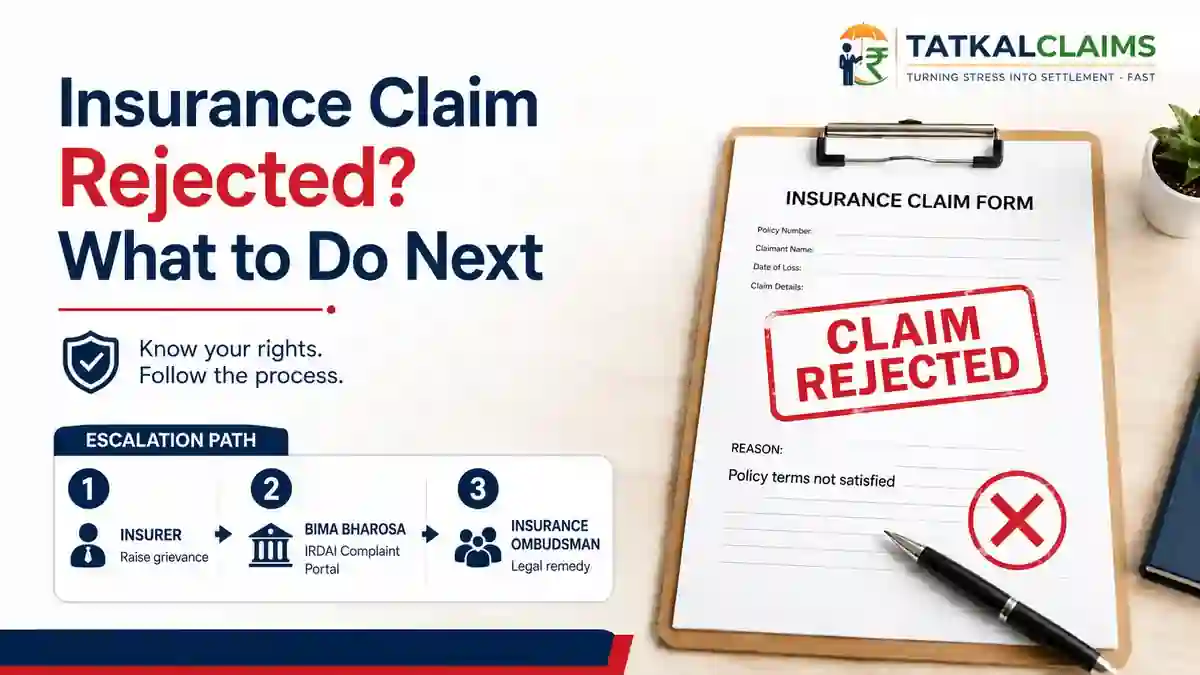
For the overall insurer grievance structure, use our insurance claim rejection guide.
Escalation: GRO → Bima Bharosa → Insurance Ombudsman
If the claims team does not reverse or adequately explain the repudiation, complain to the insurer’s Grievance Redressal Officer with the full evidence set. Bima Bharosa’s current FAQ says insurers should resolve grievances within 15 days of receipt, and unresolved or unsatisfactory grievances can be escalated through Bima Bharosa.
The Insurance Ombudsman Rules cover partial or total repudiation of claims and disputes involving policy terms within the Rules’ scope. The CIO’s current procedure says the claimant must first approach the insurer; an eligible complaint can proceed after an unsatisfactory response or no response within 30 days, subject to the applicable one-year filing rule, ₹50 lakh claim-value limit and restrictions on the same subject matter already being before another court, consumer forum or arbitrator.
Compare the two escalation routes in our Bima Bharosa vs Insurance Ombudsman guide.
If the Ombudsman route fits your case, use our Insurance Ombudsman complaint guide.
For large commercial claims, disputes outside Ombudsman jurisdiction, or cases involving third-party injury/death litigation, the correct forum may be different. Forum selection and limitation require case-specific review.
A Practical 7-Day Action Plan
| Day | Action |
| Day 1 | Save the repudiation letter, policy schedule and complete wording. |
| Day 2 | Obtain the official driving-licence extract and renewal application/effective dates. |
| Day 3 | Build a date table: expiry, accident, renewal application and renewal effective date. |
| Day 4 | Verify the vehicle class, driver identity and exact driver condition in the policy. |
| Day 5 | Check which version of Sections 14 and 15 applied on the accident date; do not use an old 30-day rule for a current accident. |
| Day 6 | Send a clause-by-clause grievance to the insurer’s GRO with the official licence evidence. |
| Day 7 | If unresolved, prepare the Bima Bharosa/Ombudsman record if the applicable conditions are met. |
How Tatkal Claims Can Help
Tatkal Claims can review the repudiation letter, motor policy wording, official driving-licence record, renewal chronology, accident documents and survey material to identify whether the insurer has applied the correct licence dates, correct policy condition and correct legal framework.
Where an appeal is supportable, assistance can include preparing a date-led insurer grievance, obtaining and organising the evidence used for the repudiation, distinguishing own-damage from third-party issues, and preparing the record for Bima Bharosa or the Insurance Ombudsman where eligible. Where the licence record shows a genuine coverage problem, the review should identify that risk rather than promise a result or an automatic non-standard settlement.
Frequently Asked Questions
Frequently asked questions
Is there still a 30-day grace period after a driving licence expires in India?
Do not rely on the old 30-day rule for a current accident. The 2019 amendment omitted the earlier Section 14 proviso that continued licences for 30 days after expiry and changed Section 15’s renewal framework. Check the current Act and the official effective dates shown in the licence record.
Can I renew my driving licence within one year after expiry?
Parivahan’s current guidance says a renewal application can be made within one year after expiry; after more than one year, a driving test can be required. That application window is not the same as saying the expired licence remained automatically effective throughout the gap.
If I renewed the licence after the accident, will it validate the accident date?
Not automatically. Check the legally effective date of the renewal shown by the licensing authority and the Motor Vehicles Act version applicable to the accident date. A later physical card does not by itself prove continuous validity.
Can my own-damage car claim be rejected because the licence was expired?
It can be a serious policy issue where the driver condition requires an effective licence at the time of accident and the licence was not effective on that date. The exact result depends on the policy, dates, statutory framework and facts.
Does the insurer have to pay 75% if the only problem is an expired licence?
No automatic 75% rule applies merely because the licence problem is described as technical. NCDRC precedent has rejected a 75% non-standard argument in an expired-licence own-damage dispute. Use authorities that actually match your policy breach and facts.
What if the expired licence did not cause the accident?
Do not assume lack of causation alone defeats the insurer’s own-damage defence. Motor policies commonly contain an effective-licence driver condition. Whether another legal argument is available depends on the wording and circumstances.
What if someone else was driving my insured car?
Check the actual driver’s licence and the policy condition. Preserve evidence showing who was driving. If the insurer has identified the wrong driver or wrong licence, correct that factual error with official records.
Can a third-party accident victim lose compensation because the driver’s licence expired?
Third-party liability is governed by a separate statutory framework and should not be treated as identical to the owner’s own-damage claim. Insurer defences and ultimate recovery rights can be considered under the Motor Vehicles Act, so obtain advice specific to the MACT/third-party claim.
What if my car was stolen while parked and my driving licence had expired?
Ask the insurer to identify the policy clause and explain how the licence condition applies to a loss that did not involve anyone driving at the relevant time. The result depends on the policy and facts; a generic licence objection should still be tested against the actual insured event.
Can I complain to the Insurance Ombudsman about an expired-licence claim rejection?
Potentially, if the complaint falls within the Ombudsman Rules and the personal-line/group/sole-proprietorship/micro-enterprise scope, monetary limit, limitation, insurer-first and parallel-proceeding conditions are met. First make a written complaint to the insurer and preserve the response.
Sources and Methodology
Disclaimer: This guide explains current statutory text, selected court and consumer decisions and practical claim-review steps in general terms. Driving-licence law changed in 2019, and older cases may apply older renewal rules. Claim outcomes depend on the accident date, policy wording, driver identity, licence class and effective dates, type of cover, evidence and forum. This is not a substitute for case-specific legal advice.