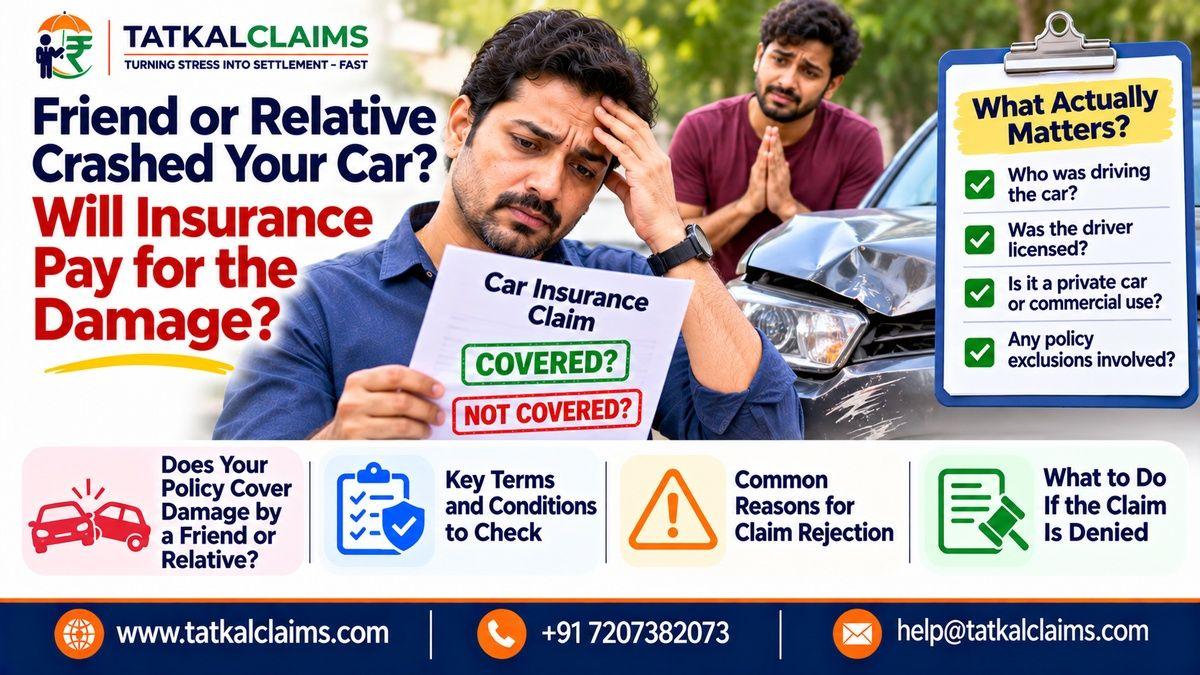
Your friend borrowed your car for a family errand and hit a divider. The repair estimate is ₹1.2 lakh. When you call your insurer, the first question is: “Who was driving?” You answer truthfully—and then wonder whether your policy covers the damage because the driver’s name is different from yours.
In many Indian private-car policies, a friend or relative can drive the insured car without making the repair claim invalid merely because they are not the registered owner. But the actual driving licence, permission, permitted use of the car and the type of insurance you bought matter. The name on the policy is only the starting point, not the entire answer.
Can a Friend or Family Member Drive Your Insured Car?
Yes, often. A private-car insurance policy covers a vehicle and defines who may drive it. ICICI Lombard’s public guidance says a friend driving with the owner’s permission and a valid licence can generally be covered, subject to the policy. Standard Indian motor policy wording commonly describes an authorised driver as 'any person including insured', followed by a requirement for an effective driving licence and compliance with other conditions.
For example, the policy could be in Meera’s name while her adult brother Arjun drives her car to the airport. If Arjun has a valid licence for that vehicle, Meera gave permission, the car was being used privately and the policy includes own-damage cover, the mere fact that Meera was not behind the wheel would not normally be enough to reject the damage claim. The insurer can still investigate the accident, the exclusions and the repair amount.
Do not rely on an agent’s verbal assurance that 'any driver is always covered'. Read the actual policy schedule, certificate, endorsements and full wording applicable on the accident date. A limited-use, commercial, motor-trade or specially endorsed policy may operate differently.
First Check Whether You Have Comprehensive or Third-Party-Only Insurance
| What happened | Which cover may respond? | Important distinction |
|---|---|---|
| Your own car is damaged by the accident | Own-damage section of comprehensive/package cover or a standalone own-damage policy | A third-party-only policy does not pay to repair your own car |
| A pedestrian or another driver is injured | Third-party liability, according to the Motor Vehicles Act and policy | The insurer's defences and the victim's rights differ from an own-damage repair claim |
| Your friend driving the car is injured | Any applicable separate cover or legally available remedy | Do not assume the owner-driver compulsory personal accident cover automatically insures the friend |
| The driver was using the car as a paid taxi | Check permit, classification and policy limitations | Permission alone cannot convert ordinary private-car cover into commercial-use cover |
| The person was given the car after a completed sale | Ownership, insurance transfer and insurable interest | Not the same as lending a car temporarily |
A claim for your own car’s repairs is commonly called an 'own-damage' claim. The insurer assesses it under the vehicle damage portion of your policy. A claim by someone else injured in the accident is a 'third-party' matter, where legislation can impose different duties on the insurer. Never use an own-damage rejection as proof that an accident victim cannot receive compensation.
Five Questions That Usually Decide a Friend-Driver Claim
1. Did the person have permission to drive?
Permission may be clear—for example, you handed your friend the keys—or it may be disputed after the event. Keep truthful messages, travel details or other records explaining why the person had the car. If the car was taken without permission, do not pretend it was lent merely to simplify the claim. The real facts affect which loss or wrongdoing is being investigated.
2. Did the driver hold an effective licence for that vehicle?
Check the actual driver’s licence, its authorised vehicle class, and whether it was effective and unsuspended on the day of the accident. The owner’s licence is not a substitute for the licence of the person who actually drove. If the licence was expired, suspended, fake, or for a different vehicle class, the insurer may raise a substantial own-damage policy objection.
If the insurer objects to the licence date or renewal, use our separate expired driving-licence claim guide; do not assume an old statutory grace period applies to a recent accident.
3. Was the car being used for an allowed purpose?
Taking family members to a doctor, buying groceries or attending a wedding is different from carrying paying passengers or making commercial deliveries. Private-car policies commonly contain a 'limitations as to use' condition. If the insurer alleges business or hire use, request the trip evidence it relies on rather than accepting an unexplained label.
A disagreement about using your car as a taxi, delivery vehicle or rideshare belongs under a different policy analysis; read our private-car commercial-use rejection guide for those cases.
4. Did any other exclusion apply?
The insurer may examine allegations of alcohol or drugs, racing, intentional damage, a prohibited driver or another policy exclusion. Do not assume the claim is safe simply because the driver is a relative. Ask for the exact exclusion, the supporting evidence and how it applies to the reported loss.
5. Is the driver's identity itself disputed?
This is the issue many families overlook. The insurer may say the driver named in the claim differs from the person shown in an FIR, hospital record, garage statement, surveyor note or witness account. A discrepancy needs a factual answer, not a made-up story. Clarify who actually drove, why any initial report differs and what independent record supports your account.
What if the Claim Form Names the Wrong Driver?
If an honest clerical mistake occurred, ask the insurer how to submit a signed correction, with the driver's licence, the claim acknowledgement and a short explanation of how the error happened. Preserve the original submission and the corrected version. If the insurer accuses you of deliberately substituting a licensed friend for an unlicensed driver, a serious factual dispute exists and you should not alter or fabricate evidence.
A particularly useful sequence is: who called the insurer first; who told the garage who was driving; what the accident report and police papers say; what CCTV, toll or dashcam evidence shows; and whether the named driver's account is consistent with the vehicle damage. Different sources can contain honest mistakes, but any conflict should be explained with dates and documents.
Do not delete messages, replace photographs or ask someone to sign a false declaration. The correct appeal is built around reliable evidence even where the original intimation was inaccurate.
Different Situations Should Not Get the Same Answer
| Situation | What to examine | Practical next step |
|---|---|---|
| Licensed adult friend driving with permission for a personal errand | Driver clause, own-damage cover, accident evidence | File the claim truthfully and provide the actual driver's licence |
| Spouse or relative driving and owner not in the car | Same driver and permitted-use conditions | Ask for the clause if rejection says only 'owner absent' |
| Driver has a learner’s licence | Licence validity and legally required learner conditions | Preserve learner permit and accompanying-driver evidence, where required |
| Underage or unlicensed person driving | Motor Vehicles Act, driver clause and actual driver identity | Do not substitute another person's licence; get case-specific advice |
| Driver may have been intoxicated | Exclusion wording and reliable accident evidence | Request the test, report or finding relied on |
| Friend uses the car for paid passenger trips or delivery | Vehicle use, permit and policy cover | Treat commercial-use concerns separately |
| Valet or parking attendant was driving | Who controlled the vehicle, permission, driver status and any special exclusion | Collect parking receipt, vehicle handover details, CCTV and valet service records |
| Owner sold the car before the accident | Registration, insurance transfer, insurable interest | Do not treat a completed sale as an ordinary loan |
Two points deserve particular care. First, a learner’s licence is not the same as a full licence: the applicable permit conditions still matter. Second, a valet accident can involve both your vehicle policy and questions about the parking operator’s duties; no one outcome can be promised without reading those records.
What Documents Should You Collect Before Disputing Rejection?
Keep the policy certificate and complete wording, registration certificate (RC), the actual driver's licence, accident date and location, claim form, the insurer's acknowledgement, photographs, and garage estimate. Add the insurer's surveyor report or inspection findings where supplied, and the FIR or other police papers if applicable to the incident.
If who was driving is disputed, preserve supporting evidence such as contemporaneous messages, dashcam footage, CCTV requests, toll or parking records, witnesses, police statements and the driver's written account. Collect only records you are entitled to obtain; do not share other people's sensitive identity information publicly.
If the insurer mentions a driver exclusion, ask whether it is in the base policy, schedule, add-on or a specific endorsement and whether that version actually applied to the car on the accident date.
Worked Example: A ₹1.2 Lakh Repair Estimate
Assume a friend with a valid car licence crashes your insured private car while driving with permission. The garage estimates ₹1,20,000 for repairs. That estimate is not automatically the insurance payment. A surveyor may assess which damage came from the accident, the applicable deductible, depreciation under the policy, excluded parts and any add-on benefits.
If the insurer says 'the policyholder was not driving', request the exact driver clause. If the clause allows an eligible licensed driver, the claim still needs assessment on ordinary damage and policy terms. An unsupported identity-only objection should not replace that assessment.
If instead the friend had no effective licence, the answer can change substantially. Do not use the first example to claim that the insurer must pay every borrowed-car loss.
A Rejection Letter You Should Challenge—And One That Needs More Evidence
A rejection saying only 'Driver is not the owner of the vehicle' is incomplete as an explanation unless an applicable policy condition actually restricts driving to the owner or named persons. Ask for the wording, what factual allegation the insurer makes and why the driver did not qualify.
A rejection saying 'the actual driver had no effective licence' presents a different problem. Request the licence verification record, accident-date licence status and the precise clause. A claim may be defensible if the insurer checked the wrong person or relied on an erroneous licensing record, but an actual licence breach must not be dismissed as a minor formality.
If the allegation is 'the person shown as driver was not driving at all', request the evidence behind that finding and answer any contradictions honestly. This may require witness statements or other original documents, not just a rewritten claim form.
Sample Written Request to the Insurer
Subject: Request to review car insurance claim rejection — actual driver, policy driver clause and evidence
I am the insured owner of vehicle [registration] under policy [number]. The vehicle was involved in an accident on [date] while being driven by [name], with my permission. My claim reference is [number]. Your rejection or query dated [date] refers to [the reason given].
Please identify the exact 'Persons entitled to drive' provision, use restriction or exclusion that you say applies. If the decision concerns the driving licence, please state which licence record and accident-date status you relied on. If you dispute the identity of the driver, please explain the relevant inconsistencies and provide the material findings or report on which you rely, subject to applicable disclosure rules.
I attach the policy, claim acknowledgement, registration certificate, driving-licence record, accident photographs and a dated account of the circumstances. Please reconsider the decision under the applicable policy wording and issue an itemised, reasoned written response.
Where to Escalate if the Insurer Does Not Correct the Decision
Begin with a written grievance to the insurer's Grievance Redressal Officer (GRO). State the precise rejection clause, what the actual policy says, the licence evidence and the relief requested. Preserve acknowledgements and avoid depending only on telephone conversations.
If the dispute remains unresolved, IRDAI's Bima Bharosa system may be used to register and track a complaint. The Insurance Ombudsman can consider eligible disputes about partial or total repudiation of claims and policy interpretation. Under the Council's published procedure, first complain to the insurer; you may then approach the Ombudsman after an unsatisfactory response or 30 days without one, subject to the ₹50 lakh monetary ceiling, one-year limitation and restrictions on the same matter already being before another forum.
For a step-by-step eligibility and document checklist, see our Insurance Ombudsman complaint guide before filing. A serious third-party injury or fatality claim may involve Motor Accident Claims Tribunal proceedings and requires a different legal analysis.
What About the Friend's Injuries or the Owner-Driver Personal Accident Cover?
Do not treat a car-repair claim and personal-accident compensation as the same insurance benefit. Compulsory personal accident (CPA) owner-driver cover has eligibility conditions tied to the owner-driver, while paid-driver, unnamed-passenger or other personal-accident benefits depend on separately applicable cover. A friend driving your car does not automatically become the owner-driver for CPA purposes.
Our owner-driver compulsory personal accident guide explains the separate requirements. It should not be used to decide whether damage to the vehicle itself is payable.
How Tatkal Claims Can Help
Tatkal Claims can review a car-insurance repudiation letter alongside the policy's driver clause, the actual driver's licence and the accident record. We can help identify whether the insurer confused the owner with the driver, relied on the wrong licence data, or raised a real exclusion needing more evidence, and help prepare a focused written challenge. We cannot guarantee claim payment; policy wording, facts and evidence decide the result.
Frequently asked questions
Will my car insurance pay if my friend crashed my car?
It often can if you have own-damage cover, your friend was permitted to drive, held an effective licence and obeyed the car's permitted-use conditions. Check the exact driver's clause and other exclusions in your issued policy.
Does the driver have to be named on my car insurance policy?
Not necessarily. Many standard Indian private-car policies permit any eligible driver, not just the person named as policyholder. But an endorsement or special policy condition may change that. Read the certificate and complete wording.
Can my car claim be rejected simply because I was not inside the car?
The owner's absence is not by itself a universal exclusion. Ask the insurer which clause it relies on and whether the person driving held a valid licence and used the car within the allowed purpose.
What if my brother or spouse was driving?
Being a family member does not automatically guarantee cover or prevent it. The driver must satisfy the policy's licence and permitted-use conditions, and you must have appropriate cover for damage to your own vehicle.
What happens if my friend had an expired driving licence?
That can be a serious own-damage driver-clause problem. Verify the actual licence status and effective dates with the licensing authority. Do not assume later renewal or a past grace period automatically validates the accident date.
Is an accident covered if a learner-driver friend was driving?
Only assess this against an effective learner's licence, the law's required driving conditions and the policy's exact learner clause. A learner permit is not permission to drive in breach of those conditions.
What if the insurer says I named a different driver after the accident?
Ask for the evidence and correct any genuine recording mistake with dated supporting documents. Do not alter the facts or produce a false licence or declaration. A disputed driver identity is a serious evidence question.
Does third-party car insurance pay to repair my own car?
No. Third-party-only insurance is for legally covered liability to other people or their property. Repairs to your own car generally require own-damage cover, whether in a package policy or standalone own-damage policy.
Can a valet driving my car cause a claim problem?
Possibly. Review the policy, who was controlling the vehicle, the attendant's licence, parking terms and CCTV or handover records. Do not assume every valet loss must be paid or rejected by the same insurer.
Can I complain to the Insurance Ombudsman about a friend-driver rejection?
A qualifying personal-line motor claim repudiation can be within the Ombudsman's scope, subject to the insurer-first complaint requirement, ₹50 lakh ceiling, filing deadlines and restrictions on parallel court proceedings.
Sources and Methodology
The primary sources below are used for the common private-car driver clause, the distinction between own damage and liability, basic claim documentation and available grievance routes. Insurance policy conditions can vary by insurer, product and endorsement. This guide does not treat an old court decision about a taxi or a third-party victim as automatic proof that a private car's own-damage claim must be paid.