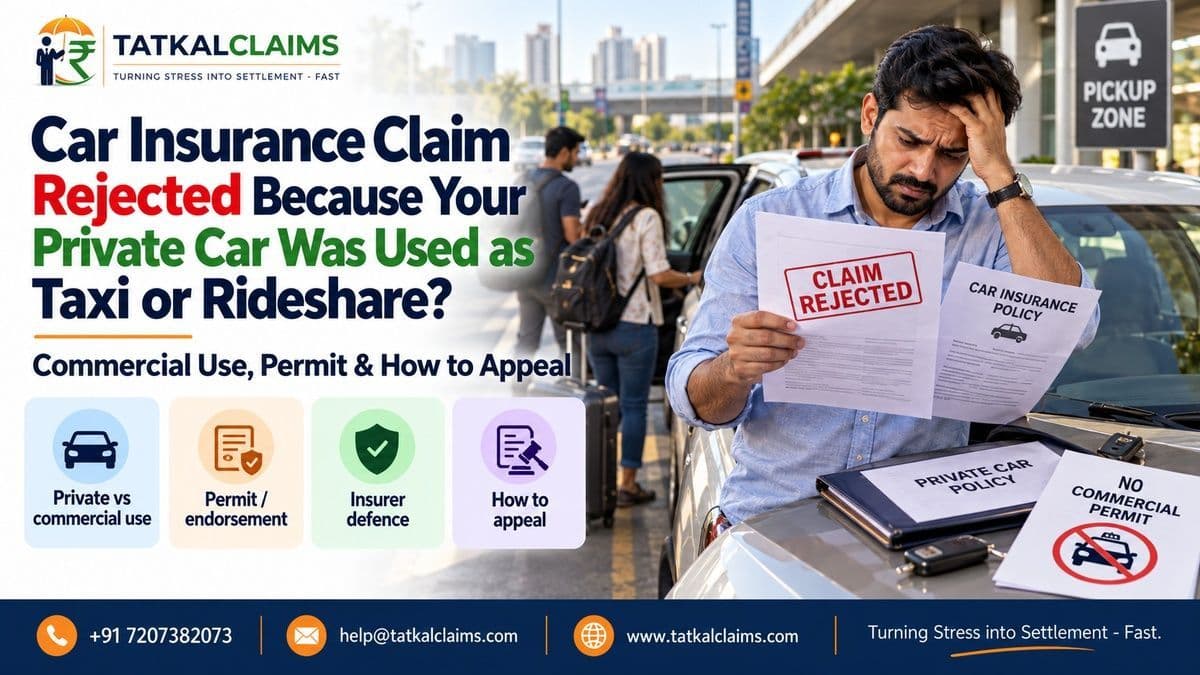
You bought and insured a car as a private vehicle. Later, it was used to carry paying passengers, attached to an app-based platform, rented out informally, or repeatedly used for paid trips. After an accident, theft or fire, the insurer says the car was being used “for hire or reward” or commercially and rejects the claim.
This dispute should be split into separate questions: what the car was actually being used for, whether that use required transport registration or a permit, whether the private-car policy excluded hire-or-reward use, whether the insurer had been told about a change in use, and whether the loss happened while the commercial use was occurring.
The answer can differ sharply between an accident during a paid trip, a theft while the car was parked, an occasional cost-sharing journey with friends, and a car that was regularly earning fares through an aggregator. Do not treat all four situations as identical.
Private Car vs Passenger Vehicle Used for Hire or Reward
The Motor Vehicles Act distinguishes private use from passenger transport for hire or reward. A “motorcab” is a motor vehicle constructed or adapted to carry not more than six passengers excluding the driver for hire or reward, and a “public service vehicle” includes a motor vehicle used or adapted for carrying passengers for hire or reward.
The Act also defines a “transport vehicle” to include a public service vehicle. Once the actual use falls into the transport/public-service category, the permit and registration framework becomes relevant even if the owner originally bought the car as a private vehicle.
A label in an app, WhatsApp group or private agreement does not decide the legal character by itself. The facts—payment, fare, repeated passenger service, platform onboarding, trip records and purpose of use—matter.
Why a Permit Matters
Section 66 of the Motor Vehicles Act says an owner cannot use or permit the use of a vehicle as a transport vehicle in a public place except in accordance with a permit authorising that use, subject to statutory exceptions.
That means a car being used as a motorcab or other public service vehicle generally requires the appropriate transport/contract-carriage framework. The precise permit, tax, fitness and registration requirements can vary by vehicle category and State or Union Territory.
For app-based passenger transport, the Motor Vehicle Aggregator Guidelines, 2025 require aggregators to ensure that vehicles attached to onboarded drivers have an appropriate permit under the Act. The Guidelines also require valid registration, fitness, third-party insurance, pollution certificate and other vehicle compliances.
The 2025 Guidelines contain a specific State-level route for aggregation of non-transport motorcycles. They do not create a general nationwide exception allowing ordinary private cars to carry paying passengers without the appropriate permit.
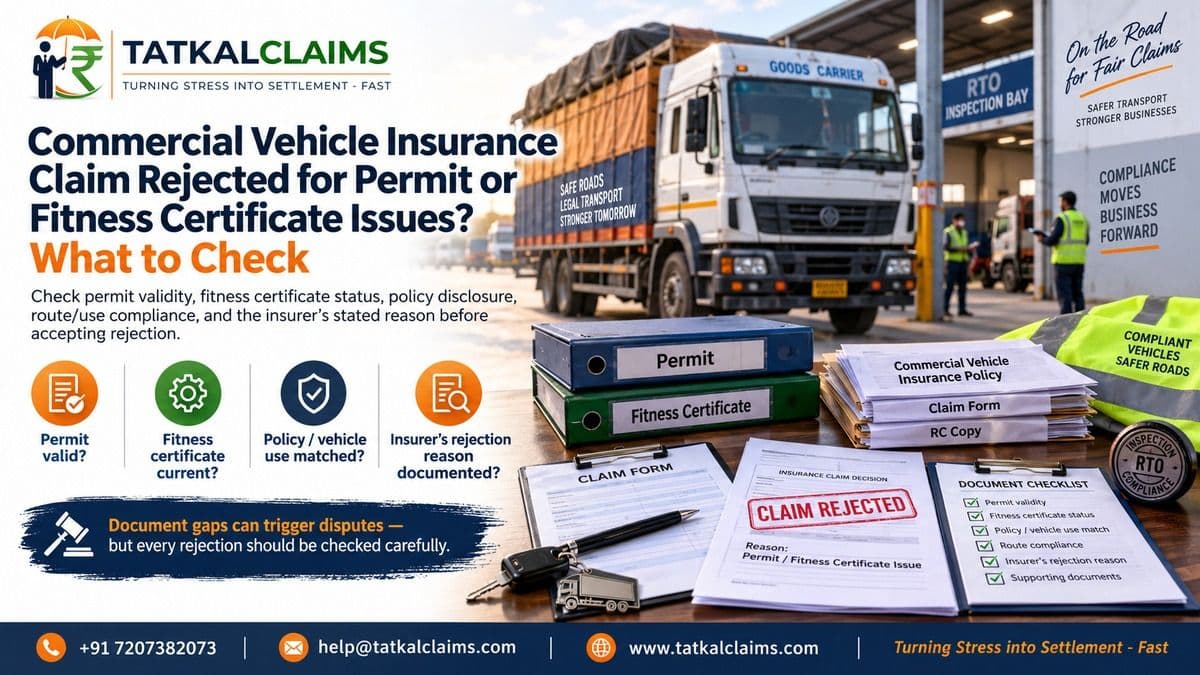
If the insurer’s rejection is specifically about an expired, missing or wrong permit/fitness certificate after the vehicle was already operating as a commercial vehicle, use our commercial vehicle permit and fitness claim guide.
Why the Private-Car Insurance Policy Is a Separate Problem
A private-car package policy commonly contains a “Limitations as to Use” section. Standard-style private-car wording excludes use for hire or reward and the general exceptions can deny accidental loss or liability arising while the vehicle is being used outside those permitted uses.
Oriental Insurance’s current public description of its Private Car Package Policy likewise states that the policy is for social, domestic, pleasure and the insured’s own business use and does not cover use for hire or reward.
So even if there is a transport-law issue, the own-damage dispute can independently turn on the insurance contract. The insurer may rely on the private-car policy’s use restriction rather than only on the absence of a permit.
IRDAI’s policyholder guidance says changes to the vehicle or its use should be recorded by endorsement. If the car’s use changes from private to paid passenger service, the safer course is to inform the insurer before the change and obtain the appropriate policy/endorsement or commercial motor cover.
What the 2025 Aggregator Guidelines Mean for Uber/Ola-Style Use
The central Motor Vehicle Aggregator Guidelines, 2025 regulate licensed aggregators and leave significant implementation to State Governments. They require the aggregator to ensure an appropriate permit for attached vehicles and specify vehicle-compliance requirements.
Clause 9.8 also contemplates onboarding vehicles with a valid contract-carriage permit, subject to the Guidelines. For private-car owners, this reinforces the point that simply turning on a rideshare app does not convert a private vehicle and private-car policy into compliant commercial passenger cover.
The Guidelines were amended in December 2025 on passenger-safety provisions. The permit and vehicle-compliance structure remains central. State rules and authorisations should still be checked because transport implementation is not identical across India.
| Check | Why it matters |
| RC classification | Shows whether the vehicle is recorded for the relevant class/use. |
| Contract-carriage / applicable permit | Central aggregator framework expects an appropriate permit. |
| Fitness certificate | Required for transport/commercial vehicle operations where applicable. |
| Tax and PUC | State transport and vehicle-compliance requirements can affect operation. |
| Insurance class | Private-car cover may exclude hire-or-reward use. |
| Insurer endorsement / commercial policy | Shows whether the risk was accepted for the changed use. |
| Aggregator trip history | Can prove or disprove whether the vehicle was on a paid trip at the time. |
Six Situations That Should Not Be Treated the Same
| Scenario | Main insurance question |
| Accident while carrying a paying passenger | Strong limitation-as-to-use and permit issue; check exact policy and trip evidence. |
| Accident while app was on but no passenger had been picked up | Check platform status, trip acceptance, purpose of journey and policy wording. |
| Theft while parked between paid trips | The use breach may still exist, but theft causation and historic non-standard-settlement cases become relevant. |
| Car used commercially weeks earlier but not at time of loss | Ask whether the policy exclusion applies to the loss when it occurred and what facts the insurer proves. |
| One-off fuel sharing with friends | Not automatically equivalent to operating a taxi; examine payment structure and purpose. |
| Car permanently converted to taxi but policy remained private | High-risk mismatch: RC/permit/tax/fitness and insurance class may all be inconsistent. |
What Evidence Can Prove Commercial Use?
Insurers may rely on app trip logs, payment records, passenger statements, police records, FASTag or location history, aggregator onboarding records, vehicle stickers, permit status, tax records or the insured’s own statement.
Do not admit a vague allegation such as “vehicle used commercially” without asking what evidence supports it. A single transfer entry or an old app registration does not necessarily prove that the car was carrying a paying passenger when the loss occurred.
Conversely, if the trip record clearly shows an accepted paid ride at the time of the accident, an appeal that simply denies commercial use is unlikely to be credible.
If the rejection relies on a surveyor, investigator or undisclosed material, use our guide on obtaining the survey report, investigator report and evidence used against the claim.
Accident During a Paid Trip: Why This Is the Hardest Case
When an accident occurs while the private car is actually carrying passengers for fare, the insurer has a direct argument that the loss arose while the vehicle was being used contrary to the private-car Limitations as to Use.
The owner may also face transport-law issues if the vehicle lacked the required permit, transport classification, tax or fitness compliance. Those issues should be analysed separately rather than treated as one generic breach.
If the driver’s licence category or validity is also disputed, that is a separate issue with its own evidence and law.
For a licence-based rejection, see our expired driving-licence motor-claim guide.
What If the Private Car Was Stolen While Being Used as a Taxi?
Theft claims have produced an important line of Supreme Court authority. In National Insurance Co. Ltd. v. Nitin Khandelwal, the insurer argued that a privately insured vehicle was being used as a taxi when it was stolen. The Supreme Court treated the nature-of-use breach differently in the theft context and upheld relief on a non-standard basis.
In Amalendu Sahoo v. Oriental Insurance Co. Ltd., involving an accident while a car was being used on hire contrary to the policy, the Supreme Court referred to insurer non-standard settlement guidelines for limitation-as-to-use breaches and held that total repudiation was not justified on those facts.
Those decisions are important but should not be converted into a blanket rule that every commercial-use breach must be paid at 75%. The exact policy, loss type, facts, later authorities and the forum’s findings still matter.
A 2025 National Commission decision, IFFCO Tokio General Insurance Co. Ltd. v. Rajiv, again applied the Nitin Khandelwal/Amalendu Sahoo line to a theft dispute involving admitted hire-and-reward use. It is useful current consumer-forum authority, but it does not erase the need for fact-specific analysis.
Own-Damage Claim vs Third-Party Liability
A claim for damage to the owner’s own car is primarily a contractual claim under the motor policy. Injury or death claims by passengers, pedestrians or other road users involve the statutory third-party framework and can raise different insurer defences and recovery issues.
Do not assume that an own-damage repudiation automatically decides a MACT claim. The status of the passenger, permit breach, policy type and statutory liability need separate analysis.
For injury or death claims after a road accident, see our third-party motor accident and MACT guide.
Does Ordinary Carpooling Count as Commercial Use?
Not every shared journey is automatically a taxi service. A family trip, office carpool or genuine cost-sharing arrangement can be factually different from carrying passengers for a fare or reward as a business.
But labels are not decisive. If the owner repeatedly advertises seats, charges fixed fares, earns a margin, accepts trips from strangers or uses a commercial ride platform, the facts can move closer to hire-or-reward use.
Because State transport rules can differ, do not rely on a generic internet definition of carpooling. Preserve the payment records and trip context and check the applicable State/UT rules.
If There Has Been No Claim Yet: Fix the Mismatch Before Driving for Fare
If you plan to use a privately registered car for paid passenger transport, do not rely on the private-car policy merely because it is still active.
Check the State transport conversion/permit process, applicable tax and fitness requirements, aggregator onboarding rules and the correct commercial motor-insurance product. Notify the insurer in writing and obtain documentary confirmation of the new cover before beginning paid trips.
If the insurer refuses to endorse the change or says a different policy is required, do not assume the old private-car cover will protect the commercial risk.
Documents to Collect After a Commercial-Use Rejection
| Document / evidence | Why it matters |
| Full policy and schedule | Shows the Limitations as to Use and exclusions. |
| Certificate of insurance | Confirms the insured class and policy period. |
| Proposal form / declarations | Shows what use was disclosed when cover was issued. |
| RC and permit | Shows registration category and authorised use. |
| Fitness and tax records | Relevant if the vehicle was functioning as a transport vehicle. |
| Aggregator onboarding agreement | Shows platform status and declared vehicle category. |
| Trip log for date/time of loss | Can prove whether the vehicle was on a paid trip. |
| Bank/UPI/payment records | Can prove or rebut a fare allegation. |
| Surveyor/investigator report | Shows the factual basis of repudiation. |
| FIR / accident record / passenger statements | Helps reconstruct actual use at the time of loss. |
What to Ask the Insurer in Writing
Ask the insurer to identify the exact Limitations as to Use clause, the evidence that the car was being used for hire or reward, whether the rejection also relies on permit/fitness/tax issues, and whether the alleged breach existed at the exact time of loss.
If the claim is theft, ask the insurer to explain how it considered the Nitin Khandelwal and Amalendu Sahoo line of authority rather than merely issuing a one-line commercial-use rejection.
If the insurer says a 75% non-standard settlement is unavailable, ask for the contractual and factual basis rather than assuming either side’s position is automatic.
How to Structure the Appeal
| Section | What to show |
| 1. Actual use | What the vehicle was doing immediately before and at the loss. |
| 2. Policy wording | Exact private-use/hire-or-reward clause relied upon. |
| 3. Transport records | RC, permit, fitness and tax status. |
| 4. Platform evidence | App status, accepted trip, passenger and payment record. |
| 5. Loss type | Accident, theft, fire or other loss; explain why that distinction matters. |
| 6. Case-law relevance | Use non-standard-settlement cases cautiously and fact-specifically. |
| 7. Relief requested | Reconsideration, reasoned decision or non-standard settlement where legally supportable. |
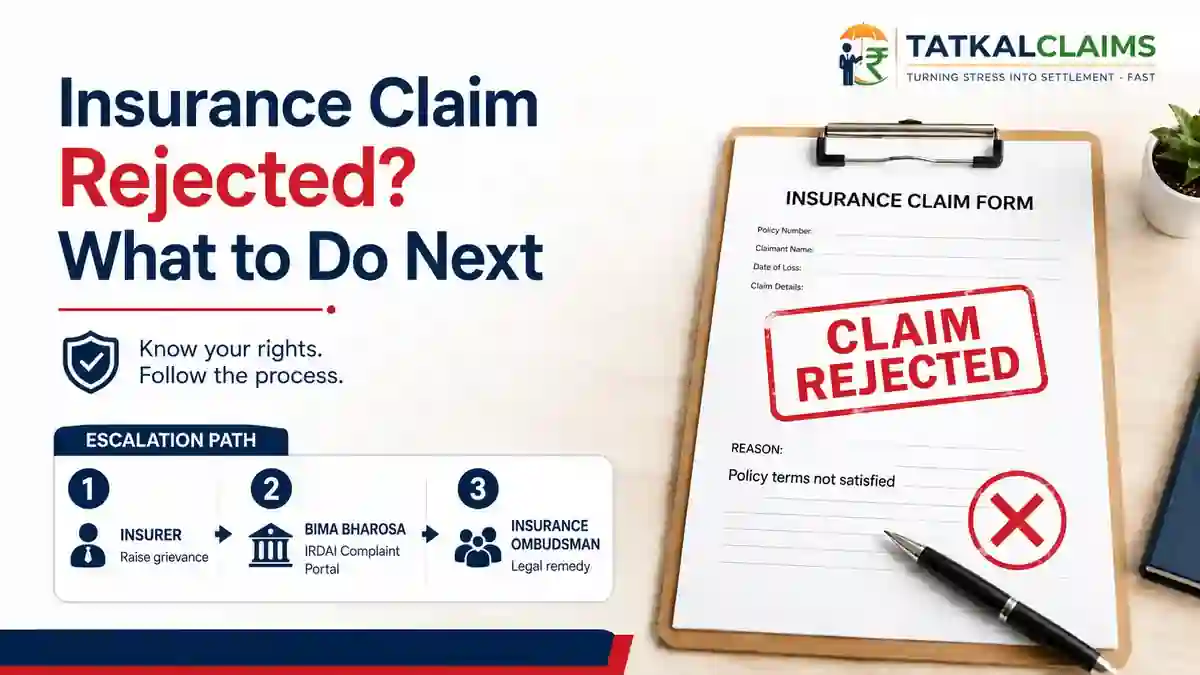
For the broader grievance sequence after repudiation, use our insurance claim rejection guide.
Escalation Route
First use the insurer’s grievance redressal process and preserve the full complaint with annexures. Ask for a written decision addressing both the policy clause and the evidence of commercial use.
If unresolved, Bima Bharosa can be used for regulatory grievance escalation. The Insurance Ombudsman may be available if the complaint satisfies the applicable eligibility, procedural and monetary requirements.
If you are choosing the next complaint route, see Bima Bharosa vs Insurance Ombudsman.
A Practical 7-Day Action Plan
| Day | Action |
| Day 1 | Preserve the repudiation letter, policy, RC and all app/trip data. |
| Day 2 | Download aggregator trip history and payment records for the loss date. |
| Day 3 | Collect permit, fitness, tax and insurer-endorsement records. |
| Day 4 | Request surveyor/investigator reports and the evidence of commercial use. |
| Day 5 | Separate own-damage, passenger/third-party and permit issues. |
| Day 6 | Prepare a clause-specific appeal addressing the exact loss type and facts. |
| Day 7 | Escalate through the appropriate grievance route if the response remains unsupported. |
How Tatkal Claims Can Help
Tatkal Claims can review the private-car policy, proposal form, RC, permit and fitness records, aggregator onboarding documents, trip/payment history, surveyor report and repudiation letter to identify whether the real issue is hire-or-reward use, permit status, non-disclosure, policy classification or a combination of these.
Where a rejection appears unsupported or overbroad, assistance can include building an evidence-based reconsideration request, analysing whether theft/non-standard-settlement authorities are relevant, separating own-damage from third-party issues and preparing insurer, Bima Bharosa or Ombudsman escalation where appropriate.
The review should not promise payment merely because earlier cases granted non-standard relief. A clear paid-trip use breach, missing permit, wrong insurance class or other concurrent breach can materially affect the outcome.
Frequently Asked Questions
Frequently asked questions
Can I use a privately registered car for Uber, Ola or other paid rides?
Paid passenger transport generally raises transport-vehicle, permit and insurance-class issues. The 2025 Aggregator Guidelines require an appropriate permit for onboarded vehicles. State-specific transport rules also apply, so a private RC and private-car policy should not be assumed sufficient.
Does private car insurance cover an accident during a paid ride?
A standard private-car policy commonly restricts use for hire or reward. If the accident occurred during a paid trip, the insurer may rely on that limitation. The exact policy wording and evidence still need to be checked.
What if the app was on but I had no passenger?
The answer is fact-specific. Check whether a ride had been accepted, whether you were travelling to pick up a passenger, what the platform records show and how the policy defines permitted use.
What if my private car was stolen while I was using it as a taxi?
Supreme Court cases such as Nitin Khandelwal and Amalendu Sahoo are relevant to some nature-of-use breaches and non-standard settlement. They do not guarantee a fixed payout in every theft claim.
Am I automatically entitled to 75% if the only breach was commercial use?
No. Earlier cases have used 75% or non-standard settlement in particular circumstances, but it is not an automatic statutory entitlement for every policy breach. The facts, policy and later authorities matter.
Is sharing fuel cost with friends the same as using the car for hire or reward?
Not automatically. Genuine cost sharing can be factually different from operating a paid passenger service. Repeated fares, strangers, profit or platform-based trips may point the other way. State rules should also be checked.
If I convert the RC to commercial use, does my private-car insurance automatically become commercial insurance?
No. Transport records and insurance records are separate. Inform the insurer and obtain the correct endorsement or commercial motor policy before beginning paid passenger use.
Can the insurer use my rideshare app history as evidence?
Yes. Trip logs, accepted rides, GPS/location data, payments and onboarding records can be relevant evidence. Ask the insurer to disclose the material it relied on if the claim is rejected.
Does an own-damage rejection also defeat a passenger’s MACT claim?
Not automatically. Own-damage cover is contractual, while third-party and passenger injury claims involve the statutory motor-accident framework. They must be analysed separately.
What should I do first after a commercial-use rejection?
Collect the policy, RC, permit/fitness records, trip and payment history, survey/investigator material and the repudiation letter. Then respond to the exact policy clause and evidence instead of sending a generic appeal.
Sources and Methodology
Disclaimer: This guide explains common motor-insurance and transport-law issues when a privately registered/insured car is used for paid passenger transport or app-based rides. The result depends on the actual policy wording, State transport rules, registration and permit status, aggregator records, loss type and evidence. Historic non-standard-settlement cases do not guarantee a fixed percentage payout. This is not legal or insurance advice for a specific claim.