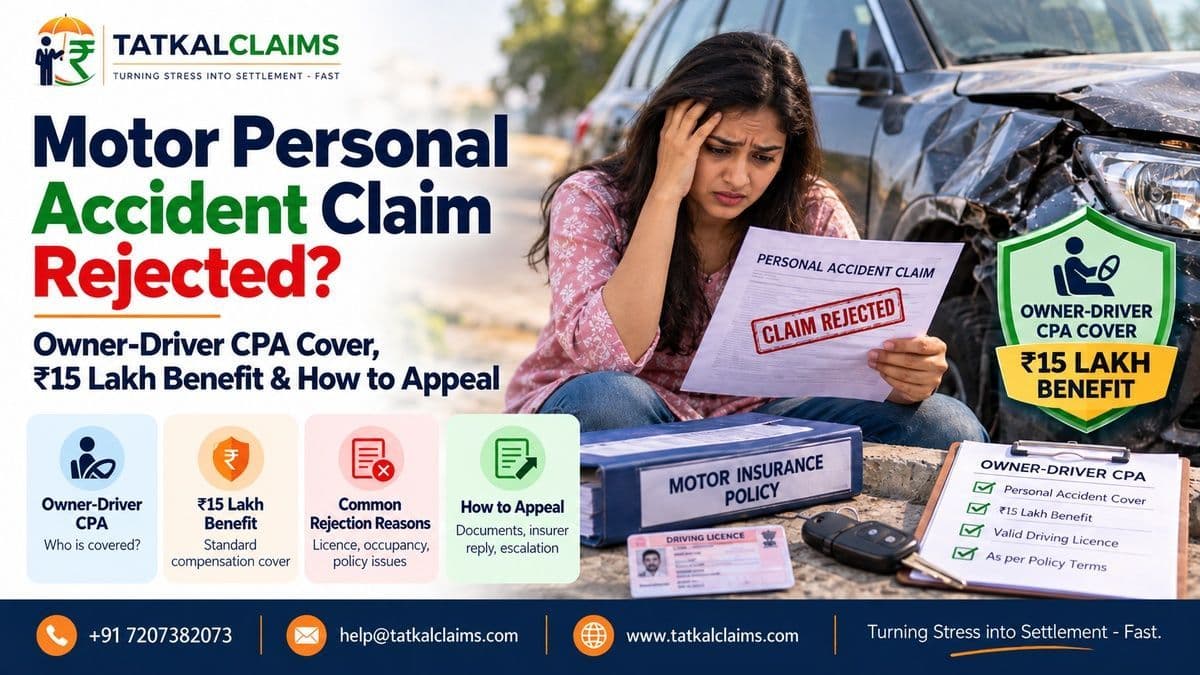
A motor Personal Accident claim can be rejected even when the vehicle itself was insured. The reason is that Compulsory Personal Accident (CPA) cover for an owner-driver is a separate benefit with its own eligibility conditions, benefit scale and exclusions.
The most common disputes are not about repair cost. They are about who was actually insured under the CPA cover, whether that person was the registered owner-driver, whether an effective driving licence was held, whether the accident had the required connection with an owned vehicle, whether the injury falls within a listed permanent-disability benefit, and whether an exclusion such as intoxication or prohibited vehicle use applies.
A rejected CPA claim should therefore be reviewed as a contract claim. Do not assume that a valid comprehensive motor policy automatically means every driver, borrower, passenger or family member has a ₹15 lakh personal-accident benefit.
What Is Compulsory Personal Accident Cover for an Owner-Driver?
IRDAI’s motor framework has long treated CPA as protection for the owner-driver rather than as cover for damage to the vehicle. In 2018, IRDAI increased the minimum Capital Sum Insured to ₹15 lakh for owner-driver CPA under motor policies.
From 1 January 2019, insurers were permitted to issue standalone CPA cover. A standalone CPA can cover the owner-driver across vehicles owned by that person, rather than requiring the same person to buy a separate CPA benefit for every vehicle.
A Lok Sabha answer from the Ministry of Finance dated 11 August 2025 confirmed that the minimum sum insured remains ₹15 lakh, that standalone CPA is available for one year, and that recognised exceptions include sufficient existing insurance protection and certain non-individual vehicle-ownership structures. For the duplicate-cover exception, the original IRDAI December 2018 circular is more specific: it refers to an existing 24-hour Personal Accident cover against death and permanent disability (total and partial) with Capital Sum Insured of at least ₹15 lakh.
What Does the Standard Owner-Driver CPA Benefit Usually Pay?
Current insurer wording continues to use a defined benefit scale. The claimant should check the exact schedule and wording because the policy may be standalone or embedded within the motor contract.
| Covered outcome | Typical scale of compensation |
| Death from the covered accident | 100% of the CPA sum insured |
| Loss of two limbs / sight of two eyes / one limb plus sight of one eye | 100% |
| Loss of one limb or sight of one eye | 50% |
| Permanent total disablement from other covered injuries | 100% |
Current examples from Tata AIG and Zurich Kotak also require the covered death or disability to arise from the specified accidental injury within the period stated in the wording, commonly six calendar months.
A fracture, hospitalisation, temporary inability to work or partial disability that does not match the policy’s listed benefit may not itself trigger the standard CPA benefit. Separate medical, personal accident, hospital cash or other covers may have different benefits.
Who Is the “Owner-Driver”?
This is one of the most important claim questions. IRDAI’s 2018 circular described the owner-driver as the owner of the insured vehicle who holds an effective driving licence.
Current 2026 Tata AIG wording states that the owner-driver must be the registered owner of the insured vehicle, the insured named in the policy and the holder of an effective driving licence at the time of the accident.
Current Zurich Kotak wording similarly makes registered ownership and effective licence status express conditions, and its standalone schedule is built around vehicles owned by the insured.
| Record | Question to answer |
| RC | Who was the registered owner on the accident date? |
| CPA / motor schedule | Who is the insured or named owner-driver? |
| Driving licence | Did that person hold an effective licence for the relevant vehicle class? |
| Vehicle involved | Was it one of the insured’s owned vehicles covered by the wording? |
| Nominee / legal representative | Who can receive the contractual benefit if the insured died? |
What If the Vehicle Is Owned by a Company, Partnership or Other Entity?
CPA is designed around an individual owner-driver. IRDAI’s October 2018 clarification stated that compulsory owner-driver PA cover is not applicable where the vehicle is owned by a company, partnership firm or similar body corporate, or where the owner-driver does not hold a valid driving licence.
The Ministry of Finance’s 2025 Lok Sabha answer also lists company, partnership and similar body-corporate ownership among recognised exceptions to the individual CPA requirement.
That does not mean an employee or paid driver can never have accident protection. Other motor endorsements, employee compensation or separate personal-accident products may apply, but they should not be confused with individual owner-driver CPA.
Can You Skip Buying a New CPA If You Already Have Personal Accident Cover?
IRDAI unbundled CPA so an owner-driver need not necessarily duplicate the same protection with every vehicle. The 2018 framework recognised an existing 24-hour personal-accident cover against death and permanent disability with at least ₹15 lakh Capital Sum Insured as a basis for not taking a separate CPA cover.
The 2025 Parliamentary answer uses broader language referring to sufficient existing cover, including other life or personal-accident insurance. For claim and purchase decisions, however, do not assume that any life policy automatically replaces CPA: verify whether the existing cover actually satisfies the motor-CPA exemption and covers accidental death plus permanent disability as required.
For a claim, the practical question is not whether CPA was absent from one motor schedule, but whether a valid qualifying PA/CPA contract actually existed on the accident date and covered the person and event. Obtain the policy wording rather than relying only on the premium schedule or a general life-insurance certificate.
What If the Deceased or Injured Person Was Driving a Borrowed Vehicle?
This is where motor-accident law and contractual CPA cover are often mixed together. A borrower may have permission to drive but still fail the wording of a standalone owner-driver CPA policy if the cover requires the insured to be the registered owner and the accident to involve a vehicle owned by that insured.
The correct first step is therefore to read the actual CPA policy. Ask whether it covers only vehicles owned by the insured, whether the deceased was the named insured, and whether any separate PA endorsement or product covered a permissive driver.
Older Supreme Court cases such as Ningamma and Ramkhiladi dealt with the statutory no-fault framework under the former Section 163A and often described a permissive borrower as stepping into the owner’s shoes. Those cases should not be converted into a blanket rule that every borrower automatically receives the registered owner’s contractual CPA benefit.
There is an additional current-law caution: in Wakia Afrin v. National Insurance Co. Ltd. (2025 INSC 919), a two-judge Supreme Court bench disagreed with the line restricting old Section 163A owner/borrower claims to third-party risks and referred the issue to a larger bench. 2026 High Court decisions continue to note that reference as pending.
For the specific Delhi High Court borrowed-car fatality decision and why the court separated MACT from contractual PA rights, see our borrowed-car fatality case analysis.
CPA Claim vs MACT Compensation
A CPA claim asks whether a contractually insured owner-driver suffered a covered accidental death or permanent disability. A MACT claim asks different statutory questions about motor-accident compensation, third-party liability, fault/no-fault routes and insurer defences.
The fact that a MACT route is unavailable or disputed does not automatically answer the CPA claim. Equally, a CPA benefit does not by itself determine the amount payable in a separate third-party accident claim.
For identified-vehicle statutory compensation, use our MACT process and compensation guide.
Can the CPA Claim Be Rejected for a Driving-Licence Problem?
Yes, this can be central because current owner-driver CPA wording commonly makes an effective driving licence an express condition of the cover.
Do not assume the same licence analysis used for a third-party claim applies automatically. Third-party statutory protection and a first-party contractual CPA benefit can respond differently to licence breaches.
Check the exact licence number, class of vehicle, validity dates, renewal date and whether the person was disqualified from holding or obtaining a licence.
If the rejection turns on expiry or renewal of the licence, use our expired driving-licence motor claim guide.
What If the Insurer Alleges Alcohol or Drugs?
Current CPA policy examples exclude an accident happening while the insured person is under the influence of intoxicating liquor or drugs.
Because wording can differ, the appeal should focus on the exact exclusion and the evidence used to establish it. Ask for the relied-on medical record, toxicology result, MLC, police material or other contemporaneous evidence.
A claimant should not assume that absence of a breathalyser automatically proves sobriety, and the insurer should not be allowed to turn a bare allegation into evidence without showing what material supports the exclusion.
Can Prohibited Vehicle Use Affect the CPA Claim?
Yes. Current standalone CPA examples also contain general exceptions linked to the vehicle’s Limitations as to Use and Driver’s Clause.
A private car being used for hire or reward, racing, speed testing or another excluded purpose can therefore create a separate CPA issue in addition to any own-damage claim problem.
The insurer should identify the exact prohibited use and evidence showing that it existed when the accident occurred. An old or unrelated use history should not automatically be treated as proof of the use at the time of loss.
For paid passenger or rideshare use of a private car, see our private car used commercially / rideshare claim guide.
Was the Death or Disability Caused by a Covered Accident?
Current CPA wording commonly requires bodily injury or death caused by violent, accidental, external and visible means, independent of other causes, and resulting in the specified benefit within the contractual time window.
Disputes can arise where death follows a medical event, where the accident is only one of several possible causes, where there was a pre-existing infirmity, or where the disability is temporary rather than permanent.
The right response is evidence-led: preserve the MLC, admission records, imaging, surgery notes, discharge summary, death certificate, post-mortem report where applicable, disability certificate and treating-doctor opinion.
Do not state that every death occurring after a road accident automatically triggers CPA. The policy still requires the causal and benefit conditions to be satisfied.
What Does the Six-Month Condition Mean?
Current policy examples from Tata AIG and Zurich Kotak provide that the covered injury must result in the listed death or disability within six calendar months of the injury.
If death or permanent disability is certified later, establish the medical timeline precisely. Do not rely only on the date of the final certificate; show when the disabling consequence arose and what the policy clause actually requires.
If the insurer rejects solely because paperwork was issued after six months, ask whether the clause refers to when the covered result occurred or when the document was generated.
What If the Vehicle Was Sold or Ownership Had Changed?
Personal Accident cover for the owner-driver is tied to the insured person and ownership conditions. Current Tata AIG wording states that PA cover is not deemed to transfer automatically to the new vehicle owner when ownership is transferred.
If an accident occurred around a sale or RC-transfer period, reconstruct the date of sale, RC status, insurance endorsement, CPA policyholder and premium period before assuming who was covered.
Documents to Collect Before Challenging a CPA Rejection
| Document | Why it matters |
| CPA policy / motor policy schedule | Shows whether PA cover existed and the sum insured. |
| Full CPA policy wording | Controls eligibility, benefits and exclusions. |
| RC | Proves registered ownership on the accident date. |
| Driving licence + renewal history | Tests the effective-licence condition. |
| FIR / accident report / MLC | Documents the accident circumstances. |
| Hospital records | Build the injury and causation timeline. |
| Post-mortem + death certificate | Critical in accidental-death claims. |
| Disability certificate / specialist report | Shows whether the claimed disability matches a listed benefit. |
| Nominee / legal-representative documents | Supports payment after death if coverage is established. |
| Existing standalone/general PA policy | May prove the relevant CPA-equivalent cover where motor schedule omitted it. |
| Investigator / medical opinion relied on by insurer | Shows the factual basis of repudiation. |
If the insurer relies on an undisclosed investigator, medical opinion or other material, use our guide on obtaining the claim file, investigator report and evidence relied on.
What to Ask the Insurer in Writing
Ask the insurer to identify the exact CPA policy/UIN, the sum insured, the clause relied on, and whether the rejection is based on registered ownership, named-insured status, driving licence, vehicle ownership, Limitations as to Use, intoxication, causation, disability classification or another exclusion.
If the insurer says no CPA cover was purchased, ask it to confirm whether the motor proposal recorded an existing standalone CPA or other qualifying PA policy and obtain the proposal/declaration relied on.
If the insurer says the claimant was not the owner-driver, compare the RC, schedule and CPA wording rather than arguing only from who was physically driving the vehicle.
How to Structure the Appeal
| Section | What to establish |
| 1. Cover existed | Policy number, CPA sum insured and period. |
| 2. Insured person | Registered owner + named insured + licence status. |
| 3. Covered vehicle connection | Why the event falls within the policy’s owned/insured vehicle wording. |
| 4. Accident evidence | FIR, MLC, hospital or post-mortem record. |
| 5. Benefit trigger | Death or the precise permanent-disability category claimed. |
| 6. Exclusion response | Answer the exact licence, intoxication, use, self-injury or other exclusion with evidence. |
| 7. Relief sought | Reasoned reconsideration and payment of the contractual benefit if established. |
Escalation After the Insurer Rejects the CPA Claim
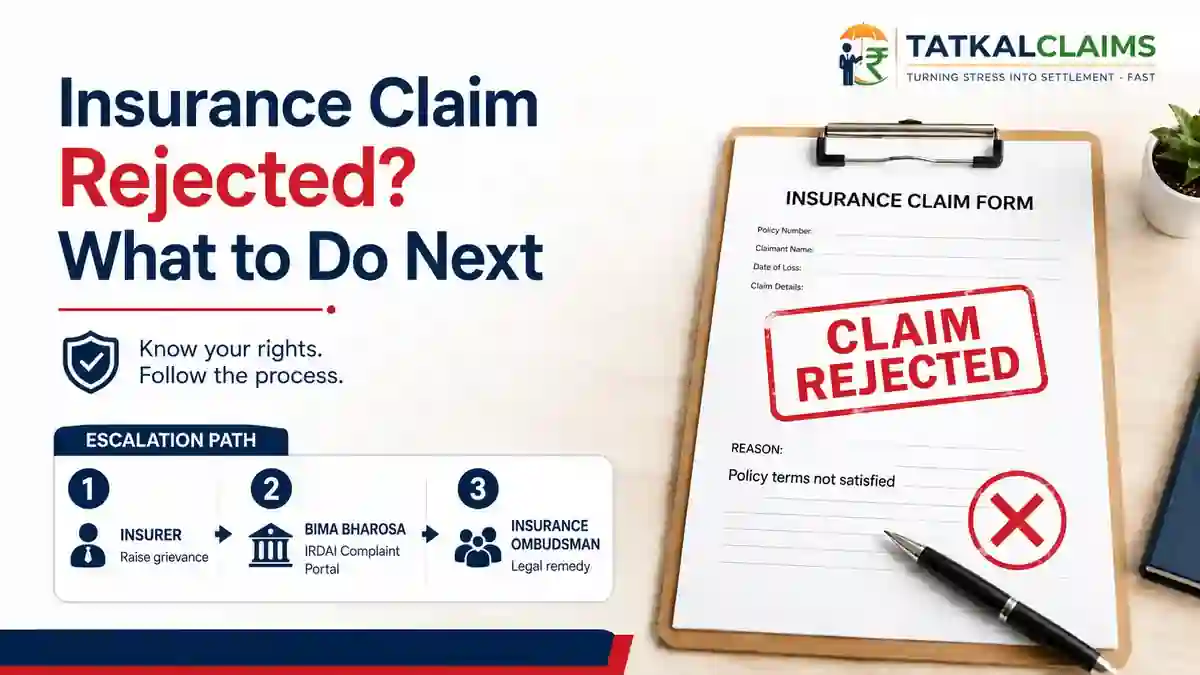
Start with the insurer’s grievance redressal process and attach the policy clause, RC, licence and medical evidence in a structured representation.
If unresolved, Bima Bharosa can be used for regulatory grievance escalation. The Insurance Ombudsman may also be available if the complaint satisfies the applicable eligibility and monetary requirements.
For choosing between the two complaint routes, see Bima Bharosa vs Insurance Ombudsman.
A Practical 7-Day Action Plan
| Day | Action |
| Day 1 | Collect the rejection letter, CPA/motor schedule and complete policy wording. |
| Day 2 | Match the RC owner, named insured and driving licence details. |
| Day 3 | Build the accident and medical timeline from FIR/MLC/hospital/post-mortem records. |
| Day 4 | Identify the exact benefit claimed: death, limb/eye loss or permanent total disablement. |
| Day 5 | Request the investigator/medical/exclusion evidence used by the insurer. |
| Day 6 | Prepare a clause-by-clause appeal with documents. |
| Day 7 | Escalate through the insurer grievance route if repudiation remains unsupported. |
How Tatkal Claims Can Help
Tatkal Claims can review the CPA policy, motor schedule, proposal form, RC, driving licence, accident records, medical evidence, disability/death records and repudiation letter to determine whether the dispute is really about cover existence, owner-driver status, licence, vehicle ownership, accident causation, disability classification or an exclusion.
Where a rejection appears unsupported or overbroad, assistance can include requesting the insurer’s evidence, preparing a clause-specific reconsideration, separating CPA rights from MACT rights, and preparing Bima Bharosa or Ombudsman escalation where appropriate.
A review should not promise ₹15 lakh merely because the vehicle carried motor insurance or because a fatal accident occurred. The person, policy, ownership, licence and covered-benefit conditions must all be checked.
Frequently Asked Questions
Frequently asked questions
Is ₹15 lakh automatically payable whenever the owner of an insured car dies in an accident?
No. ₹15 lakh is the current minimum CPA sum insured framework, but the claim must satisfy the actual CPA contract, including owner-driver status, effective licence, covered accident and benefit/exclusion conditions.
Who counts as the owner-driver for CPA?
Current Government and insurer material generally treat the owner-driver as the registered owner who is the insured and holds an effective driving licence. Always check the actual policy wording.
Does standalone CPA cover more than one vehicle?
Yes. The IRDAI framework permits a standalone CPA to extend across vehicles owned by the same owner-driver, subject to the policy terms and declared ownership.
Can I skip CPA if I already have another personal accident policy?
The IRDAI framework recognises sufficient existing 24-hour PA protection, generally at least ₹15 lakh against death and permanent disability, as a basis for not taking duplicate CPA. The actual existing policy must be valid and cover the relevant event.
Does owner-driver CPA cover a borrowed car?
Do not assume so. Current standalone CPA wordings can require the accident to involve a vehicle owned by the insured. A borrower’s contractual PA entitlement depends on the exact policy or endorsement, separate from statutory motor-accident law.
Can CPA be rejected because the driving licence had expired?
An effective driving licence is commonly an express condition of owner-driver CPA. Check the exact validity and renewal facts and the policy wording rather than assuming third-party licence principles apply.
Does CPA pay for fractures or temporary disability?
Standard owner-driver CPA is usually a defined-benefit cover for death and specified permanent disability outcomes. Temporary disability, ordinary fracture treatment or hospital bills may require another cover unless the policy expressly provides them.
Can alcohol lead to rejection of a CPA claim?
Yes, current CPA examples exclude accidents happening while the insured is under the influence of intoxicating liquor or drugs. The insurer should identify the clause and evidence supporting its allegation.
Can the nominee claim even if the deceased was not the registered owner-driver?
Nomination does not create coverage that did not exist. The nominee or legal representative can receive a covered benefit, but the insured person must first satisfy the CPA eligibility and claim conditions.
Is a CPA claim the same as a MACT claim?
No. CPA is a contractual personal-accident benefit. MACT is a statutory motor-accident compensation forum. The available routes and legal tests can differ.
Sources and Methodology
Disclaimer: This guide concerns motor Compulsory Personal Accident / owner-driver coverage and related claim disputes. The result depends on the actual CPA policy, motor schedule, registered ownership, driving-licence status, accident facts, medical evidence, benefit definition and exclusions. Statutory MACT rights are separate and older Section 163A cases should not be applied mechanically to current CPA claims. This is not legal or insurance advice for a specific claim.