
Your critical illness claim has been rejected even though a doctor has diagnosed cancer, a heart attack, stroke or another serious condition. That can feel contradictory, but a medical diagnosis and an insurance-defined critical illness are not always the same thing.
Critical illness cover is usually a fixed-benefit contract: if the insured event meets the policy definition and all applicable conditions, the policy or rider pays the stated benefit rather than reimbursing the hospital bill line by line. The dispute therefore often turns on the exact illness definition, severity threshold, timing, medical evidence and whether the benefit was actually in force.
Before appealing, identify the product you bought. A standalone critical-illness policy, a critical-illness rider attached to a life policy, a health-insurance add-on and ordinary hospitalisation indemnity cover can operate differently. A strong appeal starts by classifying the claim correctly.
First Identify What Type of Claim Was Rejected
The words “critical illness claim” can describe several different insurance arrangements. Mixing them up can lead to the wrong appeal argument.
| Claim type | Typical payment structure | What usually decides the dispute |
| Standalone critical-illness policy | Fixed lump-sum or specified benefit | Covered illness, exact definition, waiting/survival conditions, exclusions and proof |
| Critical-illness rider on a life policy | Rider benefit in addition to or alongside the base life cover | Rider schedule, rider term, covered package, definition, waiting/survival period and rider status |
| Critical-illness add-on/benefit under health insurance | Fixed benefit or product-specific benefit | Benefit wording, schedule, illness definition and product-specific conditions |
| Ordinary hospitalisation indemnity claim | Reimbursement/cashless payment of eligible medical expenses | Hospitalisation cover, exclusions, medical necessity, admissible expenses and policy limits |
A rejection under one benefit does not automatically decide another. For example, a fixed critical-illness benefit can fail because a contractual severity threshold was not met while an otherwise valid hospitalisation reimbursement claim may still need to be assessed under the separate indemnity cover. The reverse can also occur. Read each benefit independently.
The Exact Critical-Illness Definition Is the Starting Point
IRDAI has issued standardised definitions for specified critical illnesses and modified certain definitions in 2022. Where a product covers one of those specified illnesses, the regulatory definition framework is relevant. But that does not mean every policy covers every critical illness or gives the same benefit package.
The schedule and wording still determine which illnesses are covered, the benefit amount, any waiting or survival requirement, exclusions, and whether a procedure or less-severe form receives a different benefit. Always identify the UIN, policy version and benefit option that applied on the date of the insured event.
Terms such as “Cancer of Specified Severity,” “First Heart Attack of Specified Severity” or “Stroke Resulting in Permanent Symptoms” are not decorative wording. They signal that the contract may require objective criteria beyond the broad diagnosis label.
| Policy wording item | What to verify |
| Name of insured illness/event | Is your diagnosis or procedure actually listed in the selected benefit package? |
| Definition | Which clinical, pathological, imaging, functional or severity criteria must be met? |
| Exclusions inside the definition | Does the definition expressly exclude an early stage, minor form, transient event or specified subtype? |
| Waiting period | Did signs, symptoms, diagnosis or treatment arise within the policy/rider waiting period as defined? |
| Survival period | If applicable, did the insured survive for the required period after the insured event? |
| Specialist confirmation | Does the wording require confirmation by a specified medical specialist? |
| Policy/rider status | Was the benefit attached, premium paid and cover in force on the relevant date? |
Why a Serious Diagnosis May Still Fail the Policy Threshold
Critical-illness definitions are designed around a specified insured event, not simply the everyday meaning of “serious illness.” A cancer diagnosis may be medically serious yet fall outside a particular insured definition if the wording excludes an early or non-invasive form. A stroke claim may turn on whether the required neurological deficit is permanent and documented for the period stated in the definition.
Current insurer wordings illustrate this. HDFC ERGO’s current listed my:health Critical Illness wording contains disease-specific definitions and objective thresholds, including detailed criteria for cancer and stroke. Its wording also shows that different insured events can have different benefit or waiting structures. Those terms are an example of why the exact policy wording matters; they are not universal rules for every insurer.
The right appeal is therefore not “this disease is critical.” It is a clause-by-clause medical evidence exercise: identify every criterion in the definition and attach the report, test, specialist opinion or follow-up record that proves—or explains the dispute about—that criterion.
Waiting Period and Survival Period Are Different
A waiting period usually operates from the start, reinstatement or other date specified in the policy/rider and restricts claims arising during that initial window. A survival period, where the product uses one, is a separate condition measured after the diagnosis or insured event. Do not treat the two as interchangeable.
Product terms vary. ICICI Prudential Life’s current 2026 Linked Health Protect Rider, for example, states a 90-day waiting period and a 15-day survival period unless a disease-specific survival period applies. HDFC ERGO’s current listed my:health Critical Illness wording uses its own structure, including a 90-day general waiting period, a seven-day survival period and a different waiting condition for angioplasty. These are product examples—not industry-wide numbers.
| Question | Evidence |
| When did the policy/rider or benefit begin? | Policy schedule, rider schedule, endorsement and premium record |
| Was there a revival or reinstatement? | Revival letter, reinstatement date and rider terms |
| When did the first relevant signs or symptoms appear? | First consultation note, prescription and diagnostic history |
| When was the insured event diagnosed or performed? | Specialist report, pathology/imaging, procedure note and discharge summary |
| Does a survival period apply? | Exact definition/benefit clause and medical timeline |
| Is the insurer using the correct start date? | Policy history, continuity documents and insurer calculation |
Was the Critical-Illness Benefit Actually in Force?
A claim can fail even before the medical definition is examined if the claimed benefit was never attached, had ended, was not selected in the insured package, or had already terminated after an earlier payout under the product terms.
For a life-policy rider, obtain the base-policy schedule plus the rider schedule or endorsement. Check the rider name, UIN, sum assured, commencement date, rider term, benefit package and premium status. IRDAI’s current life-insurance product framework recognises critical-illness riders, but the existence and scope of your cover still come from the policy documents actually issued to you.
Also check whether the product permits multiple critical-illness claims, a second condition after a defined interval, a partial benefit for a procedure, or only one payout after which the option terminates. Do not assume that a previous payout automatically bars—or preserves—a later claim without reading the recurrence/multiple-claim wording.
Pre-Existing Disease and Non-Disclosure Need Separate Analysis
If the insurer says the illness was pre-existing or that material health information was not disclosed, separate three questions: what was known before cover began, what the proposal form actually asked and answered, and which contractual or regulatory rule the insurer is relying on.
For health insurance governed by the current IRDAI health framework, the moratorium period is 60 continuous months of coverage, including portability and migration. After that period, a health policy and claims ordinarily cannot be contested for non-disclosure or misrepresentation except established fraud; an enhanced sum insured has its own 60-month period for the enhanced limit. This does not mean every critical-illness dispute disappears after 60 months—coverage definitions, exclusions and other benefit conditions can still matter.
Do not automatically apply that health-insurance moratorium analysis to a critical-illness rider issued under a life policy. A life rider must be assessed under its own rider/base-policy terms and the applicable life-insurance framework. If the rejection alleges non-disclosure, obtain the signed proposal form, underwriting declarations, medical examination records and the insurer’s exact repudiation basis before responding.
For a deeper health-insurance analysis of waiting periods, pre-existing disease, disclosure and the 60-month moratorium, see our PED and non-disclosure claim rejection guide.
Build a Medical Evidence Pack Around the Definition
Do not send the insurer a pile of medical records without explaining what each document proves. Build the evidence pack around the policy definition.
| Issue | Potential evidence |
| Cancer definition/severity | Histopathology/biopsy, staging records, oncologist opinion, imaging and treatment plan |
| Heart attack definition | ECG, cardiac biomarkers, echocardiography or other investigations relied on by the cardiologist, admission records and specialist opinion |
| Stroke definition | CT/MRI, neurologist notes, neurological examination and follow-up records showing the duration/nature of any deficit |
| Specified surgery/procedure | Operative note, procedure report, indication for surgery and specialist confirmation |
| Functional or duration threshold | Follow-up examinations and records covering the required period |
| Waiting/survival timing | First-symptom chronology, diagnosis date, procedure date and follow-up/death records where relevant |
| Pre-policy history/disclosure | Old medical records, proposal form, insurer medical tests and underwriting correspondence |
| Insurer’s medical basis | Repudiation letter, medical opinion, investigator material and claim-file records |
The objective is not to reinterpret medicine yourself. Ask the treating specialist to address the insurer’s disputed criterion in clinical terms and, where appropriate, identify the reports that support that opinion. If the insurer relies on its own medical opinion, ask for the factual and medical basis used to reach the conclusion.
If the rejection letter refers to an internal medical opinion, investigation or evidence you have not seen, use our claim-file evidence guide to request the material relied on against the claim.
Ask the Insurer These Questions Before You Appeal
| Question | Why it matters |
| Which exact policy/rider clause and illness definition are you relying on? | Prevents a vague “criteria not met” response. |
| Which specific criterion in that definition do you say is not satisfied? | Identifies the actual medical dispute. |
| What report, test value, date or medical opinion supports that conclusion? | Lets you compare evidence rather than argue labels. |
| How did you calculate the waiting period, including the start/revival date used? | Catches timing errors. |
| What survival-period clause applies and from which event/date was it measured? | Separates survival from waiting conditions. |
| If non-disclosure is alleged, which proposal-form question and undisclosed fact are relied on? | Tests whether the allegation is tied to the actual application record. |
| Which policy version/UIN and selected benefit package did you assess? | Helps detect use of the wrong wording or package. |
Ask for the response in writing. Telephone explanations are useful for clarification but difficult to rely on later if the reason changes.
If the portal merely says “rejected,” “repudiated,” “closed” or “under verification” without a clear final reason, first understand the stage using our insurance claim status guide.
Common Critical-Illness Rejection Reasons—and How to Test Them
| Rejection reason | What to test |
| Illness not covered | Check the selected package, schedule and exact list—not only the marketing brochure. |
| Severity/stage threshold not met | Map each definition criterion to pathology, imaging, specialist notes and follow-up evidence. |
| Waiting period not completed | Verify commencement/revival trigger and the date of first signs, symptoms or diagnosis as the wording defines them. |
| Survival period not completed | Confirm whether a survival condition actually applies to that insured event and how it is measured. |
| Pre-existing disease | Check the applicable product rules, continuity, waiting period and evidence of pre-policy history. |
| Non-disclosure/misrepresentation | Obtain the proposal form and identify the exact question, answer, alleged undisclosed fact and applicable regulatory framework. |
| Required specialist confirmation missing | Supply or obtain the specialist evidence the policy requires, if the underlying criteria were in fact met. |
| Rider/benefit not in force | Check schedule, endorsement, premium, revival and rider term. |
| Prior payout/recurrence restriction | Read the multiple-claim, recurrence, partial-benefit and termination provisions before conceding the point. |
How to Build a Clause-by-Clause Appeal
A useful appeal should make the insurer able to see the dispute in one reading. Start with the policy/rider identity, claim number, insured event and rejection date. Quote only the exact disputed definition or condition, then place the evidence beside it.
| Step | What to write or attach |
| 1. Identify cover | Policy number, rider/add-on, UIN/version, benefit package and sum assured |
| 2. State rejection reason | Use the insurer’s words from the repudiation/rejection letter |
| 3. Reproduce disputed criterion | Quote the narrow clause/definition actually in issue |
| 4. Match evidence | List the report/test/specialist record proving each criterion |
| 5. Address timing | Show policy start/revival, symptom, diagnosis, procedure and survival dates |
| 6. Address disclosure/PED if raised | Proposal form, prior history, underwriting records and applicable product/regulatory rule |
| 7. Ask for remedy | Request reconsideration and a reasoned written decision on each disputed point |
Avoid adding ten weak arguments when one issue decides the claim. If the insurer says the definition requires a particular severity threshold, lead with the evidence on that threshold. If the real dispute is non-disclosure, lead with the proposal form and pre-policy record.
For the broader structure of an insurance claim appeal, use our complete claim rejection guide.
When and How to Escalate
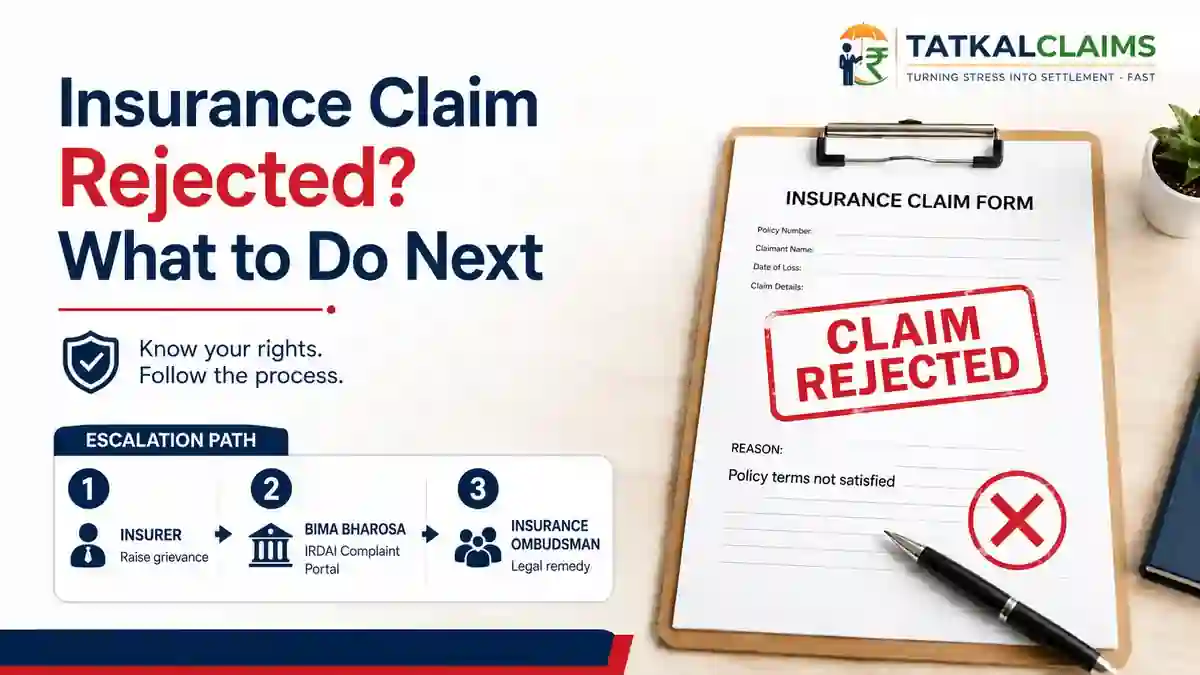
If the claims team does not reverse or adequately explain the decision, submit a written grievance to the insurer’s Grievance Redressal Officer. Attach the rejection letter, relevant policy wording, your clause-to-evidence matrix and the exact remedy requested.
Bima Bharosa’s current FAQ says an insurer should resolve a grievance within 15 days of receipt. If the response remains unsatisfactory or the grievance is unresolved, Bima Bharosa can be used to register and track the grievance with IRDAI.
The Insurance Ombudsman is a separate redress route for eligible complaints. The current Council for Insurance Ombudsmen procedure requires the complainant to approach the insurer first; an Ombudsman complaint may then be made after an unsatisfactory response or, where no reply is received, after 30 days. The current monetary ceiling is ₹50 lakh including relevant expenses, the complaint generally must be filed within one year of the insurer’s response or expiry of the response period, and the same subject should not already be pending before or decided by another court, consumer forum or arbitrator.
Those timelines serve different purposes: the Bima Bharosa grievance expectation does not replace the Ombudsman Rules’ own insurer-first eligibility conditions. Check the route that fits your facts before filing in multiple forums.
Compare the two escalation channels in our Bima Bharosa vs Insurance Ombudsman guide.
For filing requirements and documents, see our Insurance Ombudsman complaint guide.
A Practical 7-Day Action Plan
| Day | Action |
| Day 1 | Collect the policy schedule, full wording, rider/add-on schedule, UIN/version and rejection letter. |
| Day 2 | Identify the exact insured-illness definition, exclusions, waiting period and survival condition. |
| Day 3 | Build a dated medical chronology from first symptoms through diagnosis, procedure and follow-up. |
| Day 4 | Ask the treating specialist to address the disputed definition criterion and identify supporting reports. |
| Day 5 | Request the insurer’s medical opinion, investigation material or claim-file evidence if it is being relied on. |
| Day 6 | Prepare a clause-by-clause reconsideration request and submit it to the claims team/GRO. |
| Day 7 | Organise the Bima Bharosa/Ombudsman record in case the insurer’s response remains unsatisfactory and the route is eligible. |
How Tatkal Claims Can Help
Tatkal Claims can review the critical-illness policy or rider, schedule, UIN/version, rejection letter, proposal form, medical evidence and insurer correspondence to identify the real dispute: coverage, definition, severity, timing, survival, disclosure, PED, rider status or prior-claim restrictions.
Where an appeal is supportable, assistance can include building the medical chronology, mapping evidence to the exact definition, requesting missing claim-file material, preparing the insurer/GRO grievance and organising the Bima Bharosa or Ombudsman record where eligible. If the medical evidence or contract does not meet the insured trigger, the review should identify that weakness rather than promise an outcome.
Frequently Asked Questions
Frequently asked questions
Is a cancer diagnosis enough to claim a critical-illness benefit?
Not automatically. The policy may insure “cancer of specified severity” and may exclude particular early, non-invasive or other forms. Compare the pathology and staging evidence with the exact definition in your policy/rider.
My hospital treated me for a heart attack. Can the insurer still say the critical-illness definition was not met?
Yes, a fixed-benefit critical-illness claim can turn on a contractually defined insured event and objective diagnostic criteria. Ask which criterion the insurer says failed and what evidence it relied on.
Is the critical-illness waiting period always 90 days?
No. Ninety days appears in some current product wordings, but it is not a universal rule. Use the waiting period and trigger stated in your own policy or rider, including any revival/reinstatement provision.
Is there always a 30-day survival period?
No. Survival periods vary and some insured events or products may use different structures. Current product examples use different periods. Never assume a universal number.
Can I claim both a critical-illness lump sum and hospitalisation reimbursement?
Potentially, because they can be separate benefits with different triggers. Payment or rejection under one does not automatically determine the other. Check both contracts and any coordination or exclusion wording.
What if the insurer says my illness was pre-existing?
Check the product class, waiting-period wording, continuity history and evidence of the condition before cover began. For health insurance, the current IRDAI framework also has a 60-month moratorium rule; do not automatically apply that rule to a life-policy critical-illness rider.
What if the insurer alleges non-disclosure?
Obtain the signed proposal form, the exact question relied on, your answer, pre-policy medical records, insurer medical tests and the written repudiation basis. The applicable regulatory framework depends on the product class and facts.
What if the insurer says the critical-illness rider was never attached?
Check the issued policy schedule, rider endorsement, UIN, rider sum assured, commencement date and premium record. Marketing material or an oral sales statement is not a substitute for the issued contract, though a mis-selling issue may need separate examination if the documents conflict with what was sold.
Can I ask for the insurer’s medical opinion used to reject my claim?
You can request the medical and claim-file material relied on for the decision. If the insurer refers to an internal or external medical opinion, ask for the factual basis, disputed criterion and relevant record so you can respond meaningfully.
Can a critical-illness rejection go to the Insurance Ombudsman?
Potentially, if the complaint falls within the Ombudsman’s jurisdiction and the current insurer-first, monetary, limitation and parallel-proceeding conditions are met. Preserve the insurer grievance and response before escalating.
Sources and Methodology
Disclaimer: This guide explains current regulatory guidance and selected current policy/rider examples in general terms. Critical-illness coverage varies by product, policy version, rider/add-on, selected benefit package, illness definition, medical evidence, waiting/survival conditions, exclusions, disclosure history and claim chronology. It is not medical advice or a substitute for case-specific legal advice.