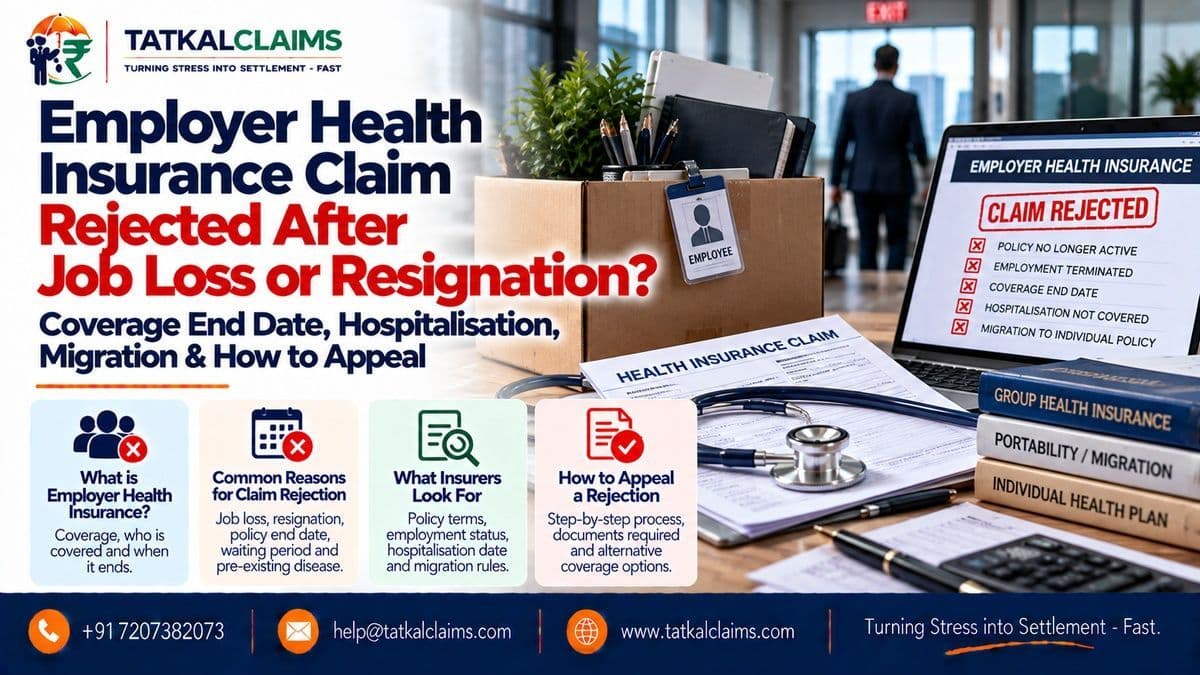
You resign on 10 September. Your last working day is 30 September. You are admitted to hospital on 28 September and discharged on 3 October. A reimbursement claim is filed after your exit, and the insurer or TPA says: “You were no longer an employee when the claim was submitted.”
That rejection may be right—or it may be using the wrong date. Employer health insurance is group cover, and the outcome can depend on the effective date on which your membership ended, the policy wording, the hospitalisation dates, any cashless authorisation already issued, and the employer’s deletion record sent to the insurer.
The practical question is not simply “Did I lose my job?” It is: on which date did the group cover legally and contractually stop for me and my dependants, and what insured event had already occurred by then?
Written by: Tatkal Claims, Claims Review Team
Reviewed by: Ankit L Kanoi, Founder
What This Guide Covers — and What It Does Not
This guide is about employer-sponsored or other indemnity-based group health insurance where an employee or member leaves the group because of resignation, termination, layoff, retirement or another exit.
It focuses on disputed claims around the exit date: hospitalisation before exit, discharge after exit, claim filing after exit, employer deletion mistakes, dependent cover, cashless approvals and migration to an individual policy.
If your issue is how to use employer cover together with a separate personal policy, see our Employer + Personal Health Insurance guide instead.
When Does Employer Health Insurance Actually End?
Employer-sponsored cover is usually tied to membership in the employer’s insured group. HDFC ERGO’s current consumer guidance says employer-provided health plans are generally valid only while employment remains in force unless otherwise specified, and that there is no universal legal requirement that the employer continue the group cover after the last working day.
But “last working day” is not always the only relevant date in a real claim. The employer may send additions and deletions to the insurer or TPA on a periodic basis, and the insurer may record a separate effective deletion date.
IRDAI’s current health FAQ says every member of a group insurance policy should receive a Customer Information Sheet and that policy servicing, claims procedure, migration and portability information should be available. That makes the member certificate/CIS and the actual master-policy terms important evidence.
| Date / record | Why it matters |
| Resignation or termination date | Starts the employment-exit chronology |
| Last working day | May be used by the employer as the group-exit date |
| Effective insurer/TPA deletion date | Shows when the member was actually removed from cover |
| Policy/certificate expiry date | Relevant if cover continued beyond employment under a special arrangement |
| Admission date | Shows when inpatient hospitalisation began |
| Discharge date | Important where hospitalisation straddles the exit date |
| Cashless pre-authorisation date | Shows what the insurer/TPA knew and approved before treatment |
| Reimbursement submission date | Usually a servicing date, not automatically the date the insured event occurred |
Hospitalisation Happened While Employed, but the Claim Was Filed After Leaving
This is one of the strongest reasons to demand a clause-specific rejection rather than accept a generic “employment ended” response.
A reimbursement claim can be submitted after discharge and therefore after employment has ended. The fact that the paperwork was filed later does not by itself answer whether the hospitalisation was covered when it occurred.
The insurer should identify the policy provision it is applying: does the wording require the insured person to remain a member on the date of admission, throughout the hospital stay, on discharge, or merely when the insured event occurs? Different group arrangements can handle this differently.
If admission and most treatment occurred while you were still an insured member, preserve the e-card, cashless records, employer confirmation and insurer eligibility record for that date.
Admission Before Exit, Discharge After Exit: Do Not Assume Either Outcome
A hospital stay that crosses the employment-exit date is a genuine boundary dispute.
For example, if admission was on 28 September, the employee was deleted effective 30 September and discharge was on 3 October, the insurer may argue that some or all expenses fall outside the period of cover. The claimant may argue that the covered hospitalisation had already begun while membership was active.
There is no safe market-wide answer without the specific policy. The correct review is to identify the event trigger in the group wording, the effective deletion endorsement and whether the wording contains any continuation rule for an already-admitted insured person.
Hospitalisation Started Only After the Cover Had Validly Ended
This is the harder case. If the employee and dependants had already been validly deleted from the group policy before the hospitalisation began, the former employee generally cannot rely on the old employer cover simply because symptoms or an illness existed earlier.
The key distinction is between an illness that existed earlier and an insured hospitalisation or other covered event that happened after membership ended.
A claim can still deserve review if the deletion date is wrong, backdated, inconsistent with the employer’s promised cover, or different from the insurer’s own eligibility record.
Employer Says One Exit Date, Insurer/TPA Shows Another
Group health disputes often become data disputes. HR may say cover continued until the end of the month, while the TPA portal shows deletion from the last working day. Or an employee may still have a working e-card even though the employer says the member had already been removed.
| Document | What it can show |
| Offer / HR benefits policy | How employer health eligibility was described |
| Resignation acceptance / termination letter | Last working day and exit terms |
| Severance letter | Whether health cover was extended |
| Employee e-card / certificate of insurance | Member identity and stated validity |
| Customer Information Sheet | Core policy/migration/claims information |
| TPA eligibility screenshot / email | Operational member status |
| Employer addition/deletion file | Date employer asked insurer to remove member |
| Insurer endorsement / member deletion record | Effective contractual deletion date |
| Payroll premium deduction, if any | Supporting evidence only; not conclusive by itself |
If HR made a late or incorrect deletion, the insurance issue and the employer-benefits issue may need to be separated. Do not assume the insurer is responsible for every employer data error, but do not accept a backdated deletion without asking for the endorsement and instruction trail.
Cashless Was Approved Before Exit — Can It Be Withdrawn Later?
Cashless pre-authorisation is valuable evidence because it shows the insurer or TPA had the member and treatment in its system at that point.
It is not necessarily a final guarantee of payment. Current group policy wording still makes cashless payment subject to the policy terms and the extent of authorisation.
If cashless was approved before the employee left but later cancelled or reduced because of job exit, ask for the eligibility check used at pre-authorisation, the deletion effective date, the reason for the change and the exact policy clause.
Where the hospital relied on the authorisation and discharge is being blocked, keep every pre-authorisation and enhancement communication.
What Happens to Spouse, Children or Parents Covered Through the Employee?
Dependants covered only because the employee is an eligible group member usually depend on that underlying membership.
If the employee exits, the dependant’s cover may also end on the applicable deletion date unless the group arrangement provides otherwise.
For a dependant hospitalised around the exit date, build the same chronology: employee exit, dependant eligibility/deletion, admission, discharge, cashless approval and claim filing.
Resignation, Termination, Layoff and Retirement: The Insurance Question Is Similar
The employment reason can matter to HR benefits, but for the insurance claim the central question remains group eligibility and the effective cessation date.
A resignation may have a notice-period continuation. A layoff or redundancy package may expressly extend benefits. Retirement may come with a separate retiree scheme. Termination for cause may end eligibility immediately under the employer arrangement.
Read the benefit terms rather than assuming that every exit reason produces the same insurance date.
IRDAI Migration Option When You Exit the Group
IRDAI uses “migration” for transfer of continuity credits from one health policy to another policy with the same insurer. Its current Health Department FAQ expressly includes members of group insurance policies in the migration concept.
IRDAI’s published migration guidelines say that every individual member, including family members, covered under an indemnity-based group health policy should be provided an option to migrate at the time of exit from the group to an individual health policy or family floater policy.
The same guideline says migration from a group policy to an individual policy can be subject to underwriting. So the right is an option to seek migration with continuity credit—not a promise that every proposed retail product must be issued on any terms the member chooses.
Do not wait until after a medical event to discover this. If you know your employment is ending, contact the same insurer before the group exit and ask in writing which individual/family floater migration options are available and what documents/underwriting are required.
What Continuity Credits Can Matter After Employer Cover?
IRDAI’s current health FAQ says continuity credits in migration/portability can include the sum insured, no-claim bonus, specific waiting periods, pre-existing-disease waiting period and moratorium period, subject to the applicable framework.
That can be important for an employee who has spent several years under group cover and does not want to restart every waiting-period clock from zero.
Ask the acquiring/same insurer to show exactly what continuity period and sum insured it has credited in the new schedule.
| Record | Why it matters |
| Group certificate/CIS | Proof of existing group cover |
| Continuous coverage history | Waiting-period and moratorium credit |
| Claims history | Underwriting / continuity record |
| Sum insured history | Extent of credit |
| Dependants list | Who needs to migrate |
| Exit date | Timing of group cessation |
| Migration proposal and insurer response | Proof the option was exercised |
Migration Requested After Job Loss but the Insurer Refuses
Do not confuse three different outcomes: the insurer saying no migration option exists, the insurer offering a different eligible retail product, and the insurer underwriting the group-to-individual proposal and declining or restricting it under the applicable framework.
IRDAI’s 2020 migration guideline specifically says group-to-individual migration can be subject to underwriting.
A useful grievance therefore asks whether the insurer offered the migration option at group exit, what product was available, what continuity credit was recognised, what underwriting decision was made and whether the process followed the applicable IRDAI framework.
Documents to Collect for a Claim Rejected After Leaving the Job
| Document | What it proves |
| Group policy/member certificate/CIS | Coverage terms and member identity |
| Resignation/termination/retirement letter | Employment-exit chronology |
| HR benefits confirmation | Promised coverage end date |
| Insurer/TPA member deletion record | Effective insurance exit date |
| Admission/discharge records | Hospitalisation chronology |
| Cashless pre-authorisation/enhancements | Insurer/TPA knowledge and eligibility checks |
| Hospital final bill | Covered expenses and treatment period |
| Claim submission acknowledgement | When reimbursement was filed |
| Rejection/repudiation letter | Exact insurer reason |
| Migration request/response | Continuity option after group exit |
If the insurer or TPA keeps asking for new records, use our claim query and deficiency-letter response guide to answer each requirement without losing the chronology.
Stronger Grounds for Challenging the Rejection
- The insurer relies only on the reimbursement submission date even though the covered hospitalisation began while group membership was active.
- The employer promised cover through a stated date and the insurer/TPA eligibility record supports that date.
- Cashless approval was issued while the employee/dependant was shown as active, but the later rejection uses a different backdated deletion date without producing the endorsement.
- HR and insurer records conflict on the effective deletion date and the rejection does not explain which record controls.
- The insurer treats resignation date and last working day as the same even though the employee remained eligible through the notice period.
- The claimant is denied a migration option without the insurer explaining the applicable group-to-individual process.
- Continuity credit in the migrated policy is lower than the documented group coverage history without explanation.
Grounds That Are Usually Harder to Challenge
- The employee/dependants were validly deleted before hospitalisation began and the policy contains no continuation provision that helps the claim.
- The employee relies only on an old e-card even though the insurer’s effective deletion endorsement predates treatment.
- The illness existed while employed but the insured hospitalisation occurred only after group cover ended.
- The employer never promised post-exit cover and the master policy ties membership strictly to employment.
- A migration proposal is declined after permitted underwriting and the grievance does not identify a process or continuity-credit error.
A hard claim can still deserve review, especially where dates are inconsistent. But the appeal should not assume that an employer policy remains active merely because the master policy itself has not expired.
How to Appeal an Employer Health Claim Rejected After Job Loss
- Obtain the group policy/member certificate/CIS and the exact effective deletion date from the insurer or TPA.
- Build the full timeline: resignation/termination, last working day, deletion, admission, discharge, cashless approval and reimbursement submission.
- Ask the employer to confirm in writing what health-cover end date applied under the employee benefits arrangement.
- Ask the insurer which date and clause it used to reject the claim—admission, discharge, deletion or submission date.
- If cashless had been approved, attach all authorisations and ask why eligibility later changed.
- If a dependant is involved, obtain the dependant-specific deletion/eligibility record too.
- If employment has ended, separately ask the same insurer about group-to-individual migration and continuity credits.
- Escalate a reasoned grievance if the rejection remains inconsistent with the policy or documented member status.
If the insurer maintains the decision after grievance, compare the escalation routes in our Bima Bharosa vs Insurance Ombudsman guide and verify current eligibility before filing.
Questions to Put to HR, the TPA and the Insurer
| 1 | What was my exact effective date of deletion from the group policy? |
| 2 | Who instructed that deletion and on what date? |
| 3 | Was the deletion prospective or backdated? |
| 4 | What does my Certificate of Insurance/CIS say about cessation of membership? |
| 5 | Which date does the insurer say controls this claim: admission, discharge, deletion or submission? |
| 6 | If cashless was approved, what eligibility check was used at that time? |
| 7 | If the hospitalisation straddled my exit date, which clause governs the continuation of that admission? |
| 8 | When did my dependants cease to be insured? |
| 9 | What migration option was available to me on exit from the group, and what continuity credits apply? |
| 10 | Please provide the final reasoned rejection and the master-policy clause relied upon. |
How Tatkal Claims Can Help
Tatkal Claims can review the employer/group health certificate, HR exit records, insurer/TPA deletion data, cashless authorisations, admission/discharge dates, rejection letter and migration correspondence to identify whether the insurer has used the correct coverage-end date and policy clause.
Where the evidence supports a challenge, assistance can include reconstructing the member-status timeline, testing a backdated deletion or claim-submission-date rejection, organizing cashless records, and preparing a clause-specific grievance. We cannot promise payment: if group membership validly ended before the insured hospitalisation and no continuation provision applies, the rejection may be sustainable.
Frequently Asked Questions
Frequently asked questions
Does employer health insurance automatically continue after resignation or job loss?
No universal post-employment extension applies across all employer group policies. Cover is generally tied to group eligibility, but the exact end date depends on the employer arrangement, master policy, member certificate and insurer deletion record.
Can I file a reimbursement claim after my last working day?
You can submit a claim after leaving, but admissibility depends on when the covered hospitalisation/event occurred and the policy’s membership terms. The filing date alone should not be assumed to decide coverage.
What if I was admitted before my last working day but discharged afterward?
That is a policy-specific boundary case. Obtain the effective deletion date and ask which clause governs an admission that began while cover was active and continued after group exit.
What if I became ill while employed but was hospitalised only after leaving?
The earlier illness does not automatically preserve employer cover. If membership had validly ended before the covered hospitalisation or treatment event, the old group policy may not respond unless its wording provides otherwise.
Does a cashless approval guarantee payment after I leave the job?
Not necessarily. Cashless authorisation is important evidence but remains subject to policy terms and eligibility. If it is later withdrawn because of job exit, ask for the deletion date and clause used.
Do my spouse, children or parents also lose employer health cover when I leave?
Often their eligibility depends on the employee’s group membership, but the actual cessation date should be checked in the policy/member records. Obtain dependant-specific eligibility if a claim is disputed.
Can I convert employer group health insurance into an individual policy?
IRDAI’s migration framework provides an option for members of indemnity-based group policies to migrate at group exit to an individual or family floater policy with the same insurer. Group-to-individual migration can be subject to underwriting.
What continuity benefits can carry into the new policy?
IRDAI’s current FAQ says migration/portability credits can include sum insured, no-claim bonus, specific waiting periods, PED waiting period and moratorium period, subject to the applicable rules and policy.
What if HR and the insurer give different coverage-end dates?
Ask for the employer’s deletion instruction, insurer endorsement/member-deletion record and your certificate/CIS. The claim should be decided using the contractual and documented effective date, not an unexplained verbal date.
What is the strongest format for an appeal after job loss?
Use a date-and-document file: last working day, member deletion date, admission/discharge, cashless approval, claim filing, employer confirmation, certificate/CIS and a point-by-point response to the insurer’s stated clause.
Sources & Methodology
Primary-source and insurer-source review checked on 30 September 2026. Group health policies differ by employer, insurer and negotiated benefits, so this guide does not assume that every employer uses the same cessation date or continuation rule. For a live claim, apply the master policy, Certificate of Insurance/CIS, member-addition/deletion records, endorsements and the facts of the hospitalisation.
Disclaimer: This guide explains employer/group health insurance disputes after job loss, resignation, termination, retirement or other group exit in India in general terms. Coverage-end dates, member deletion procedures, treatment of hospitalisation that crosses the exit date, cashless authorisations, dependant eligibility, migration, underwriting and continuity credits vary by master policy, employer arrangement and insurer. Do not rely on an old e-card or a generic HR statement alone. Apply the Certificate of Insurance/CIS, master policy, deletion endorsement and hospitalisation chronology. This is not legal, employment or financial advice for a particular case.