
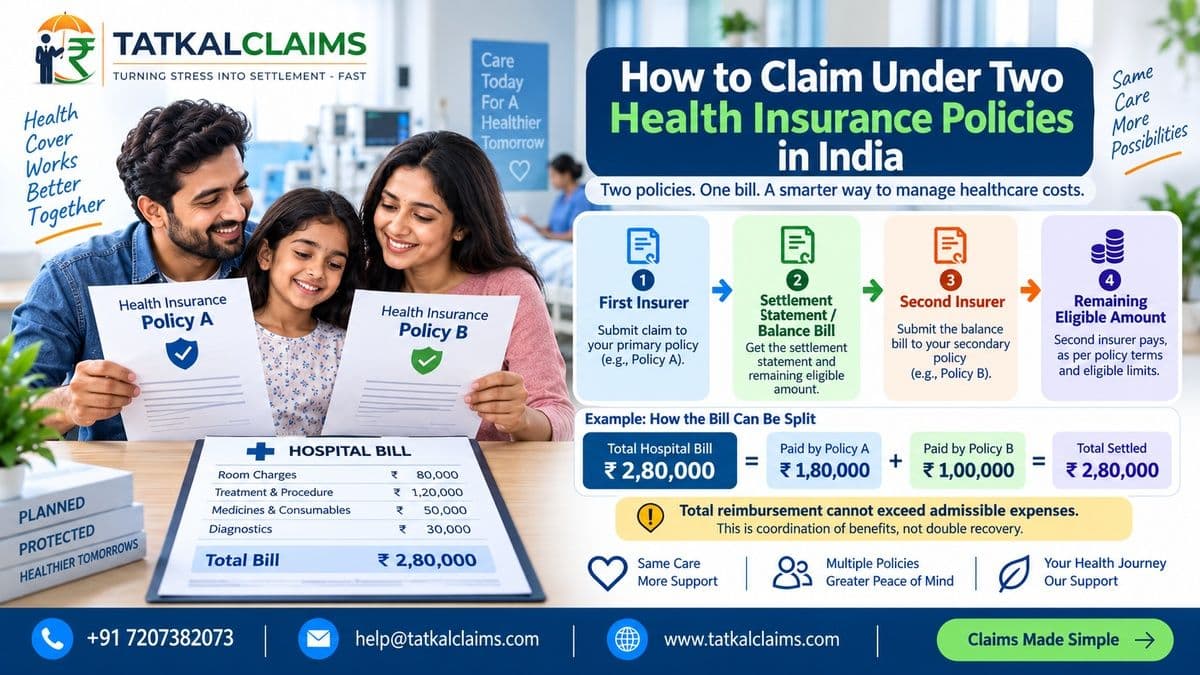
Yes, a person can have more than one health-insurance policy, and the current IRDAI framework explains how claims should work. The first distinction is whether the policies are indemnity policies, which reimburse admissible treatment costs, or benefit policies, which pay a fixed benefit when the insured event occurs.
Indemnity Policy vs Benefit Policy
| Policy type | How multiple claims work |
|---|---|
| Indemnity health policy | Pays admissible hospital/treatment costs up to policy terms. You cannot recover more than the eligible loss merely because you hold several indemnity policies. |
| Benefit policy | Pays the fixed benefit specified when the insured event occurs. IRDAI says eligible benefit claims can be made from all insurers under all such policies. |
Which Policy Should You Claim From First?
IRDAI's current Health Department guidance says the policyholder can file a claim under any indemnity policy of their choice. That chosen insurer is treated as the primary insurer. This makes the order a practical choice rather than an automatic rule that the employer policy must always be used first.
Example: Employer Cover + Personal Cover
| Step | Illustration |
|---|---|
| Admissible hospital claim | ₹8,00,000 |
| Employer group policy available for this claim | ₹5,00,000 |
| Amount settled by primary policy | ₹5,00,000, assuming fully admissible under that policy |
| Potential balance to be considered under personal policy | ₹3,00,000, subject to that policy's own terms, limits, deductibles, co-pay and exclusions |
Can You Recover a Deduction From the Second Insurer?
Sometimes, but not automatically. Older and current IRDAI guidance recognises claims across multiple policies, but the second insurer applies its own contract. A deduction caused only by exhaustion of the first policy's sum insured may be very different from an amount excluded under both policies. For example, if both policies exclude a non-payable item, simply holding two policies does not make that item payable.
Before moving to a second policy solely because the first policy’s base sum insured appears exhausted, check whether the first policy includes a restore, recharge or refill feature and whether its trigger has actually been met. Our restoration-benefit denial guide explains what to verify.
What About Deductibles and Co-Payments?
A deductible or co-payment is part of the policy's claim calculation. The interaction between two policies depends on the wording of both contracts and the reason for the balance. Ask each insurer to provide a written settlement calculation so you can distinguish exhausted cover from policy-specific deductions.
Documents to Keep for a Second-Policy Claim
- Complete hospital and medical records.
- Final itemised bill and payment receipts.
- Settlement letter from the first insurer showing the amount admitted and the reason for every deduction.
- Claim form and policy documents for the second insurer.
- Copies of records retained by the first insurer, certified where required.
- Employer/TPA correspondence if one policy is a group policy.
What If Both Policies Are With Different Insurers?
That is specifically contemplated by IRDAI's current coordination rule. Give the primary insurer accurate details of the other available policy. If coordination does not happen smoothly, ask both insurers in writing who is handling the eligible balance and what documents are outstanding.
What If the First Claim Is Cashless?
A cashless settlement under one policy does not prevent the remaining eligible amount from being considered under another policy, but the second claim may be processed differently and will require the settlement record from the primary insurer. Obtain the discharge summary, final bill, first insurer settlement sheet and evidence of the amount you actually paid.
Common Mistakes
- Assuming two ₹5 lakh policies automatically give ₹10 lakh for every expense.
- Submitting the second claim without the first insurer's settlement calculation.
- Confusing benefit policies with indemnity policies.
- Assuming a co-pay, exclusion or non-payable item under the first policy must be reimbursed by the second.
Frequently asked questions
Can I choose my personal policy before my employer policy?
IRDAI's current guidance says a policyholder with multiple indemnity policies can choose the policy under which to file first.
Can I claim more than my hospital bill by using two indemnity policies?
No. Indemnity insurance is intended to reimburse the eligible loss, not create a profit from the same hospitalization.
Can I claim from all benefit policies?
IRDAI states that on occurrence of the insured event, eligible benefit-based claims can be made from all insurers under all such policies.
Does the second insurer have to pay every amount the first insurer deducted?
No. The second insurer applies its own terms, limits and exclusions to the amount presented to it.