
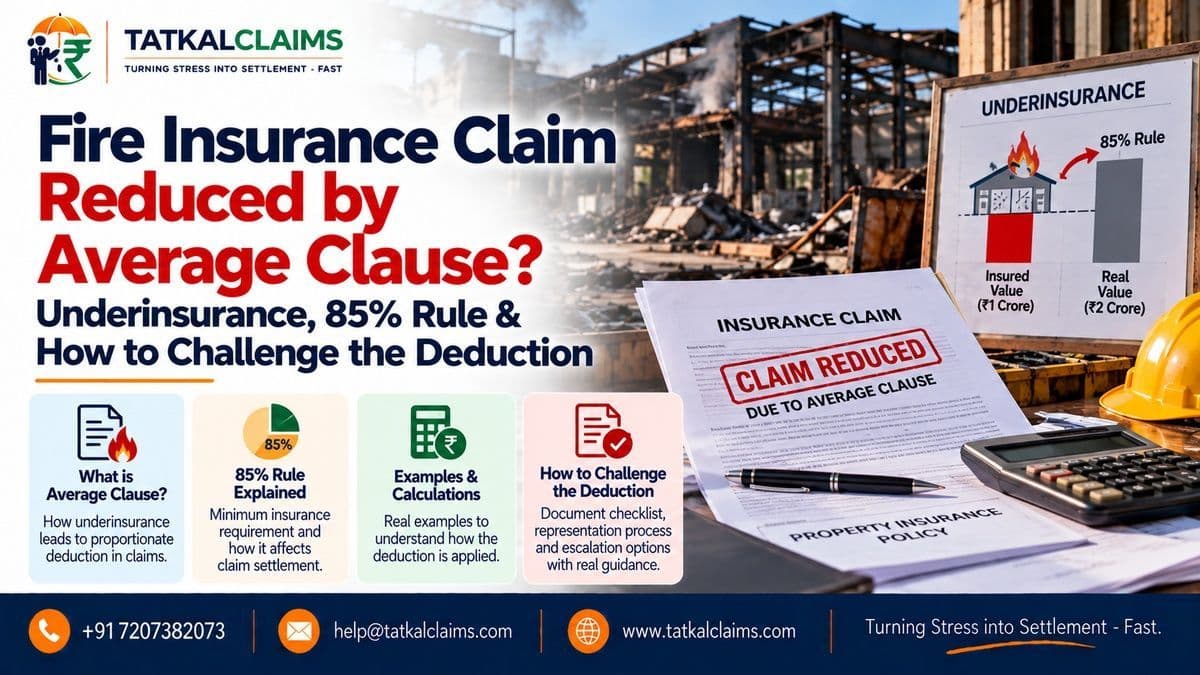
The fire is admitted. The damaged stock, machinery or building is visible. The surveyor even accepts that a covered loss occurred. Then the settlement sheet arrives and a second calculation cuts the claim again: “underinsurance / average applied.”
This is the point where many property claims become confusing. The policyholder looks at a ₹50 lakh sum insured and a ₹12 lakh fire loss and asks a reasonable question: if the loss is below ₹50 lakh, why is the insurer paying only ₹8 lakh or ₹9 lakh?
The answer is that an average clause does not compare only the loss with the sum insured. It compares the sum insured with the value of the entire relevant property at risk on the date of loss. If the policy says that property should have been insured for more, the insurer may treat the policyholder as carrying part of the risk and reduce a partial claim proportionately. Whether that reduction is correct depends on the exact policy, the correct valuation basis and the surveyor’s working—not simply on the fact that the word “average” appears in a report.
What Is the Average Clause in Fire and Property Insurance?
The average clause—also called the condition of average or an underinsurance clause—is a proportionate-settlement mechanism. If the value that should have been insured is higher than the sum insured, the policyholder may bear the same proportion of a partial loss that was left uninsured.
IRDAI’s consumer guidance on fire insurance makes the practical point clearly: the sum insured should reflect the applicable market value or reinstatement value, depending on the policy basis, and inadequate insurance can lead to proportionate payment rather than full reimbursement of the damaged amount.
The Basic Average-Clause Formula
| Element | Amount |
| Value at risk on date of loss | ₹1,00,00,000 |
| Sum insured | ₹60,00,000 |
| Admissible physical loss before average | ₹20,00,000 |
| Insurance ratio | 60% |
| Illustrative amount after average | ₹12,00,000 |
The simple form is: admissible loss × (sum insured ÷ value at risk). In the example above, ₹20 lakh × 60% = ₹12 lakh. The remaining ₹8 lakh is borne by the insured because the policy covered only 60% of the value at risk.
This example isolates the average calculation. A real settlement may separately contain excess/deductible, salvage, depreciation where applicable, non-admissible items, limits or other adjustments. Ask for the insurer’s line-by-line calculation rather than trying to reverse-engineer a final figure from one percentage.
Before You Accept the Deduction, Identify Which Policy You Actually Have
There is no single average-clause rule for every fire/property policy in India. The correct starting point is the policy name, UIN, schedule, endorsements and basis of sum insured that applied on the date of loss.
| Policy / situation | Underinsurance position to check |
| Bharat Griha Raksha (standard home policy) | The standard wording waives underinsurance; a shortfall between calculated sum insured and actual value at risk does not reduce the claim merely for underinsurance. |
| Bharat Sookshma Udyam Suraksha (business value at risk up to ₹5 crore at one location) | Standard wording contains a 15% underinsurance waiver; below the 85% threshold, proportionate underinsurance can apply. |
| Bharat Laghu Udyam Suraksha (more than ₹5 crore and up to ₹50 crore at one location) | Standard wording also contains the 15% underinsurance waiver and 85% threshold. |
| Older SFSP / proprietary / package / larger commercial policies | Do not import the 15% rule automatically. Read the actual average/underinsurance clause and endorsements. |
The standard fire products were introduced from 1 April 2021 for homes and specified business-size bands. That does not mean every current property policy is one of those standard products. Package policies, large commercial risks and proprietary wordings can use different settlement terms.
Home Claim? Bharat Griha Raksha Has a Very Different Rule
Under the Bharat Griha Raksha standard wording, underinsurance does not apply. The wording states that if the sum insured calculated from the information supplied is lower than the actual value at risk, that difference will not affect the amount paid.
That is a major reason not to accept an “average clause” deduction merely because the surveyor has valued a home building higher. First confirm that the policy is actually Bharat Griha Raksha and that the disputed item falls within the cover being assessed. Other home/property products can have different wording.
Business Fire Policies: What the 15% Waiver and 85% Rule Actually Mean
The standard Bharat Sookshma Udyam Suraksha and Bharat Laghu Udyam Suraksha wordings say the sum insured for each item must be sufficient for reinstatement/replacement on the date of loss, and they waive underinsurance up to 15%. If the applicable sum insured is less than 85% of the value of the relevant insurable assets, the insured bears a proportionate share of the loss.
| Example | Illustrative result before other deductions |
| Value at risk ₹1 crore; sum insured ₹90 lakh; admissible loss ₹20 lakh | 10% underinsurance: within the 15% waiver under the standard business wording, so average should not reduce the ₹20 lakh merely for underinsurance. |
| Value at risk ₹1 crore; sum insured ₹80 lakh; admissible loss ₹20 lakh | Sum insured is below 85% of value at risk. Illustrative proportionate result: ₹20 lakh × 80% = ₹16 lakh. |
| Value at risk ₹1 crore; sum insured ₹60 lakh; admissible loss ₹20 lakh | Illustrative proportionate result: ₹12 lakh. |
The threshold is only useful if the surveyor has first calculated the correct value at risk. If the ₹1 crore denominator is wrong, the underinsurance percentage is wrong even if the formula itself is mathematically perfect.
Average Is Usually Tested Against the Relevant Insured Item—not the Damaged Piece Alone
The standard business wording applies underinsurance separately to each item of insured property. That matters where a schedule has separate sums insured for building, plant and machinery, furniture/fixtures, stock or other contents.
A fire may damage machinery worth ₹10 lakh, but the underinsurance test may require the surveyor to value the entire machinery block covered by that item—not only the three machines that burned. Conversely, an insurer should not casually combine unrelated property into the denominator if the schedule insured it separately.
One of the first claim-review questions should therefore be: which schedule item did the surveyor test, what assets did the surveyor include in that item, and why?
The Valuation Basis Often Decides the Dispute
A property can have several numbers attached to it: book value, depreciated market value, purchase cost, current replacement cost and accounting written-down value. They are not interchangeable in an insurance claim.
In the standard Bharat Sookshma business wording, buildings, plant and machinery, furniture, fixtures and fittings are insured on reinstatement value. Stocks use different bases: raw material uses landed cost at the premises; work-in-process uses input cost; finished stock uses manufacturing cost; and qualifying sold-but-not-delivered goods can use contract price.
| Insured item | Evidence that may matter |
| Building | Current reinstatement estimate, BOQ, area and construction specification, architect/engineer estimate, repair/reconstruction quotations. |
| Plant & machinery | Asset register, make/model/capacity, current equivalent replacement quotations, invoices, installation/freight costs where policy permits. |
| Raw material stock | Purchase invoices, inward register, landed-cost records, GST records, stock ledger. |
| Work in process | Production records, input consumption and cost records at date of loss. |
| Finished stock | Manufacturing-cost records, stock statements, production and dispatch records. |
| Sold but not delivered goods | Sale contract, responsibility for goods, contract price and evidence the sale was affected by the insured damage. |
If a policy requires reinstatement value but the surveyor tests underinsurance using a heavily depreciated or otherwise inconsistent basis in one part of the calculation, or uses a market-value approach contrary to the contract, that can be a substantive challenge—not a request for sympathy.
What Courts and Consumer Fora Say About Valuation and Surveyor Reports
A surveyor’s report is important evidence, but it is not automatically immune from challenge. The Supreme Court in New India Assurance Co. Ltd. v. Pradeep Kumar held that a surveyor’s report can be the foundation for settlement but is not conclusive or binding on either side.
That principle does not mean a claimant can discard a survey report merely because the assessment is low. In Khatema Fibres Ltd. v. New India Assurance Co. Ltd. (2021), the Supreme Court cautioned that a consumer forum should not undertake a forensic re-examination of a surveyor’s report once the surveyor has performed the regulated role properly and the report is not arbitrary or ad hoc.
The practical lesson is to attack the calculation with evidence: wrong policy clause, wrong valuation basis, wrong measurements, wrong stock quantity, wrong asset grouping, omitted invoices, inconsistent quotations or an unexplained methodology.
The valuation basis itself can be decisive. In M/s Oswal Plastic Industries v. Manager, Legal Deptt., N.A.I.C.O. Ltd. (2023), the Supreme Court restored reinstatement-value compensation where the policy clause required that basis instead of the lower depreciated value. In a 2024 NCDRC fire-claim decision involving Jagdish Woollen’s, the Commission likewise directed recalculation on reinstatement value under that policy’s facts and documents.
These decisions do not create a universal rule that every fire claim must be paid at new-for-old replacement cost. They show why the contract’s chosen valuation basis must be followed. Market-value wording, reinstatement-value wording and stock valuation provisions can produce different results.
If the insurer is relying on a surveyor’s valuation but has not shared the working or report, use our claim-file and survey-report evidence guide to request the material relied on.
When an Average-Clause Challenge Is Strong
The policy is Bharat Griha Raksha but the insurer has still applied underinsurance to the home building/contents contrary to the applicable wording.
A Bharat Sookshma or Bharat Laghu claim is within the 15% underinsurance waiver, but the insurer has nevertheless reduced the claim for average.
The surveyor’s value at risk includes assets that belong to a separately insured schedule item, another location, another entity or property not forming part of the insured block.
The surveyor used market value or depreciated value where the policy requires reinstatement value—or otherwise changed the valuation basis between setting the sum insured and testing the claim.
The stock valuation ignores purchase, production, GST, bank stock statements or audited inventory records without explaining why, or values the stock on a basis different from the policy wording.
The insurer gives only an underinsurance percentage without disclosing the value-at-risk calculation, asset list, rates, quantities or formula.
When the Deduction May Be Difficult to Challenge
The policy clearly contains an average clause, the applicable waiver has been correctly applied, and reliable evidence shows the total property value materially exceeded the declared sum insured.
The business expanded, added machinery or accumulated much higher stock but did not increase the sum insured or use an appropriate declaration/floater mechanism where needed.
The claimant disputes the surveyor’s value only by pointing to old book value or original purchase price even though the policy requires current reinstatement/replacement value.
The insured cannot produce records needed to establish stock quantity, machinery specification or reinstatement cost and the surveyor’s method is otherwise reasoned and supported.
The only argument is that the physical damage is less than the sum insured. That does not answer an average clause because the clause tests adequacy of insurance against the full relevant value at risk.
Documents to Collect Before You Appeal the Average Deduction
| Document | What it helps test |
| Policy schedule, wording, CIS and endorsements | Which average/underinsurance clause and waiver actually apply. |
| Survey report and calculation sheet | Value at risk, percentage of underinsurance, asset grouping and deductions. |
| Proposal / renewal declarations | How the sum insured was originally fixed and what information the insurer received. |
| Fixed-asset register | Assets, acquisition dates, location, description and insured block. |
| Current replacement quotations | Whether reinstatement value used by the surveyor is realistic. |
| Engineer / valuer / architect estimate | Building and machinery reinstatement methodology. |
| Purchase and GST records | Raw material, machinery and stock cost evidence. |
| Stock register / production records / bank stock statements | Quantity and value at the date of loss. |
| Photographs, site plan and survey measurements | Whether the surveyor counted the right property and quantities. |
| Settlement letter / deduction sheet | Exact amount reduced for average versus excess, salvage or depreciation. |
If the surveyor or insurer is repeatedly asking for valuation records without specifying what remains missing, use our claim query and deficiency-letter response guide to answer each requirement in a controlled, indexed way.
Eight Questions to Put to the Insurer or Surveyor in Writing
| 1 | What exact policy clause authorises the underinsurance/average deduction? |
| 2 | What was the sum insured used for the affected item? |
| 3 | What value at risk did you determine on the date of loss? |
| 4 | What assets, quantities and locations were included in that value? |
| 5 | What valuation basis and unit rates were used for each asset class? |
| 6 | Was any underinsurance waiver or 85% threshold applicable, and how was it applied? |
| 7 | Please provide the formula showing gross assessed loss, average deduction, salvage, excess, depreciation and other adjustments separately. |
| 8 | Which documents supplied by us were rejected or not relied on, and why? |
How to Appeal an Average-Clause Deduction
Start with a calculation audit, not a broad complaint that the settlement is unfair. Rebuild the insurer’s number from the policy schedule and survey report and identify the first factual or contractual step that is wrong.
If the disagreement is about value at risk, attach competing evidence on the same valuation basis. A fresh quotation for a larger or upgraded machine is weak evidence if the damaged machine had different capacity. A dated quotation for a current equivalent model, linked to the asset register and policy basis, is much stronger.
If the issue is stock, reconcile quantity and value across the stock ledger, purchase/production records, GST data, bank statements and any stock statements submitted before the fire. Explain discrepancies instead of hoping the surveyor will ignore them.
Ask the insurer’s grievance team to issue a reasoned response to each disputed component. Keep the average issue separate from unrelated disputes such as cause of loss, exclusion, salvage or deductible unless they genuinely overlap.
If the insurer maintains the deduction after the internal grievance, compare the available escalation routes in our Bima Bharosa vs Insurance Ombudsman guide before choosing the next forum.
What About Surveyor and Claim-Decision Timelines?
IRDAI’s current policyholder-protection framework imposes tighter timelines for retail general-insurance claims: surveyor allocation is to happen quickly, the survey report is generally expected within 15 days of allocation, and the insurer’s claim decision follows on the prescribed timeline. The circular expressly says the usual decision timeline does not apply in the same way to property/building policies issued on reinstatement-value basis.
Do not let a timeline argument replace the valuation dispute. A late report can be a servicing issue, but it does not by itself prove that the average calculation is wrong. Preserve both issues separately.
Do Not Sign Away the Valuation Dispute Without Understanding the Settlement
If the insurer asks for a full-and-final discharge after applying average, record your objection to the underinsurance calculation before accepting any disputed settlement. Whether a discharge can later be challenged depends on the wording, circumstances and evidence of consent or coercion; do not assume that writing “under protest” automatically resolves every legal issue.
Before signing a disputed settlement document, review our full-and-final discharge voucher guide and preserve the settlement calculation and your written objection.
Do Not Confuse Average With These Other Property-Claim Deductions
| Deduction | What it means |
| Average / underinsurance | Sum insured is inadequate compared with the applicable value at risk. |
| Depreciation | Reduction for age/use where the policy settlement basis permits it. |
| Salvage | Residual value of damaged property or material. |
| Policy excess / deductible | Amount contractually borne by the insured for the claim/event. |
| Non-admissible item | Cost outside the insured property/peril/cover. |
| Limit or sub-limit | Maximum payable for a defined cover or expense. |
A settlement that simply gives one large “deduction” number is hard to audit. Ask the insurer to separate these components. The evidence needed to dispute underinsurance is different from the evidence needed to dispute salvage or depreciation.
A Fire Claim Can Be Admissible and Still Be Short-Settled
This distinction is important in practice. The insurer may fully accept that fire is covered and still disagree with the amount payable because of valuation, stock proof, underinsurance or policy limits. The appeal should target the actual settlement issue rather than re-arguing coverage that has already been admitted.
For an example of a fire claim where the dispute centred on claim handling and documents rather than whether fire itself was a covered event, see our Oriental Insurance fire-claim case study.
How to Prevent the Same Problem at Renewal
Do not renew a property sum insured by copying last year’s figure. Recalculate the basis the policy actually requires. Construction rates, machinery replacement prices, freight, installation cost, currency movements and stock levels can move far faster than accounting book values.
For fluctuating stock, discuss declaration or floater structures where appropriate instead of insuring an average month and hoping a peak-season fire occurs at the same level. For new machinery, extensions or acquisitions, check whether the policy gives temporary automatic cover and what notification period applies.
Keep the valuation worksheet used at renewal. If a claim occurs six months later, that worksheet can become critical evidence showing how the declared sum insured was derived and what information the insurer or intermediary had.
How Tatkal Claims Can Help
Tatkal Claims can review the policy schedule, average/underinsurance clause, survey report, value-at-risk working, fixed-asset or stock records, reinstatement quotations and settlement sheet to identify whether the reduction follows the contract or whether the calculation has mixed valuation bases, ignored a waiver or included the wrong property.
Where there is a documented valuation error, assistance can include preparing a calculation-led representation to the insurer, organising the supporting asset/stock evidence, responding to surveyor queries and escalating the unresolved service/claim dispute through the appropriate grievance route. We cannot promise that an average deduction will be reversed: if the property was genuinely underinsured under the applicable wording, a proportionate reduction may be contractually justified.
Frequently Asked Questions
Frequently asked questions
What is the average clause in fire insurance?
It is an underinsurance provision that can reduce a partial property claim in the same proportion that the applicable sum insured falls short of the value at risk. The exact trigger, waiver and valuation basis depend on the policy wording.
Why was my ₹10 lakh fire loss reduced when my sum insured is ₹30 lakh?
Because the comparison may not be ₹10 lakh versus ₹30 lakh. The surveyor may be comparing the ₹30 lakh sum insured with the full value of the relevant insured property. If that property should have been insured for a much higher amount and the policy contains average, the ₹10 lakh partial loss can be reduced proportionately.
What is the 85% rule in Bharat Sookshma and Bharat Laghu Udyam Suraksha?
The standard wordings waive underinsurance up to 15%. If the applicable sum insured is at least 85% of the relevant value of insurable assets, average is waived for that shortfall. If the sum insured is below 85%, proportionate underinsurance applies under the wording.
If I am 20% underinsured under the standard business policy, is only 5% deducted after the 15% waiver?
Do not assume that. Standard-product wording and insurer explanations treat the 15% as a waiver threshold; once the shortfall exceeds it, underinsurance applies to the full extent, subject to the exact policy wording applicable to your claim.
Does Bharat Griha Raksha apply an average clause to home claims?
The standard Bharat Griha Raksha wording waives underinsurance. If your policy is genuinely Bharat Griha Raksha, check that wording before accepting a proportionate average deduction. Other home/property policies can have different terms.
Can the insurer use book value to calculate underinsurance?
Only if that matches the policy’s required valuation basis. Standard business property wording commonly uses reinstatement value for building, plant, machinery and similar contents, while stock uses specified cost bases. Accounting book value is not automatically the insurance value at risk.
Can I challenge the surveyor’s underinsurance valuation?
Yes, but a useful challenge needs evidence. Identify the wrong clause, valuation basis, asset grouping, quantity, rate or ignored document. Courts treat survey reports as important evidence even though they are not automatically conclusive.
Does average apply separately to building, machinery and stock?
Under the standard Bharat Sookshma/Laghu wording, each item of insured property is subject to the underinsurance condition separately. Check the policy schedule because itemisation and endorsements determine the relevant insured block.
Is average the same as depreciation?
No. Average addresses inadequate sum insured. Depreciation addresses age/use where the policy settlement basis permits it. A settlement may contain both, but the insurer should show the calculations separately.
What is the most important document for challenging an average-clause deduction?
Usually the combination of the policy schedule/wording and the surveyor’s value-at-risk calculation. Without knowing the exact clause and denominator used, it is difficult to test whether the underinsurance percentage is correct.
Sources and Methodology
Disclaimer: This guide explains average/underinsurance clauses in Indian fire and property insurance in general terms. The result in a particular claim depends on the exact policy name, UIN, schedule, endorsements, valuation basis, value-at-risk evidence, survey report, asset or stock records and facts on the date of loss. The 15% waiver and 85% threshold discussed here belong to the standard Bharat Sookshma/Laghu business wordings and should not be imported into a different policy without checking its terms. Court and consumer-forum decisions cited are policy- and fact-specific. This is not legal, accounting or valuation advice for a specific claim.