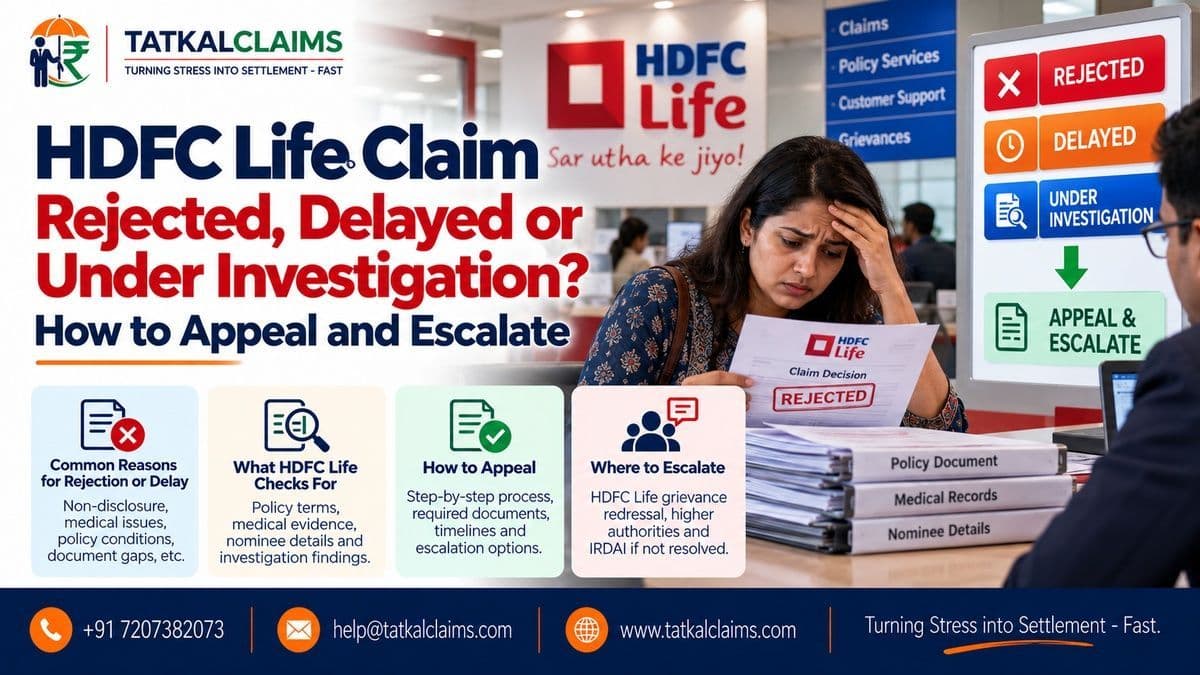
A family may think an HDFC Life death claim is moving normally until the file suddenly changes direction: more medical records are requested, a prior policy or proposal answer is questioned, the status stays under review, or a repudiation letter arrives. At that point, the claimant needs more than a generic complaint. The real task is to identify exactly what HDFC Life has decided, what evidence it relied on and which internal or external route fits the dispute.
Delay and rejection are not the same problem. A claim waiting for investigation needs a chronology and status challenge; a repudiated claim needs a clause-and-evidence appeal; a policy-lapse dispute needs premium and revival records; and a nominee or legal-title issue may require a different set of documents altogether.
This guide focuses on HDFC Life Insurance Company Limited. It does not cover HDFC ERGO General Insurance, which is a separate insurer handling general and health insurance products.
Written by: Tatkal Claims, Claims Review Team
Reviewed by: Ankit L Kanoi, Founder
What This HDFC Life Guide Covers
This page owns the HDFC-Life-specific search intent: death-claim filing, delayed claims, claims under investigation, repudiation, HDFC Life’s current 15-day and 45-day claim timelines, its stated rejection-letter practice, Claims Review Committee reference, grievance levels, Bima Bharosa and Insurance Ombudsman escalation.
It does not replace the broader Tatkal Claims guides on Section 45, early-death investigation, nominee law or general life-claim filing. Those pages remain the primary owners of the cross-insurer legal framework.
For the broader investigation framework, see Life Insurance Claim Under Investigation After an Early Death.
HDFC Life Is Not HDFC ERGO
HDFC Life is a life insurer. HDFC ERGO is a separate general insurer. A health, motor or property claim issued by HDFC ERGO should not be escalated using HDFC Life’s claim or grievance channels.
First Identify What HDFC Life Has Actually Done
| Status | What it usually means | Immediate claimant action |
| Requirement pending | HDFC Life says one or more documents or clarifications are outstanding | Ask for one consolidated written list and submit with proof |
| Under investigation | Additional verification is being conducted before decision | Ask what issue is being verified and track the 45-day standard |
| Delayed | The applicable processing period has passed without decision/payment | Raise a dated grievance with the chronology |
| Rejected / repudiated | HDFC Life has issued an adverse claim decision | Audit the exact ground, policy wording, dates and evidence |
| Partly admitted | One benefit or amount is admitted but another is disputed | Separate the admitted amount from the disputed component |
Do not treat a portal label as a complete explanation. If the status says only “pending” or “under process,” ask HDFC Life to identify the exact pending requirement, whether the claim is classified as investigated, and what the next decision date is expected to be.
How an HDFC Life Death Claim Is Filed
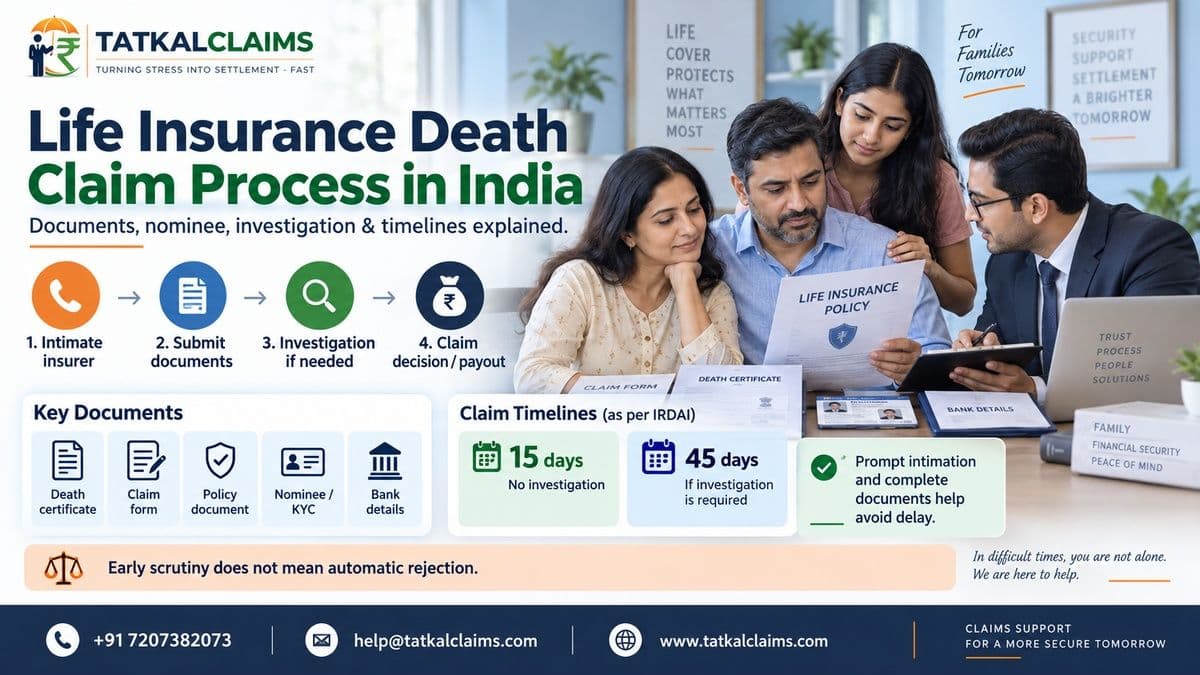
HDFC Life’s current claims page provides death-claim forms and document checklists. The usual file can include the claim form, death certificate, claimant identity and bank details, policy documents and additional medical or accidental-death records depending on the facts.
The exact requirement can differ by policy and claim type. The claimant should therefore respond to the actual checklist or written requirement issued for the claim rather than assuming every death claim requires the same documents.
| Document/date | Why it matters |
| Policy schedule | Confirms product, risk commencement, sum assured, riders and policy number |
| Proposal and medical records | Critical where disclosure or underwriting is disputed |
| Revival record, if any | Can affect policy status and Section 45 timing |
| Claim acknowledgement/reference | Anchors the claim chronology |
| Death certificate | Core evidence of death |
| Claimant KYC and bank details | Supports entitlement and payout processing |
| Hospital/doctor records | Relevant where medical history or cause of death is investigated |
| FIR/post-mortem/police papers, if relevant | May be required for accidental or unnatural death |
| Queries and replies | Shows what HDFC Life requested and when you responded |
For the broader nominee and filing process across insurers, see Life Insurance Death Claim Process in India.
Current HDFC Life Death-Claim Timelines: 15 Days and 45 Days
HDFC Life’s current claims page states a maximum processing timeline of 15 days from lodging the claim where investigation is not required and 45 days from lodging the claim where investigation is required.
These are processing standards, not a promise that every disputed claim will be paid within that period. A claimant should still confirm whether HDFC Life says the file is complete and whether it has formally classified the claim as requiring investigation.
A Useful HDFC Life-Specific Detail: Rejection Communication
HDFC Life’s current claims page says that if a claim is rejected, it will send a detailed rejection letter within 10 days of the decision and include the reason for rejection.
That letter should become the starting point of the appeal. Do not answer a rejection you have not read. If you were told verbally that the claim was rejected but have no detailed letter, ask for the written decision and reason.
| Check | Why it matters |
| Exact rejection ground | Defines the dispute you must answer |
| Policy clause or condition | Shows the contractual basis being relied on |
| Proposal/revival allegation | May trigger Section 45 and materiality analysis |
| Medical or investigator evidence | Lets you test whether the record supports the allegation |
| Policy/revival dates | Critical to the statutory three-year calculation |
| Benefit affected | Clarifies whether the whole claim or only a rider/component is denied |
If HDFC Life Says the Claim Is Under Investigation
Investigation is a verification stage, not itself a repudiation. The practical question is what HDFC Life is checking and whether the claimant has supplied everything reasonably required.
Common areas can include prior medical treatment, proposal answers, occupation or income, cause of death, revival declarations, policy status, claimant entitlement or authenticity of supporting records.
When an investigator asks family members for statements, answer from records where possible. Do not guess dates, diagnoses or habits simply to fill silence. If a statement is reduced to writing, read it before signing and retain a copy where possible.
| 1 | What specific issue is being investigated? |
| 2 | What documents remain outstanding and why are they material? |
| 3 | Has HDFC Life received all documents already submitted? |
| 4 | On what date was the claim lodged / treated as complete? |
| 5 | Is the claim formally classified as requiring investigation? |
| 6 | What is the expected decision date under the 45-day processing standard? |
Common Rejection Grounds — and What to Check
| Ground raised | What to examine before appealing |
| Medical non-disclosure | Proposal questions, pre-policy records, medical tests, materiality and Section 45 timing |
| Other policies / financial underwriting | Exact proposal wording, disclosure actually made, financial evidence and materiality |
| Policy lapse | Premium due date, grace period, bank debit, auto-debit failure, revival and policy status |
| Revival-related dispute | Revival form, declaration, medical evidence and revival date |
| Suicide or other exclusion | Exact policy clause, dates and cause-of-death evidence |
| Accidental rider rejected | Rider wording, FIR/post-mortem and causal facts |
| Nominee/title issue | Separate admissibility of claim from entitlement to receive proceeds |
A repudiation based on one fact should not be answered with ten unrelated arguments. Build the appeal around the insurer’s actual allegation and the documents that prove or disprove it.
Section 45 and HDFC Life Claims
Section 45 of the Insurance Act applies to life insurance policies generally. It sets the statutory three-year framework for when a policy can be called in question, measured from the latest relevant date among policy issuance, commencement of risk, revival and rider, as applicable.
Within the applicable window, an insurer can rely on qualifying fraud or material misstatement/suppression subject to the statutory tests. For a non-fraud material-misstatement case, the fact must have a direct bearing on the risk and the statutory communication requirements matter.
Do not calculate the three-year period only from the original policy issue date if the policy was revived. Revival can change the relevant date.
For the full statutory framework, see Life Claim Rejected After 3 Years? What Section 45 Actually Protects.
Why the Proposal Form Wording Matters
Tatkal Claims already has an HDFC Life case study involving a ₹50 lakh death claim where the Kurnool District Consumer Commission examined the wording of the proposal form and the allegation concerning other insurance policies. That decision is useful as an illustration of why the exact question asked and the evidence of disclosure matter.
It should not be treated as a universal rule that every similar HDFC Life rejection will fail. Consumer commission decisions turn on their own pleadings, evidence, proposal wording and facts.
Read the separate case study: HDFC Life ₹50 Lakh Claim — Kurnool Commission on Proposal Form Ambiguity.
HDFC Life Claims Review Committee
HDFC Life’s current claims page refers to a Claims Review Committee and says a claimant who remains dissatisfied after the committee’s response can approach the Insurance Ombudsman. HDFC Life’s current governance material also lists the Claims Review Committee among its management committees.
The public claims page does not set out a detailed claimant-facing CRC application procedure in the same way it sets out its grievance levels. For a repudiated claim, ask HDFC Life or its Grievance Redressal Officer to confirm how the claim review should be routed and retain that written response.
HDFC Life Grievance Escalation
HDFC Life’s current grievance page provides an initial grievance stage with a regulatory TAT of 14 days. If the claimant receives no response or is dissatisfied, the matter can be escalated to Level One.
The current page says Level One is handled by Chief Manager and above — Customer Relations, with a stated response period of 10 working days. If still unresolved, Level Two goes to the Grievance Redressal Officer / Vice President (Customer Relations), with a stated 7-working-day response period. The page currently identifies gro@hdfclife.com for Level Two escalation.
| Stage | Published route / TAT |
| Initial concern | Branch / online grievance / service@hdfclife.com / helpline — 14 days |
| Level One | Chief Manager and above — Customer Relations — 10 working days |
| Level Two | Grievance Redressal Officer / VP (Customer Relations) — 7 working days |
| After unresolved insurer process | Bima Bharosa and, where eligible, Insurance Ombudsman |
| Claim-review issue | Ask HDFC Life to route the repudiation to its Claims Review Committee as applicable |
For a delayed claim, the grievance should attach the claim chronology and ask one clear question: what exactly is preventing the decision? For a repudiated claim, the grievance should be accompanied by the reason-by-reason appeal, not just a complaint that the outcome is unfair.
Bima Bharosa and the Insurance Ombudsman
HDFC Life’s grievance page links dissatisfied customers to Bima Bharosa, IRDAI’s grievance platform. This is useful for creating a regulator-visible complaint trail where the insurer’s internal response is delayed or inadequate.
The Insurance Ombudsman is a separate external forum. Current Council for Insurance Ombudsmen guidance requires the complainant to first approach the insurer or broker. An eligible complaint can then be filed after rejection, an unsatisfactory response, or no reply for one month, subject to the applicable filing period and other rules.
Current Ombudsman guidance also uses a ₹50 lakh monetary ceiling for the compensation/loss under the policy and restricts complaints where the same subject matter is already pending before or disposed of by specified other forums.
Compare the two escalation routes in Bima Bharosa vs Insurance Ombudsman.
A 7-Day Working Plan After an HDFC Life Rejection or Serious Delay
| Day 1 | Collect policy, proposal, revival papers, claim acknowledgement and rejection/delay communications |
| Day 2 | Build a date-by-date chronology and identify the 15-day/45-day point |
| Day 3 | Map each rejection ground to the exact policy/proposal wording |
| Day 4 | Collect medical, employer, bank, premium or police records needed to answer the allegation |
| Day 5 | Draft a numbered representation with annexures |
| Day 6 | Check Section 45 dates and any revival/rider date |
| Day 7 | Submit through the stated claim-review/grievance route and preserve the acknowledgement |
When the Appeal Position May Be Stronger — or Weaker
| Potentially stronger | Potentially weaker |
| The alleged fact was disclosed in the proposal or medical records | Signed proposal/revival documents contain a clear contrary answer |
| HDFC Life cannot identify the material supporting the allegation | Primary records directly support the insurer’s allegation |
| The proposal question is ambiguous or does not ask what HDFC Life now alleges was suppressed | The question is clear and the omitted fact is material |
| Payment records contradict a lapse allegation | Policy status clearly shows no cover on the event date |
| The claim is outside the Section 45 challenge window on the correct relevant date | The claim is within the statutory window and evidence supports a qualifying ground |
| The insurer’s delay is unexplained after the file is complete | A material claimant-side requirement remains genuinely outstanding |
These are indicators, not outcomes. The actual policy, proposal/revival forms, dates and evidence determine the case.
How Tatkal Claims Can Help
Tatkal Claims can review the HDFC Life policy, proposal and revival records, claim correspondence, rejection letter, medical/employer evidence, investigator communications and grievance history to identify the real dispute and the evidence that matters.
Where appropriate, assistance can include preparing a structured review representation, organising annexures, identifying missing evidence, challenging delay and escalating through HDFC Life’s grievance process, Bima Bharosa or the Insurance Ombudsman. No claim outcome can be guaranteed.
Frequently Asked Questions
Frequently asked questions
How long should HDFC Life take to process a death claim?
HDFC Life’s current claims page states 15 days from lodging the claim where investigation is not required and 45 days where investigation is required. The actual file should still be checked for outstanding requirements and the date HDFC Life treats the claim as lodged or complete.
What should I do if HDFC Life says my claim is under investigation?
Ask what specific issue is being verified, what documents remain outstanding, whether the claim is formally classified as requiring investigation and the expected decision date under the 45-day processing standard.
How does HDFC Life communicate a rejected claim?
HDFC Life’s current claims page says it sends a detailed rejection letter within 10 days of the decision and includes the reason for rejection. If you have only a verbal rejection, ask for the written decision.
Can I challenge an HDFC Life rejection based on non-disclosure?
Yes, but the strength of the appeal depends on the exact proposal/revival question, what was disclosed, the evidence, materiality and Section 45. Non-disclosure is not a one-size-fits-all issue.
Does HDFC Life have a Claims Review Committee?
HDFC Life’s current claims page refers to a Claims Review Committee, and current company governance material lists the committee. The public page does not provide a detailed claimant-facing application process, so ask HDFC Life or the GRO to confirm routing for your specific claim.
What is HDFC Life’s current grievance escalation?
The current grievance page provides an initial 14-day stage, Level One with a stated 10-working-day response period, and Level Two through the Grievance Redressal Officer with a stated 7-working-day response period.
Is HDFC Life the same as HDFC ERGO?
No. HDFC Life is a life insurer. HDFC ERGO is a separate general insurer. Use the insurer named on your policy schedule and do not mix their claim or grievance channels.
Does Section 45 apply to HDFC Life policies?
Yes. Section 45 of the Insurance Act applies to life insurance policies generally. The three-year calculation can depend on policy issuance, commencement of risk, revival and rider dates.
Can I complain through Bima Bharosa if HDFC Life does not resolve my grievance?
Yes. HDFC Life’s current grievance page links dissatisfied customers to Bima Bharosa. It is an IRDAI grievance platform and is different from filing an Insurance Ombudsman complaint.
When can I approach the Insurance Ombudsman?
Current Ombudsman guidance requires that you first approach the insurer or broker. An eligible complaint may then be filed after rejection or an unsatisfactory response, or after one month without reply, subject to the filing deadline, ₹50 lakh monetary ceiling and other eligibility conditions.
Sources and Methodology
Disclaimer: This guide explains current HDFC Life claim-handling information, selected insurer procedures, the Insurance Act and grievance/Ombudsman routes in general terms. Actual rights depend on the policy wording, proposal and revival records, premium status, cause of death, claimant entitlement, dates, evidence and applicable law. HDFC Life procedures may change, so the latest insurer communication for the specific claim should be checked before filing. This is not legal advice and does not guarantee claim settlement.