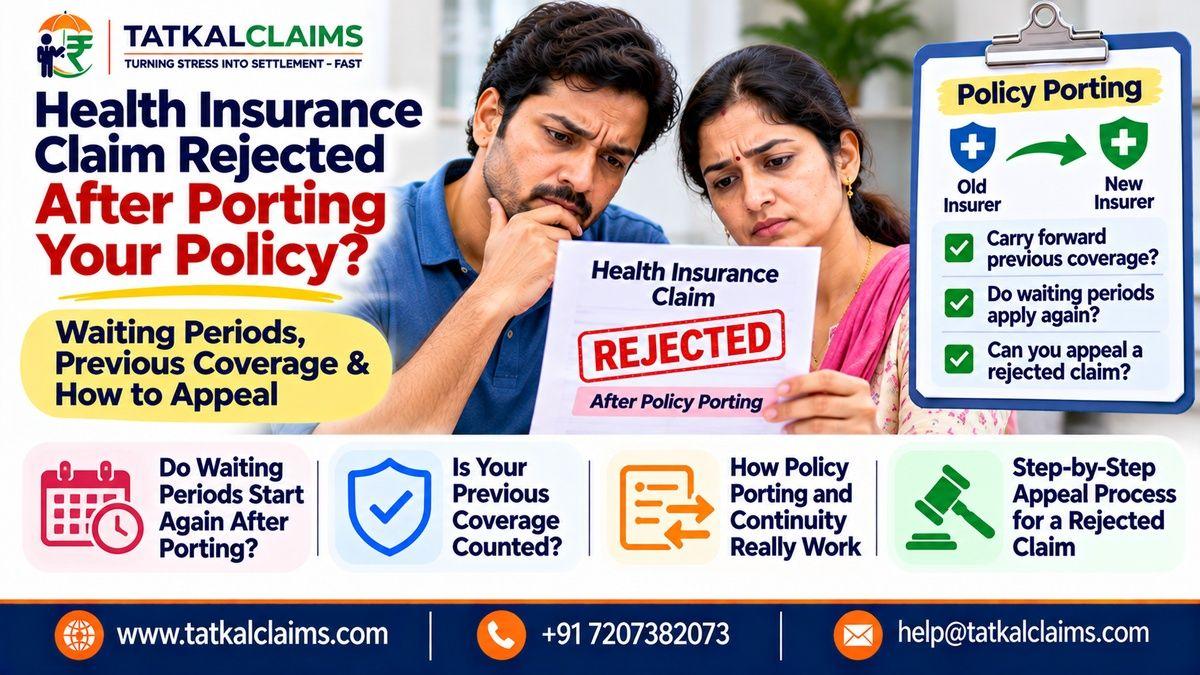
You had health insurance for four years. You switched companies at renewal because the new policy looked better. Six months later, you needed surgery. The new insurer rejected the hospital bill, saying: “Waiting period not completed.” The question is not simply when the new policy began. It is whether the insurer gave you credit for the years you were already insured.
In India, eligible health insurance portability lets you move to another insurer without losing qualifying waiting-period credits from continuous previous coverage. But it does not promise that every old benefit survives, that the whole amount of a higher new policy is immediately free of waiting periods, or that any claim must be paid regardless of other policy terms.
What Does Porting a Health Insurance Policy Actually Mean?
Portability is switching a qualifying health insurance policy from one insurance company to another, generally at renewal, and carrying forward eligible credits from the old policy. A Customer Information Sheet (CIS) should explain key items such as coverage, exclusions, waiting periods and portability. It is not the same as buying a brand-new policy with no previous insurance history.
Migration is different: you change health insurance products within the same insurer. Both can protect continuity credits, but the paperwork and the receiving insurer are different. The new insurer can assess a portability proposal under its applicable underwriting policy before accepting it. Once it issues cover on stated terms, the claim must be examined against those terms and applicable continuity rules. If renewal of the existing plan was refused after a claim, review our health insurance renewal-refusal guide before deciding whether to seek portability.
Can the New Insurer Restart Your Waiting Period From Zero?
Not simply because its brand name is different. The 5 September 2024 IRDAI policyholder-protection master circular says porting policyholders are entitled to eligible credits for pre-existing-disease waiting periods, specified waiting periods, no-claim bonus, moratorium and other qualifying matters, up to the applicable insured amount and benefits carried from the previous policy.
That does not mean every new benefit has already served a waiting period. If your new policy adds a treatment, a higher sum insured or coverage that the earlier policy did not include, ask the insurer how the new term applies and what portion of the claim the portability credit protects. A written calculation is more persuasive than a blanket claim that all waiting periods vanish on porting.
Also check whether the old policy was truly continuous, whether the new policy was accepted and commenced without a break, and which insured family member had accrued the relevant time. The statement “I have been insured for years” needs to be backed by policy schedules, payment records and the actual insured person's coverage history.
Three Waiting-Period Problems That Often Get Confused
| Insurer's reason | The first question to ask | Evidence that matters |
|---|---|---|
| Pre-existing disease waiting period | How many eligible months of continuous cover had this person already completed? | Old policy schedules, declared conditions, continuity/portability credit, new PED clause |
| Specific disease or procedure waiting period | Was this surgery subject to a specific wait, and how much prior credit applies? | Old and new policy wording, dates, treatment code, continuity-credit record |
| Initial waiting period on new policy | Has the insurer applied it despite accepted portability and eligible prior cover? | New-policy terms, port acceptance, dates and precise rejection clause |
| Higher new sum insured | Is the insurer applying a waiting period only to the additional insured amount? | Previous sum insured and bonus, new sum insured, claim amount and itemised split |
| Treatment newly covered under new product | Was the benefit available earlier, and does the new policy impose its own conditions? | Both policy benefit schedules, endorsements and procedure wording |
| Alleged lapse or coverage break | Was the renewal actually late, and does the regulatory grace-period protection apply? | Premium dates, grace-period rule, renewal receipts and policy start/end dates |
Worked Example: Four Years of Cover, Then a New Insurer Says “Wait Three Years”
Imagine Priya had an individual health insurance policy covering ₹5 lakh from 1 July 2022 through 30 June 2026, renewed without a break. At renewal she successfully ported to another insurer for ₹5 lakh from 1 July 2026. In October 2026 she is hospitalised, and her new insurer rejects the claim because a pre-existing-disease waiting period supposedly began only on 1 July 2026.
The right challenge is to produce Priya's old four-year policy history, any disclosure or accepted medical-condition records, the new insurer's acceptance of portability, and the precise waiting-period clause. The insurer should explain why eligible previous coverage was not counted. This is an illustration, not a promise that a particular illness or procedure must be covered—medical necessity, exclusions and the rest of the contract still matter.
Now change one fact. Suppose she upgraded from ₹5 lakh to ₹10 lakh on porting. The old ₹5 lakh and any qualifying cumulative bonus may support credit, while the extra ₹5 lakh may be subject to conditions or waiting periods for the enhanced portion. Ask the insurer to show the insured-amount split and claim calculation rather than rejecting or promising the whole ₹10 lakh without analysis.
How to Calculate Your Waiting-Period Credit
A simple audit uses actual dates, not estimates. Start with the date the first qualifying health cover began for the relevant person. List every renewal, policy number, insurer change and sum insured. Mark any missed premium and whether it was cured within the legally applicable grace period. Compare the total eligible continuous cover with the waiting period the new insurer applies.
| Record | Example | What to verify |
|---|---|---|
| Old policy start | 1 July 2022 | Original schedule for the insured person |
| Old policy end / last renewal | 30 June 2026 | Continuous renewal proof and payment receipts |
| Ported policy starts | 1 July 2026 | Acceptance letter, new policy schedule, no gap |
| Amount insured before port | ₹5 lakh | Bonus, sublimits and benefit scope |
| Amount insured after port | ₹10 lakh | Whether the extra ₹5 lakh has distinct waiting conditions |
| Claim / hospitalisation date | 15 October 2026 | Which policy was in force on the date of treatment |
| Insurer's rejected head | PED waiting period | Exact clause, prior time credited and coverage slice |
For a family floater, make a separate row for each insured member. Someone added only recently may not have the same continuity history as a spouse covered for years. Do not borrow the policyholder's coverage time for another person without evidence that they were insured for that period.
Pre-Existing Disease, a 36-Month Wait and the Five-Year Moratorium Are Different
The Insurance Products Regulations, 2024 describe pre-existing disease and specific waiting periods and generally cap the disclosed pre-existing-disease waiting period at 36 months of continuous health cover, with defined product exceptions. Previously completed eligible coverage can count when a policy is ported. Always identify the old and new policy conditions and treatment dates before concluding the waiting period has finished. For a denial citing a listed procedure or Excl02, see our specific disease waiting-period appeal guide to distinguish the applicable waiting period from a pre-existing disease dispute.
The 60-month moratorium is a different protection. Under the 2024 rules, after 60 continuous months of applicable health insurance coverage—including qualifying porting or migration history—the insurer cannot contest a policy or claim on grounds of non-disclosure or misrepresentation except established fraud. This does not erase ordinary contractual coverage limits or mean excluded treatment becomes payable. For an increase in sum insured, the moratorium relating to the enhanced portion runs separately from that enhancement.
A 36-month PED waiting-period argument and a 60-month non-disclosure argument are not interchangeable. A rejection may invoke one, both or neither. Ask the insurer to identify exactly what it alleges.
For the rules on medical history, PED evidence and the moratorium, see our pre-existing disease claim rejection guide; the present article focuses on the continuity records that should move with the policy.
What if Your Policy Was Ported but the Old Medical History Was Missing?
An insurer may claim it has no record of the original policy, disclosures or previous waiting periods. The 2024 portability framework requires the old and new insurers to transfer relevant underwriting and claims history through the Insurance Information Bureau (IIB) process. The old insurer is to provide requested information within 72 hours of the request, and the new insurer is to decide and communicate on a portability proposal within five days after receiving that information. These are portability-processing timelines—not a guarantee that a hospital claim will be approved in five days.
Ask the new insurer whether its portability record shows your previous policy number, start and end dates, member-wise continuity, insured amount, bonus and accepted waiting-period credits. If the original insurer failed to send accurate information, request the IIB transfer date, what data is missing and what steps the new insurer has taken to correct it.
If your original proposal disclosed diabetes, hypertension or another condition, obtain the old proposal and medical underwriting records rather than relying on a vague renewal card. If an insurer alleges a disclosure conflict, respond to the exact question it says was answered incorrectly. Do not alter historic forms or create retrospective disclosures.
Where the insurer's decision relies on an inaccurate hospital history rather than the porting record, use our wrong medical records claim guide to separate record correction from the portability dispute.
What if You Applied to Port Late or There Was a Premium Gap?
IRDAI's 5 September 2024 protection circular says an applicant generally should approach the new insurer at least 30 days before, but not earlier than 60 days before, the existing policy's renewal due date. It also allows insurers to consider proposals received within 15 days of the renewal date, provided the acquiring insurer ensures no coverage break in such cases. Those are application rules; a late application is not itself proof that an issued policy lacks continuity.
A real uninsured gap requires careful checking. The 2024 health insurance circular also gives a 15-day grace period for monthly instalment payments and 30 days for quarterly, half-yearly or annual payments, and says renewal within the grace period protects accrued credits. The rules about coverage during grace periods can differ according to how premiums are paid. Do not assume the grace period always covers hospital bills or that a long lapse can be cured by paying later.
If porting was still awaiting approval at the old renewal date, ask the existing insurer about lawful continuation options before letting it expire. If the new policy was issued with an incorrect start date or the insurer's records show a fictional gap, preserve the email acceptance, premium debit and policy issue dates and seek correction in writing.
Portability Does Not Automatically Keep Every Benefit From the Old Policy
The insurer's acceptance of portability should not make the earlier waiting-period history vanish. But the receiving product can differ in room eligibility, co-payment, disease or procedure sublimits, deductibles, provider network, hospital package rules and other contract terms. A lower premium may come with less generous coverage. Continuity credit is not a promise of identical products.
For instance, an earlier plan might permit a single private room and the new plan might cap room rent. If the claim is reduced due to a documented room limit, the dispute is not automatically about portability. Likewise a maternity waiting period, newly introduced benefit or special add-on should be checked against the actual old and new wording rather than assumed to be universally portable.
If the new insurer cites both a waiting period and a co-pay or sublimit, ask for each deduction separately. A written itemised calculation can reveal whether the real problem is missing continuity credit, a distinct new benefit condition or an ordinary claim underpayment.
If your insurer paid part of the hospital bill but deducted a large amount, compare the decision with our health claim short-settlement guide before assuming portability is the only issue.
The Six Documents That Matter Most in a Portability Claim Appeal
First, assemble the full old-policy schedule history, not just the most recent card. Second, include old premium receipts or renewal acknowledgements showing no uninsured break. Third, get the portability request, proposal, acceptance and continuity-credit or portability certificate issued by the new insurer. Fourth, include the new policy schedule, endorsements, Customer Information Sheet and complete wording. Fifth, include the hospital documents and rejection letter quoting the waiting-period clause. Sixth, ask both insurers for the member-wise coverage/claim history or IIB portability transfer record as applicable.
Create a one-page table listing each policy number, insurer, covered member, start and end date, sum insured and no-claim bonus. If a renewal receipt falls in a grace period, identify its due date and actual payment date. Mark missing records instead of assuming continuity: a strong appeal tells the insurer exactly what to verify.
What to Ask the New Insurer if It Rejects the Claim
Do not send a generic email saying you have had insurance for years. Ask specific questions. Which person was covered under the earlier policy, and from which date? How many months of waiting-period credit has been recognised? What was the previous insured amount, including any eligible bonus? Does the rejection apply to the entire claim or only to an enhanced portion? Is the decision based on the ported policy's wording, a newly added benefit, or a suspected break?
If the insurer says no portability record exists, ask for the dates on which it requested and received information from the old insurer and whether it issued the policy after accepting the portability proposal. If the refusal relates to non-disclosure, ask for the original question, proposal response, medical evidence and its specific policy/claim basis.
Sample Letter: Request Reconsideration of a Waiting-Period Rejection
Subject: Health claim reconsideration — ported policy waiting-period credit not recognised
I am insured under policy [new policy number], claim [reference], with your company from [new cover start]. My previous health policy with [earlier insurer], number [old policy number], provided continuous cover for [person] from [original start] to [old policy end]. My portability application was accepted on [date]. Your claim decision dated [date] applies a waiting period for [disease/procedure].
Please confirm the continuous-cover months and waiting-period credit recognised for this insured person, including relevant no-claim bonus and previous sum insured; identify the exact current policy clause relied upon; and explain whether the disputed amount falls within the previous insured limit or an increase under the new policy.
If the continuity information is missing or incorrect, please obtain and reconcile the portability/underwriting history with the former insurer and issue a written, itemised reconsideration. I attach the old schedules and premium receipts, portability acceptance, new policy documents, medical records and claim rejection letter. Please identify any further specific evidence needed and explain the review outcome in writing.
How to Complain if Both Insurers Keep Blaming Each Other
Start with the current insurer's Grievance Redressal Officer. Send the continuity worksheet and policy documents and ask it to take ownership of reconciling the porting record with the previous insurer. If the old insurer has failed to provide policy history, raise a separate written request with its servicing/grievance team and retain both reference numbers.
If the insurer's response is unsatisfactory or the grievance is unresolved, the official Bima Bharosa system lets policyholders register or track insurance complaints. An eligible claim-rejection or policy-interpretation dispute may also be taken to the Insurance Ombudsman after first writing to the insurer, subject to the Council's 30-day complaint process, ₹50 lakh jurisdictional limit, filing timelines and restriction on the same dispute pending in another court or forum.
For eligibility, evidence and the correct order of escalation, see our Insurance Ombudsman complaint process guide; keep the claim decision and any refusal to recognise previous coverage.
How Tatkal Claims Can Help With a Portability Claim Dispute
Tatkal Claims can compare the old and new insurance contracts, rebuild a member-wise coverage timeline, identify how much waiting-period credit was earned, and test the insurer's stated reason for refusing the claim. Where the records support a challenge, we can help prepare a focused reconsideration letter and an evidence-indexed grievance. No amount is guaranteed: the payable benefit depends on the policy, continuity evidence and treatment facts.
Frequently asked questions
Can health insurance reject my claim after I port to another company?
Yes, where a valid policy term, exclusion or missing coverage applies. But the new insurer should recognise eligible continuity credits gained under the previous cover. A refusal based only on a new insurer's start date is worth checking against the actual portability record.
Does the waiting period start again after porting health insurance?
Eligible waiting-period credit for pre-existing diseases and specified conditions can transfer under IRDAI's 2024 rules. New benefits or enhanced insured amounts may have distinct conditions, so do not assume every waiting period disappears.
I completed four years with my old insurer. Can the new insurer impose a three-year PED wait?
Ask it to show the previous coverage months it accepted and the policy clause for the relevant person and insured amount. If those four years are eligible continuous coverage, ignoring them simply because you changed insurers is a serious issue to challenge.
What if I increased health insurance from ₹5 lakh to ₹10 lakh while porting?
The previous insured amount and qualifying bonus may carry continuity credit. The increased portion can be subject to additional conditions, including waiting periods. Ask for a calculation separating the original and additional insured amounts.
Is the five-year moratorium reset when I port my health policy?
The 2024 rules count eligible continuous months under ported and migrated policies toward the 60-month moratorium. This protection limits non-disclosure or misrepresentation challenges except established fraud; it does not make uncovered expenses payable.
What if the old insurer did not send my policy history to the new insurer?
Ask the new insurer for the portability transfer request and record, and the old insurer for confirmation of what was shared. The 2024 framework places obligations on insurers to transfer underwriting and claims information.
Does a 30-day premium grace period protect my waiting-period credit?
For qualifying renewals paid within the applicable regulatory grace period, accrued continuity credits are protected. Claim cover during a grace period depends on the payment mode and governing terms; a longer uninsured break is different.
Can the new insurer refuse the same room-rent or maternity benefit I had earlier?
Portability does not automatically carry every feature of your previous policy into a different product. Compare both benefit schedules, endorsements, waiting conditions and exclusions rather than assuming the new cover is identical.
Is a porting request accepted automatically if the old insurer sends details?
No. The new insurer evaluates the proposal under its underwriting framework. IRDAI specifies a five-day decision and communication deadline after receiving the existing insurer's information, not automatic acceptance.
Can I complain to the Insurance Ombudsman about lost waiting-period credit?
Potentially, if the dispute concerns claim repudiation, incorrect policy terms or servicing and falls within the Ombudsman's rules. Complain to the insurer first and verify the monetary limit, response interval, limitation and parallel-forum rules.
Primary Sources and Editorial Notes
This guide concerns eligible indemnity health insurance portability under the Indian regulatory framework and disputes after a new insurer has issued a policy. It does not mean every portability proposal must be accepted, every original benefit continues unchanged, or a waiting-period dispute overrides a valid exclusion. The worked examples are hypothetical and should not be treated as claim decisions.