A pedestrian, cyclist, two-wheeler rider or car occupant is seriously injured—or killed—by a motor vehicle that leaves the scene. Police investigate, but the offending vehicle cannot be identified despite reasonable efforts. In that situation, the family may have no known owner or insurer against whom to immediately pursue an ordinary motor-accident claim.
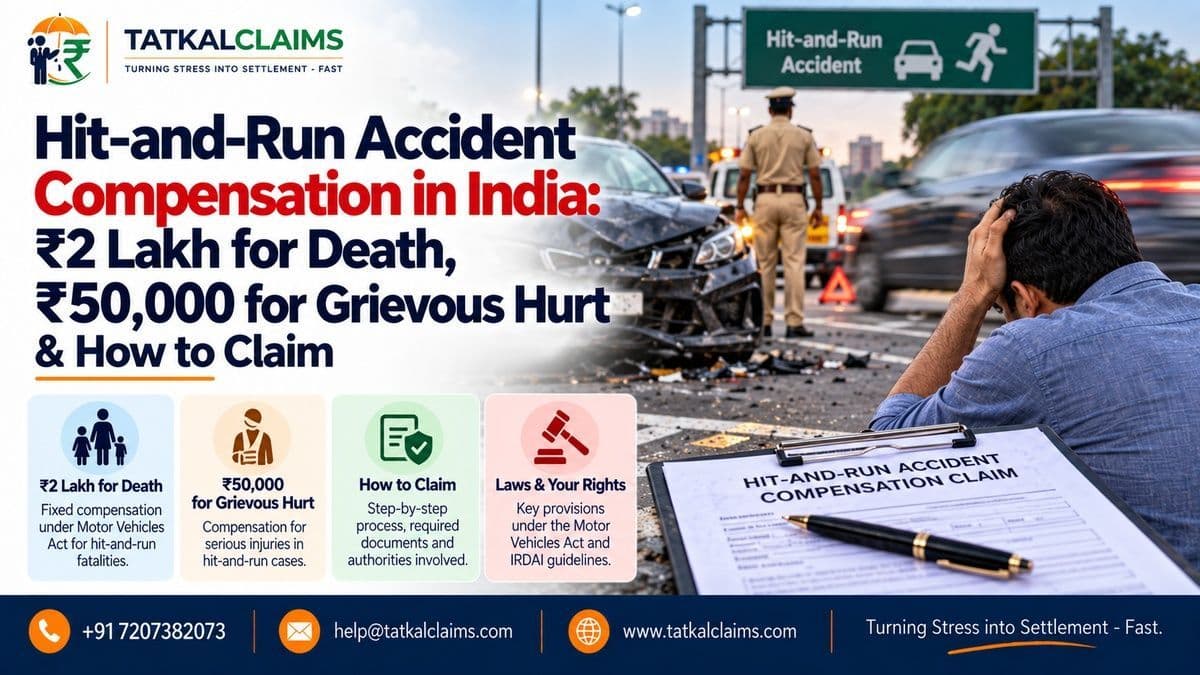
Section 161 of the Motor Vehicles Act creates a separate fixed-compensation route for this specific problem. The current statutory amount is ₹2 lakh where a person dies and ₹50,000 where a person suffers grievous hurt, subject to the Act and the Compensation to Victims of Hit and Run Motor Accidents Scheme, 2022 as amended in March 2026.
This route is not the same as a normal MACT claim against an identified vehicle, and it is not the same as a claim merely because the driver fled the spot. The statutory hit-and-run definition focuses on whether the identity of the offending vehicle cannot be ascertained despite reasonable efforts.
What Legally Counts as a Hit-and-Run Accident Under Section 161?
The Motor Vehicles Act treats a hit-and-run motor accident as one where the identity of the motor vehicle or vehicles causing the accident cannot be ascertained despite reasonable efforts.
That means a driver can flee the scene and the case can still stop being a Section 161 hit-and-run case if the vehicle is later identified through CCTV, registration details, witnesses, toll or FASTag records, number-plate fragments, app data or police investigation.
Conversely, the victim does not need to know the owner or insurer if the offending vehicle itself remains genuinely unidentified after reasonable efforts.
How Much Compensation Is Payable?
| Outcome | Fixed statutory amount |
| Death caused by a hit-and-run motor accident | ₹2,00,000 |
| Grievous hurt caused by a hit-and-run motor accident | ₹50,000 |
Section 161 allows the Central Government to prescribe a higher amount, but the current scheme and recent Government material continue to use ₹2 lakh for death and ₹50,000 for grievous hurt.
This is fixed statutory compensation. It is not calculated from the victim’s income, age, future prospects, medical bills or dependency in the way a conventional MACT award may be.
That difference matters. A Section 161 claim can provide a defined fund-based payment where the vehicle is unknown, but it should not be described as the full economic value of a serious injury or death.
When the Section 161 Scheme May Not Fit
| Situation | Section 161 position |
| Vehicle remains unidentified despite reasonable efforts | Potentially fits the hit-and-run scheme. |
| Vehicle number/identity is known but driver escaped | Usually not the statutory hit-and-run situation because the vehicle is identified. |
| Vehicle is identified but has no insurance | Different problem; Section 161 is not simply an uninsured-vehicle compensation route. |
| Only minor/simple injury | Section 161 fixed compensation is for death or grievous hurt. |
| Vehicle is identified later | The case can move into the identified-vehicle/MACT framework, subject to adjustment/refund rules. |
| Accident did not arise from use of a motor vehicle | Section 161 does not apply. |
Hit-and-Run Scheme vs MACT Claim: Do Not Mix Them Up
A conventional MACT claim under the Motor Vehicles Act generally proceeds against an identified vehicle, owner, driver and/or insurer and can involve questions of fault, statutory no-fault compensation, income, dependency, disability, medical expenditure and insurer defences.
The Section 161 scheme exists because the usual identified-vehicle route may be impossible when the offending vehicle cannot be traced. The compensation is therefore fixed rather than individually assessed.
If the offending vehicle is later identified, Section 163 and the Motor Vehicle Accident Fund rules contain adjustment or refund mechanisms so the same loss is not paid twice without accounting for the earlier Section 161 payment.
If the offending vehicle is identified or later traced, use our third-party motor accident and MACT compensation guide to understand the separate claim routes.
What Changed in March 2026?
The Compensation to Victims of Hit and Run Motor Accidents (Amendment) Scheme, 2026 took effect on 2 March 2026 and materially updated the 2022 process.
The amendment formally introduced a web/electronic portal developed and managed by the GI Council, updated the roles of the District Road Safety Committee and State Road Safety Council, revised Forms I, II and III, and required claim-enquiry and sanction communications to move through the portal at key stages.
The revised Form I now expressly captures claimant contact details, Aadhaar/identity information, bank account particulars, FIR, injury or post-mortem material, death certificate where applicable, police-station details and hospital/medical-practitioner details.
The 2026 amendment also allows the legal representative of a grievously injured claimant who later dies from a cause unrelated to the accident to receive the sanctioned grievous-hurt compensation, subject to the scheme.
Important 2026 Correction: Cashless Treatment Is No Longer Deducted Under Old Paragraph 22(2)
The original 2022 scheme contained paragraph 22(2), which required the Claims Settlement Commissioner to deduct certain cashless-treatment expenditure from the fixed Section 161 compensation.
The March 2026 amendment expressly omitted paragraph 22(2) and its provisos. Therefore, older summaries that automatically subtract the hospital’s cashless-treatment amount from the ₹2 lakh or ₹50,000 Section 161 sanction no longer reflect the amended scheme.
This is different from Section 163, which still contains adjustment/refund rules where other compensation is later awarded or paid for the same death or grievous hurt.
Separate Benefit: Cashless Treatment of Road Accident Victims Scheme, 2025
Road-accident victims also have a separate statutory cashless-treatment framework under Section 162. The Cashless Treatment of Road Accident Victims Scheme, 2025 provides treatment cover up to ₹1.5 lakh per victim, subject to a maximum period of seven days from the date of accident, at designated hospitals under the scheme.
This treatment scheme applies to road accidents caused by use of motor vehicles and is wider than Section 161 because it is not limited to death or grievous hurt and does not depend on the offending vehicle remaining unidentified.
Do not confuse the two benefits: Section 162 addresses emergency treatment; Section 161 is fixed compensation for death or grievous hurt in a statutory hit-and-run case.
What the Police Should Do in a Hit-and-Run Case
The 2022 scheme and the Supreme Court’s January 2024 implementation order place practical responsibilities on the police once an accident is treated as a hit-and-run case.
The Supreme Court directed the police to inform the injured victim or legal representatives of the deceased about the availability of the scheme and to provide the contact details of the jurisdictional Claims Enquiry Officer.
The Court also directed the officer in charge of the police station to forward the First Accident Report to the Claims Enquiry Officer within one month from the date of the accident, together with victim/legal-representative details available with the police.
If the Claims Enquiry Officer receives the accident information but no claim application is filed within one month, the Supreme Court directed that the concerned District Legal Services Authority be informed so it can contact and assist the claimants.
Who Can Apply?
For grievous hurt, the injured person can apply. The amended 2026 Form I also accommodates an application through the legal representative where a grievously injured person later dies from a cause unrelated to the accident.
For death caused by the hit-and-run accident, the legal representative or representatives of the deceased can apply.
Where there is more than one claimant, the Claims Enquiry Officer has the duty to decide who the rightful claimants are under the scheme.
Where Is the Application Filed?
Under the amended paragraph 20, the applicant submits Form I, Form IV undertaking and the required documents—including through electronic means—to the Claims Enquiry Officer of the Sub-Division or Taluka in which the accident took place.
The Claims Enquiry Officer is generally a Sub-Divisional Officer, Tehsildar or other specified officer of equivalent level under the State’s implementation setup. Local designations can vary.
Because the 2026 amendment now uses a GI Council portal for claim processing, the district administration may process parts of the application electronically even where the claimant first approaches the local revenue/district office.
Documents Required Under the Current Form I
| Document / information | Why it matters |
| Victim’s ID proof | Identifies the injured/deceased person. |
| Claimant’s ID / Aadhaar details | Required in the revised Form I for the claimant/legal representative. |
| Bank passbook or statement | Provides account number, IFSC, branch and claimant banking proof. |
| FIR copy | Current Form I expressly asks for it with accident place/date/time. |
| Injury report or post-mortem report | Supports grievous-hurt or death claim. |
| Death certificate | Required for a death claim. |
| Police station details | Identifies where the accident occurred or was registered. |
| Hospital / medical practitioner details | Identifies who treated or examined the victim. |
| Claimant names and relationship | Important in death cases and multiple-claimant situations. |
| Other helpful accident evidence | CCTV requests, witness contacts, photographs and police correspondence can support the hit-and-run classification. |
Step-by-Step Claim Process
| Stage | What should happen |
| 1. Police registration / investigation | Accident is reported and reasonable efforts are made to identify the offending vehicle. |
| 2. Application | Form I + Form IV + supporting documents go to the Claims Enquiry Officer for the accident location. |
| 3. Enquiry | Claims Enquiry Officer obtains the FAR/post-mortem material as applicable and verifies claimant/accident facts. |
| 4. Enquiry report | Officer should send Form II report and recommendation to the Claims Settlement Commissioner within one month of receiving the application. |
| 5. Sanction | Claims Settlement Commissioner should, as far as possible, sanction within 15 days of receiving the report and send Form III to the GI Council through the portal. |
| 6. Payment | GI Council makes e-payment to the claimant/legal representative’s bank account, ordinarily within 15 days of sanction receipt. |
| 7. Extended payment period | The scheme permits a further period of up to 30 days for recorded reasons; payment-detail deficiencies may be sought from the claimant. |
What If the Claims Enquiry Officer Rejects the Application?
Paragraph 20 retains an important safeguard: if the Claims Enquiry Officer does not accept the grounds advanced by the applicant, the officer must record a speaking order and communicate the reasons for not accepting the claim application.
That written reason matters. A claimant should not be left with only an oral statement such as “vehicle not traced yet,” “not our jurisdiction,” “no scheme available,” or “come later” without a recorded decision where the application is actually being rejected.
The response should be checked against the statutory definition, police investigation, FIR/FAR, injury classification and the amended 2026 scheme rather than answered with a generic representation.
What If the Claim Is Delayed?
The scheme is deliberately time-bound: one month for the Claims Enquiry Officer’s report after receipt of the application, up to 15 days for sanction after the Claims Settlement Commissioner receives that report, and ordinarily 15 days for GI Council payment after sanction.
Those stages are sequential, so the overall calendar depends on when each authority actually receives the relevant document. Keep dated acknowledgements, application number, eDAR Victim ID where available, and written follow-ups.
The 2026 amendment makes the District Road Safety Committee responsible for maintaining month-wise statistics of applications received, awarded or pending and reasons for pendency, while the State Road Safety Council can review implementation and issue directions to district authorities.
Is There a Filing Limitation Period?
In its January 2024 order, the Supreme Court expressly noted that the 2022 Scheme does not prescribe a specific limitation period for submitting a hit-and-run claim, unlike the older Solatium Scheme, 1989.
The March 2026 amendment changed the forms and procedure but did not introduce a specific filing limitation into paragraph 20.
That does not mean delay is harmless. Accident records, witnesses, hospital documents and police classification become harder to reconstruct over time. File as soon as possible.
What If the Offending Vehicle Is Identified Later?
If police later identify the vehicle, the claim may move into the ordinary identified-vehicle framework involving the owner, driver and insurer where applicable.
Section 163 requires adjustment/refund where other compensation is later awarded or paid for the same death or grievous hurt after Section 161 compensation. The Claims Tribunal or other authority must check whether Section 161 compensation has already been paid or is pending.
The Motor Vehicle Accident Fund rules were also amended with effect from January 2026 to address reimbursement to the Fund where the offending vehicle is subsequently identified and a MACT award is made.
Do not abandon an identified-vehicle claim merely because ₹2 lakh or ₹50,000 was already received under Section 161. The later route may involve a different compensation assessment, subject to statutory adjustment so there is no double recovery.
What If the Vehicle Is Known but Uninsured?
A known uninsured vehicle is not automatically a Section 161 hit-and-run case because the defining problem under Section 161 is that the identity of the offending vehicle cannot be ascertained despite reasonable efforts.
There are separate Motor Vehicle Accident Fund provisions and the 2025 cashless-treatment framework for uninsured-vehicle situations, while a MACT claim may still be pursued against the identified owner/driver depending on the facts.
For an identified offending vehicle, even if insurance is disputed or absent, the ordinary owner/driver and MACT framework should be analysed separately from Section 161.
Can You Also Claim Under Personal Accident, Life or Other Insurance?
Section 161 is a statutory motor-accident compensation route. It does not by itself replace separate contractual insurance benefits such as personal accident cover, life insurance or another policy that may respond to the death or injury.
Those contracts have their own eligibility, exclusions, nomination and claim-document requirements. A rejection under a private policy should be analysed separately from the Section 161 fund claim.
If a separate insurer rejects a contractual claim arising from the accident, use our insurance claim rejection guide rather than treating the Section 161 application as an insurer grievance.
Is Bima Bharosa or the Insurance Ombudsman the Main Route for a Section 161 Claim?
No. The primary Section 161 route is the statutory scheme administered through the Claims Enquiry Officer, Claims Settlement Commissioner, GI Council portal and Motor Vehicle Accident Fund.
Bima Bharosa and the Insurance Ombudsman are principally relevant to grievances involving regulated insurers. They should not be substituted for the prescribed Section 161 application process.
If you also have a separate dispute with an insurance company, see Bima Bharosa vs Insurance Ombudsman for the insurer-grievance routes.
What to Ask the District Authority if the Claim Is Stuck
| Ask for | Why it helps |
| Application number | Proves the claim was formally received. |
| eDAR Victim ID | Links the case to the electronic accident record where generated. |
| Name/designation of Claims Enquiry Officer | Identifies the responsible authority. |
| Date application was received | Starts the one-month enquiry-report timeline. |
| Date Form II was sent | Shows whether the matter has reached the Claims Settlement Commissioner. |
| Date Form III was sanctioned | Starts the GI Council payment stage. |
| Written deficiency list | Prevents repeated informal document demands. |
| Speaking order if rejected | Allows the reasons to be reviewed and challenged. |
A Practical 7-Day Action Plan After a Serious Hit-and-Run
| Day | Action |
| Day 1 | Ensure police registration, preserve accident location details, CCTV leads and witness contacts. |
| Day 2 | Collect hospital records, injury report or post-mortem material and victim/claimant IDs. |
| Day 3 | Confirm whether police are treating the offending vehicle as unidentified after reasonable efforts. |
| Day 4 | Identify the Claims Enquiry Officer for the Sub-Division/Taluka where the accident occurred. |
| Day 5 | Prepare current Form I, Form IV, bank proof, FIR and medical/death documents. |
| Day 6 | Submit and obtain a dated acknowledgement/application number. |
| Day 7 | Create a follow-up calendar for the one-month enquiry report, 15-day sanction stage and payment stage. |
How Tatkal Claims Can Help
Tatkal Claims can review whether the facts actually fit the Section 161 hit-and-run definition, organise the current Form I/Form IV documents, identify missing FIR/FAR, medical, bank or legal-representative material, and build a dated claim file for the Claims Enquiry Officer.
Where the application is delayed or rejected, assistance can include reviewing the speaking order or deficiency, comparing it with the amended 2026 scheme, preparing a structured representation to the competent district authority, and separating the Section 161 claim from any MACT, personal accident or other insurer claim.
A review should not promise ₹2 lakh or ₹50,000 merely because the words “hit and run” appear in an FIR. The unidentified-vehicle test, death/grievous-hurt requirement, supporting records and scheme procedure still have to be satisfied.
Frequently Asked Questions
Frequently asked questions
How much compensation is available for a hit-and-run death in India?
Section 161 currently provides a fixed ₹2 lakh for death resulting from a statutory hit-and-run motor accident, subject to the Act and the current scheme.
How much is available for injury?
Section 161 provides ₹50,000 for grievous hurt. Simple or minor injury does not automatically qualify for this fixed compensation, although the separate 2025 cashless-treatment scheme may still be relevant to road-accident treatment.
Does the driver merely fleeing the scene make it a Section 161 hit-and-run?
Not by itself. The offending motor vehicle must remain unidentified despite reasonable efforts. If the vehicle is identified, the claim generally belongs in the identified-vehicle framework.
Where do I submit the application?
Current paragraph 20 directs Form I, Form IV and supporting documents to the Claims Enquiry Officer of the Sub-Division or Taluka where the accident occurred, including through electronic means.
What documents are required after the 2026 amendment?
The revised Form I asks for identity details, claimant Aadhaar/ID, bank information, FIR, injury or post-mortem report, death certificate where applicable, police-station details, hospital/medical-practitioner details and claimant relationship information.
How long should the process take?
The Claims Enquiry Officer should send the report within one month of receiving the application. The Claims Settlement Commissioner should, as far as possible, sanction within 15 days of receiving that report. GI Council payment is ordinarily due within 15 days of the sanction order, with a limited extension mechanism.
Is there a six-month filing deadline?
The Supreme Court noted in January 2024 that the 2022 Scheme does not prescribe a specific limitation period for claim submission. The March 2026 amendment did not add one to the application paragraph. Even so, claimants should apply promptly.
Is cashless hospital treatment deducted from the ₹2 lakh or ₹50,000?
The original 2022 scheme contained a deduction mechanism in paragraph 22(2), but the March 2026 amendment expressly omitted that sub-paragraph and its provisos. Older summaries applying that automatic deduction are outdated.
What happens if police later identify the offending vehicle?
The ordinary owner/driver/insurer and MACT framework may become available. Section 163 and current Fund rules address adjustment or refund so Section 161 compensation is accounted for if other compensation is later awarded.
Can Bima Bharosa process the Section 161 hit-and-run application?
The primary route is not Bima Bharosa. Section 161 claims follow the statutory Claims Enquiry Officer, Claims Settlement Commissioner, GI Council portal and Motor Vehicle Accident Fund process. Bima Bharosa is more relevant to a separate insurer grievance.
Sources and Methodology
Disclaimer: This guide explains the central Section 161 hit-and-run compensation framework in general terms. Eligibility depends on the statutory unidentified-vehicle test, the nature of injury or death, current scheme procedure, police records and claimant documents. State and district implementation arrangements can differ. A Section 161 payment may also interact with later MACT or other compensation through Section 163. This is not legal advice for a specific accident.