An LIC policyholder may have paid premiums for twenty years, kept every receipt and still be unable to find the original policy bond when the maturity notice arrives. For a family filing after death, the search is harder: the person who knew where the bond was kept is no longer there to explain whether it was deposited with LIC or pledged against a loan.
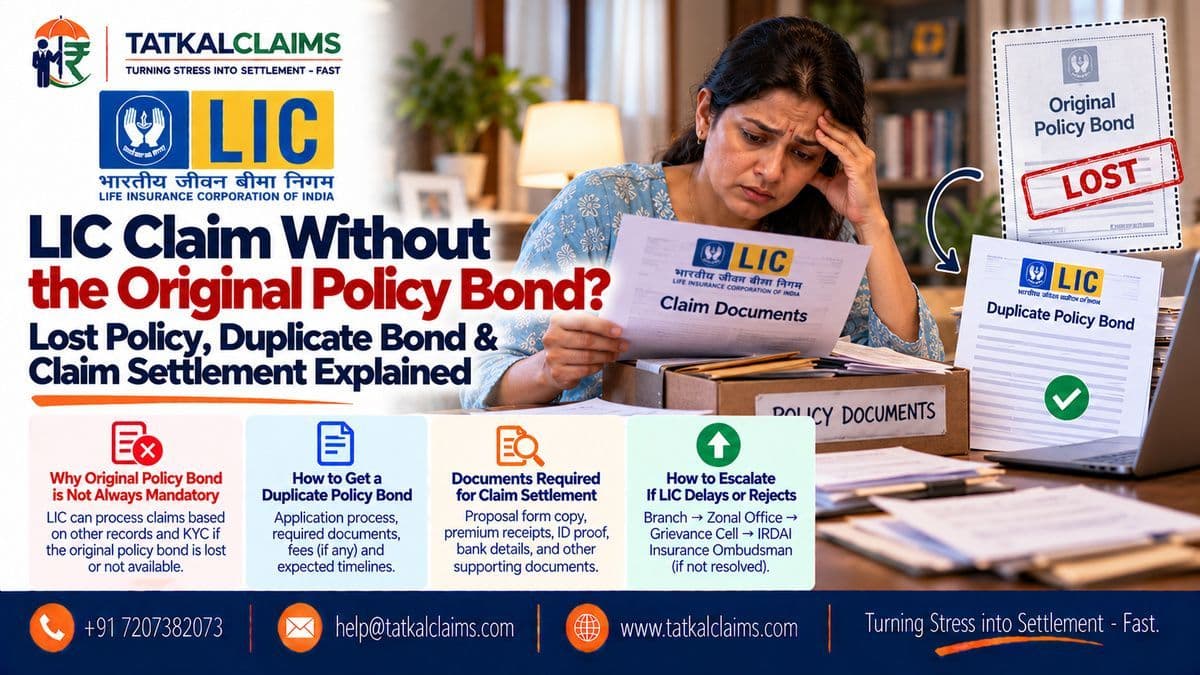
The missing document must be dealt with, but it is important not to confuse the document problem with the claim itself. LIC's policy-conditions guidance expressly says a duplicate policy confers the same rights and privileges as the original. What you need is the correct replacement or claim-specific documentation, followed by a clear written decision—not an indefinite instruction to 'bring the original' when it cannot be found.
Written by: Tatkal Claims, Claims Review Team
Reviewed by: Ankit L Kanoi, Founder
Before Saying the Bond Is Lost, Check Who Last Held It
LIC itself warns that a bond described as 'lost' may actually be sitting with a bank, the policyholder's employer, an agent, or LIC in connection with a policy loan. Finding that out can save a duplicate-policy application and avoid an incorrect affidavit.
| Possibility | What to establish |
| Home and personal papers | Insurance folder, locker, old addresses, investment records and scanned copy location |
| LIC policy loan | Whether LIC retained the bond as security and whether loan interest or principal remains due |
| Bank or lender assignment | Whether the bond was deposited and an assignment/reassignment was recorded |
| Agent or adviser | Whether the original was previously entrusted for servicing |
| Previous branch submission | Whether LIC already took custody for an earlier transaction; ask for acknowledgement |
| Partly burned, torn or flood-damaged bond | Keep and submit surviving fragments as evidence of damage |
What Is the Difference Between the Bond and the Insurance Contract?
The bond is documentary evidence of the policy and its terms. It helps LIC identify the plan, benefits, nomination, assignments and servicing conditions. Losing the physical paper does not, by itself, establish that the policy expired, that cover was forfeited or that a valid claim must be rejected.
But a missing bond does not eliminate every other condition either. LIC still needs to establish which person is entitled to the proceeds, whether the policy was in force or paid-up, whether any assignment or loan operates, and whether the claim's normal documents have been provided.
| Question | How to resolve it |
| Is a policy recorded with LIC? | Policy number, customer/branch records, premium receipts, correspondence |
| Is it eligible for the claimed benefit? | Exact policy terms, status, premium position and insured event |
| Who can receive the claim? | Nomination, assignment and other evidence of legal entitlement |
| How to replace the missing bond? | Branch-approved duplicate or claim-specific indemnity/document route |
LIC's Current Duplicate-Policy Requirements
LIC's Policy Conditions page currently lists four basic requirements for issuing an ordinary duplicate policy: a notarized indemnity bond on the requisite stamp value, one acceptable photo ID, one acceptable residence proof, and the policy-preparation fee payable at the branch cash counter.
| Item | What LIC currently says |
| Request to servicing branch | Intimate the loss and request requirements for the policy concerned |
| Duplicate-policy questionnaire | Download from LIC's current Download Forms page; disclose how the bond was lost and what search was made |
| Form No. 3756 | Listed by LIC for duplicate-policy issuance; an indemnity instrument that needs correct execution |
| Photo identity proof | For example PAN, passport, voter ID or driving licence |
| Residence proof | For example bank statement, utility bill or other LIC-accepted proof |
| Notarisation and stamp duty | Follow the branch's instruction for applicable stamp value and execution |
| Policy preparation charges | Ask the servicing branch for its current charge and official receipt |
LIC does not publish one universal, always-current rupee amount for every duplicate-policy situation on its Policy Conditions page. Some individual LIC product documents give dated preparation/stamp-charge examples, but the amount and applicable tax can be product- and date-specific. Confirm the current written demand with the servicing branch; do not rely on an old online fee figure.
What the LIC Questionnaire Actually Asks
The current two-page questionnaire on LIC's Download Forms page is explicitly headed for a matured policy whose policy document has been misplaced or lost by the life assured/proposer. It asks how the bond was lost, what steps were taken to find it, and whether it was assigned, used for a loan or the subject of an earlier surrender claim.
It also asks for identifying details from the time the policy began, including occupation, former address and agent, and seeks information about the last LIC letter or receipt received before maturity.
Form 3756 Is an Indemnity Document, Not a Claim-Settlement Form
LIC's currently linked four-page Form No. 3756 is a stamped indemnity instrument used in the duplicate-policy process. Its text is designed to protect LIC against competing demands or future claims connected with the original document after a duplicate is issued.
The form includes spaces for the policyholder, assignee and surety, along with signature and witness sections. That does not mean every individual must arrange the same combination of signatories regardless of policy circumstances; ask the servicing branch to confirm the version, applicable signatories, surety requirements, stamp value and notarisation procedure before executing it.
| Ask LIC | Reason |
| Whose signatures are required? | An assignment or death claim may change who can properly execute documents |
| Is a surety required in this case? | Do not assume an unrelated person should sign without understanding liability |
| What stamp value and notarisation are needed? | Avoid paying for a document LIC will not accept |
| Where must it be executed/submitted? | The branch's current instructions should control |
| How is the new bond delivered and recorded? | Obtain acknowledgement and a fresh policy-document reference |
How to Apply for a Duplicate LIC Policy Bond
Start at the branch servicing the policy. A policyholder can use the following sequence while the claim file is being prepared; any case-specific branch requirements should be requested in writing.
| Stage | Action |
| 1 — Report | Submit policy number, claimant identity and a short signed loss statement; ask for an acknowledgement |
| 2 — Check custody | Ask whether LIC or an assignee already holds the bond against loan/assignment |
| 3 — Collect forms | Use the current questionnaire and Form 3756 only as applicable to that claim |
| 4 — Confirm execution | Get written particulars of stamp duty, notarisation, surety and fees |
| 5 — Submit evidence | Provide approved ID, address proof and any old policy copy, receipts or correspondence |
| 6 — Track | Obtain application reference, date and the exact pending requirement |
| 7 — Complete claim | Submit the maturity, death or surrender documents separately; ask LIC for the expected settlement stage |
Maturity Claim: The Bond Was Lost Just Before Payment
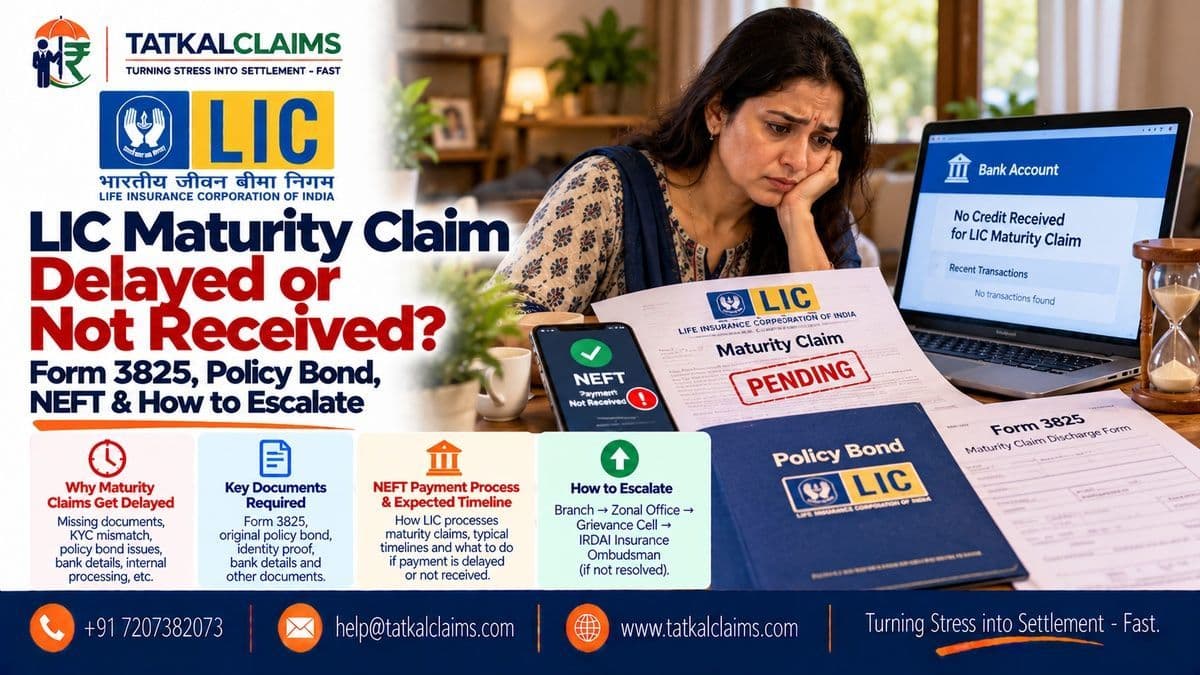
A maturity claim has a date. LIC's Download Forms page asks the policyholder to submit Form 3825 along with the original policy document at least one month before the due date. If the bond cannot be produced, the sensible response is to start the duplicate/approved indemnity process immediately and ask the branch what will allow the maturity file to proceed.
For example, if the bond was misplaced one month before a maturity payment, the delay may be the document-replacement process rather than a dispute over the payout amount. Obtain a dated branch acknowledgement, NEFT mandate status and the exact remaining requirements; the due date alone does not prove that a file lacking required documents was complete.
For Form 3825, NEFT, loan deductions and due-date payment issues, see our LIC maturity claim delay guide.
Death Claim: The Nominee Cannot Find the Deceased's Bond
LIC's current death-claim requirements call for the original policy document along with the death-claim form, proof of death and, where applicable, proof of entitlement and other records. Report the missing bond in writing when notifying LIC of the death; do not hold back the death intimation while looking for the paper.
The branch should confirm how the missing bond will be handled in that claim, including any indemnity or additional evidence of title. LIC's Policy Conditions page specifically warns that the standard duplicate-policy route needs special branch instructions for death claims where title is open and a waiver of strict legal evidence of title is being considered.
| Document | Purpose |
| Policy number, scanned copy or premium receipt | Helps LIC trace policy records |
| Death certificate | Proves death; still required under the death-claim process |
| Claimant statement/claim form | Identifies claimant and circumstances |
| Nomination or assignment record | Checks who is entitled to payment |
| Missing-bond declaration and branch-specified indemnity | Addresses the absent original |
| Claimant ID and bank details | Identity and settlement information |
| Other death-claim evidence | Any medical, early-claim or accident documents LIC legitimately calls for |
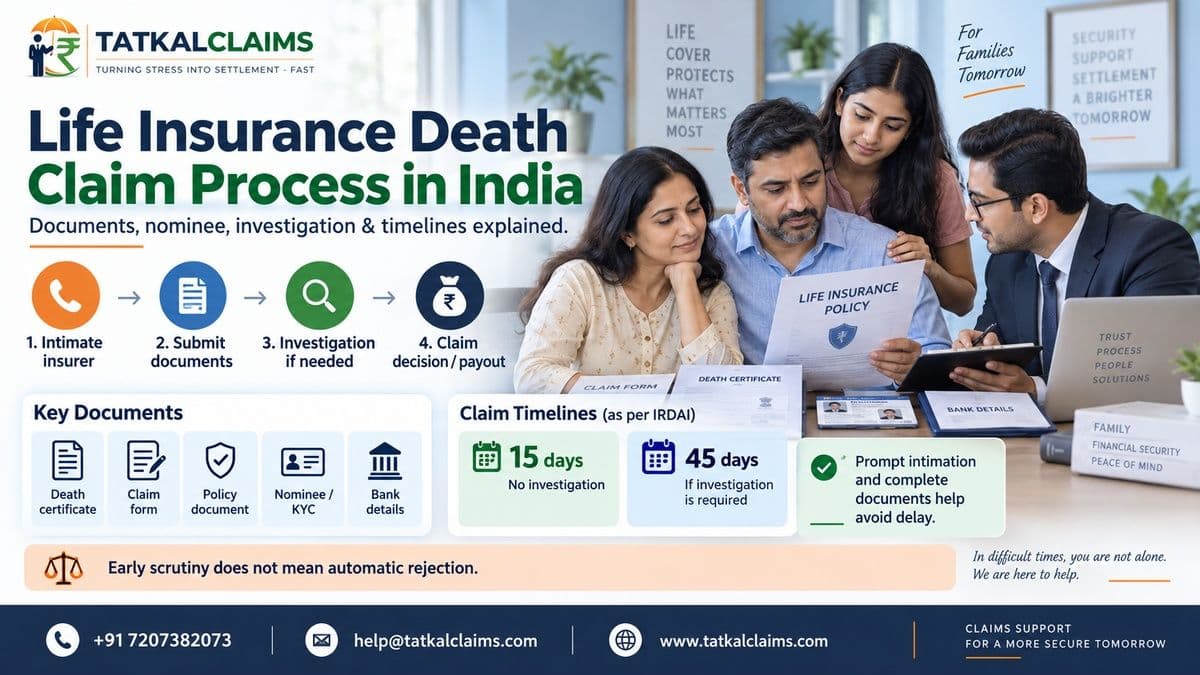
For documents and timelines separate from the lost-bond problem, read our life insurance death claim process guide.
If the deceased made no valid nomination or multiple family members claim the money, our nominee versus legal heir guide explains the separate entitlement issue.
What Changes When the Policy Was Assigned to a Bank?
This is a material distinction, not a technicality. LIC's guidelines say policies can be assigned when a loan is taken and the document can remain with LIC or another lender. LIC's Policy Conditions page identifies an operative absolute assignment as a situation requiring the policyholder to visit the branch for the correct duplicate-policy requirements.
Ask for a written statement of the assignee of record, whether the loan has been closed, whether reassignment was registered, and who currently holds the physical bond. Do not state that the original has been 'lost' simply because the policyholder personally does not possess it.
Surrender and Other Servicing Transactions
Surrender is different from maturity. The amount and eligibility depend on the contract and policy status; if the surrender procedure asks for the original bond and it is unavailable, ask the branch for the correct replacement/indemnity route before signing the surrender discharge.
Similarly, do not assume that every money-back survival payment requires the bond. LIC's claims guidance describes some smaller survival-benefit payments that may be released without the original bond or discharge receipt where the stated eligibility conditions are met. That exception does not automatically apply to a regular maturity, surrender or death claim.
When a Missing Bond Becomes an Unreasonable Delay
A branch may legitimately seek documentation to protect against double payment or rival claimants. But repeated verbal instructions without a written list of requirements leave the claimant unable to comply or challenge the issue.
| Branch response | What to request |
| 'Original bond compulsory' | Which duplicate/indemnity route applies and which forms are needed |
| 'Nominee cannot apply' | Is the issue bond replacement, nomination or competing title? |
| 'Bond is assigned' | Assignee name, assignment/reassignment record and custody status |
| 'Form 3756 incomplete' | Specific missing signature, witness, stamp or notarisation detail |
| 'We have not received the claim' | Claim/intimation acknowledgement and list of pending documents |
| 'It will take time' | Processing stage, date documents were accepted and expected next update |
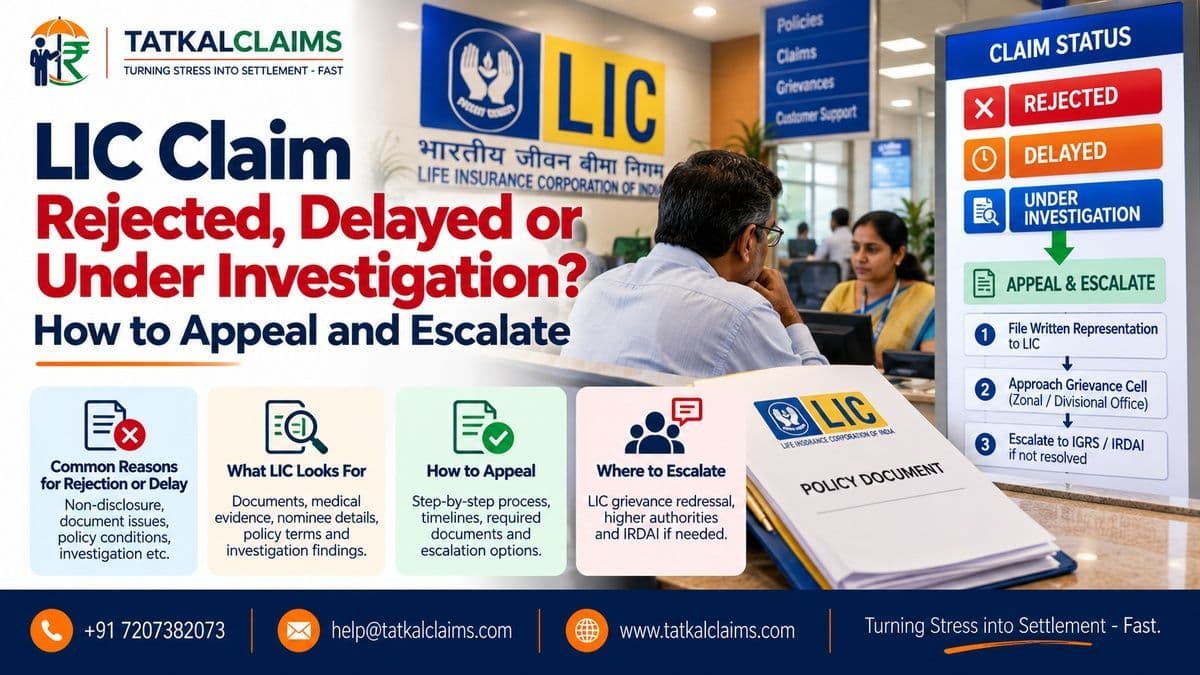
Where to Escalate if LIC Will Not Process the Request
Start with the Servicing Branch
Submit the missing-bond application and claim intimation separately, each with an acknowledgement. Ask for an itemised deficiency letter, current charges and the official basis for any requested additional declaration or indemnity.
Then Use LIC's Grievance System
LIC's current grievance page lists the Senior/Branch Manager, divisional Manager CRM, zonal Regional Manager CRM and central Executive Director CRM. Registered users may raise a complaint through LIC's Customer Portal; LIC also lists co_complaints@licindia.com. Attach the timeline and the branch's written response.
Use Bima Bharosa and the Ombudsman Where Eligible
Bima Bharosa provides an IRDAI-visible complaint trail. The Insurance Ombudsman accepts eligible policy-servicing complaints and claim-delay disputes once the insurer-first requirement is met. Its current published procedure refers to 30 days for insurer response, a ₹50 lakh monetary limit including expenses, a general one-year filing rule and restriction on parallel proceedings about the same matter.
A missing-bond servicing issue is not automatically a repudiated death claim. Do not assume LIC's CDRC internal death-claim route is the required first forum for every lost-policy problem.
How TatkalClaims Can Help With a Missing LIC Policy Bond
These disputes often start with a sentence from the servicing branch: 'Bring the original.' We review what the policyholder or nominee can actually produce—the policy number, premium records, copy of the bond, branch receipt, loan/assignment history, claim documents and the written deficiency or refusal.
Our work is to separate a genuine duplicate-document requirement from an unresolved entitlement issue or an unnecessary delay, then prepare a factual representation to the appropriate LIC service or grievance team. We do not promise that a photocopy will replace the original, that every indemnity will be waived or that an ineligible claim will be paid.
For an initial review, call +91 7207382073 or email help@tatkalclaims.com. Share the policy number, last available bond copy or premium receipt, claimant's relation to the insured, reason the bond is unavailable and any LIC letter already received.
Frequently asked questions
Does losing the original LIC policy bond mean the policy is cancelled?
No. LIC provides a formal duplicate-policy route and says a duplicate confers the same rights and privileges as the original. Claim admissibility still depends on the policy terms and who is entitled to payment.
Is an FIR or newspaper advertisement compulsory for every lost LIC bond?
LIC's general published duplicate-policy checklist lists a notarized indemnity, photo ID, residence proof and preparation fee; it does not announce an FIR or newspaper advertisement as a universal requirement. Ask the servicing branch for a written case-specific requirement before incurring those costs.
Can I use a photocopy or LIC portal screenshot instead of the original?
A copy is useful for tracing the policy and proving which contract is involved, but LIC's published regular maturity and death-claim requirements still ask for the original. Use the branch-approved duplicate/indemnity procedure if the original cannot be produced.
Can a nominee sign the missing-bond questionnaire after the insured's death?
LIC's presently linked questionnaire is worded for a matured policy and asks for the life assured/proposer's signature. A nominee should request the separate claimant-side instructions for a death claim instead of signing as though they were the deceased policyholder.
What if the bank has the policy bond as loan security?
Ask LIC or the bank to confirm custody, outstanding loan, assignment and whether reassignment was completed. A bond lawfully held by a lender is not simply a lost document, and a duplicate does not erase the lender's rights.
Can LIC charge a fee to issue a duplicate policy?
Yes. LIC lists policy-preparation charges and a notarized indemnity with the requisite stamp value. Its product documents may mention historical example amounts, but the actual current charge and stamp requirement should be confirmed with the servicing branch.
Sources & Methodology
Reviewed 6 October 2026. LIC's current Policy Conditions and Policy Guidelines were checked for the effect of a missing bond, duplicate-policy conditions, assignment and loan custody. The April 2026 Download Forms page was used to identify the official duplicate questionnaire and Form 3756; their actual scanned PDF pages were examined, including signature and indemnity sections. Claim-specific requirements were checked against LIC's current claims guidance; escalation was checked against the August 2026 LIC grievance page, Bima Bharosa and the Council for Insurance Ombudsmen. Branch-specific execution details and fee amounts were deliberately not invented.
Disclaimer: This article concerns ordinary LIC policy servicing and claim-document issues. Actual requirements depend on the policy version, reason the bond is unavailable, pending loan or assignment, the insured's survival/death, claimant entitlement, stamp law and branch instructions. It is not legal advice and does not guarantee issuance of a duplicate or payment of a claim.